
Medical Terminology Daily (MTD) is a blog sponsored by Clinical Anatomy Associates, Inc. as a service to the medical community. We post anatomical, medical or surgical terms, their meaning and usage, as well as biographical notes on anatomists, surgeons, and researchers through the ages. Be warned that some of the images used depict human anatomical specimens.
You are welcome to submit questions and suggestions using our "Contact Us" form. The information on this blog follows the terms on our "Privacy and Security Statement" and cannot be construed as medical guidance or instructions for treatment.
We have 2234 guests online
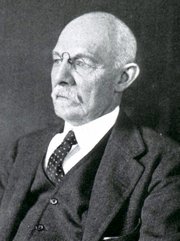
William S. Halsted, MD
(1852 – 1922)
American anatomist, teacher, and surgeon, William Stewart Halsted was born in New York City, USA to a wealthy family of English origin. His father was involved in charitable work and Governor and trustee to a city hospital. Not a brilliant student initially, Halsted took an undergraduate in Liberal Arts in Yale, CT., after which he entered the Medical College of Physicians at the Columbia College, where he excelled.
As a second-year medical student Halsted applied and obtained a position in surgery at a local hospital. In here he learned about Lister’s antiseptic technique and became an adamant proponent of it to reduce infection. In 1877 Halsted obtained his MD. After a short time as House Physician at the New York Hospital, Halsted traveled to Europe to further his education studying for two years at the Universities of Vienna, Leipzig, and W?rzburg.
Besides being at the forefront of surgical and antiseptic techniques (introducing the use of rubber gloves in surgery), Halsted was extremely concerned with the way medical students were taught in the US. He pioneered bedside clinical round discussions with the medical students after two years of basic sciences studies. Halsted developed the idea of a patient chart; he also developed the residency program for medical students in use today.
Halsted is probably the most influential researcher and surgeon at the turn of the century. He dedicated time to the study of intestinal anastomoses and the use of silk as a suture material. His experimental work in 1887 proved that the inclusion of the submucosa layer in an anastomosis was mandatory, as well that a single layered anastomosis was enough to attain closure. Perhaps Halsted’s most important contribution was the application and use of the scientific method to surgical questions. Halsted’s principles, also known as "Halsted's Rules of Surgery", set the standards used today in surgical suturing and surgical stapling.
He also pioneered the development and surgical techniques for radical mastectomy as a treatment for breast cancer.
As a side effect of this studied in anesthesia and the use of cocaine for anesthesia, Halsted became addicted to this substance, a problem that followed him through the years. Without impairing his capacity as a researcher and a surgeon, Halsted eventually recovered. He died in Baltimore in 1922 as a complication to surgery.
Sources:
1. Dubay, A. D., & Franz, G. M. (2003). Acute Wound Healing: The Biology of Acute Wound Failure. Surg Clin NA, 83, 463-481.
2. Halsted, W. S. (1887). Circular Suture of the Intestine - An Experimental Study. Am J Med Sci, 436-461.
3. “William Stewart Halsted: his life and contributions to surgery” Osborne, P. Lancet Oncol 2007; 8: 256–65
4. “William Stewart Halsted: Surgical pioneer” Burress, P Endoc Today (2010), 8: (2) 22
5. “William Stewart Halsted (1852–1922) Neurological stamp” Haas, LF J Neurol Neurosurg Psych 2000;69:641
Original image courtesy of "Images from the History of Medicine" at www.nih.gov

"Clinical Anatomy Associates, Inc., and the contributors of "Medical Terminology Daily" wish to thank all individuals who donate their bodies and tissues for the advancement of education and research”.
Click here for more information


- Details
Click for a larger image
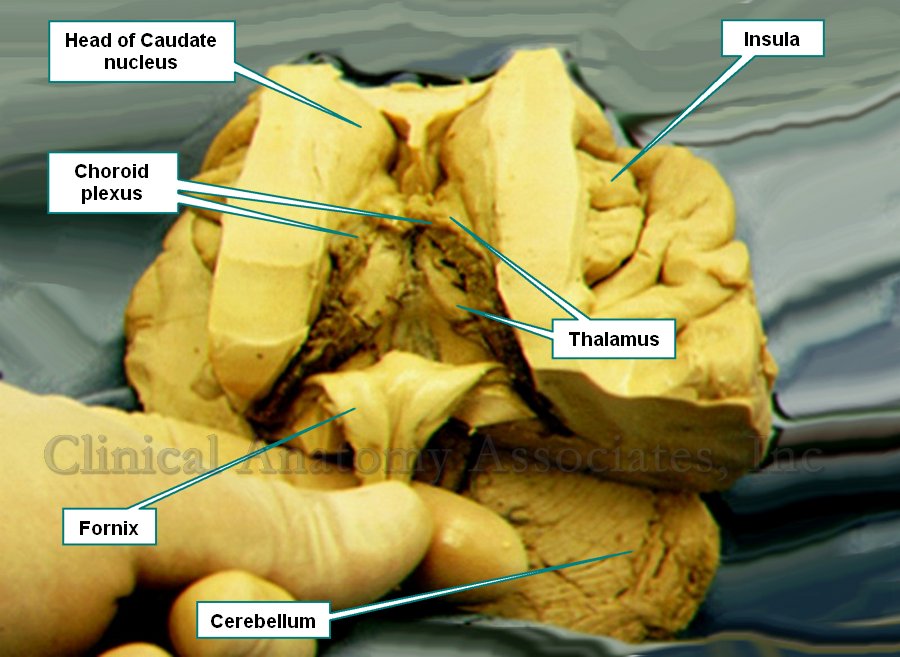
The term [thalamus] arises from the Latin (Thalamo], meaning “the wedding chamber”, "the inner chamber" or “the wedding bed”. It also has a similar meaning in Greek. Early anatomists thought that the enclosure of the lateral ventricles with the fornix as a roof formed a chamber. The lager nuclear mass known as the thalamus looked to some as a double bed in a chamber, hence the name.
It did help that the thalamus has a larger posterior protuberance akin to a cushion or a pillow, the pulvinar.
The thalamus is a paramedian structure which forms the lateral walls of the third ventricle of the brain, as well as part of the floor of the lateral ventricles of the brain. It can sometimes (30%) present a midline mass which communicates both thalami across the third ventricle. It is separated from the mesencephalon (midbrain) by the subthalamic region.
It is an important relay system, as all the sensory information to the brain (with the exception of the olfactory) has a synaptic stop at one or more of the thalamic nuclei before being sent to the cortex of the brain. The thalamus also receives important motor collaterals, as well as cerebellar and subthalamic information. This makes the thalamus an important entity in the regulation of fine motor control. Thalamic dysfunction can lead to sleep disorders and coma.
The thalamus also serves as an important relay between sensory, motor, limbic, and hypothalamic activity, making it critical to the relation of emotions, visceral responses, and prefrontal cortical activity. It also plays an important role in wakefulness, and consciousness.
In the accompanying image the thalamus is found covered by the choroid plexuses of the lateral ventricle.
Note: The links to Google Translate include an icon that will allow you to hear the pronunciation of the word. Image property of CAA, Inc. Photographer: E. Klein
- Details
Click for a larger image
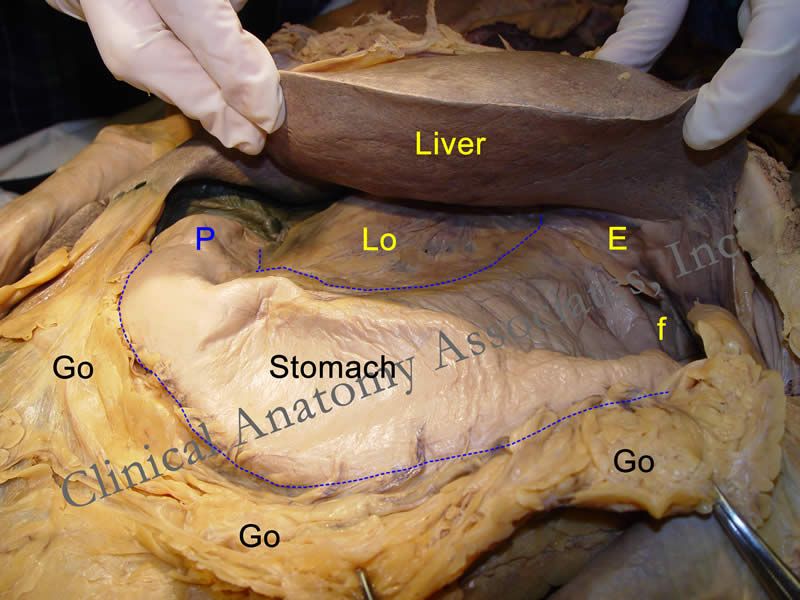
The adjectival term [epiploic] arises from the Greek term [επίπλουν] (pronounced “epiploun”) which is synonymous with the Latin term [omentum], referring to two abdominal peritoneal membranes, the lesser omentum and the greater omentum. For more information on the word [omentum] click here.
The word itself is used in Greek in the expression [επιπλέουν πάνω] (epiploun pano) which means “to float upon”, referring to the fact that the fatty omental apron “floats” or “drapes” upon the abdominal viscera. Hippocrates of Cos (460 BC - 370 BC) referred to the greater omentum as epiploon. This anatomical name evolved towards the Latin version, which is used today. In spite of this there are other languages where the Greek root is still used. As examples, in Spanish the terms are “epiplón mayor” and “epiplón menor”, and in French they are “grand epiploon” and “petit epiploon”.
Because of the presence of fat in the greater omentum, the medical adjectival term [epiploic] has also evolved to mean “fatty”, such as in the case of the epiploic appendages, a series of fatty appendages found in the colon.
Images property of:CAA.Inc.. Photographer:D.M. Klein
- Details
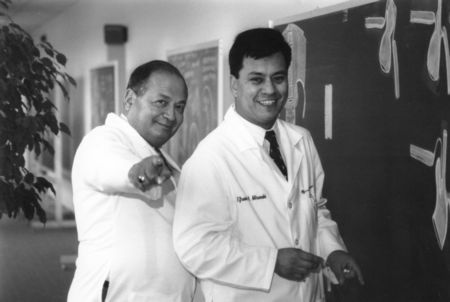
Aaron Ruhalter, MD, FACS

I am sad to let everybody know that Dr. Ruhalter passed on yesterday January 25th, 2016. A good friend, guide, and mentor, Dr. Ruhalter was always reminding me to keep on using drawings and sketches to teach human anatomy, a subject he loved, and at which he excelled. I will miss him dearly. May he rest in peace. Dr. Miranda
Dr. Aaron Ruhalter was for many years the Executive Director of Medical Education at the Johnson & Johnson Endo-Surgery Institute in Cincinnati. Dr. Ruhalter is a Professor of Anatomy and a former Professor of Surgery at the Robert Wood Johnson Memorial Hospital in New Jersey. He was also one of the founding members of the American Association of Clinical Anatomists (AACA).
His review on the surgical anatomy of the parotid gland, submandibular triangle, and floor of the mouth is outstanding. This review was published in 1997 in the book "Mastery of Surgery", third edition, by Drs. Lloyd M. Nyhus, Robert J. Baker, and Josef E. Fischer.
Dr. Miranda worked with Dr. Ruhalter for several years, both at the Endo-Surgery Institute and at the University of Cincinnati College of Medicine. The picture above shows both of them preparing an anatomy blackboard session at the Institute, back in 1994.
- Details
Refers to the internal lining of an artery or a vein. The tunica (layer) intima is composed of an inner layer known as endothelium (inner fabric or inner layer) and a subendothelial layer.
Also known as the [tunica intima vasorum], Latin for intimal (inner) layer of the vessels, the tunica inima is also known as "Bichat's tunic"
- Details
Click for a larger image
The term [bruxism] arises from the Greek [βρυγμός] (vrygm?s), meaning “a gnashing of the teeth”, or “bruxism”.
Bruxism is usually a subconscious problem, presenting most of the times at night while the individual is asleep, and does not continue into the waking hours. In some people bruxism does continue into the day and the person is constantly gnashing the teeth, but not conscious of the activity. Awake bruxism is sometimes called [bruxomania].
Bruxism is usually idiopathic (of unknown origin) or it can be secondary to other medical conditions.
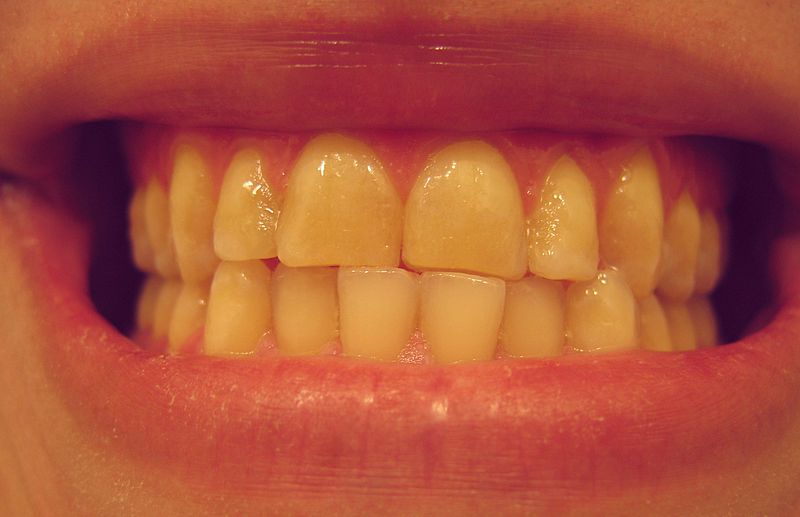
Patients with bruxism usually present with damage to the teeth by the constant attrition of the teeth by laterally grinding of the teeth of the maxilla against the teeth of the jaw. This can lead to severe tooth damage with exposure of the dentin through and absent, fractured, or damaged enamel. A secondary problem is misalignment of the teeth. The accompanying image shows misalignment and tooth damage.
Note: The links to Google Translate include an icon that will allow you to hear the pronunciation of the word.
Image by DRosenbach (en:Image:Deviated midline.JPG) [Public domain], Wikimedia Commons
- Details
Abdominal regions
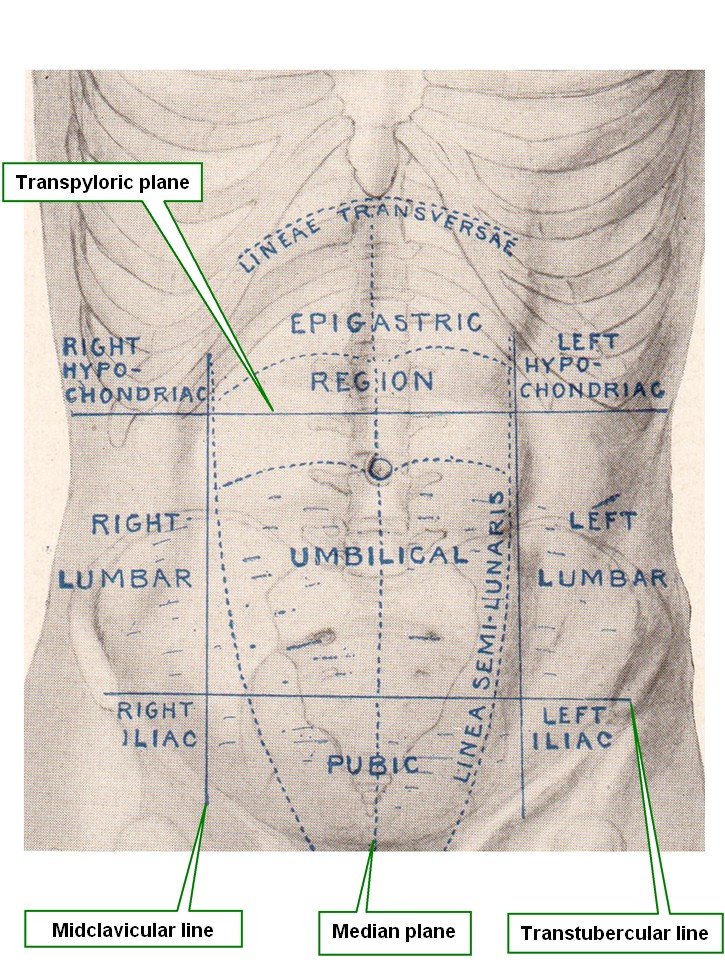
The transtubercular plane (also called the transtubercular line) is one of the surface reference lines used in surface anatomy and surgery to delineate the abdominal regions.
It is a horizontal or transverse plane that passes through the iliac tubercles, small elevations found in the iliac crest of the iliac bone. These tubercles can be palpated in a thin person, but their location can be approximated if you take the distance between the transpyloric plane and the superior aspect of the pubic symphysis and divide it in half.
The transtubercular plane marks the location of the body of the fifth lumbar vertebra and the location of the confluence of both common iliac veins to form the inferior vena cava.
Sources:
1. "Clinical Anatomy" Brantigan, OC 1963 McGraw Hill
2. "Tratado de Anatomia Humana" Testut et Latarjet 8th Ed. 1931 Salvat Editores, Spain
3. Davis, Gwilym G. "Applied Anatomy: The Construction of the Human Body Considered in Relation to Its Functions, Diseases, and Injuries"; Philadelphia: J.B. Lippincott Co., 1910
Image modified from the original Davis, 1910