
Medical Terminology Daily (MTD) is a blog sponsored by Clinical Anatomy Associates, Inc. as a service to the medical community. We post anatomical, medical or surgical terms, their meaning and usage, as well as biographical notes on anatomists, surgeons, and researchers through the ages. Be warned that some of the images used depict human anatomical specimens.
You are welcome to submit questions and suggestions using our "Contact Us" form. The information on this blog follows the terms on our "Privacy and Security Statement" and cannot be construed as medical guidance or instructions for treatment.
We have 190 guests online
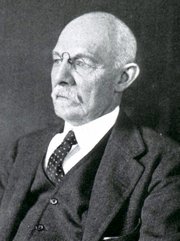
William S. Halsted, MD
(1852 – 1922)
American anatomist, teacher, and surgeon, William Stewart Halsted was born in New York City, USA to a wealthy family of English origin. His father was involved in charitable work and Governor and trustee to a city hospital. Not a brilliant student initially, Halsted took an undergraduate in Liberal Arts in Yale, CT., after which he entered the Medical College of Physicians at the Columbia College, where he excelled.
As a second-year medical student Halsted applied and obtained a position in surgery at a local hospital. In here he learned about Lister’s antiseptic technique and became an adamant proponent of it to reduce infection. In 1877 Halsted obtained his MD. After a short time as House Physician at the New York Hospital, Halsted traveled to Europe to further his education studying for two years at the Universities of Vienna, Leipzig, and W?rzburg.
Besides being at the forefront of surgical and antiseptic techniques (introducing the use of rubber gloves in surgery), Halsted was extremely concerned with the way medical students were taught in the US. He pioneered bedside clinical round discussions with the medical students after two years of basic sciences studies. Halsted developed the idea of a patient chart; he also developed the residency program for medical students in use today.
Halsted is probably the most influential researcher and surgeon at the turn of the century. He dedicated time to the study of intestinal anastomoses and the use of silk as a suture material. His experimental work in 1887 proved that the inclusion of the submucosa layer in an anastomosis was mandatory, as well that a single layered anastomosis was enough to attain closure. Perhaps Halsted’s most important contribution was the application and use of the scientific method to surgical questions. Halsted’s principles, also known as "Halsted's Rules of Surgery", set the standards used today in surgical suturing and surgical stapling.
He also pioneered the development and surgical techniques for radical mastectomy as a treatment for breast cancer.
As a side effect of this studied in anesthesia and the use of cocaine for anesthesia, Halsted became addicted to this substance, a problem that followed him through the years. Without impairing his capacity as a researcher and a surgeon, Halsted eventually recovered. He died in Baltimore in 1922 as a complication to surgery.
Sources:
1. Dubay, A. D., & Franz, G. M. (2003). Acute Wound Healing: The Biology of Acute Wound Failure. Surg Clin NA, 83, 463-481.
2. Halsted, W. S. (1887). Circular Suture of the Intestine - An Experimental Study. Am J Med Sci, 436-461.
3. “William Stewart Halsted: his life and contributions to surgery” Osborne, P. Lancet Oncol 2007; 8: 256–65
4. “William Stewart Halsted: Surgical pioneer” Burress, P Endoc Today (2010), 8: (2) 22
5. “William Stewart Halsted (1852–1922) Neurological stamp” Haas, LF J Neurol Neurosurg Psych 2000;69:641
Original image courtesy of "Images from the History of Medicine" at www.nih.gov

"Clinical Anatomy Associates, Inc., and the contributors of "Medical Terminology Daily" wish to thank all individuals who donate their bodies and tissues for the advancement of education and research”.
Click here for more information


- Details
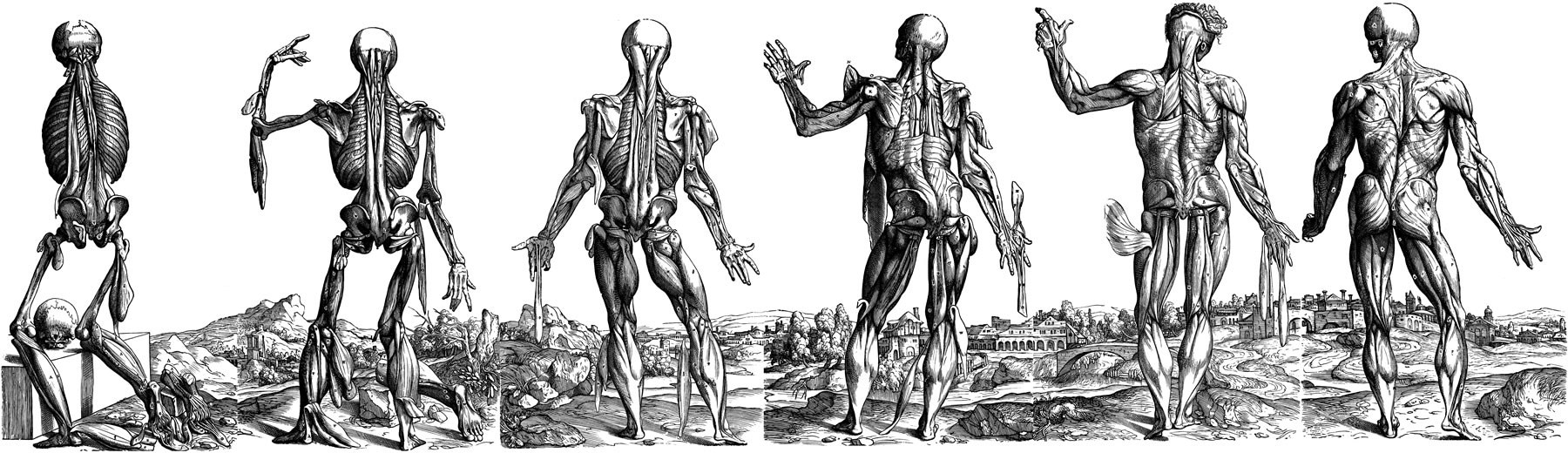
UPDATED: If you came to this article directly, you should probably start reading the first one here: "The landscape panorama of Vesalius' muscle men (1)", then come back.
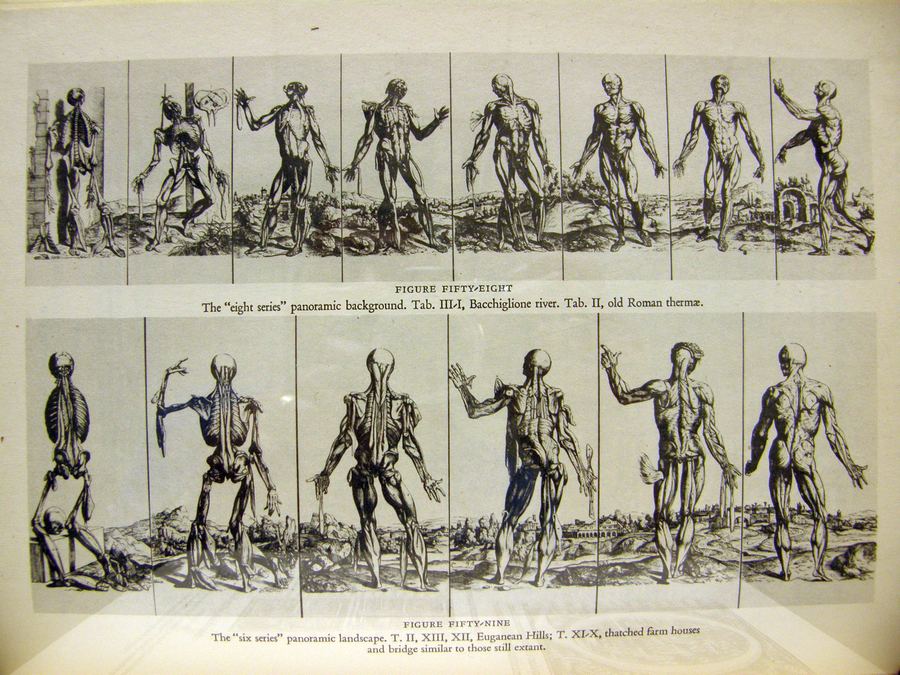
I had always looked at these panorama images as only one, the one that is formed by the anterior views (and one lateral view) of the muscle men plates which I shared with you in the first article. The image in the first article is what Harvey Cushing (1943) called the "eight-series". It was not until my friend Pascale Pollier sent me an interesting BBC article that I looked at the panorama formed by the posterior view images of the muscle men, called by Cushing the "six-series". After some work with original images that I own, I made the image shown here. If anything this panorama is even better!To see Cushing's original template click here.
In the enlarged version that appears when you click on the image on this article you can see how some houses' roofing and arches are shared between plates. Towards the right side of this panorama you can clearly see a meandering stream that passes through several plates. Another incredible fact of this masterpiece by Jan Stephan Van Calcar (the artist) and Andrea Vesalius (the anatomist).
The image shown here was done using original images from Vesalius’ Fabrica and composed using Adobe Fireworks CS5. Click on the image for a larger depiction. The larger image is 1800px wide.
Sources:
1. “A New View of the Vesalian Landscape” Cavanagh, GST Med Hist 1983, 27: 77-79
2. “The Panorama of Vesalius: A 'Lost' Design From Titian's Studio” Skandalakis, JE JAMA May 28, 1997, Vol 277, No. 20
3. “A Drawing for the Fabrica; and some Thoughts Upon the Vesalius Muscle-Men” Kemp. M. Med Hist. Jul 1970; 14(3): 277–288
4. “Andreas Vesalius: The Making, the Madman and the Myth” Joffe, SN. Persona Publishing 2009
5. "A Bio-Bibliography of Andreas Vesalius" Cushing, H. (1943) Schumann's
- Details
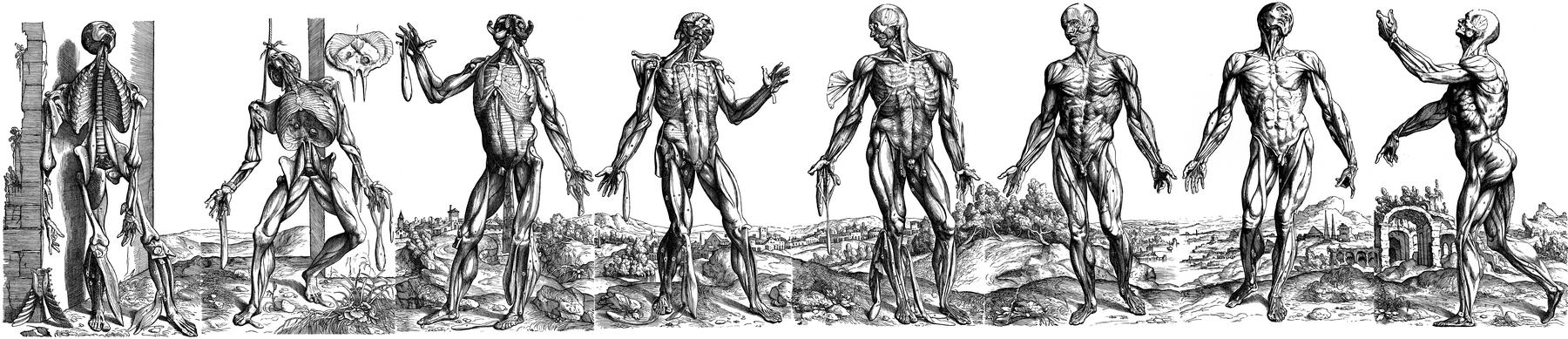
UPDATED: There is no doubt that the book “De Humani Corporis Fabrica Libri Septem” written by Andreas Vesalius and published by Johannes Oporinus in May, 1543 is one of the most important scientific anatomical and medical books ever written. Much has been said about the place this book has in medical history as part of the discarding of dogmas and the establishment of scientific observation and thinking.
Some of the most intriguing images published in the book are fourteen woodcuts in the second book. These amazing and detailed images show the muscles in a whole body as it is dissected. The text details the structures and the procedure of how the dissection is performed.
It is believed that these images were done by Jan Stephan Van Calcar, an artist from the Titian’s studio, although there are indications that these images may have been authored by somebody else, or even that they were the effort of more than one artist working under the close supervision of Andreas Vesalius.
Today’s anatomical images are very descriptive and the artistry is relegated to the technique used for the depiction of the image. In Vesalius’ muscle men plates each image has a background showing a landscape. It was not until 1903 that it was discovered that the landscapes of the different images were part of a complete landscape. This is evident if these images are placed side by side. There have been several books and articles published on these images. Interestingly, some of the images had to be reversed to be placed in the panorama. This is due to the process of cutting the woodblocks.
The image in this article is one of two identified and composed by Harvey Cushing in 1943 (see sources). He calls it the "eight-series". The "six-series" can be seen here. To see Cushing's original template click here. The panorama of the six-series was identified by Cushing to be an area of the Euganean hills near Venice and Padua, Italy. There landscape formed by the eight-series is an actual region near Padua, Italy showing the ruins of old Roman baths. Cavanagh (1938) adds more information on these images, for his .pdf article, click here.
The image shown at the top of this article was created using original images from Vesalius’ Fabrica and composed using Adobe Fireworks CS5. Click on the image for a larger depiction. The large image is 1800px wide.
NOTE: In June 2023, I was able to purchase a single leaf of the 1543 Fabrica, page 187, which depicts one of the "muscle men". In the panorama image in this article it is figure number 3, from left to right. For more information on this image click here. This image is now properly framed in my office. Dr. Miranda.
This article continues here: "The landscape panorama of Vesalius' Muscle Men (2)"
Sources:
1. “A New View of the Vesalian Landscape” Cavanagh, GST Med Hist 1983, 27: 77-79
2. “The Panorama of Vesalius: A 'Lost' Design From Titian's Studio” Skandalakis, JE JAMA May 28, 1997, Vol 277, No. 20
3. “A Drawing for the Fabrica; and some Thoughts Upon the Vesalius Muscle-Men” Kemp. M. Med Hist. Jul 1970; 14(3): 277–288
4. “Andreas Vesalius: The Making, the Madman and the Myth” Joffe, SN. Persona Publishing 2009
5. "A Bio-Bibliography of Andreas Vesalius" Cushing, H. (1943) Schumann's
- Details
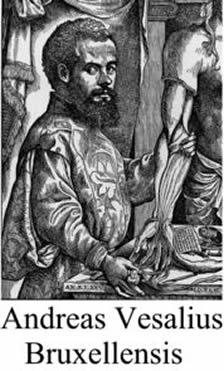
Click for Vesalius' biography
UPDATED: We have discussed many times on this blog the importance of Andreas Vesalius (1514 – 1564), his impact on modern science and anatomy, and the influence of his opus magnum publication in 1543, the Fabrica. The complete name of this publication is “De Humani Corporis Fabrica, Libri Septem” (Seven books on the structure of the human body).
Harvey Cushing wrote in his Vesalius bio-bibliography of 1943:”As a book, the Fabrica has been probably more admired and less read than any publication of equal significance in the history of science”.
The first (1543) and second (1555) editions of the Fabrica were published in Basel, Switzerland by Johannes Oporinus (1507 – 1568). With few exceptions, the Fabrica was sold as an unbound book and it was the owner’s responsibility to bind the book. One of the exceptions was the sumptuous purple silk-bound presentation copy delivered to the Emperor Charles V. As an interesting note, a Fabrica was discovered in Canada that was heavily annotated and as such had a low value. Who wants a book that of this importance that is so heavily hand-written? Analysis of the writing and style indicate that this copy belonged to Vesalius himself and was most probably the basis for a third edition that was never published. The annotations are used in the "New Fabrica" and if you are interested, here is a PDF file of a 2014 article on this topic.
Today we do not know how many books were actually printed as part of the first and the second edition of the Fabrica. Because of the time passed, lost or damaged books, during the last century efforts have been made to inventory the number of Fabricas still in existence, in studies made by Cushing in 1943 and Horowiz and Collins in 1984.The latest effort to account for the total number of these books was made by Stephen N. Joffe, MD, and Veronica Buchanan, MA in 2015 for both the 1543 and the 1555 editions of the Fabrica. Their papers were presented in February 2015 at the interdisciplinary symposium “Vesalius and the Invention of the Modern Body” in St. Louis, MO.
Dr. Joffe is the author of the book “Andreas Vesalius: The Making, the Madman, and the Myth”. Veronica Buchanan is the Archivist at the University of Cincinnati Henry R. Winkled Center for the History of the Health Professions.
The authors of these papers estimate that there are 64 complete copies surviving of the estimated 300 – 500 first edition printed in 1543. While a similar printing run is estimated for the 1555 edition, only 58 complete copies survive in the USA The papers can be read and downloaded on the following links:
"Updated Census in USA of First Edition of Andreas Vesalius’ ‘De Humani Corporis Fabrica’ of 1543”
READ DOWNLOAD
“An Updated Census of the Edition of 1555 of Andreas Vesalius’ De Humani Corporis Fabrica in the United States of America” READ DOWNLOAD
Note: The following link was sent to me by Dr. Elizabeth Murray and refers to the study by Joffe and Buchanan. The article “Accounting for an Historic Text” is from the University of Cincinnati Newsletter. Dr. Miranda
Sources
1. “Updated Census in USA of First Edition of Andreas Vesalius’ ‘De Humani Corporis Fabrica’ of 1543” Joffe, SN; Buchanan V. International Archives of Medicine; 2015: 8:1
2. “An Updated Census of the Edition of 1555 of Andreas Vesalius’ De Humani Corporis Fabrica in the United States of America” International Archives of Medicine; 2015: 8:1
3. Cushing, Harvey: A Bio-bibliography of Andreas Vesalius 2nd edition. Hamden: Conn.
4. Garrison, Daniel H., Hast, Malcom H.: Andreas Vesalius: The Fabric of the Human Body. Published S. Karger, Basel; 2014
5. "Andreas Vesalius; The Making, the Madman, and the Myth" Joffe, Stephen N. Persona Publishing 2009
- Details
Click for a larger image
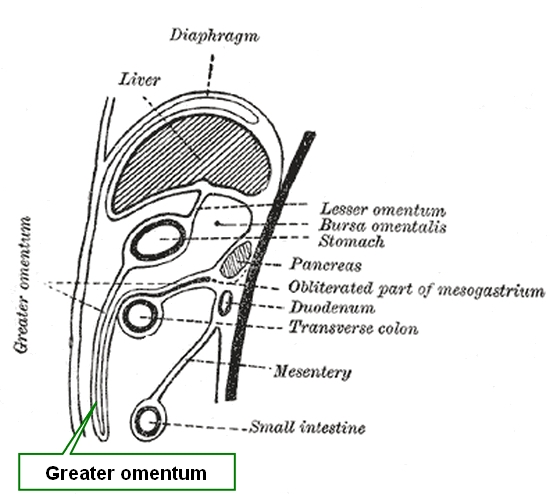
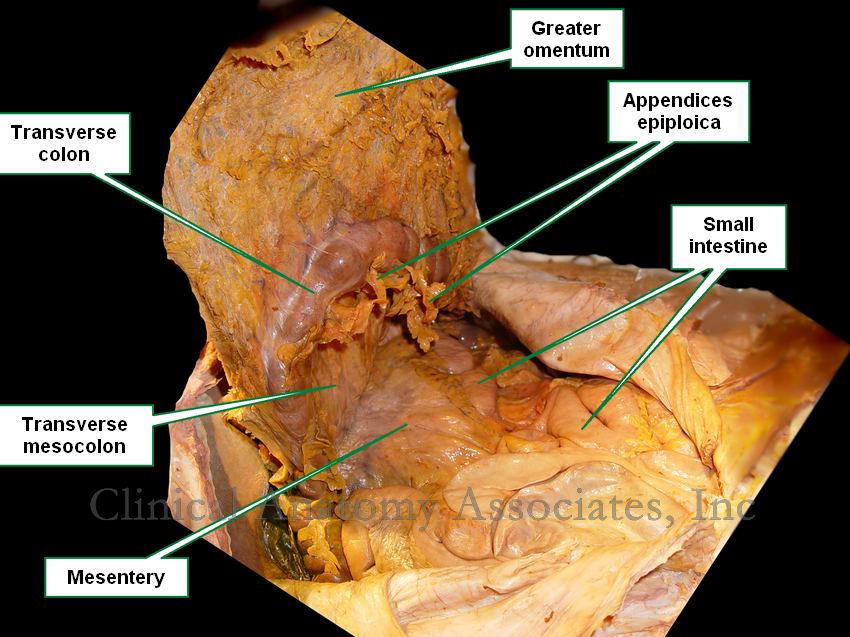
The [greater omentum] is a large, fatty apron-like structure that covers the abdominal viscera inferior to the greater curvature of the stomach. It is formed by a double peritoneal layer that contains fat, vessels, lymphatics, and nerves. This double peritoneal structure is continuous with the anterior and posterior serosal layers of the greater curvature of the stomach, drapes inferiorly, sometimes all the way to the pelvis and the folds upon itself posteriorly and superiorly ascending to become continuous with the anterior and posterior serosal layer of the transverse colon. Because it folds upon itself, the greater omentum can be considered to be a four-layered structure. See accompanying image.
The greater omentum contains vessels that arise from the right and left gastroepiploic arteries and veins as well as omental (epiploic) branches of the greater curvature vascular arcade.
The left border of the greater omentum reaches to the splenic hilum, while the right border extends as far as the pylorus and inferior aspect of the first portion of the duodenum. Because of its location, covering the intestines and its apron-like structure, the greater omentum is also known as the “surgeon’s apron”.
Click for a larger image
The term ‘abdominopelvic ligament” has been discussed in this article. The greater omentum has several “ligament” components that stretch between abdominal viscera. They are the:
• Gastrocolic ligament: Main portion of the greater omentum extending between the stomach and the transverse colon
• Gastrosplenic ligament: The portion of the greater omentum stretching between the stomach and spleen
• Splenorenal ligament: A continuation of the greater omentum stretching from the left kidney to the spleen.
As a side note, the lesser omentum (related to the lesser curvature of the stomach) contains less fat than the greater omentum.
First image(s) modified from the original by Henry VanDyke Carter. Public Domain
Second image(s) property of: CAA.Inc.. Photographer: D.M. Klein
- Details
Click for a larger image
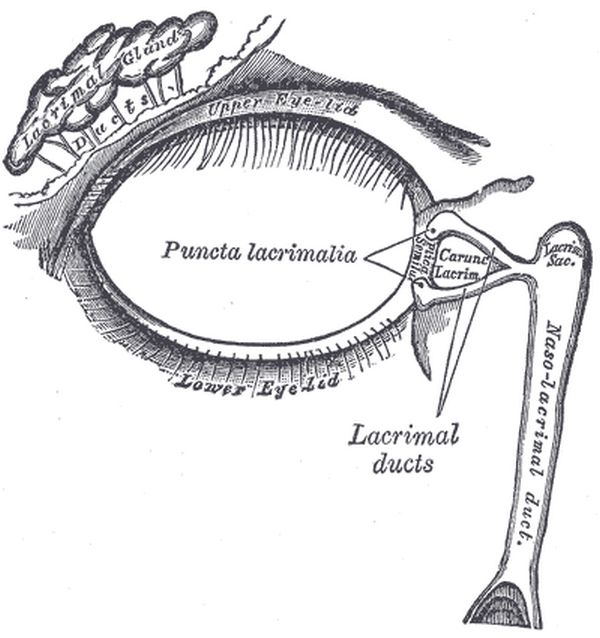
The root term [-dacry-] originates from the Greek word [δάκρυ] (d?kry), meaning “tear”, as in “a tear in your eye”. The equivalent Latin-derived root term is [-lacrim] from the Latin word [lacrima], meaning the same.
Here are some examples of the use of this root term:
- Dacryocystitis: Inflammation of the lacrimal sac. Look up [-cyst-], and [-itis]
- Dacryoadenitis: Inflammation of the lacrimal gland. Look up [-aden-], and [-itis]
- Dacryostenosis: Narrowing or blockage of a tear duct. Look up [stenosis]
- Dacryocystolithiasis: Presence of stones (calculi) in the lacrimal system. What is then a dacryocystolithectomy?
Image by Henry Vandyke Carter [Public domain], via Wikimedia Commons
- Details
The root term [-aden-] originates from the Greek word [αδένας] (adénas), meaning “gland”.
Glands are organs or groups of cells that internally secrete a substance and release it. When the substance is released into the bloodstream the substance will be known as a hormone and the gland as an endocrine gland. If the substance is released into an organ cavity or outside the body, the substance will have different names (sweat, sebum, mucus, etc.) and the gland will be known as an exocrine gland. Here are some examples of the use of this root term:
- Adenitis: Inflammation of a gland
- Adenocarcinoma: Cancer of a gland or a cancer that has a glandular look to it
- Lymphadenitis: Inflammation of a lymph gland (node)
- Lymphadenopathy: Disease of the lymph glands (nodes)
Note: The links to Google Translate include an icon that will allow you to hear the pronunciation of the word.