
Medical Terminology Daily (MTD) is a blog sponsored by Clinical Anatomy Associates, Inc. as a service to the medical community. We post anatomical, medical or surgical terms, their meaning and usage, as well as biographical notes on anatomists, surgeons, and researchers through the ages. Be warned that some of the images used depict human anatomical specimens.
You are welcome to submit questions and suggestions using our "Contact Us" form. The information on this blog follows the terms on our "Privacy and Security Statement" and cannot be construed as medical guidance or instructions for treatment.
We have 2240 guests online
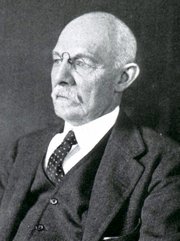
William S. Halsted, MD
(1852 – 1922)
American anatomist, teacher, and surgeon, William Stewart Halsted was born in New York City, USA to a wealthy family of English origin. His father was involved in charitable work and Governor and trustee to a city hospital. Not a brilliant student initially, Halsted took an undergraduate in Liberal Arts in Yale, CT., after which he entered the Medical College of Physicians at the Columbia College, where he excelled.
As a second-year medical student Halsted applied and obtained a position in surgery at a local hospital. In here he learned about Lister’s antiseptic technique and became an adamant proponent of it to reduce infection. In 1877 Halsted obtained his MD. After a short time as House Physician at the New York Hospital, Halsted traveled to Europe to further his education studying for two years at the Universities of Vienna, Leipzig, and W?rzburg.
Besides being at the forefront of surgical and antiseptic techniques (introducing the use of rubber gloves in surgery), Halsted was extremely concerned with the way medical students were taught in the US. He pioneered bedside clinical round discussions with the medical students after two years of basic sciences studies. Halsted developed the idea of a patient chart; he also developed the residency program for medical students in use today.
Halsted is probably the most influential researcher and surgeon at the turn of the century. He dedicated time to the study of intestinal anastomoses and the use of silk as a suture material. His experimental work in 1887 proved that the inclusion of the submucosa layer in an anastomosis was mandatory, as well that a single layered anastomosis was enough to attain closure. Perhaps Halsted’s most important contribution was the application and use of the scientific method to surgical questions. Halsted’s principles, also known as "Halsted's Rules of Surgery", set the standards used today in surgical suturing and surgical stapling.
He also pioneered the development and surgical techniques for radical mastectomy as a treatment for breast cancer.
As a side effect of this studied in anesthesia and the use of cocaine for anesthesia, Halsted became addicted to this substance, a problem that followed him through the years. Without impairing his capacity as a researcher and a surgeon, Halsted eventually recovered. He died in Baltimore in 1922 as a complication to surgery.
Sources:
1. Dubay, A. D., & Franz, G. M. (2003). Acute Wound Healing: The Biology of Acute Wound Failure. Surg Clin NA, 83, 463-481.
2. Halsted, W. S. (1887). Circular Suture of the Intestine - An Experimental Study. Am J Med Sci, 436-461.
3. “William Stewart Halsted: his life and contributions to surgery” Osborne, P. Lancet Oncol 2007; 8: 256–65
4. “William Stewart Halsted: Surgical pioneer” Burress, P Endoc Today (2010), 8: (2) 22
5. “William Stewart Halsted (1852–1922) Neurological stamp” Haas, LF J Neurol Neurosurg Psych 2000;69:641
Original image courtesy of "Images from the History of Medicine" at www.nih.gov

"Clinical Anatomy Associates, Inc., and the contributors of "Medical Terminology Daily" wish to thank all individuals who donate their bodies and tissues for the advancement of education and research”.
Click here for more information


- Details
This suffix originates from two Greek root terms [ectos], meaning "out or outside" and "[tomos], which means "to cut" or "to open". The final [-y] means "process". The suffix [-ectomy] means "process of cutting out". Other synonyms are: extirpation, excision, and removal.
Applications of this suffix include:
- Pneumonectomy: Removal of a lung
- Gastrectomy: Extirpation of the stomach
- Nephrectomy: Excision of a kidney
- Cholecystectomy: Extirpation of the gallbladder
- Details
UPDATED: Latin word meaning "tail". The plural form is "caudae". The adjective use "caudal" or "caudad" means "towards the tail" or "inferior". Although not correct, in many anatomy books the term "caudal" is defined as "towards the feet", meaning that has become accepted through use. In reality this is a embryological term that can also be used in quadrupeds. The use of this term in the adult human is not correct, or at least should be avoided; unless you are truly going "towards the tail" i.e. coccyx
Applications of this word include:
- Cauda equina (the horse's tail): A structure formed by the inferior portion of the spinal cords and the corresponding ventral and dorsal roots, resembling a horse's tail.
- Caudate nucleus: One of the deep ganglia of the brain which has an elongated, curved extension resembling a tail
- Caudate lobe (of the liver): A small lobe of the liver that has a small projection resembling a tail, the caudate process.
- Details

Cauda equina dissection
The term cauda equina is Latin. The word [cauda] means "tail", and the word [equina] means "horse". The horse's tail.
Since the spinal cord is shorter that the spinal canal, there is a discrepancy as to the origin of the dorsal and ventral roots and their corresponding intervertebral foramen, where they exit as a spinal nerve. The cauda equina is found inside the sacrolumbar portion of the spine's dural or thecal sac, inferior to the conus medullaris, and is formed by the filum terminale and the dorsal and ventral roots found inferior to the distal end of the canus medullaris.
If you click on the accompanying image you will see a larger version. Observe the resemblance of the grouping of these roots to a horse's tail. For an image from Gray's anatomy click here.
Image property of CAA.Inc. Photographer:D.M. Klein.
Link and linked image courtesy of Bartleby.com
- Details
This article is part of the series "A Moment in History" where we honor those who have contributed to the growth of medical knowledge in the areas of anatomy, medicine, surgery, and medical research.
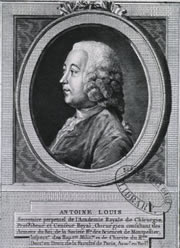
Antoine Louis
Antoine Louis (1723- 1792). French surgeon, anatomist, and physiologist. Following his medical studies and a long career as a physiologist, Antoine Louis was named Permanent Secretary of the Royal French Academy of Surgery. His other titles were those of Professor of the Royal Academy, Consultant Surgeon of the Armies of the King, member of the Royal Society of Sciences of Montpellier, Inspector of the Royal Military Hospitals, and Doctor in Law of the University of Paris. As a member of these academies Louis was instrumental in the design and construction of the guillotine. Initially called the "Louisette", this device was later named after another French physician in the same committee, Dr. Joseph-Ignace Guillotin.
Antoine Louis' name is better know to history as the eponymic origin of the "sternal angle" also know as the "Angle of Louis" and synonymously (probably by misspelling or translation) the "angle of Lewis", and "angle of Ludwig". This anatomical landmark is extremely important as it serves as a superficial landmark for important anatomical occurrences (click here).
As a point of controversy, there are some that contest the history of this eponym adjudicating it to Pierre Charles Alexander Louis (1787-1872), another French physician dedicated to the study of tuberculosis.
Sources:
1. Srickland, N; Strickland A Angle of Louis, More Than Meets the Eye. MedTalks:
2. Ramana, R. K., Sanagala, T. and Lichtenberg, R. (2006), A New Angle on the Angle of Louis. Congestive Heart Failure, 12: 197–199
3. "The origin of Medical Terms" Skinner, HA; 1970
- Details
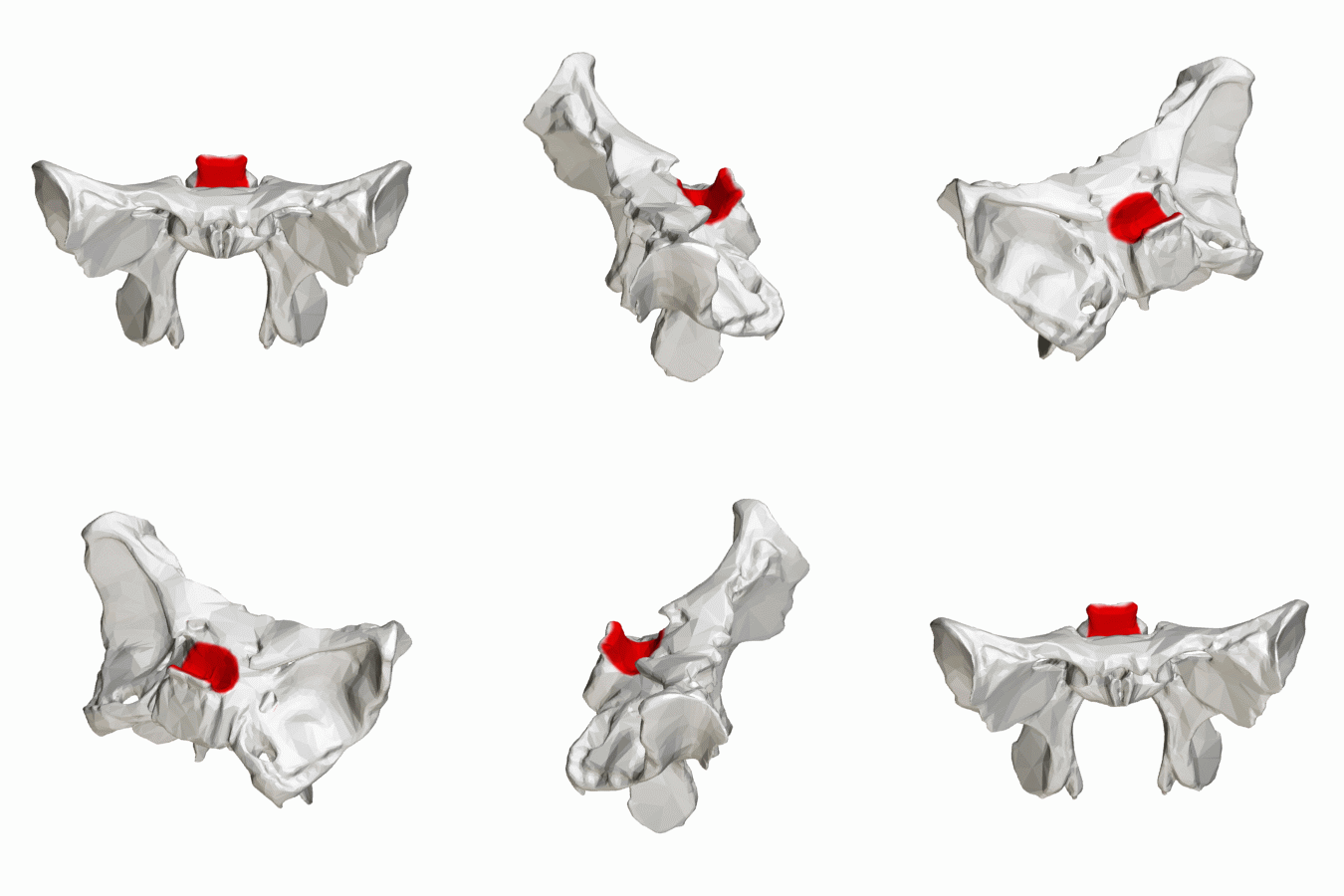
Click for an animation of the
sella turcica
UPDATED: The words [sella turcica] are Latin and mean "Turkish chair". The sella turcica is a depression found in the superior aspect of the sphenoid bone and it does resemble one! The accompanying image is that of a Turkish chair made in wicker. (wickerbydesign.com). The Turkish chair resembles a horse saddle with high ends.
If you click on the image, you will see an animation of the sphenoid bone highlighting the sella turcica, where you will see the resemblance between the chair and the bone.
The hypophysis or pituitary gland, which dangles from the hypothalamus by a neural stalk, is found within the concavity of the sella turcica, surrounded by the optic tracts laterally and by the optic chiasm anteriorly.
The depression of the sella turcica is sometimes called the [pituitary fossa] or [fossa hypophyseos]. It is bound anteriorly and posteriorly by four bony processes, the (left and right) middle and posterior clinoid processes.
The pituitary fossa is closed by a tent-like structure made of dura mater which has a small opening that allows the hypophyseal stalk to pass trough. This is the diaphragma sellae.
Question: Do you know that there are four named diaphragms in the human body? See if you can name them!
Image of the Turkish chair courtesy of wickerbydesign.com.Secondary animated image byBodyParts3D, courtesy of Wikipedia.
- Details
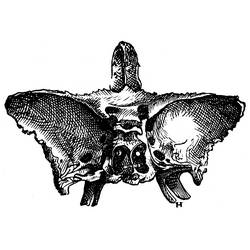
Hover for another image
This word has a Greek root [-sphen-] meaning "wedge", and the suffix [-oid] meaning "similar to" or "resembling". [Sphenoid] means "resembling a wedge" or "wedge-like".
The sphenoid bone (os sphenoidale) has been described as butterfly or bat-shaped, and is a complex bone situated as a wedge or keystone in the base of the skull. Hover over the image1 for a view of the location of this bone.
The sphenoid bone has a superior depression called the sella turcica, Latin for "turkish chair" where the hypophysis or pituitary gland is found.
On its inferior aspect the sphenoid bone presents with two thin wing-like plates called the lateral and medial pterygoid plates or lamina (see the area with the letter "H" in the accompanying image)

Image1 modified from "De Humani Corporis Fabrica" 1543 1st Ed.by Andreas Vesalius. Animation via Wikimedia Commons, public domain. Polygon data generated by Database Center for Life Science (DBCLS), CC BY-SA 2.1 JP.