
Medical Terminology Daily (MTD) is a blog sponsored by Clinical Anatomy Associates, Inc. as a service to the medical community. We post anatomical, medical or surgical terms, their meaning and usage, as well as biographical notes on anatomists, surgeons, and researchers through the ages. Be warned that some of the images used depict human anatomical specimens.
You are welcome to submit questions and suggestions using our "Contact Us" form. The information on this blog follows the terms on our "Privacy and Security Statement" and cannot be construed as medical guidance or instructions for treatment.
We have 178 guests online
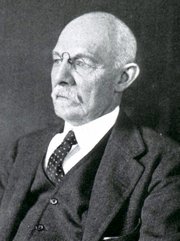
William S. Halsted, MD
(1852 – 1922)
American anatomist, teacher, and surgeon, William Stewart Halsted was born in New York City, USA to a wealthy family of English origin. His father was involved in charitable work and Governor and trustee to a city hospital. Not a brilliant student initially, Halsted took an undergraduate in Liberal Arts in Yale, CT., after which he entered the Medical College of Physicians at the Columbia College, where he excelled.
As a second-year medical student Halsted applied and obtained a position in surgery at a local hospital. In here he learned about Lister’s antiseptic technique and became an adamant proponent of it to reduce infection. In 1877 Halsted obtained his MD. After a short time as House Physician at the New York Hospital, Halsted traveled to Europe to further his education studying for two years at the Universities of Vienna, Leipzig, and W?rzburg.
Besides being at the forefront of surgical and antiseptic techniques (introducing the use of rubber gloves in surgery), Halsted was extremely concerned with the way medical students were taught in the US. He pioneered bedside clinical round discussions with the medical students after two years of basic sciences studies. Halsted developed the idea of a patient chart; he also developed the residency program for medical students in use today.
Halsted is probably the most influential researcher and surgeon at the turn of the century. He dedicated time to the study of intestinal anastomoses and the use of silk as a suture material. His experimental work in 1887 proved that the inclusion of the submucosa layer in an anastomosis was mandatory, as well that a single layered anastomosis was enough to attain closure. Perhaps Halsted’s most important contribution was the application and use of the scientific method to surgical questions. Halsted’s principles, also known as "Halsted's Rules of Surgery", set the standards used today in surgical suturing and surgical stapling.
He also pioneered the development and surgical techniques for radical mastectomy as a treatment for breast cancer.
As a side effect of this studied in anesthesia and the use of cocaine for anesthesia, Halsted became addicted to this substance, a problem that followed him through the years. Without impairing his capacity as a researcher and a surgeon, Halsted eventually recovered. He died in Baltimore in 1922 as a complication to surgery.
Sources:
1. Dubay, A. D., & Franz, G. M. (2003). Acute Wound Healing: The Biology of Acute Wound Failure. Surg Clin NA, 83, 463-481.
2. Halsted, W. S. (1887). Circular Suture of the Intestine - An Experimental Study. Am J Med Sci, 436-461.
3. “William Stewart Halsted: his life and contributions to surgery” Osborne, P. Lancet Oncol 2007; 8: 256–65
4. “William Stewart Halsted: Surgical pioneer” Burress, P Endoc Today (2010), 8: (2) 22
5. “William Stewart Halsted (1852–1922) Neurological stamp” Haas, LF J Neurol Neurosurg Psych 2000;69:641
Original image courtesy of "Images from the History of Medicine" at www.nih.gov

"Clinical Anatomy Associates, Inc., and the contributors of "Medical Terminology Daily" wish to thank all individuals who donate their bodies and tissues for the advancement of education and research”.
Click here for more information


- Details
The complex suffix [-opathy] is formed by two combined suffixes. The first one is similar in origin to the root term [-path-] (basis for the medical term [pathology]); both arise from the Greek word [παθος] (pathos). Although Google Translate says it means “passion”, it also means “feeling”, “suffering” or a “distressed state” (Skinner, 1970). If we add the second suffix ending [-y] meaning “process”, a simple translation of the complex suffix [-opathy] is “disease process”, or “disease”.
It was first used by Galen of Pergamon (129AD – 200AD) as a term to denote a disturbance of a vital process. Vital processes were a convoluted attempt at explaining human physiology. Although wrong, Galen’s physiology was used for almost 1,400 years! You can read more on Galen’s physiological system here.
This suffix is widely used in medicine. Following are some examples:
- Cardiomyopathy: Disease of the heart muscle
- Myopathy: Muscle disease
- Nephropathy: Kidney disease
- Arthropathy: Joint disease
- Lymphadenopathy: Disease of the lymph glands (nodes)
Sources:
1. "The origin of Medical Terms" Skinner, AH, 1970
Note: The links to Google Translate include an icon that will allow you to hear the pronunciation of the word.
- Details
Click for a larger image
UPDATED: Scientific thought today is a given. Today most of us believe something only after it is proven factually. A scientist is recognized by the capacity to change a position if the appropriate experiments, demonstrations and facts against their position are proven. A scientist holds a healthy position of doubt and even if their positions are proven for a long time, they are willing to accept a scientific counterproposal.
When a belief or a position is supported only by a belief without proof, then it falls into the realm of suppositions and religion. In this article I will not discuss this.
The above is written to support why at the time Andrea Vesalius’ opus magnum “De Humani Corporis Fabrica, Libri Septem” was condemned by so many, and how Vesalius’ words ushered the beginnings of scientific thought.
Anatomical and medical teachings flourished with the Greeks and attained its peak with Galen of Pergamon (129AD - 200AD), called by many (Vesalius included) “prince of physicians”. Galen was known for his many published works and his writings were translated into Arabic. This was important, because with the invasion of Rome of Greece many of the published works were lost and later the only way to read Galen was to translate his works back into Greek or Latin. Also many books were lost during the Dark Ages.
After the Dark Ages decline of Medicine, the “light” of the Renaissance brought with it the belief that the Ancient Greeks were never wrong and that if anything was wrong, it was the quality of the translation and the interpretation of the works. Early in his career and because of his knowledge of languages, Vesalius was one to work as a translator for commentaries that were made on Galen. Because of his personal dissection skills and his direct observation of the human body Vesalius started to encounter a problem: what was being taught as human anatomy by Galen’s works was wrong. In many cases Vesalius found clear evidence that Galen used goat, dog, and ape anatomy instead of human anatomy to write his works. This was a slow process of breaking with Galenic teachings. Even in the first edition of the Fabrica (1543) Vesalius, even questioning Galen, would not go too far.
In 1540, three years before the publishing of the Fabrica, Vesalius performed a public anatomy in Bologna. There is a well-written and translated diary of the dissection published by Baldasar Heseler, which many say earned him a place in the title page of the Fabrica. Heseler describes Vesalius’ dissection and lectures as well as the fierce discussions between the host, Matthaeus Cortius (1475 – 1542) and Vesalius. The elderly Cortius, Galen’s book in hand, discussed the impossibility of what Vesalius was demonstrating, arguing that Galen “just cannot be wrong”. This discussion was reenacted during one of the lectures by Rebecca Messbarger, Ph.D. at the “Vesalius and the Invention of the Modern Body” interdisciplinary symposium.
With the publication of the Fabrica the reaction of many Galenists was fierce, probably none more caustic than Jacobus Sylvius (1478 - 1555). Sylvius was a teacher of Vesalius and saw his anti-Galenic position as treason. Known for his propensity to foul language, Sylvius started a personal was against Vesalius, even publishing a small book where he called Vesalius a “madman” plus “purveyor of filth and sewage, pimp, liar, and various epithets unprintable even in our own permissive era” (excerpt from Magner, 1992). Sylvius’ publication was entitled “Vaesani cuiusdam calumniarum in Hippocratis Galenique rem anatomicam depulsio” (A refutation of calumnies by a certain madman against Hippocratic and Galenic anatomy). Garrison (2015) explains the play on words where Sylvius transforms “Vesalii” into “Vaesani” – the madman.
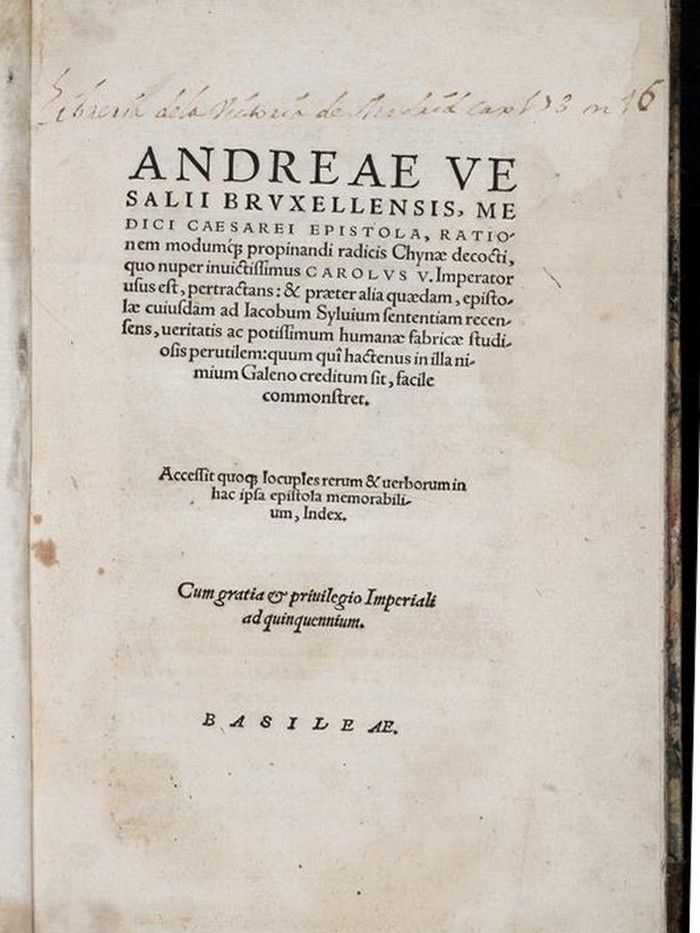
Initially Vesalius tried to be conciliatory and scientific, trying to persuade his opponents with the facts as seen in the human body. His final argument was published in October 1546 in “Epistola rationem modumque propinandi radices Chynae dedocti“ a publication known to many as the “Epistle (letter) on the China Root”. Vesalius used the excuse of writing on a controversial medicinal plant as the venue to explain in detail the reasons why he deemed Galen wrong in many aspects of human anatomy. The “Epistle on the China Root” was printed in Basel by Johannes Oporinus and the introduction was written by Andreas Vesalius’ brother Franciscus. The "Epistle on the China Root" has recently been translated (2015) by Dr. Daniel Garrison, one of the authors of the "New Fabrica".
Personal note: It is clear to me that Vesalius is not the first to promote scientific thought processes, but he is the one that used human anatomy to start the debunking (and acceptance) of portions of what was known at the time in that particular arena. Dr. Miranda
Sources
1. “Jacobus Sylvius (Jacques Dubois) 1478-1555 – Preceptor of Vesalius” JAMA (1966) 195 13; 1147
2. "Andreas Vesalius; The Making, the Madman, and the Myth" Joffe, Stephen N. Persona Publishing 2009
3. “A History of Medicine” Magner, LN Ed. M Deckker Pub 1992
4. “Vesalius: The China Root Epistle. A New Translation and Critical Edition” Garrison DH, 2015 Cambridge University Press
5. “Andreas Vesalius' first public anatomy at Bologna 1540 – An Eyewitness Report by Baldasar Heseler” Eriksson, R 1959 Almquist& Wiksells Boktryck
- Details
The term [incarcerated] is composed by the prefix [in-] which is Latin and means “in”, and “into”; the Latin root [-carcer-] meaning “jail” and the adjectival suffix [-ated]. [Incarcerated] means “jailed” or “in jail”.
It is used in medicine to denote a hernia where a viscus or viscera are trapped inside its hernia sac, not allowing the visceral contents to move or slide in and out of the hernia sac. Incarcerated hernias have higher potential for morbidity as the protruding hernia is now prone to outside trauma and there is also the potential for vascular complications such as ischemia or hypoxia.
Note: The links to Google Translate include an icon that will allow you to hear the pronunciation of the word.
- Details
![By Government of the United Kingdom. (Transferred from en.wikipedia.) [Public domain], via Wikimedia Commons](https://commons.wikimedia.org/wiki/File:Letters_Patent_Australia.jpg "By Government of the United Kingdom. (Transferred from en.wikipedia.) [Public domain], via Wikimedia Commons")
Click for a larger image
The medical terms [patent] and [patency] use the root term [-pat-] which arises from the Latin word [patentum] and its nominative form [patens], meaning "open". It refers to a structure that is open allowing for free flow.
The suffixes [-ent] and [-cy] are abstract suffixes (similar to adjectival suffixes) that are used as "pertaining to", or simply ignored.
Note of interest: An initial look at this term used in medicine clashes with the legal meaning of [patent] which is defined as a "a government authority or license conferring a right or title for a set period, especially the sole right to exclude others from making, using, or selling an invention" (Google search). Fact is, they are similar and arise from the same origin.
In medieval times letters meant to be read by a single individual were sealed, but government letters, edicts or resolutions meant to be read by many or be the law of the land where written as [litteræ patentes] (medieval Latin) which can be loosely translated as "an open letter". These "Letters of Patent" where written in parchment with seals and looked impressive! The term later was reduced to "patent", thus the double meaning for this word both in the medical and legal arenas.
Note: The links to Google Translate include an icon that will allow you to hear the pronunciation of the word.
Clicking on the image will take you to an example of a patent (Australia)
- Details
- Written by: Prof. C. Uribe
Click for a larger image
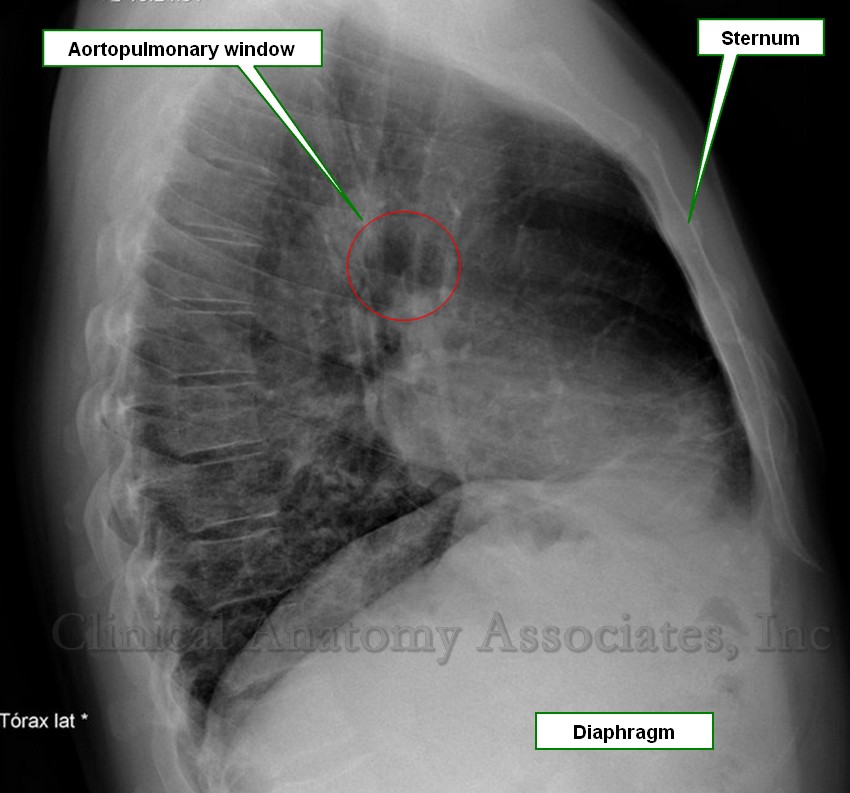
Anatomy: The term [aortopulmonary window] is a radiological term that refers to a small space in the left mediastinal region. It is bounded anteriorly by the ascending aorta, posteriorly by the descending aorta, superiorly by the aortic arch, inferiorly by the left pulmonary artery, medially by the arterial ligament [ligamentum arteriosum] and left main bronchus, and laterally by the pleura and left lung. It contents the recurrent laryngeal nerve, lymph nodes, and adipose tissue.
Clinical: The aortopulmonary window is commonplace for lymphadenopathy in various inflammatory and neoplastic diseases.
Radiology: In a frontal projection, it corresponds to a focal concavity on the left border of the mediastinum, inferior to the aorta and superior to the left pulmonary artery. In the lateral projection (which is the proper image to identify this area), it is seen as a radiolucency inferior to the aortic arch and superior to the left pulmonary artery. Its appearance can be modified by tortuosity of the aorta.
Congenital heart disease: This term also refers to a congenital heart disease similar in appearance to patent ductus arteriosus, (or truncus arteriosus) with the difference that this involves septal defect. It is described as a communication between the ascending aorta and pulmonary trunk portion or right pulmonary artery. It is a rare anomaly that represents 0.2% -0.6% of congenital cardiac abnormalities.
Sources:
1. Heitzman ER. The infraaortic area. In: The mediastinum: With correlations radiologic anatomy and pathology. Berlin, Germany: Springer-Verlag, 1988; 151: -168.
2. Blank N, Castellino RA. Patterns of pleural reflections of the left upper mediastinum: Normal anatomy and distortions produced by adenopathy. Radiology 1972; 102: 585-589.
3. Marc Dewey, Donna Magid, Paul S. Wheeler and Bernd Hamm aortopulmonary Angle Window or on the Chest Radiograph? American Journal of Roentgenology. 2004; 182: 1085-1086.
4. SY Ho, Gerlis LM, Anderson C, Devine WA, Smith A. The morphology of aortopulmonary windows With regard to their classification and morphogenesis. Young Cardiol 1994; 4: 146-55.
5. Kutsche LM, Van Mierop LHS. Anatomy and pathogenesis of aorticopulmonary septal defect. Am J Cardiol 1987; 59: 443-7.
6. Stevenson, Roger E .; Hall, Judith G. (2006). Human malformations and related anomalies. Oxford University Press US. pp. 119-. ISBN 978-0-19-516568-5
7. Donoghue, Veronica B .; Bj?rnstad, Per G. Radiological Imaging of the Neonatal Chest. Springer. pp. 330-. ISBN 978-3-540-33748-5.
- Details
- Written by: Prof. C. Uribe
|
Anatomy:[Hilum] is a generic term which names area of an organ where all the structures that enter or leave the organ are found. In the lung it is depression in the mediastinal surface of the lung through which the vessels and bronchi enter and leave the lungs. This set of structures corresponds to the “root of the lung” or “pulmonary pedicle”. The term has a singular form, [hilum]; and a plural form, [hila]; the adjectival form is [hilar]. Radiographs and CAT Scan: The hilum appears as a composite opacity at the root of each lung produced by bronchi, arteries, veins, lymph nodes, nerves ,and other tissues. Sources: |
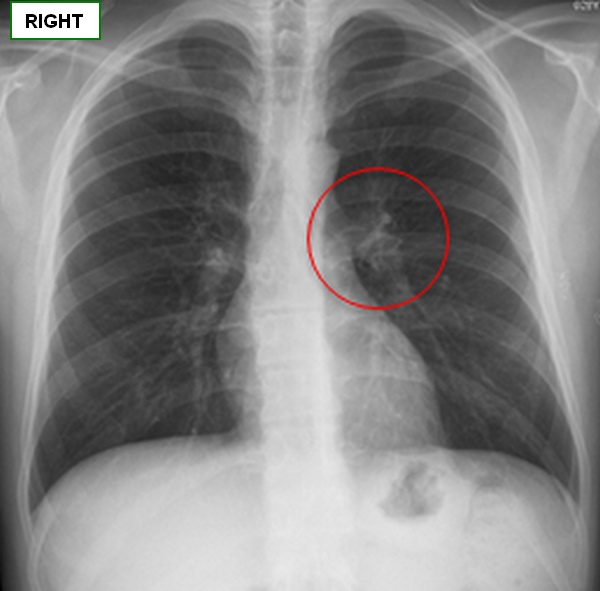 AP thoracic x-ray image showing the pulmonary hilum |
| Back to MTD Main Page | Subscribe to MTD |