
Medical Terminology Daily (MTD) is a blog sponsored by Clinical Anatomy Associates, Inc. as a service to the medical community. We post anatomical, medical or surgical terms, their meaning and usage, as well as biographical notes on anatomists, surgeons, and researchers through the ages. Be warned that some of the images used depict human anatomical specimens.
You are welcome to submit questions and suggestions using our "Contact Us" form. The information on this blog follows the terms on our "Privacy and Security Statement" and cannot be construed as medical guidance or instructions for treatment.
We have 1976 guests online
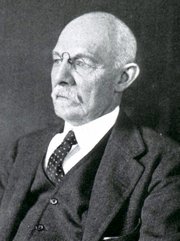
William S. Halsted, MD
(1852 – 1922)
American anatomist, teacher, and surgeon, William Stewart Halsted was born in New York City, USA to a wealthy family of English origin. His father was involved in charitable work and Governor and trustee to a city hospital. Not a brilliant student initially, Halsted took an undergraduate in Liberal Arts in Yale, CT., after which he entered the Medical College of Physicians at the Columbia College, where he excelled.
As a second-year medical student Halsted applied and obtained a position in surgery at a local hospital. In here he learned about Lister’s antiseptic technique and became an adamant proponent of it to reduce infection. In 1877 Halsted obtained his MD. After a short time as House Physician at the New York Hospital, Halsted traveled to Europe to further his education studying for two years at the Universities of Vienna, Leipzig, and W?rzburg.
Besides being at the forefront of surgical and antiseptic techniques (introducing the use of rubber gloves in surgery), Halsted was extremely concerned with the way medical students were taught in the US. He pioneered bedside clinical round discussions with the medical students after two years of basic sciences studies. Halsted developed the idea of a patient chart; he also developed the residency program for medical students in use today.
Halsted is probably the most influential researcher and surgeon at the turn of the century. He dedicated time to the study of intestinal anastomoses and the use of silk as a suture material. His experimental work in 1887 proved that the inclusion of the submucosa layer in an anastomosis was mandatory, as well that a single layered anastomosis was enough to attain closure. Perhaps Halsted’s most important contribution was the application and use of the scientific method to surgical questions. Halsted’s principles, also known as "Halsted's Rules of Surgery", set the standards used today in surgical suturing and surgical stapling.
He also pioneered the development and surgical techniques for radical mastectomy as a treatment for breast cancer.
As a side effect of this studied in anesthesia and the use of cocaine for anesthesia, Halsted became addicted to this substance, a problem that followed him through the years. Without impairing his capacity as a researcher and a surgeon, Halsted eventually recovered. He died in Baltimore in 1922 as a complication to surgery.
Sources:
1. Dubay, A. D., & Franz, G. M. (2003). Acute Wound Healing: The Biology of Acute Wound Failure. Surg Clin NA, 83, 463-481.
2. Halsted, W. S. (1887). Circular Suture of the Intestine - An Experimental Study. Am J Med Sci, 436-461.
3. “William Stewart Halsted: his life and contributions to surgery” Osborne, P. Lancet Oncol 2007; 8: 256–65
4. “William Stewart Halsted: Surgical pioneer” Burress, P Endoc Today (2010), 8: (2) 22
5. “William Stewart Halsted (1852–1922) Neurological stamp” Haas, LF J Neurol Neurosurg Psych 2000;69:641
Original image courtesy of "Images from the History of Medicine" at www.nih.gov

"Clinical Anatomy Associates, Inc., and the contributors of "Medical Terminology Daily" wish to thank all individuals who donate their bodies and tissues for the advancement of education and research”.
Click here for more information


- Details
- Written by: Pavlos Plessas
Text from the presentation at the 2014 Vesalius Continuum Meeting in Zakyhnthos, Greece by Pavlos Plessas.
Continued from: Powerful indications that Vesalius died from scurvy (2)

Click for a larger image
Traditional herbal medicine from just north of Jerusalem reveals a not so unexpected legacy. Several plants are considered effective in the treatment of scurvy by local healers (14). This means that scurvy was well known in the area until recently. There is also more solid evidence from not too long ago: in a United Nations report from 1951 it is mentioned that not only many of the Palestinian refugees suffered from a mild form of scurvy but it was widespread amongst the general population of Jordan and Gaza (15). Gaza is by comparison much more fertile than Jerusalem. If the natives suffered from scurvy, what luck could the wandering foreigners have? When not on the road, living off preserved foods, pilgrims like Vesalius stayed and dined at monasteries. Fredrik Hasselquist, an 18th century naturalist, came across an outbreak of scurvy amongst the monks of exactly such a monastery, the one in Bethlehem (16). Hasselquist attributed their illness to eating salted fish and staying indoors.
In fact Vesalius, who travelled around in very high temperatures, was in a worse position than the monks. In a clinical experiment Michelsen and Keys showed (17) that, in conditions similar to those Vesalius would have faced, up to 4 mg of Vitamin C daily can be lost through perspiration, irrespective of dietary intake and concentration in the plasma. Vesalius would not have gone through the gruelling regime of the experiment’s subjects; however, the accumulative impact over his long stay in the area would have been significant.
It is by no means certain that Vesalius stayed in the Holy Land for three whole months. Hubert Languet wrote (18) that he intended to visit Mount Sinai, and Metellus hinted that he may have actually met Boucherus in Egypt. If this is true, he would have spent up to a month and a half in one of the harshest deserts on earth. His diet would have been similar to that on a ship: preserved or long lasting foods with perhaps some fresh meat, extremely poor in Vitamin C (19). His brief passage through the fertile Nile Delta would not have helped him much as he would have coincided with the annual inundation of the Nile, when almost all fertile land was either submerged or recently planted. The only fruit that would have been abundant in Egypt in early September is dates; but those contain virtually no Vitamin C (20).
Click for a larger image
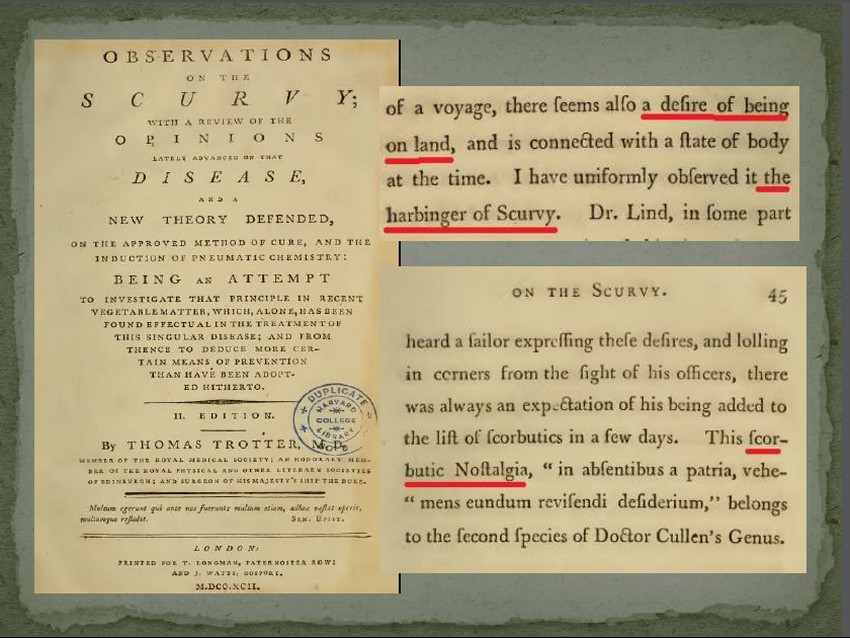
Mentioning Vesalius’s symptoms was not in Metellus’ intentions. He did, however, mention two inadvertently. The first is Vesalius’ anxiety and fear, although Metellus considered them as one of the causes of his disease. Kinsman and Hood showed (21) that, in fact, personality changes and in particular hypochondriasis, depression, and hysteria, are the very first symptoms of scurvy. Such changes seem to have a physiological rather than a purely psychological basis according to Harrison (22). It is worth noting that, according to Solenander, Vesalius was taciturn by nature and melancholic, which may be an indication, that, unknown even to himself, he was already ill by the time Boucherus met him.
Depression was considered a cause rather than a symptom of scurvy for centuries after Vesalius’ death as we can see in a Sanitary Commission Report from the American Civil War. Alongside it another exciting factor is mentioned: nostalgia (23).
Thomas Trotter, who had called it (the depression) “Scorbutic Nostalgia”, observed it to be “the harbinger of Scurvy” and described it as “a desire of being on land” (24). Instinctively the sick person longed to be where the cure for his illness could be found. The most intriguing aspect of Vesalius’ altered behaviour was his fear of being buried at sea. It is as if his desire to be on land was so strong that he could not bear the thought of being away from it forever.
The second mentioned symptom is Vesalius’ collapse and instant death. The sudden death of scorbutic patients, often while they felt well enough to engage in some activity and while doing their utmost, has been observed and documented in several medical treatises and in accounts of long sea voyages (25). So many died after stepping out of the hold and onto the deck, or during and immediately after their disembarkation, that it was believed the change of air could kill a man with scurvy (26). This is exactly how Vesalius’ death is described: he dropped dead, soon after landing and while striving to complete the short walk to the first buildings of Zakynthos.
Article continued here: Powerful indications that Vesalius died from scurvy (4)
Initial page of this article here.
Sources and author's comments:
14. 6% of the plant species in use, according to Raeda Tawfeeq Ebrahim Daoud in Studies on Folkloric Medicinal Plants Used by Palestinians in the Qalqilia District, An-Najah National University, Nablus 2008, p. 32, table 3.3.
15. Assistance to Palestine Refugees, Report of the Director of the United Nations Relief and Works Agency for Palestine Refugees in the Near East, General Assembly, Official Records: Sixth Session, Supplement No 16 (A/1905), 28 September 1951, Chapter 1, 31.
16. Voyages and Travels in the Levant in the Years 1749, 50, 51, 52, London 1766, p. 147.
17. Olaf Mickelsen and Ancel Keys, The composition of sweat, with special reference to the vitamins, The Journal of Biological Chemistry, 1943, pp. 479 - 490.
18. Adam Melchior, Vitae Germanorum medicorum, Frankfurt Main 1620, p. 133. Also in a manuscript, with the title De morte Vesalii ex letteris Huberti Langueti, scriptis ad D. D. Casparu[m] Peuceru[m], National Library of Medicine, Bethesda, Washington DC (manuscript E 86).
19. According to Felix Faber, who travelled to the Holy Land in the last quarter of the 15th century, food on a pilgrim galley consisted of bread or biscuit, panada, cheese, eggs and mutton or fish; also lettuce with olive oil when they could find it. See Fratris Felicis Fabri Evagatorium in Terrae Sanctae, vol. 1, Stuttgart 1843, pp 136 – 137. In Vesalius’ time travelling in the Mediterranean in a sailing ship rather than a galley had become much more common. Those ships did not need frequent stops for water like the galleys, so fewer chances of lettuce salad. For his desert journey Faber used biscuit, smoked meat, smoked cheese, smoked fish, eggs, rice, almonds, oil, butter, vinegar, salt, wine, live poultry, raisins and onions. Information from the book Once to Sinai: The further pilgrimage of Friar Felix Fabri, by H.F.M. Prescott, New York 1958. Of these only onions contain appreciable quantities of Vitamin C when raw but hardly any if they are sautéed. For obvious reasons boiling was not very popular in the desert.
20. Deglet noor dates contain only 0.4 mg per 100 g. Medjool dates contain nil. Data from the United States Department of Agriculture
21. Robert A. Kinsman and James Hood, Some behavioral effects of ascorbic acid deficiency, The American Journal of Clinical Nutrition, April 1971.
22. Fiona E. Harrison, Behavioural and neurochemical effects of scurvy in gulo knockout mice, Journal for Maritime Research, Volume 15, Issue 1, 2013.
23. Report of a Committee of the Associate Medical Members of the Sanitary Commission on the Subject of Scurvy with Special Reference to Practice in the Army and Navy, Washington 1862, p. 17.
24. Observations on the Scurvy, 2nd Edition, London 1792, pp. 44 – 45.
25. For example Richard Walter, A voyage round the world in the years MDCCXL, I, II, III, IV, 5th edition, London 1749, p. 101 and James Lind, A Treatise on the Scurvy, London 1772, p. 132 and p. 281.
26. Thomas Trotter, Observations on the Scurvy, 2nd Edition, London 1792, p. 48.
- Details
- Written by: Pavlos Plessas
Text from the presentation at the 2014 Vesalius Continuum Meeting in Zakyhnthos, Greece by Pavlos Plessas.
Continued from: Powerful indications that Vesalius died from scurvy (1)
Click for a larger image
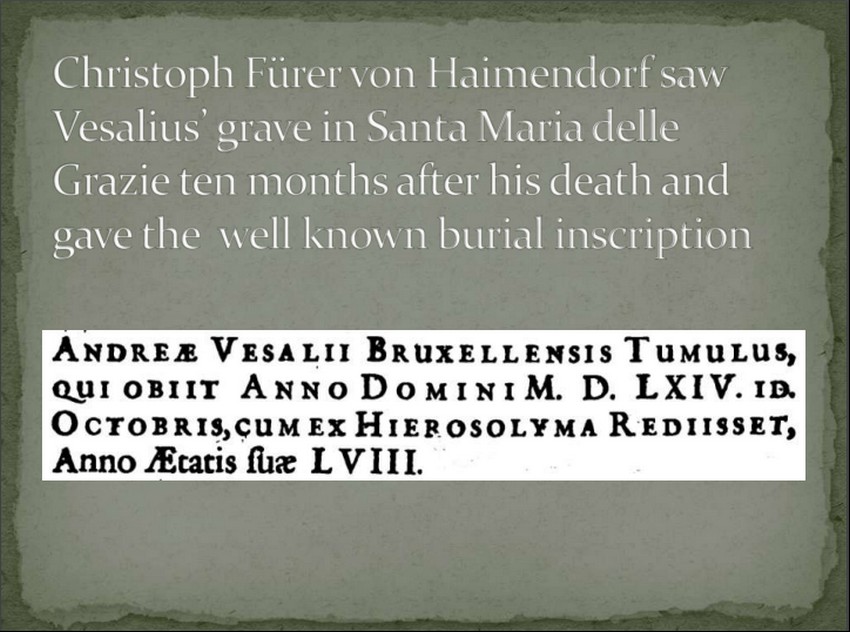
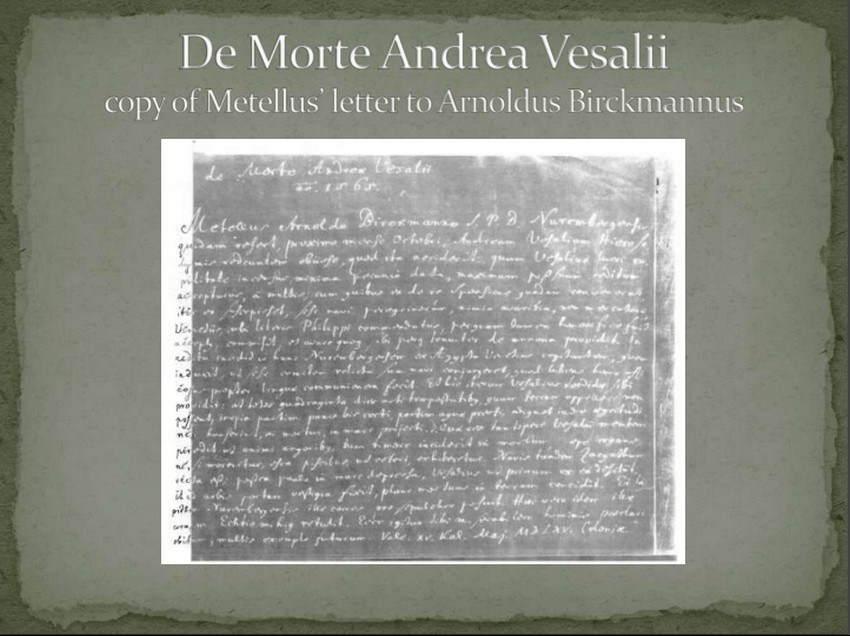
Metellus and Solenander agree on most of the details of the story, to the point that it appears the initial source of their information was the same person, however, their versions are not identical. Metellus claims to have received his information from Georgius Boucherus in person, in the presence of a reliable witness, while we do not know how many times the story was recounted before reaching Solenander. Hence, while Solenander provides some valuable information, it is Metellus’ version, notwithstanding his conjectures, that should be considered more faithful (8).
It is very clear from both versions that, some weeks into the journey, a disease broke out on board the ship. Also, more clear in Metellus than in Solenander, that Vesalius was a victim of the same disease, which was somehow connected to food and water shortages..
(Based on the above) It can be easily concluded that the mysterious outbreak does not appear to have been due to contagion on board the ship. Neither the crew was affected nor Boucherus developed symptoms, either during the voyage or in the following months, in spite of his close proximity with the patients for at least forty days. Consequently, the disease was the result of either a pathogenic factor the pilgrims came in contact with or of some nutrient deficiency.
Contact with a pathogenic factor should have happened before boarding the ship, with the possible exception of the pilgrims consuming contaminated food that was not available to the crew. That way they could have fallen ill with typhoid fever, which has a variable incubation period of up to 30 days. However, complications and death from typhoid usually occur in the third week of the illness, which would have been near the end of the journey. Vesalius would simply not have had the time to get worried, fall ill, develop complications and die by the time they reached land. His sudden collapse and death does not fit in well with typhoid either.
Click for a larger image
Looking for pathogenic factors on land we can distinguish between vector borne diseases and poisoning. It is, however, inconceivable that the victims of some 16th century poison would have shown no symptoms for weeks after receiving a lethal dose. Therefore, only vector born diseases need be considered and from those only the ones that are very deadly and present in the region. None of these though agree with what Metellus let us know about the disease.
When considering the various nutritional deficiencies we only need to deal with those that could have led to multiple deaths within six weeks from the onset of obvious physical symptoms, and could conceivably have appeared under the prevailing conditions of the journey and the socioeconomic and cultural traits of the region. As such, only scurvy appears to fulfil the criteria. Many may think that even scurvy is not a good candidate since a six week sailing is not thought sufficient for its appearance.
In fact, very often scurvy did not take long to appear or cause deaths. According to the naval physician Thomas Trotter it was common for an 18th century British warship of the Channel Fleet to lose up to a dozen seamen to scurvy and have another fifty hospitalised during a cruise of just eight weeks (9). A scurvy patient on a ship rarely survived for seven weeks and many died much earlier (10).
Also, it has to be pointed out that Vesalius’ journey did not last only weeks; he left Venice sometime before the 24th of May (11) and died in Zakynthos in the middle of October, a minimum of five months. More than two of these he spent sailing and the remainder in semi-desert or desert conditions. The Holy Land in Vesalius’ time was arid and mostly barren, especially in the high summer. Many pilgrims, shocked by what they saw, believed the area had been cursed by God (12). No vegetables grew at that time of year and only some grapes, grown by Christians, and figs, growing wild, could have been ripe. Both fruit contain very little Vitamin C (13).
Article continued here: Powerful indications that Vesalius died from scurvy (3)
Sources and author's comments:
8. There are additional reasons for this. In Solenander’s version there are efforts to explain certain aspects of the story, which may have been nothing but an intermediate informant’s speculation passed on as reliable information. An example of this is that, according to Solenander, Boucherus met Vesalius and the other pilgrims in Venice, and travelled with them to Cyprus where they separated. He went to Egypt while they continued to Jerusalem. On his return journey he travelled again via Cyprus and by coincidence met the same companions on the same ship. All this is possible but unlikely, especially if he meant that the ship waited for the pilgrims for three months. There is even the suspicion that at least one part of the original story was intentionally “corrected”: Metellus says that Vesalius collapsed and died soon after disembarking, while Solenander says he died on board the anchored ship. Conventional wisdom dictates that a very sick man does not disembark and walk on the shore of Zakynthos but expires on board his ship. This is not always true but the temptation to perform a little cosmetic surgery on the story is understandable.
9. Medicina Nautica: an Essay on the Diseases of Seamen, Volume III, London 1803, p. 387.
10. James Lind, A Treatise on the Scurvy, London 1772, p. 281.
11. This is the publication date of the Examen, in the preface of which Francesco dei Franceschi recalls Vesalius’ visit to Venice.
12. Felix Faber’s description is typical: But even I said secretly in my heart: see, this is the land that is supposed to flow with milk and honey; but I see no fields for bread, no vineyards for wine, no gardens, no green meadows, no orchards, but it is all rocky, burnt by the sun and parched.
13. Figs contain about 2 mg per 100 g; grapes 3.2 mg. Data from the United States Department of Agriculture. A man whose body stores of Vitamin C are very low will need to eat 10 – 12 figs or more than 60 grapes every day just to remain above the threshold of scurvy.
- Details
- Written by: Pavlos Plessas
Text from the presentation at the 2014 Vesalius Continuum Meeting in Zakyhnthos, Greece by Pavlos Plessas.
This article appeared originally on the blog of Fr. Panagiotis Capodistrias, a Zakynthian priest and poet, and a former schoolmate of Pavlos Plessas on September, 2014. Published here with permission from the author
Pavlos Plessas
The circumstances of Andreas Vesalius’ death in Zakynthos in 1564 may have been described in one of two differing accounts, originally written by three different men between the years 1565 and 1573, in five different texts. No additional information from people who may have been in possession of some facts is known to have survived.
In two of those texts the writer Petrus Bizarus claims that a travelling goldsmith found the great anatomist abandoned in a miserable hut on a deserted beach, dying from an unspecified illness (1). The unnamed goldsmith, in spite of strong opposition from the locals, buried him with his own hands in a plot of land he purchased for that purpose.
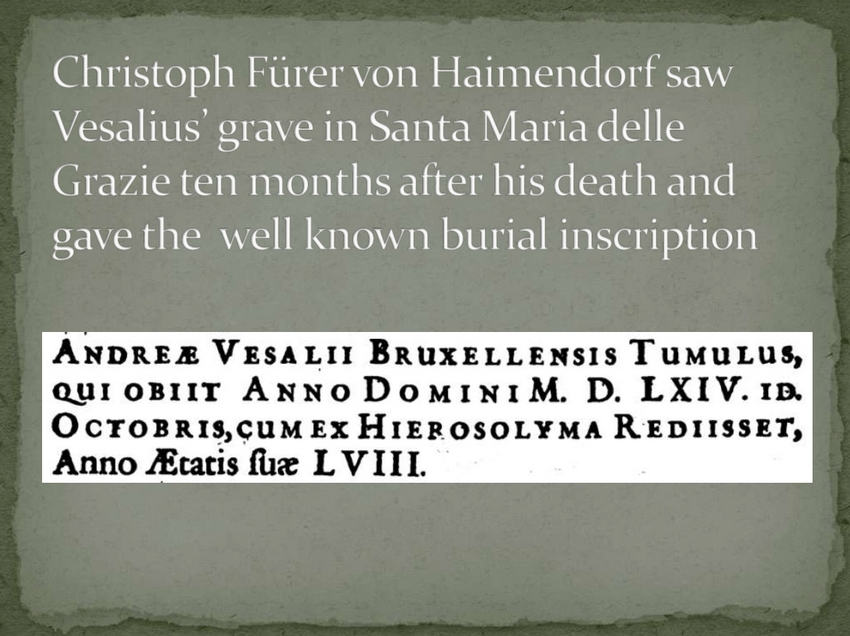
The veracity of Bizarus’ account appears doubtful due to its pervasive vagueness and the improbability of such treatment of an important nobleman by both, the Venetian authorities of Zakynthos and his own companions. More importantly it is incompatible with the testimonies of Christoph Fürer von Haimendorf (2) and Giovanni Zuallardo (3) , who saw Vesalius’ tomb at the Franciscan monastery of Santa Maria delle Grazie, in 1565 and 1586 respectively. Their testimonies are also supported by that of Filippo Pigafetta (4). From their descriptions it is obvious that Vesalius was buried with some decorum and his grave was not dug simply to prevent the desecration of the body by wild animals.
The rival account is given in two letters of Johannes Metellus (5) , written in 1565, and another by Reinerus Solenander a year later. Two more of Vesalius’ contemporaries, Carolus Clusius and Henricus Pantaleon provided shortened versions of this account that do not offer additional information and, hence, will not be discussed further. According to Metellus and Solenander Vesalius’ tomb was paid for by a fellow passenger, a Georgius Boucherus of Nuremberg, returning from Egypt. This account is not only compatible with the testimonies of those who saw Vesalius’ tomb but its credibility is enhanced by Metellus’ mention of a gravestone, put up by Boucherus, and Solenander’s statement that Vesalius was buried “next to a chapel or shrine close to the port of Zakynthos”. Santa Maria delle Grazie was the only Western church near the port at the time (7).
Click for a larger image
In a rather unexpected way this account’s credibility is further strengthened by the astonishing events it describes. For if someone is to present a fabricated account it is natural to try and make it as believable as possible. Even if the aim is to impress or to shock, the disturbing inventions have to have plausible and uncomplicated explanations. Contrary to this we are told of a ship that was unable to reach land for forty days, of severe food and water shortages, the consequent outbreak of an illness that caused many deaths but strangely affected only the pilgrims, Vesalius becoming depressed and anxious – which in the belief of Metellus contributed to his illness – his pleading to the crew to not bury him at sea, and finally his death as soon as they reached land – a very sudden collapse by the city gate according to Metellus. It will be shown that this sequence of extraordinary events has a reasonable, quite likely even, and singular explanation.
Article continued here: Powerful indications that Vesalius died from scurvy (2)
Sources and author's comments:
1. Historia di Pietro Bizari della guerra fatta in Ungheria dall'invictissimo imperatore de'christiani contra quello de'Turchi, Lyons, 1568, p. 179; also in his Pannonicum bellum, Basel, 1573, p. 284.
2. Itinerarium Aegypti, Arabiae, Palaestinae, Syriae, aliarumque Regionum Orientalium, Nuremberg, 1621, p.2
3. Il devotissimo Viaggio Di Gierusalemme, Rome, 1595, pp. 85 – 86.
4. Theatro del Mondo di A. Ortelio: da lui poco inanzi la sua morte riveduto, e di tavole nuove et commenti adorno, et arricchito, con la vita dell' autore. Traslato in lingua Toscana dal Sigr F. Pigafetta, 1608/1612, background information to Map 217. Pigafetta, commenting almost two decades after his visit to Zakynthos in July 1586, mistakenly named the burial place of Vesalius as the monastery of St Francis. However, he leaves no doubt with regards to which monastery he actually meant by corroborating Zuallardo’s story of the inscription’s looting by the Turks in 1571. There was indeed a St Francis monastery in Zakynthos. It was, however, inside the castle and, hence, it was never looted by the Turks. Santa Maria delle Grazie on the other hand was in the area that is known to have been looted. I am grateful to Marcel van den Broecke for sending me photographs of the original text kept in the Koninklijke Bibliotheek in Hague.
5. Metellus’ letter to Georgius Cassander was published in Petrus Bertius’ Illustrium & clarorum Virorum EPISTOLAE SELECTIORES, Superiore saeculo scriptae vel a Belgis, vel ad Belgas, Leyden 1617, pp. 372 – 373. His short letter to Arnoldus Birckmannus is unpublished though an English translation is in Charles Donald O'Malley’s Andreas Vesalius of Brussels, 1514-1564. A photocopy was kindly provided by the Cushing/Whitney Medical Historical Library of Yale University and a transcript made by Maurits Biesbrouck.
6. Maurits Biesbrouck, Theodoor Goddeeris and Omer Steeno, The Last Months of Andreas Vesalius: a Coda, Vesalius – Acta Internationalia Historiae Medicinae, Vol. XVIII, No 2, December 2012, pp. 70 – 71, from Thomas Theodor Crusius’ Vergnügung müssiger Stunden,oder allerhand nutzliche zur heutigen galanten Gelehrsamkeit dienende Anmerckungen of 1722.
7. The monastery of St Elias was on the hill high above the port and St Franciscus even higher, inside the castle. St Mark was built later, in the 17th century.
- Details
This article is part of the series "A Moment in History" where we honor those who have contributed to the growth of medical knowledge in the areas of anatomy, medicine, surgery, and medical research.
William Harvey
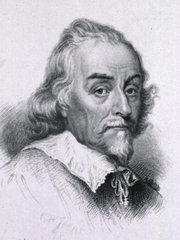
William Harvey (1578 - 1609) English physician, physiologist, and anatomist. He was born in Folklestone, where his father was the mayor.
Harvey studied at the King’s College in Canterbury, after which he entered Cambridge. He later traveled through France and Italy and continued his studies in Padua, where he graduated with an MD in 1602. He later returned to Cambridge to complete his Doctoral studies.
He became the Physician-In-Charge at St. Bartholomew’s Hospital. It was at this time that he started a long process of scientific observation and logical reasoning that led him to postulate the circulation of the blood in his 1628 publication "Excercitatio Anatomica de Motu Cordis et Sanguinis in Animalibus" (Anatomical Exercises on the Movement of the Heart and the Blood in Animals).
Harvey’s publication caused incredible controversy, as his proposed theory went against Galen’s theories and the idea that blood passed through "invisible pores" from the right to the left atrium of the heart. His main problem was that he could not prove the presence of capillaries, which were not observed until Antoine van Leeuwenhoek invented the microscope in the late 1600's.
In his book Harvey states ''It is absolutely necessary to conclude that the blood in the animal body is impelled as in a circle and is in a state of ceaseless motion: that this is the act or function which the heart performs by means of the pulse, and that it is the sole and only end of the motion and contraction of the heart”. Even today there are many that use the term “circulatory system” without realizing that the meaning “as in a circle” coined by William Harvey is present in it.
Although the first to consider the term “circulation” was Michael Servetus (1511 – 1553), his ideas were not completely evolved. Had he completed his research and studies Servetus could have precluded Harvey, but he was considered a heretic and burnt at the stake. Thankfully, Harvey was not!
Sources:
1. "William Harvey"Billimoria, A. J Assoc Phys 60 (2012) 57
2. “William Harvey” Foucar, HO. Can Med Assoc J 1951; 64(5): 452–453.
3. “William Harvey” McKecnie, EDJ, Robertson, C. Resuscitation 55 (2002) 133-136
4. “William Harvey, an Aristotelian anatomist” Fara, P. Endeavour 21:2 (2007) 43–44
5. “The life and work of William Harvey” Keele, KD Endeavour 2:3 (1978) 104–107
Original image in the Public Domain. Courtesy of the National Library of Medicine
- Details
UPDATED: The suffix [-(o)pexy] means "fixation" or "surgical fixation". This surgical fixation or repositioning is performed on an organ or portion of an organ that has been displaced or detached by weakness of the surrounding tissues, trauma, or other means. The fixation can be attained by the use of sutures, surgical staples, bone tacks, mesh, etc. or a combination of these devices.
Some applications of this suffix are:
• Hemorrhoidopexy: Surgical repositioning of hemorrhoids.
• Nephropexy: Surgical repositioning and fixation of a kidney when the kidney "falls" or easily moves from its normal position.
• Hysteropexy: Surgical repositioning and fixation of the uterus. Uterine body displacement can lead to infertility.
- Details
Click for a larger image
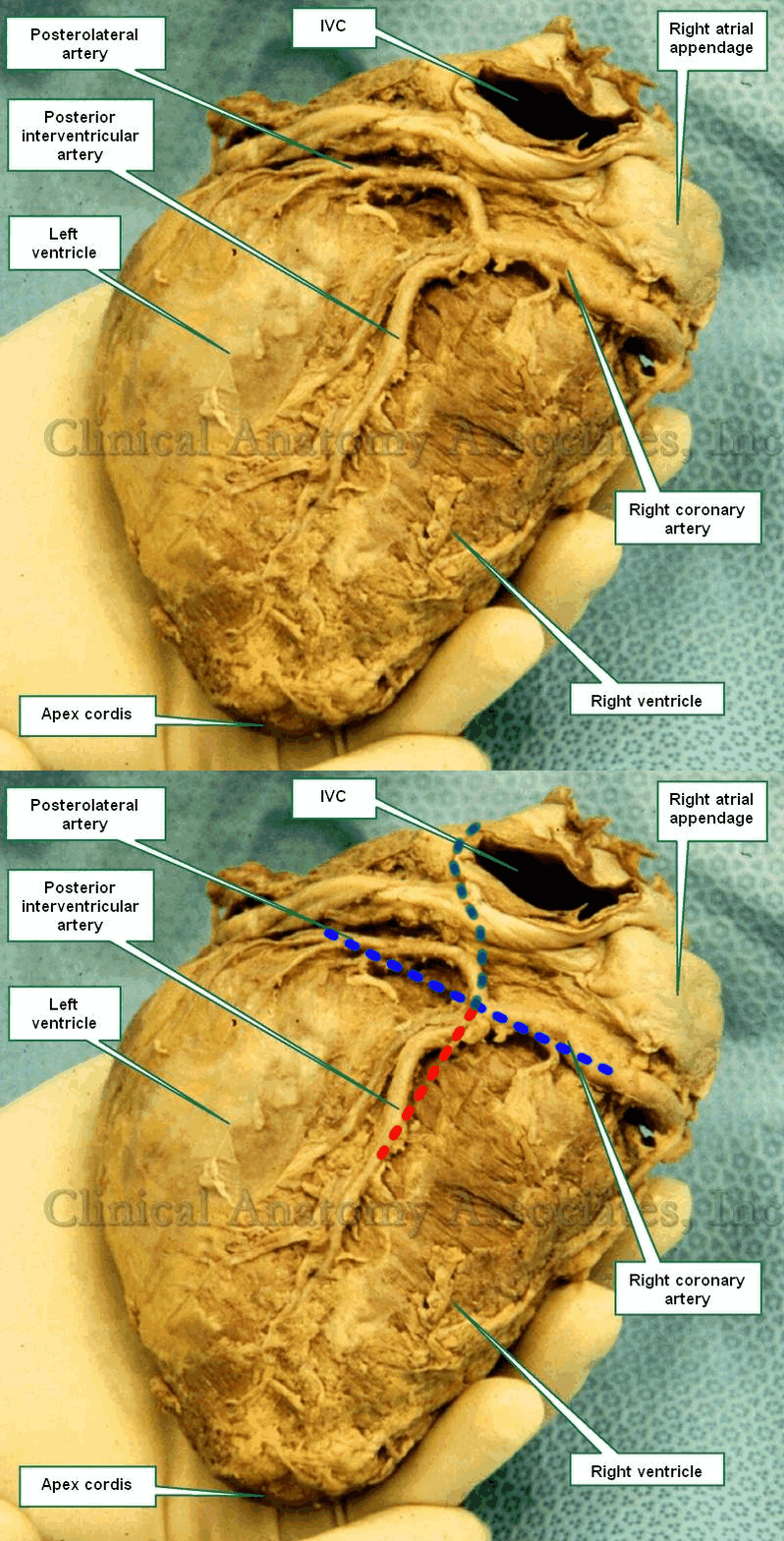
UPDATED: The term [Crux Cordis] is Latin and means "the cross of the heart". It is an anatomical landmark used in angiography. It is formed by the crossing of the atrioventricular sulcus and the conjunction of the posterior interventricular sulcus and the interatrial sulcus.
In the accompanying image the atrioventricular sulcus is colored blue, the posterior interventricular sulcus is red, and the interatrial sulcus is green.
The right coronary artery, posterolateral artery, and the circumflex artery are found in the atrioventricular sulcus. The posterior interventricular artery (PDA) is found in the posterior interventricular sulcus.
The AV node artery, which provides blood supply to the atrioventricular node (a component of the conduction system of the heart) usually arises from the PDA , the right coronary artery, or the posterolateral artery at the level of the crux cordis.
The interatrial sulcus is curved and hugs the inferior vena cava. It is known eponymically as Waterston's groove (David J. Waterston, British surgeon and anatomist 1910-1985) and also as Sondergaard's groove.