

Medical Terminology Daily - Est. 2012

Medical Terminology Daily (MTD) is a blog sponsored by Clinical Anatomy Associates, Inc. as a service to the medical community. We post anatomical, medical or surgical terms, their meaning and usage, as well as biographical notes on anatomists, surgeons, and researchers through the ages. Be warned that some of the images used depict human anatomical specimens.

You are welcome to submit questions and suggestions using our "Contact Us" form. The information on this blog follows the terms on our "Privacy and Security Statement" and cannot be construed as medical guidance or instructions for treatment.


We have 1786 guests online


A Moment in History

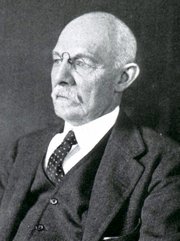
William S. Halsted, MD

William S. Halsted, MD
(1852 – 1922)

American anatomist, teacher, and surgeon, William Stewart Halsted was born in New York City, USA to a wealthy family of English origin. His father was involved in charitable work and Governor and trustee to a city hospital. Not a brilliant student initially, Halsted took an undergraduate in Liberal Arts in Yale, CT., after which he entered the Medical College of Physicians at the Columbia College, where he excelled.

As a second-year medical student Halsted applied and obtained a position in surgery at a local hospital. In here he learned about Lister’s antiseptic technique and became an adamant proponent of it to reduce infection. In 1877 Halsted obtained his MD. After a short time as House Physician at the New York Hospital, Halsted traveled to Europe to further his education studying for two years at the Universities of Vienna, Leipzig, and W?rzburg.

Besides being at the forefront of surgical and antiseptic techniques (introducing the use of rubber gloves in surgery), Halsted was extremely concerned with the way medical students were taught in the US. He pioneered bedside clinical round discussions with the medical students after two years of basic sciences studies. Halsted developed the idea of a patient chart; he also developed the residency program for medical students in use today.

Halsted is probably the most influential researcher and surgeon at the turn of the century. He dedicated time to the study of intestinal anastomoses and the use of silk as a suture material. His experimental work in 1887 proved that the inclusion of the submucosa layer in an anastomosis was mandatory, as well that a single layered anastomosis was enough to attain closure. Perhaps Halsted’s most important contribution was the application and use of the scientific method to surgical questions. Halsted’s principles, also known as  "Halsted's Rules of Surgery", set the standards used today in surgical suturing and surgical stapling.

He also pioneered the development and surgical techniques for radical mastectomy as a treatment for breast cancer.

As a side effect of this studied in anesthesia and the use of cocaine for anesthesia, Halsted became addicted to this substance, a problem that followed him through the years. Without impairing his capacity as a researcher and a surgeon, Halsted eventually recovered. He died in Baltimore in 1922 as a complication to surgery.

Sources:
1. Dubay, A. D., & Franz, G. M. (2003). Acute Wound Healing: The Biology of Acute Wound Failure. Surg Clin NA, 83, 463-481.
2. Halsted, W. S. (1887). Circular Suture of the Intestine - An Experimental Study. Am J Med Sci, 436-461.
3. “William Stewart Halsted: his life and contributions to surgery” Osborne, P. Lancet Oncol 2007; 8: 256–65
4. “William Stewart Halsted: Surgical pioneer” Burress, P Endoc Today (2010), 8: (2) 22
5. “William Stewart Halsted (1852–1922) Neurological stamp” Haas, LF J Neurol Neurosurg Psych 2000;69:641
Original image courtesy of "Images from the History of Medicine" at  www.nih.gov


 "Clinical Anatomy Associates, Inc., and the contributors of "Medical Terminology Daily" wish to thank all individuals who donate their bodies and tissues for the advancement of education and research”.

Click here for more information


bookplateink.com


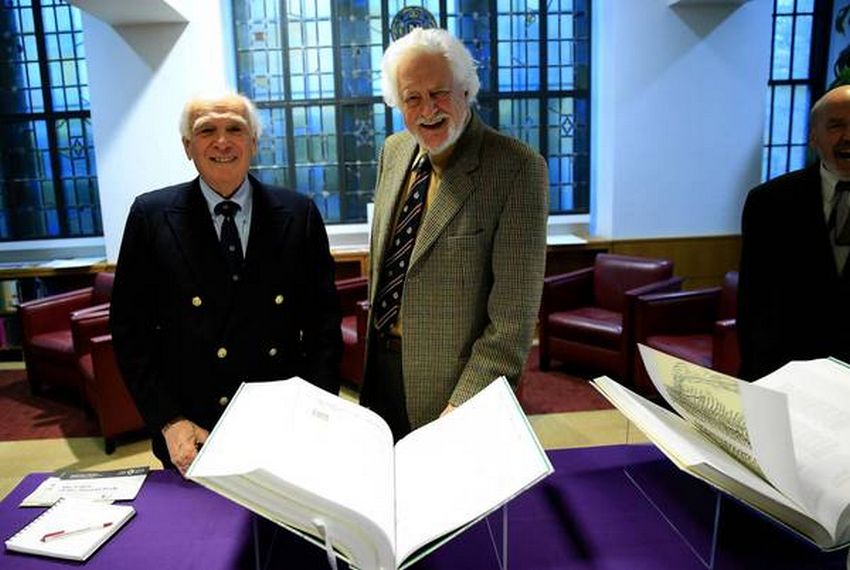
Drs. Hast and Garrison with the two volumes of the new Fabrica
Click for a larger image

Andreas Vesalius opus magnus was the creation and the publication of his book “De Humani Corporis Fabrica, Libri Septem" (Seven books on the structure of the human body). This book was published on May 26th, 1543 by the printing press of Johannes Oporinus.

Much has been said and written about this book and the influence of Vesalius’ work on scientific thinking, the scientific method, and the displacement of dogmatic thinking based on the works of the ancient Greeks and Galen of Pergamon (129AD - 200AD) for a different view of the construction of the body based on direct and empirical observation.

Unfortunately, because of Vesalius’ following of Erasmus’ teachings on Latin, the book was written in a very difficult and circumvoluted language which made it difficult to understand. In addition, the book was very expensive for the times, with an estimated maximum printing of 600 copies.

Drs. Hast and Garrison with the two volumes of the new Fabrica
Click for a larger image

Were it not for the images and the captions, as well as the many plagiarized versions of the Fabrica in different languages, Vesalius opus magnus would have been lost to history. Harvey Cushing wrote in his Vesalius bio-bibliography of 1943:”As a book, the Fabrica has been probably more admired and less read than any publication of equal significance in the history of science”.

Although several attempts have been done to translate the Fabrica, most of the works have been incomplete, or have tried to paraphrase or correct Vesalius’ words, leaving us with a watered-down image of the author and his intent.

In 1993 Drs. Daniel H Garrison and Malcom H. Hast began a collaboration to translate the Fabrica of Vesalius. The 20- year story of how they obtained federal grants, discussed the translation, found a publisher, scanned and improved on the original images of the Fabrica, and how they even worked with Christian Mengelt to create a new typography for an annotated new Fabrica, was part of their presentation on the interdisciplinary symposium “Vesalius and the Invention of the Modern Body” hosted by the St. Louis University and the Washington University February 26-28, 2015.
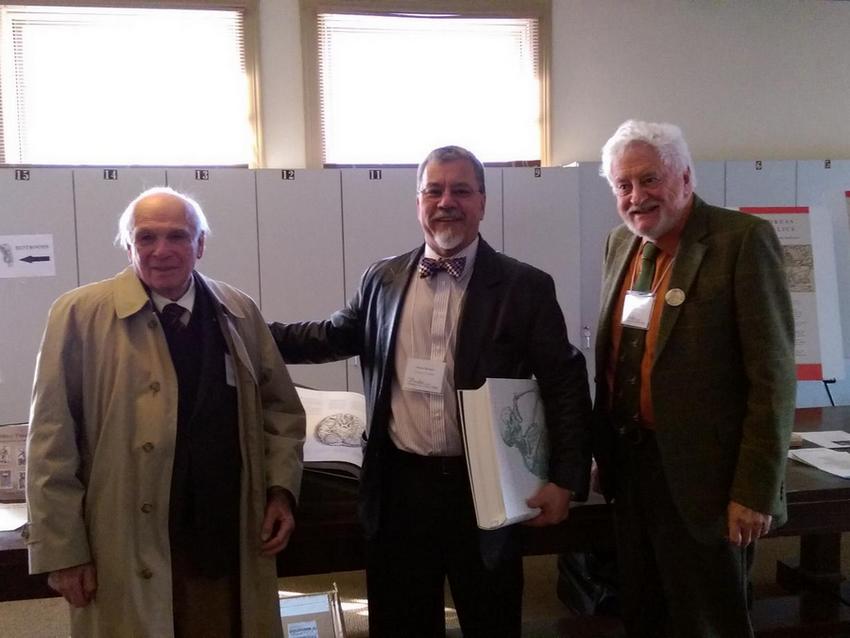
Drs. Hast, Miranda, and Garrison with the  new Fabrica
Click for a larger image

This annotated new Fabrica is a translation of the 1543 first edition with comments on the 1555 second edition and it also includes passages and comments from a heavily edited 1555 second edition that has side margins comments and corrections now certified to be in Vesalius’ own handwriting. This book has been speculated to have been Vesalius’ personal copy and probably the basis of a potential third edition. This particular book is now known as "Vesalius' Annotated Fabrica"

The "New Fabrica" was published in 2013 by Karger Publishing, a company based in Basel, Switzerland, the same city where the original Fabrica was published in 1543. The ISBN is 978-3-318-02246-9. Only 948 books were published and it has now been sold out. Because of the demand, an original is now considered a rare book.

Daniel H. Garrison received his degrees from Harvard (A.B. Classics, 1959) and Berkeley (PhD Comparative Literature, 1968). He was a member of the Classics Department at Northwestern University from 1966 until his retirement in 2010. 
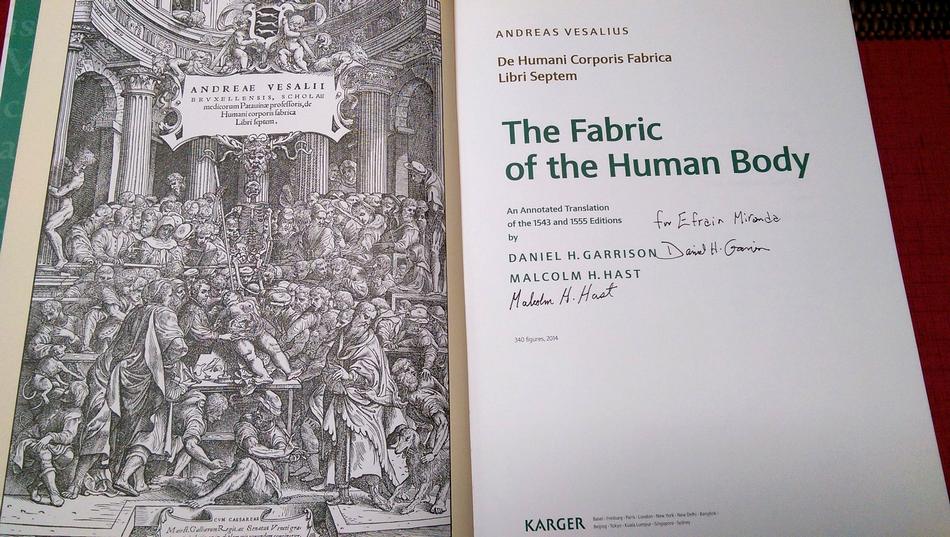
Title pages of the new Fabrica with the authors' signatures
Click for a larger image

Malcolm H. Hast is Professor Emeritus of Otolaryngology – Head and Neck Surgery – and also past Professor of Cell and Molecular Biology (Anatomy) at Feinberg School of Medicine of Northwestern University. He is Fellow of the American Association for the Advancement of Science as well as Fellow of the Anatomical Society (UK) and a Chartered Biologist and Fellow of the Society of Biology (UK). He is also a recipient of The Gould International Award in Laryngology and a NATO Senior Fellowship in Science.

Personal note: I am honored to have met both Drs. Garrison and Hast at the symposium, shared some of the stories behind the new Fabrica and have them sign my own copy of this incredible book. Dr. Miranda

Sources:
1. "A Bio-blibliography of Andreas Vesalius" Cushung, H. 1943 Saunders