
Medical Terminology Daily (MTD) is a blog sponsored by Clinical Anatomy Associates, Inc. as a service to the medical community. We post anatomical, medical or surgical terms, their meaning and usage, as well as biographical notes on anatomists, surgeons, and researchers through the ages. Be warned that some of the images used depict human anatomical specimens.
You are welcome to submit questions and suggestions using our "Contact Us" form. The information on this blog follows the terms on our "Privacy and Security Statement" and cannot be construed as medical guidance or instructions for treatment.
We have 212 guests online
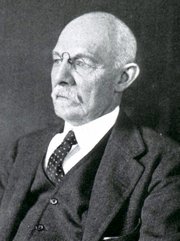
William S. Halsted, MD
(1852 – 1922)
American anatomist, teacher, and surgeon, William Stewart Halsted was born in New York City, USA to a wealthy family of English origin. His father was involved in charitable work and Governor and trustee to a city hospital. Not a brilliant student initially, Halsted took an undergraduate in Liberal Arts in Yale, CT., after which he entered the Medical College of Physicians at the Columbia College, where he excelled.
As a second-year medical student Halsted applied and obtained a position in surgery at a local hospital. In here he learned about Lister’s antiseptic technique and became an adamant proponent of it to reduce infection. In 1877 Halsted obtained his MD. After a short time as House Physician at the New York Hospital, Halsted traveled to Europe to further his education studying for two years at the Universities of Vienna, Leipzig, and W?rzburg.
Besides being at the forefront of surgical and antiseptic techniques (introducing the use of rubber gloves in surgery), Halsted was extremely concerned with the way medical students were taught in the US. He pioneered bedside clinical round discussions with the medical students after two years of basic sciences studies. Halsted developed the idea of a patient chart; he also developed the residency program for medical students in use today.
Halsted is probably the most influential researcher and surgeon at the turn of the century. He dedicated time to the study of intestinal anastomoses and the use of silk as a suture material. His experimental work in 1887 proved that the inclusion of the submucosa layer in an anastomosis was mandatory, as well that a single layered anastomosis was enough to attain closure. Perhaps Halsted’s most important contribution was the application and use of the scientific method to surgical questions. Halsted’s principles, also known as "Halsted's Rules of Surgery", set the standards used today in surgical suturing and surgical stapling.
He also pioneered the development and surgical techniques for radical mastectomy as a treatment for breast cancer.
As a side effect of this studied in anesthesia and the use of cocaine for anesthesia, Halsted became addicted to this substance, a problem that followed him through the years. Without impairing his capacity as a researcher and a surgeon, Halsted eventually recovered. He died in Baltimore in 1922 as a complication to surgery.
Sources:
1. Dubay, A. D., & Franz, G. M. (2003). Acute Wound Healing: The Biology of Acute Wound Failure. Surg Clin NA, 83, 463-481.
2. Halsted, W. S. (1887). Circular Suture of the Intestine - An Experimental Study. Am J Med Sci, 436-461.
3. “William Stewart Halsted: his life and contributions to surgery” Osborne, P. Lancet Oncol 2007; 8: 256–65
4. “William Stewart Halsted: Surgical pioneer” Burress, P Endoc Today (2010), 8: (2) 22
5. “William Stewart Halsted (1852–1922) Neurological stamp” Haas, LF J Neurol Neurosurg Psych 2000;69:641
Original image courtesy of "Images from the History of Medicine" at www.nih.gov

"Clinical Anatomy Associates, Inc., and the contributors of "Medical Terminology Daily" wish to thank all individuals who donate their bodies and tissues for the advancement of education and research”.
Click here for more information


- Details
Click for a larger image
We would like to welcome Professor Cristián Uribe as a contributor to Medical Terminology Daily.
Prof. Uribe is a Physical Therapist, has a Masters in Human Anatomy and is a Professor in the Human Anatomy Department of the Medical School at the University Finis Terrae in Santiago, Chile.
Prof. Uribe is also the Director of the Postgraduate Course on “Anatomical Bases of Normal Imaging”, as well as the Executive Secretary of the Postgraduate Office at the same University.
He published the book “Eponyms in Anatomical Nomenclature” (2011, Ed. U. Finis Terrae). For his LinkedIn page click here.
- Details

Click for a larger image
The [valve of the inferior vena cava] is probably better known by its eponym, the [Eustachian valve]. This is an incomplete valve found at the most distal end of the inferior vena cava, at the point where it opens into the right atrium of the heart. The valve is muscular at its base and composed mostly by membranous endocardium, and is normally the only valve present in the inferior vena cava.
It appears as a membranous semilunar fold extending posteriorly from the limbus fossa ovalis, anterior to the inferior caval orifice where it disappears. Its free border is usually membranous, concave, and directed anterosuperiorly. Its base is a transverse muscular ridge continuous with the anterior margin of the caval orifice.
It has no function in the adult, but in the fetus it helps to divert the flow of blood coming from the inferior vena cava towards the foramen ovale [fossa ovalis], as part of fetal circulation.
It has great anatomical variation in size, shape and thickness. On its medial aspect it joins with the Thebesian valve at the orifice of the coronary sinus.
First described by Bartolomeo Eustachius (c1500 - 1574) in 1653, the existence of the valve of the inferior vena cava was disputed by many until Winslow in 1717 confirmed its presence and suggested its function in fetal circulation.
Sources:
1. "The Valve of the Inferior Vena Cava" Hickie, JB Br Heart J. 1956 Jul; 18(3): 320–326
2. "Bartolommeo Eustachio; a great medical genius whose masterpiece remained hidden for 150 years" Wells, WA Arch Otolaring (1925) 48: 58
- Details
The medical word [dysphagia] arises from the suffix [dys-] which means "abnormal", the root term [phag-] which arises from the Greek [φάγος] (phagos), meaning "to swallow", a "glutton" or "eating much", and the suffix [-ia] meaning "condition". The word dysphagia then means "a condition of abnormal swallowing".
- Details
This article is part of the series "A Moment in History" where we honor those who have contributed to the growth of medical knowledge in the areas of anatomy, medicine, surgery, and medical research.

Bartolomeo Eustachius
Bartolomeo Eustachius (c1500 - 1574) Italian physician and anatomist, also known as Bartholomew Eustachius, Esutachi, and e was born in the small town of San Severino Marche, in the province of Macerata, central Italy. His father was a respected physician, and may have attended as a student the University of Sapienza, where he later taught as a professor of practical medicine. Eustachius’ life is mostly unknown and some of his works remained hidden for over 150 years. His birth date is only an estimate and data varies from c1500 AD to c1510 AD.
It is known that Eustachius lived and worked in Rome from 1549 to 1574. He was both an anatomist and a physician to the Vatican. As an anatomist, Eustachius is credited for having been the first to prepare anatomical images for printing using copper plates.
As a hospital physician, Eustachius was adamant on the need of autopsies on patients who died at the hospital, crediting him with being one of the first pathological anatomists.
Eustachius’ is credited with several anatomical discoveries, which he published in short monographs, on topics like the kidneys, the suprarenal glands (which he was the first to describe), the movements of the head, the azygos vein, etc. One of these was entirely dedicated to dentistry, “Libellus de Dentibus”, which have led to some to call Eustachius “The Father of Dental Anatomy”.
Eustachius dedicated himself to prepare a number of anatomical copper plates, apparently getting ready to publish a book to rival Vesalius’ “Fabrica”. It is known that Eustachius disliked Vesalius because of Vesalius’ contempt for the teachings of Galen. Eustachius died before completing his work and the copper plates were forgotten for over a century. After being rediscovered, these plates were published with commentaries by anatomists, until a final publication in Latin by Bernard Siegfried Albinus (1697 – 1770) entitled “Explicatio Tabularum Anatomicarum Bartholomaei Eustachii Anatomici Summi” (An explanation of the Anatomical Picture of Bartholomew Eustachius, Supreme Anatomist”.
Besides the suprarenal gland, Eustachius is credited for having discovered the stapes, the tensor tympani muscle, the valve of the inferior vena cava, the cervical sympathetic chain and the thoracic duct.
Interesting note: Eustachius’ assistant Petrus Matthaeus Pinus, who helped develop the copper plates, voiced his master’s dislike of Vesalius in a poem that was published by Albinus over a hundred years after the death of all of them, it is also an epitaph for a great anatomist:
“Just as the Master from Pergamon (Galen)
Teaching his method of healing, once refuted
The false writings of the ignorant Thessalus,
So also my BARTOLO (Eustachius)
Teaching his method of denoting every detail, position,
Shape, structure, order, number and condition
Has repulsed the shameless arrogance and claims
Of the impudent Vesalius
To him (Eustachius) all future generations
Adhere In reverential admiration
The age to come will envy us on account of you Father,
And historians will wish they had lived sooner
They will extol our era, through you fortunate,
Lucky beyond measure"
Sources:
1. "The root of dental anatomy: a case for naming Eustachius the "Father of Dental Anatomy"" Bennett, G (2009) J Hist Dent (1089-6287), 57 (2) 85 -88
2. “The papal anatomist: Eustachius in renaissance Rome” Simpson, D, ANZ J Surg (2011) 81: (12)905 -910
3. “Bartholomeo Eustachio – The Third Man: Eustachius Published by Albinus” Fahrer, M. (2003) ANS J Surg; 73: 523- 528
4. "Bartolommeo Eustachio; a great medical genius whose masterpiece remained hidden for 150 years" Wells, WA Arch Otolaring (1925) 48: 58
Original image courtesy of: Wikimedia Commons.
- Details

Click for a larger image
UPDATED: The mediastinum is the median region of the thorax, usually described as the "space"1 between the lungs. This region is divided into a superior and inferior mediastinum by a plane that pases through the sternal angle or Angle of Louis.
The inferior mediastinum is itself divided into three separate regions by the pericardial sac. The region anterior to the pericardial sac is the "anterior mediastinum", the region posterior to the pericardial sac is the "posterior mediastinum", and the region containing and including the pericardial sac is the "middle mediastinum". Thus described the mediastinum comprises four regions as follows:
• Superior mediastinum: It contains the aortic arch, the brachiocephalic trunk, the thoracic segments of the left common carotid and the left subclavian arteries, the brachiocephalic veins, a portion of the superior vena cava, the vagus nerve, phrenic nerve, and left recurrent laryngeal nerve, trachea, esophagus, thoracic duct and the remains of the thymus gland
• Anterior mediastinum: A narrow space, more developed on the left side, anterior to the pericardial sac and contains some lymph nodes and connective tissue
• Middle mediastinum: The largest mediastinal region, it contains the pericardial sac, the heart, the bifurcation of the trachea, the inferior vena cava, and the cardiac end of the great vessels.
• Posterior mediastinum: Contains the descending aorta, the azygos and hemiazygos veins, the esophagus, and thoracic duct.
Personally, I do not use the description of the mediastinum as a "the space beween the lungs", as it conjures the image of literal "open spaces" around or between the organs. The fact is that the mediastinum is tightly packed with no spaces between the organs. This is why I prefer the definition of the mediastinum as an "area" or "region" between the lungs. Dr. Miranda.
- Details
Click for a larger image
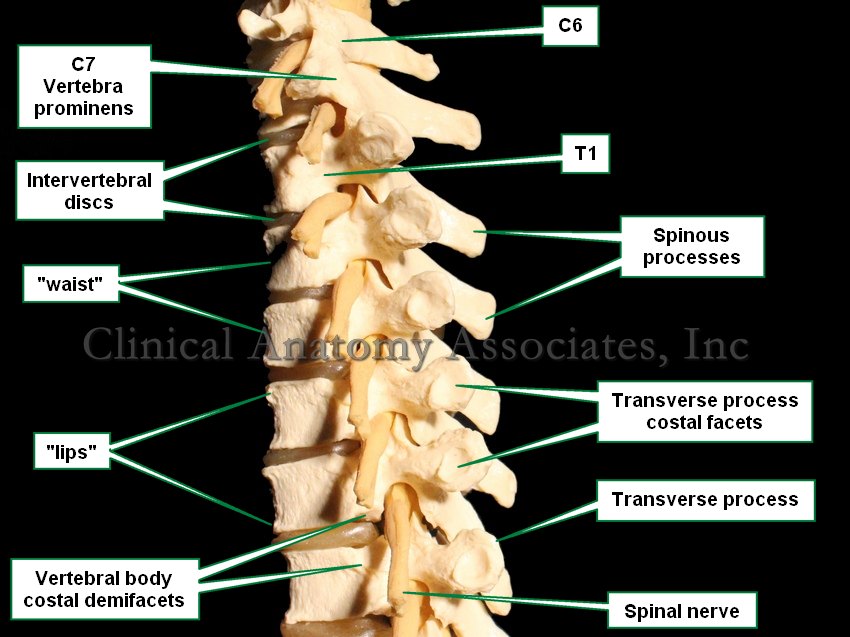
There are two types of [costal facets]: costal demifacets, and transverse costal facets.
The first type are small, half-moon shaped facets found in the posterior aspect of the vertebral body of thoracicvertebrae. They are called demifacets, from the French word [demi], which itself derives from the Latin [dimidius] meaning "split in two" or "halved". A demifacet is "half a small face". There is usually one larger superior demifacet and a smaller inferior demifacet, both close to the area where the vertebral body meets the pedicle. Anothe term for each demifacet is a fovea costalis. The articulation of two adjacent demifacets and one rib form a costovertebral joint.
The second type are articular facets found in the transverse processes of the thoracic vertebrae. These allow most of the rib to articulate with the same number vertebra (T1 - Rib 1, T2 - Rib 2, etc). The articulation of a transverse costal facet and one rib form a costotransverse joint.
There are specific variations to these facets and joints as follows:
• T11 and T12 do not have transverse costal facets
• T1 has a complete superior costal facet for rib #1 and an inferior demifacet for rib #2
• T11 and T12 have a complete costal facet on their vertebral body, no demifacets
Image property of: CAA.Inc. Photographer: David M. Klein