
Medical Terminology Daily (MTD) is a blog sponsored by Clinical Anatomy Associates, Inc. as a service to the medical community. We post anatomical, medical or surgical terms, their meaning and usage, as well as biographical notes on anatomists, surgeons, and researchers through the ages. Be warned that some of the images used depict human anatomical specimens.
You are welcome to submit questions and suggestions using our "Contact Us" form. The information on this blog follows the terms on our "Privacy and Security Statement" and cannot be construed as medical guidance or instructions for treatment.
We have 2243 guests online
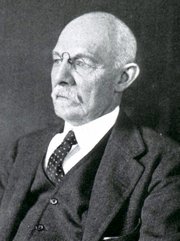
William S. Halsted, MD
(1852 – 1922)
American anatomist, teacher, and surgeon, William Stewart Halsted was born in New York City, USA to a wealthy family of English origin. His father was involved in charitable work and Governor and trustee to a city hospital. Not a brilliant student initially, Halsted took an undergraduate in Liberal Arts in Yale, CT., after which he entered the Medical College of Physicians at the Columbia College, where he excelled.
As a second-year medical student Halsted applied and obtained a position in surgery at a local hospital. In here he learned about Lister’s antiseptic technique and became an adamant proponent of it to reduce infection. In 1877 Halsted obtained his MD. After a short time as House Physician at the New York Hospital, Halsted traveled to Europe to further his education studying for two years at the Universities of Vienna, Leipzig, and W?rzburg.
Besides being at the forefront of surgical and antiseptic techniques (introducing the use of rubber gloves in surgery), Halsted was extremely concerned with the way medical students were taught in the US. He pioneered bedside clinical round discussions with the medical students after two years of basic sciences studies. Halsted developed the idea of a patient chart; he also developed the residency program for medical students in use today.
Halsted is probably the most influential researcher and surgeon at the turn of the century. He dedicated time to the study of intestinal anastomoses and the use of silk as a suture material. His experimental work in 1887 proved that the inclusion of the submucosa layer in an anastomosis was mandatory, as well that a single layered anastomosis was enough to attain closure. Perhaps Halsted’s most important contribution was the application and use of the scientific method to surgical questions. Halsted’s principles, also known as "Halsted's Rules of Surgery", set the standards used today in surgical suturing and surgical stapling.
He also pioneered the development and surgical techniques for radical mastectomy as a treatment for breast cancer.
As a side effect of this studied in anesthesia and the use of cocaine for anesthesia, Halsted became addicted to this substance, a problem that followed him through the years. Without impairing his capacity as a researcher and a surgeon, Halsted eventually recovered. He died in Baltimore in 1922 as a complication to surgery.
Sources:
1. Dubay, A. D., & Franz, G. M. (2003). Acute Wound Healing: The Biology of Acute Wound Failure. Surg Clin NA, 83, 463-481.
2. Halsted, W. S. (1887). Circular Suture of the Intestine - An Experimental Study. Am J Med Sci, 436-461.
3. “William Stewart Halsted: his life and contributions to surgery” Osborne, P. Lancet Oncol 2007; 8: 256–65
4. “William Stewart Halsted: Surgical pioneer” Burress, P Endoc Today (2010), 8: (2) 22
5. “William Stewart Halsted (1852–1922) Neurological stamp” Haas, LF J Neurol Neurosurg Psych 2000;69:641
Original image courtesy of "Images from the History of Medicine" at www.nih.gov

"Clinical Anatomy Associates, Inc., and the contributors of "Medical Terminology Daily" wish to thank all individuals who donate their bodies and tissues for the advancement of education and research”.
Click here for more information


- Details
UPDATED: The term [cholangiogram] is composed by the combined root terms [-chole-] derived from the Greek word [χολή] (cholí) meaning "gall" or "bile, and the root term [-angi-], also derived from the Greek [αγγείο] (angeío), meaning "vase", or "vessel"letter. The suffix [-(o)gram] evolved from the Greek word [γράμμα] (grámma) , meaning "letter", although today we use it to mean "examination of". For more information on this suffix, click here. The term [cholangiogram] therefore means "examination of a bile vessel".
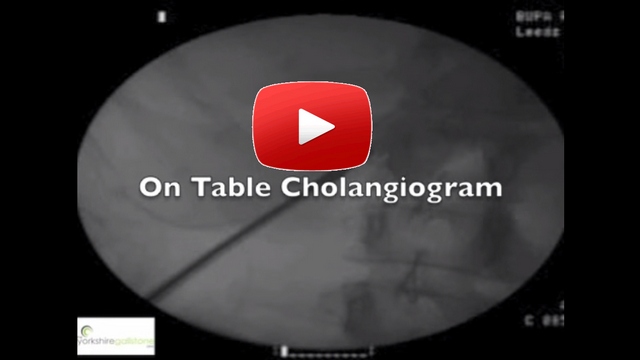
A cholangiogram is the fluoroscopic imaging of a bile duct. To do this a radio-opaque dye is introduced in the bile system and a series of X-ray images are taken of the hepatobiliary tree. Today the examination can be performed intraoperative in conjunction with a cholecystectomy using a C-arm fluoroscope
The accompanying video (without sound) shows an intraoperative normal cholangiogram.
Video courtesy of YouTube, Mr. Andrew Smith and the Yorkshire Gallstone Clinic.
- Details
This article is part of the series "A Moment in History" where we honor those who have contributed to the growth of medical knowledge in the areas of anatomy, medicine, surgery, and medical research.
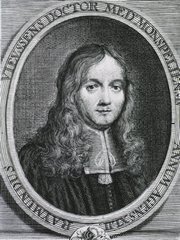
Raymond de Vieussens
Raymond de Vieussens (c.1635 – 1715). French anatomist and physician. His exact date and place of birth are uncertain, some place him being born in the area of Le Vigan in France and the date for some authors as late as 1641.
What we do know is that he studied at the University of Montpellier where he graduated from his medical studies in 1670. He became a physician at the Hôtel Dieu Saint-Eloi in Montpellier. He later became head physician at the same hospital and apparently maintained this position for the rest of his life. His studies on the anatomy of the heart and lymphatic system were pioneers for the time, as were his studies on the anatomy of the nervous system.
Vieussens was a prolific writer. Among his works in 1706, he published “Nouvelles Découvertes sur le Coeur” (New Discoveries on the Heart) followed by “Traité Nouveau de la Structure et Des causes du Mouvement Naturel du Coeur” (New Treaties on the Structure and Cause of the Natural Movement of the Heart) in 1715. In these books he presented detailed anatomy of the lymphatic system and blood vessels of the heart, as well as his theories on the movement of the heart. In his work, he did the first accurate description of mitral stenosis and aortic disease.
One of his greatest works was “Neurographia Universalis”, published in 1684 in Lyons, France. In this book Vieussens describes the structure of the nervous system with emphasis on the pathways of the white substance, which we know today is formed by bundles of neuronal axons. He accurately described the internal structure of the cerebellum and other structures that today bear his name. Unfortunately Vieussens attempted to describe the physiology of the brain with little factual support, developing wild theories, including the statement that he had found the “fluid of the nerves”.
Some of Vieussens’ work was published posthumously by his family and colleagues. Today, many eponyms remember Vieussens’ name, here are some of them:
- Valve of Vieussens: A valve found at the distal end of the great cardiac vein, where it empties into the coronary sinus
- Ring of Vieussens: Name for and anatomical variation in the heart, an anastomotic communication between two conal arteries, one arising from the right coronary artery, the other arising from the left anterior descending artery (LAD)
- Centrum of Vieussens: A term that describes the mass of white matter at the center of each cerebral hemisphere
- Ring of Vieussens: Eponymic term for the limbus fossa ovalis, a raised muscular ring surrounding the fossa ovalis in the heart
- Valve of Vieussens: A thin veil of tissue between the superior cerebellar peduncles, forming part of the roof of the 4th ventricle. This is known as the superior medullary vellum and may have some sparse cerebellar tissue on it
- The ventricle of Vieussens: The name of a cavity found in the case where the septum pellucidum is double. The septum pellucidum is a membrane that separates the lateral ventricles of the brain in the midline
If you hover with your mouse over the image of young Vieussens you will see another image of Vieussens at 65.
Original images courtesy of National Library of Medicine.
- Details
The suffix [-(o)rrhaphy] is derived from the Greek language and means "surgical repair". Initially, the meaning was that of "suturing" but nowadays surgical repair can be accomplished with sutures, staples, tacks, tissue glue, and other medical devices.
Some applications of this suffix are:
- Herniorrhaphy: Surgical repair of a hernia
- Enterorrhaphy: Surgical intestinal repair
- Aneurysmorrhaphy: Surgical repair of an aneurysm
- Gastrorraphy: Surgical repair of the stomach
- Details
Latin term probably derived from [varus] meaning "bent or crooked". The term is used in medicine to denote a single dilation of a vein. The plural form of [varix] is [varices], the adjective [varicose] denotes an area affected by varices.
Peripheral varicose veins are usually caused by failure of the venous valves found in them.
Note that the dilation of a vein is called a varix, while the dilation of an artery is called an aneurysm.
- Details
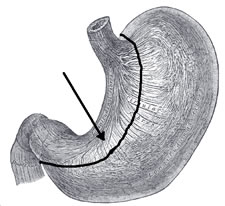
Anterior view of the stomach
This is a German word composed of [magen] meaning "stomach" and [strasse] meaning "road or street", therefore [magenstrasse] means "stomach road".
Most everybody that studies anatomy or gastrointestinal surgery knows that the stomach has several regions that include the fundus, body (corpus), antrum, pyloric canal , and pylorus. The anatomical term [magenstrasse] refers to a tubular and thicker area of the stomach close to the lesser curvature (see image).
This old anatomical German term has come back en vogue because of bariatric surgery. In a sleeve gastrectomy, the stomach is stapled and separated along the left lateral border of the magenstrasse, leaving only a tubular, less distensible portion of the stomach.
Here is an article from the "Journal of Biomechanics" on the physiological magenstrasse and gastric emptying. For a video of this procedure CLICK HERE
Video available on YouTube, published by Realize TM
- Details
UPDATED: From the Greek [εὐφωνία] [eu-] meaning "good" and [phone/phonos] meaning "sound or voice". The term [euphonic] means "sounds good".
This is useful when combining root terms where the proximal to distal order of root terms does not apply. An example is the removal of the Fallopian tubes and ovaries. Since there is no true attachment, or flow of fluids between these structures, the words [salpingooophorectomy] and [oophorosalpingectomy] are both correct, but one of them is easier to pronounce and articulate, or euphonic, therefore that is the one we use: [salpingooophorectomy].
Note: Since the two root terms [-salping-] (Fallopian or uterine tube) and [-oophor-] (ovary) are connected with an [-o-] (meaning "and") per the rules used for combining root terms, the use of a hyphen to connect these terms is redundant and incorrect!