
Medical Terminology Daily (MTD) is a blog sponsored by Clinical Anatomy Associates, Inc. as a service to the medical community. We post anatomical, medical or surgical terms, their meaning and usage, as well as biographical notes on anatomists, surgeons, and researchers through the ages. Be warned that some of the images used depict human anatomical specimens.
You are welcome to submit questions and suggestions using our "Contact Us" form. The information on this blog follows the terms on our "Privacy and Security Statement" and cannot be construed as medical guidance or instructions for treatment.
We have 490 guests online
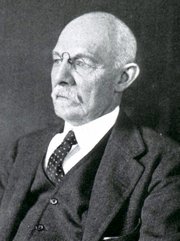
William S. Halsted, MD
(1852 – 1922)
American anatomist, teacher, and surgeon, William Stewart Halsted was born in New York City, USA to a wealthy family of English origin. His father was involved in charitable work and Governor and trustee to a city hospital. Not a brilliant student initially, Halsted took an undergraduate in Liberal Arts in Yale, CT., after which he entered the Medical College of Physicians at the Columbia College, where he excelled.
As a second-year medical student Halsted applied and obtained a position in surgery at a local hospital. In here he learned about Lister’s antiseptic technique and became an adamant proponent of it to reduce infection. In 1877 Halsted obtained his MD. After a short time as House Physician at the New York Hospital, Halsted traveled to Europe to further his education studying for two years at the Universities of Vienna, Leipzig, and W?rzburg.
Besides being at the forefront of surgical and antiseptic techniques (introducing the use of rubber gloves in surgery), Halsted was extremely concerned with the way medical students were taught in the US. He pioneered bedside clinical round discussions with the medical students after two years of basic sciences studies. Halsted developed the idea of a patient chart; he also developed the residency program for medical students in use today.
Halsted is probably the most influential researcher and surgeon at the turn of the century. He dedicated time to the study of intestinal anastomoses and the use of silk as a suture material. His experimental work in 1887 proved that the inclusion of the submucosa layer in an anastomosis was mandatory, as well that a single layered anastomosis was enough to attain closure. Perhaps Halsted’s most important contribution was the application and use of the scientific method to surgical questions. Halsted’s principles, also known as "Halsted's Rules of Surgery", set the standards used today in surgical suturing and surgical stapling.
He also pioneered the development and surgical techniques for radical mastectomy as a treatment for breast cancer.
As a side effect of this studied in anesthesia and the use of cocaine for anesthesia, Halsted became addicted to this substance, a problem that followed him through the years. Without impairing his capacity as a researcher and a surgeon, Halsted eventually recovered. He died in Baltimore in 1922 as a complication to surgery.
Sources:
1. Dubay, A. D., & Franz, G. M. (2003). Acute Wound Healing: The Biology of Acute Wound Failure. Surg Clin NA, 83, 463-481.
2. Halsted, W. S. (1887). Circular Suture of the Intestine - An Experimental Study. Am J Med Sci, 436-461.
3. “William Stewart Halsted: his life and contributions to surgery” Osborne, P. Lancet Oncol 2007; 8: 256–65
4. “William Stewart Halsted: Surgical pioneer” Burress, P Endoc Today (2010), 8: (2) 22
5. “William Stewart Halsted (1852–1922) Neurological stamp” Haas, LF J Neurol Neurosurg Psych 2000;69:641
Original image courtesy of "Images from the History of Medicine" at www.nih.gov

"Clinical Anatomy Associates, Inc., and the contributors of "Medical Terminology Daily" wish to thank all individuals who donate their bodies and tissues for the advancement of education and research”.
Click here for more information


- Details
The root term [-sept-] arises from the Latin word [septum] which means “partition”, referring to a wall or division between areas or compartments. The addition of the adjectival suffix [-al] gives us the word [septal], meaning “pertaining to a septum”. The plural for [septum] is [septa]
In human anatomy the term is used in:
- Nasal septum: The osteocartilaginous division between both sides of the nose
- Interatrial septum: The wall or division between the atria of the heart
- Interventricular septum: The partition between the heart ventricles
- Septum pellucidum: A membranous separation between the lateral ventricles of the brain
- Intermuscular septa: There are several fibrous septa between the muscles in both the upper and lower extremities.
There are other septa in the human body not listed here.
Interestingly, the Greek counterpart of the Latin term [septum] is [διάφραγμα] (diáfragma) meaning “diaphragm”.
Note: The links to Google Translate include an icon that will allow you to hear the pronunciation of the word.
- Details
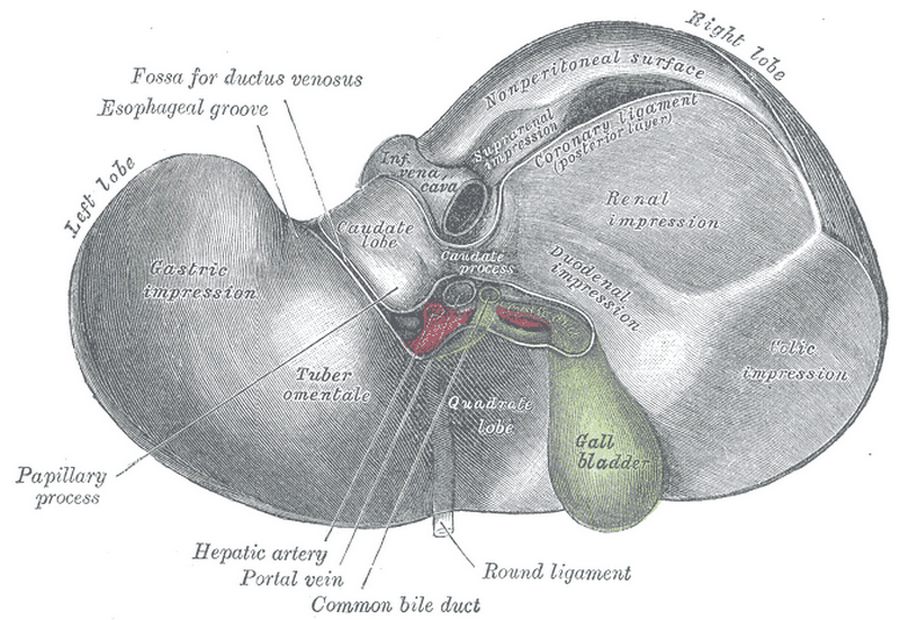
Click for a larger image
The root term [-hepat-] arises from the Greek word [ηπαρ] (ipar) which means “liver”. It is used in many medical terms:
- Hepatic: The adjectival suffix [-ic] means “pertaining to”. Pertaining to the liver, as in “common hepatic artery”
- Hepatitis: The suffix [-itis] means “inflammation” or “infection”. Inflammation of the liver
- Hepatectomy: The suffix [-ectomy] means “removal of”. Removal of the liver
- Hepatomegaly: The suffix [-(o)megaly] means “enlargement”. An enlarged liver
Note: The links to Google Translate include an icon that will allow you to hear the pronunciation of the word.
Image in Public Domain, by Henry Vandyke Carter, MD - Gray's Anatomy.
- Details

Click for a larger image
[UPDATED] The term [semilunar] means "half moon"; [luna] is Latin for "moon"). The term [semilunar valve] is a generic term used to describe both the pulmonary and aortic valves found at the exit of the right and left ventricle respectively. These valves are also called the "sigmoid valves"
Each valve is formed by three half-moon shaped leaflets (see accompanying image). Each leaftlet "hangs" loosely towards the lumen of the vessel, creating a space between the leaflet and the wall of the vessel. Each one of these spaces is called a "sinus of Valsalva".
The point where two leaflets meet is called a "commissure".
Image property of:CAA.Inc.
- Details
Click for a larger image
The term [semilunar] is composed of the prefix [semi-] meaning "half", the root term [-lun-] which arises from the Latin word [luna] meaning "moon", and the adjectival suffix [-ar] meaning "pertaining to".
It is used to describe semicircular structures such as the leaflets or cusps that form both the both the pulmonary and aortic valves, Because of the shape of these leaflets these valves are also called "semilunar valves".
Image property of: CAA.Inc.
- Details
Click for a larger image
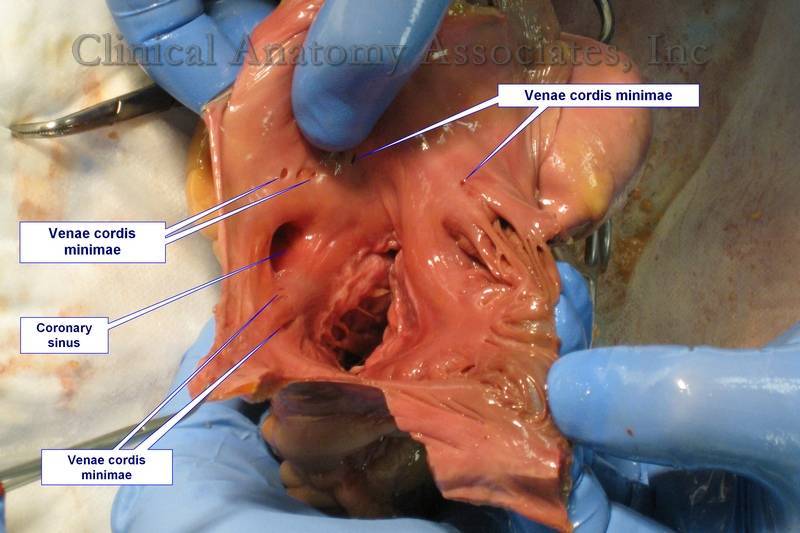
The venae cordi minimae, or smallest cardiac veins are known eponimically as the "veins of Thebesius". These "veins" are open, valveless communication channels between the heart chambers and the subendocardial vascular plexus. The Thebesian veins are most prevalent in the right atrium, although they have been described in all four heart chambers.
Studies have been conducted that demonstrate that these channels communicate with both arteries and veins1. This being so, the Thebesian "veins" are not true veins, nor arteries. It has been argued that when performing a transmural myocardial revacularization procedure using lasers, the surgeon is only copying what nature already has built in the heart, the Thebesian veins.
The actual opening of the venae cordi minimae into the chambers of the heart are called the foramina Thebesii. The image shows an human heart dissection, where the right atrium has been opened and the foramina Thebesii clearly shown. For a larger depiction, click on the image.
1. "Anatomy and clinical significance of ventricular Thebesian veins" Ansary A. Clin Anat 2001; 14(2) 102-10
- Details
[UPDATED]The root term [-cephal-] is Greek, arising from the word [κεφάλι] (kef?li) , meaning "head". It was later latinized as [cephalicus]. The applications of this root term are multiple, as follows:
• Cephalic: The suffix [-ic] means "pertaining to", therefore, "pertaining to the head"
• Encephalon: The prefix [en-] means "inside or within", therefore "inside the head". Encephalon is another term for brain
• Anencephalic: The prefix [an-] means "without" Anencephalia is a condition where the brain does not develop.
• Cephalalgia: The suffix [-algia] means "pain". Cephalalgia is the medical term for "headache"
• Cephalad: The suffix [-ad] means "toward".
• Hydrocephaly: Process or condition of "water in the head"
• Dolichocephaly: From the Greek prefix [dolich-] meaning "long". Dolichocephaly is a condition where the head is abnormally large and long
Note: The links to Google Translate include an icon that will allow you to hear the pronunciation of the word.