
Medical Terminology Daily (MTD) is a blog sponsored by Clinical Anatomy Associates, Inc. as a service to the medical community. We post anatomical, medical or surgical terms, their meaning and usage, as well as biographical notes on anatomists, surgeons, and researchers through the ages. Be warned that some of the images used depict human anatomical specimens.
You are welcome to submit questions and suggestions using our "Contact Us" form. The information on this blog follows the terms on our "Privacy and Security Statement" and cannot be construed as medical guidance or instructions for treatment.
We have 1984 guests online
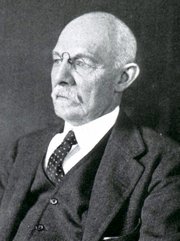
William S. Halsted, MD
(1852 – 1922)
American anatomist, teacher, and surgeon, William Stewart Halsted was born in New York City, USA to a wealthy family of English origin. His father was involved in charitable work and Governor and trustee to a city hospital. Not a brilliant student initially, Halsted took an undergraduate in Liberal Arts in Yale, CT., after which he entered the Medical College of Physicians at the Columbia College, where he excelled.
As a second-year medical student Halsted applied and obtained a position in surgery at a local hospital. In here he learned about Lister’s antiseptic technique and became an adamant proponent of it to reduce infection. In 1877 Halsted obtained his MD. After a short time as House Physician at the New York Hospital, Halsted traveled to Europe to further his education studying for two years at the Universities of Vienna, Leipzig, and W?rzburg.
Besides being at the forefront of surgical and antiseptic techniques (introducing the use of rubber gloves in surgery), Halsted was extremely concerned with the way medical students were taught in the US. He pioneered bedside clinical round discussions with the medical students after two years of basic sciences studies. Halsted developed the idea of a patient chart; he also developed the residency program for medical students in use today.
Halsted is probably the most influential researcher and surgeon at the turn of the century. He dedicated time to the study of intestinal anastomoses and the use of silk as a suture material. His experimental work in 1887 proved that the inclusion of the submucosa layer in an anastomosis was mandatory, as well that a single layered anastomosis was enough to attain closure. Perhaps Halsted’s most important contribution was the application and use of the scientific method to surgical questions. Halsted’s principles, also known as "Halsted's Rules of Surgery", set the standards used today in surgical suturing and surgical stapling.
He also pioneered the development and surgical techniques for radical mastectomy as a treatment for breast cancer.
As a side effect of this studied in anesthesia and the use of cocaine for anesthesia, Halsted became addicted to this substance, a problem that followed him through the years. Without impairing his capacity as a researcher and a surgeon, Halsted eventually recovered. He died in Baltimore in 1922 as a complication to surgery.
Sources:
1. Dubay, A. D., & Franz, G. M. (2003). Acute Wound Healing: The Biology of Acute Wound Failure. Surg Clin NA, 83, 463-481.
2. Halsted, W. S. (1887). Circular Suture of the Intestine - An Experimental Study. Am J Med Sci, 436-461.
3. “William Stewart Halsted: his life and contributions to surgery” Osborne, P. Lancet Oncol 2007; 8: 256–65
4. “William Stewart Halsted: Surgical pioneer” Burress, P Endoc Today (2010), 8: (2) 22
5. “William Stewart Halsted (1852–1922) Neurological stamp” Haas, LF J Neurol Neurosurg Psych 2000;69:641
Original image courtesy of "Images from the History of Medicine" at www.nih.gov

"Clinical Anatomy Associates, Inc., and the contributors of "Medical Terminology Daily" wish to thank all individuals who donate their bodies and tissues for the advancement of education and research”.
Click here for more information


- Details
By Maurits Biesbrouck, MD. Continued from "Andreas Vesalius’s fatal voyage to Jerusalem (3)".
For the first page of this article, click here.
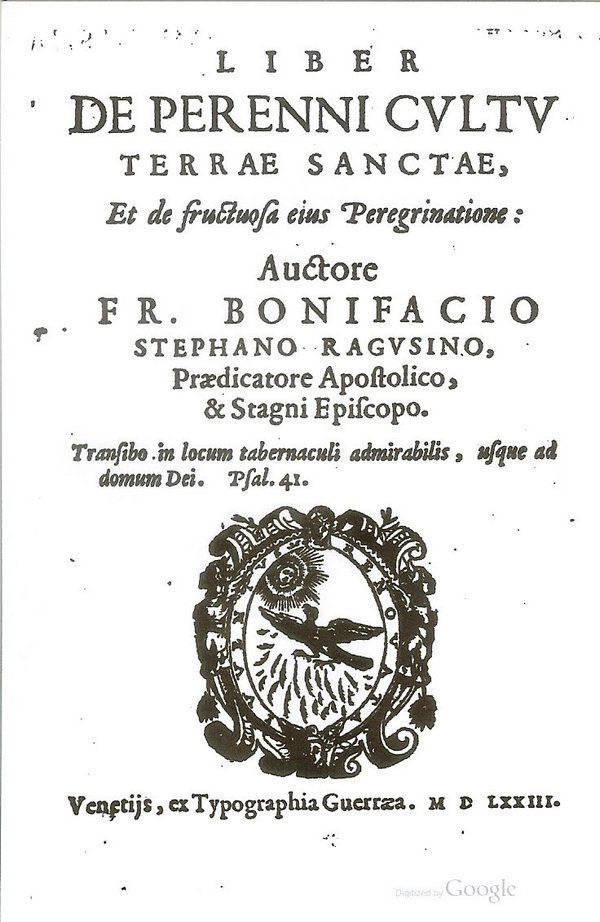
Stephanus BONIFACIUS, Liber
de Perenni Cultu Terrae Sanctae
et de Fructuosa eius Peregrinatione,
Venice: Guerra, 1573
Letter 4: from Brother Bonifacio to Philip II
The last letter is from Fra Bonifacio de Ragusa, guardian of the monastery of Mount Sion, and Custodian of the Holy Places, and is dated May 29th, 1564 in Jerusalem. That is two months later and it is likewise addressed to Philip II. As much in this letter is of a religious nature, I only translate what is important to our story: “Holy and Royal Majesty, … , Doctor Vesalius, a devout pilgrim in Jerusalem, and the bearer of this letter, has taken the risk of bringing to us, … , the royal gift of five hundred ducats, intended for the Catholic worshippers in the kingdom of Jerusalem, as a contribution for its shrines, … , etc.”
He ends with:
“… Here I conclude by kissing your royal hands. From … the Holy Mount Sion in Jerusalem, May the 29th, 1564. The pious chaplain, Brother Bonifacio, Guardian of the Holy Land and Apostolic Vicar.”
The letter is, on its address side, sealed with an oval seal, around which run the words (in Latin) “Seal of the guardian of the monastery of the holy Mount Sion”.
Thus, Bonifacio de Ragusa confirms that Vesalius was in Jerusalem on 29 May 1564, and mentions that Vesalius had brought five hundred ducats with him as a contribution for the holy places from the King. Next, Bonifacio states in this letter, that it (the letter) was given to Vesalius to deliver it personally to the King. This is very important! As we shall see, the letter reached its destination although Vesalius himself remained behind on Zakynthos, and died there shortly afterwards, as we all know. Most importantly that letter does not only still exist, but it is preserved in good shape, and there are no signs of damage by seawater (thus debunking the theory that Vesalius shipwrecked and fell into the sea).
As Bonifacio specifies that Vesalius will deliver the letter himself, this shows that Vesalius had not yet made it known on 29 May 1564 that he did not wish to return to Madrid. It may only have been afterwards, that he received the invitation, from the Venetian Senate, to return to Padua, to which various sources refer. Then he might have changed his mind, but we found no authentic documents to support this. At the time Bonifacio de Ragusa wrote this letter, Vesalius clearly was in the favor of the King and intended to return to Spain.
Vesalius’ stay in the Holy Land
Vesalius was in Palestine for at least five months: from the end of March to the end of August 1564. So we must ask what he did there during this months. Well, we don’t know very much about that. The only thing is that Bonifacio writes elsewhere, that he visited the planes in Jericho, together with Vesalius, and that they were interested in the medical virtues of the various herbs and fruits of that region. This point is confirmed by a passage in Bonifacio’s book Liber de Perenni Cultu Terrae Sanctae (11).
Thanks to the four letters, found by José Barón Fernández, the purpose of the journey is now clear: a pilgrimage by Vesalius to the Holy Land with a monetary contribution for the holy places, from the king of Spain. The letters do not give the impression that the primary purpose of the journey was to send Vesalius on ‘a diplomatic mission’. Rather, it seems that the king simply took the opportunity provided by this pilgrimage to send the sum of money with his physician. Such a gift, was not an extraordinary one, as the catholic king used to do this each year.
His return voyage
Now, let us look at his return voyage. The voyage to Jerusalem was usually made, according to Jean Zuallart, in April, May or June, and was accompanied by fine, warm weather, whereas the return trip was made in the autumn, when the weather was usually not so fine and could be windy or even stormy. During the return trip, the traditional stops after Jerusalem were Tripoli, Cyprus, Candia in Crete, Zakynthos and then to Corfu and finally Venice. This represented a route without too many detours. Zuallart also refers to Jaffa and Ramma as stops. According to him, the route took anything from between ten and thirty days, depending on the wind. Interesting perhaps, to illustrate how adventurous and uncertain the trip was, is that Zuallart himself did not reach Zakynthos while returning, and sailed past the island, because of adverse winds.
The causes of Vesalius’s death
We all know that Vesalius died in Zakynthos. The reasons and circumstances of his death remain mysterious however. Most authors refer to a shipwreck due to a storm. Also, the literature consistently refers to Vesalius as the only victim when arriving at Zakynthos. When there is a shipwreck, there are multiple victims. But – as already told - the fact that Vesalius had the letter with him, from Bonifacio for the King, and that this letter still exists, rules out definitely the possibility of a shipwreck. Exhaustion from lack of food or drinking water and from drifting aimlessly over a long period due to adverse winds, as some have suggested, is certainly possible. But Vesalius was a man of means, and if there was a general shortage on board, he would certainly not have been the only one with problems. The most plausible explanation does indeed seem to be illness, possibly exacerbated by general weakness, from whatever cause.
Article continued here: Andreas Vesalius’s fatal voyage to Jerusalem (5).
Sources and author's comments:
11. Stephanus BONIFACIUS, Liber de Perenni Cultu Terrae Sanctae et de Fructuosa eius Peregrinatione, Venetië: Guerra, 1573; see p. 235.
- Details
By Maurits Biesbrouck, MD. Continued from "Andreas Vesalius’s fatal voyage to Jerusalem (2)".
For the first page of this article, click here.
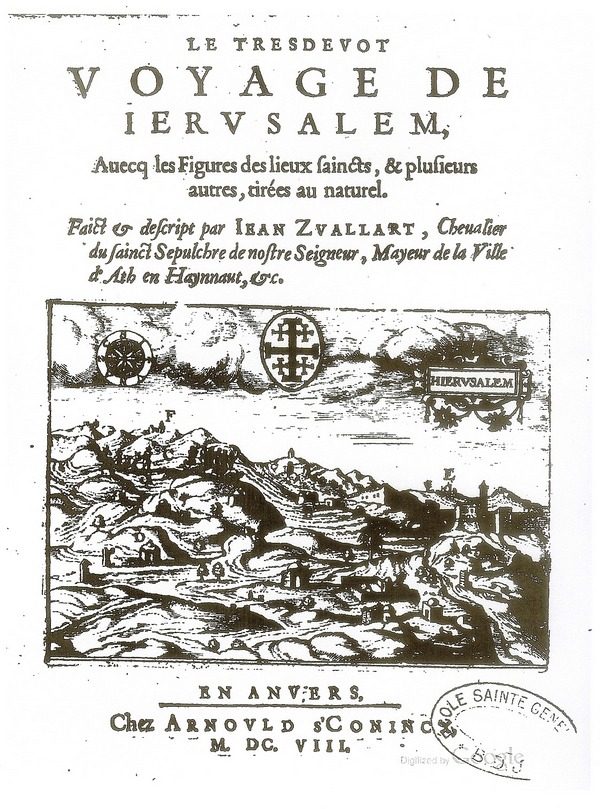
Title page of Jean Zuallart’s
Le tresdevot voyage de Iervsalem (1608)
This important letter was written in Monzon. Barón Fernández points out that it must date from the 24th of January, at the latest, as the monarch then left Monzon, after the sessions of the Cortes of Aragon were over. Vesalius was also in Monzon with the king. The king himself returned in January 1564, to Madrid, arriving there in May. So Vesalius must have received permission for his trip to Jerusalem while in Monzon, situated approximately 240 km from Perpignan, at the French border, while Madrid is 600 km from Perpignan. Presumably Vesalius left Spain directly via Monzon in order to avoid returning to the capital and making the far longer journey to France from Madrid. He definitely cannot have accompanied the king all the way back to the Spanish capital, as he was already in Venice by the 10th of March, as we shall see in the second letter.
But first some other important remarks. It is hard to imagine that the ultra-Catholic king would have written about Vesalius, to his ambassador, in such terms, if he had been condemned by the Inquisition, let alone, if he himself had had to intervene to protect him from the death penalty. If any of this had been true, we may suppose that the king would have expressed himself very differently. Second, the letter also undermines any claim that there was an ambivalent relationship between Vesalius and his king. Third, Philip II is apparently concerned about Vesalius’s welfare and takes safety measures. This was in no way excessive, as Jean Zuallart describes this journey as one of the most dangerous (10). Fourth, it is striking how Philip II expressly asks his ambassador to urge Vesalius to return swiftly. He will probably also have asked him this in person in Monzon, at the point when he gave him his permission to depart. It is just as if he was not entirely relaxed about the matter.
Letter 2: from Garcihernandez to Philip II
The second letter is the reply of Garcihernandez to the king, on March the 13th. Its translation reads: “Doctor Vesalius arrived here on the tenth of this month, and in order not to waste any time during his journey will, when conditions are favourable, sail from here to Cyprus, and will travel very well equipped, and in company, to Jerusalem. He says that he will travel as swiftly as possible. Ambassador Paulo Tiepolo and a brother of Giovanni Soranzo have very kindly helped him, to comply with [the wish of] Your Majesty. … Venice, the 13th of March 1564.” Signed: “Garcihernandez”.
So, in this letter Garciherandez states, that Vesalius had arrived in Venice on March the 10th, and would be sailing from there to Cyprus, with the support of several people. He stresses that no time will be wasted, and that he has conveyed to Vesalius the king’s wish that he should return as soon as possible. The theory that Vesalius used the journey, so that he could afterwards travel to Padua, seems to be undermined here, by the reply of Vesalius from Venice - albeit given indirectly -, that he will return to the royal court, as soon as possible.
Letter 3: also from Garcihernandez to Philip II
Fifteen days later, on March the 28th, ambassador Garcihernandez sent the king another letter, with only a short passage on Vesalius. Here we read in translation:
“Five hundred soldiers are being sent to Cyprus and a hundred to Corfu. The ships have remained in port because of the adverse weather, and Doctor Vesalius will be sailing in one of them, as I wrote to your Majesty...”
This short fragment means that Vesalius was still in Venice on March 28th, and that he was only waiting for better weather to embark.
Article continued here: Andreas Vesalius’s fatal voyage to Jerusalem (4).
Sources and author's comments:
10. Jean ZUALLART, Le tresdevot voyage de Iervsalem, auecq les figures des lieux saincts, & plusieurs autres, tirées au naturel, Anvers, Arnovld s’Conincx, 1608 ; see p. 85. First edition in Italian Il devotissimo viaggio di Gierusalemme (Roma, 1595).
- Details
By Maurits Biesbrouck, MD. Continued from "Andreas Vesalius’ fatal voyage to Jerusalem (1)".

Front cover of C. D.O'MALLEY,
Andreas Vesalius of Brussels 1514 1564,
Many other letters of Languet, in that period, to his friends and acquaintances were published but surprisingly in none of them he repeated the story, just as if it was of no importance (or even wrong) (4). We found it not even in his Historica descriptio susceptae a caesarea maiestate executionis... (Aug. 1567), in a copy of which North found his manuscript on the first flyleaf. In his biography of Hubert Languet the French biographer Henri Chevreuil found no mention of it either (5). The overall impression is that this short message is not more than a gossip written by Languet as a fait divers, perhaps who knows somewhat light-hearted after a couple of glasses on that first day of the new year. Apparently Languet didn’t believe in the story himself as he begins with the words ‘Fama est…’ (Rumour has it…) and he continues with the remark that the story with the direct motive for his Jerusalem travel is a remarkable (mirabilis) one. His letter concerns only that motive, thus things that happened some twelve months before, and were not at all very recent. He gives no details on Vesalius’s death itself. Languet and Peucer knew each other well. That same year 1565 Languet returned to Germany after a mediation of Peucer, but later on he returned to France (6). In any case it can not be regarded as a genuine letter, as such writings, for obvious reasons, normally treat on different subjects and are considerably longer. C.D. O'Malley, who gives an English translation too, calls this story "wholly unacceptable" (7).
The best and most detailed account of Vesalius’s last months is indeed to be found in O’Malley’s biography, but he was apparently not yet aware of the letters found by Barón Fernández. Yet it represents the first proper attempt to distinguish truth from fabrication. O’Malley was convinced that the ulterior motive behind Vesalius’ journey to Jerusalem was to escape the Spanish court and take up for a second time the chair in anatomy in Padua, which had fallen vacant, as a result of the death of Gabriele Falloppio, well before Vesalius’s departure.
The letters found by José Barón Fernández
After the congress of 1962 José Barón Fernández, a Spanish pediatrician, published his discovery of the four relevant letters, that he came across in the archives of Simancas (Spain), also in his Vesalius biography of 1970 (8). They were:
• a letter from the king of Spain to Garcihernandez, at his embassy in Venice;
• an answer from his ambassador ad interim;
• followed by an additional letter; and
• a letter from Bonifacio de Ragusa, custodian in Jerusalem, also addressed to the king (9).
Each of them concerns Vesalius’s trip to the Holy Land, a journey or pilgrimage, which was the subject of so much speculation.
Letter 1: from Philip II to Garcihernandez
This first letter is thus from Philip II, son of Emperor Charles V, and king of Spain, and is addressed to Garcihernandez, secretary to his ambassador, who was temporarily in charge of the Spanish embassy in the then powerful and wealthy Republic of Venice. The letter was written in Monzon, in Aragon, and dated January 1564. It reads in translation:
“ … Doctor Vesalius, who gives you this [letter], was the physician of the Emperor, my late father, and is now the same for me. He served his Majesty and likewise serves me, so that I have now very willingly allowed him and granted him permission, to travel to Jerusalem and visit the Holy Sepulchre of our Redeemer, in which he is motivated by piety. With my grateful consent, I expressly urge you, to help him on his way, so that he has a good passage, and to give him every help and assistance, …, so that he may swiftly travel there in safety, and remain there for as short a time as possible, in order that he may return with the same speed, so as to resume his service to me. Kindly encourage him to do this on my behalf. Monzon, January 1564.”
So, the king stresses that he gave Vesalius the permission to travel, and that the motive was his pious desire to visit the holy places. The Spanish ruler asks his ambassador to provide Vesalius with the necessary facilities for his journey, and to guarantee his safety, and also to ensure that he returns as soon as possible, in order to resume his service at the royal court.
Article continued here: Andreas Vesalius’ fatal voyage to Jerusalem (3).
Sources and author's comments:
4. Huberti Langueti Epistolae ad Joachimum Camerarium Patrem et Filium, Lipsiae et Francofurti, Mauritius Georgius Weidmannus, 1685. Also The Correspondence of Sir Philip Sidney and Hubert Languet, London: William Pichering, 1845. And Hubert Langueti ... Epistolae secretae ad principem ... Augustum Sax. Ducem ..., Halae Hermunduror., J. F. Zetler en H. G. Mussellus, 1699
5.Henri CHEVREUIL, Hubert Languet, Paris: L. Potier, 1856.
6. Oscar SCHOLTZ, Hubert Languet als kursächsischer Berichterstatter und Gesandter in Frankreich wärend der Jahre 1560-1572, Halle: Hermann Gesenius, 1875, 62 pp.
7. Charles Donald O'MALLEY, Andreas Vesalius of Brussels 1514 1564, Berkeley and Los Angeles: University of California Press, 1964, 8°, XV-480 pp.; see p. 304.
8. BARON FERNANDEZ, José. Andrés Vesalio: su vida y su obra, Madrid, Consejo Superior de Investigaciones Cientificas, Instituto “Arnaldo de Villanova”, 1970, 8°, XIX-312 pp., ill.; see pp. 234-248.
9. Ragusa is Italian for Dubrovnik in Croatia.
- Details
This article was written by Maurits Biesbrouck, MD. It is an expanded version of Dr. Biesbrouck’s communication on the International Conference Vesalius Continuum on the Ionian island of Zakynthos (Greece) on September 5th, 2014. This study is the result of a close collaboration with Dr. Biesbrouck’s colleagues and friends Prof. Omer Steeno and Dr. Theodoor Goddeeris, as a trio nicknamed ‘Cerberus’ by Theo Dirix, then the Consul of Belgium in Athens, and co-organizer of the conference with Pascale Pollier, Mark Gardiner and Ann Van de Velde.
In this overview I will try to tell something about the reasons for Andreas Vesalius’ travel, his stay in the Holy Land, his return voyage, the cause of his death, his burial place, and his epitaph. This text contains some new details and insights since our previous publications (1).
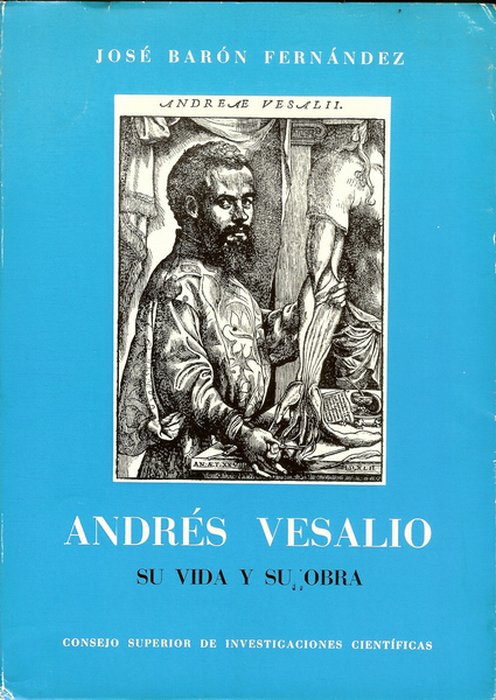
Title page of Barón Fernández’s
Vesalius biography (1970)
The legends
Many biographers wrote about the last months of Andreas Vesalius’ life. But because the necessary primary sources have been lacking, most of their stories should be regarded now as speculative. Thanks to the discovery of several letters in the archives of Simancas by José Barón Fernández in 1962 various points became clearer. As he presented the letters at the 19th International Congress on the History of Medicine in Basel in September of that year, it remains very strange that his important contributions remained unnoticed. Yet they were published at several instances in Spanish, a world language (2).
But first, something about the legends. The most persistent story, has it that Vesalius performed a dissection in Spain, on a nobleman whose heart was still beating when he exposed it, causing a great outcry. As a result Vesalius was condemned to death by the Inquisition, a sentence being commuted to perform a pilgrimage to Jerusalem, thanks to the intervention of Philip II, king of Spain.
There are numerous variants of this story, and anyone looking through the literature, invariably comes across one of these. Apart from this story - a legend as we must assume - here is a summary of the other so-called reasons that led Vesalius to travel to Jerusalem, according to different writers: for killing a woman; for dissecting a cleric’s mistress; because of an insatiable lust for wealth; to be away from his (quarrelsome) wife; troubles with the Galenist Spanish physicians; to escape from the tiresome Spanish Court; a promise after recovering from an illness; etc.
What is remarkable is that all these stories, without exception, only started to circulate after Vesalius’ death. It may be interesting however to look at the origin of the Inquisition story, the most tenacious one. This was caused by a short letter (merely twenty-four short rules) from Hubertus Languetus (1518-1581), a French diplomate, written in Paris on January 1st, 1565 to Caspar Peucer (1525-1602), physician and son-in-law of Philipp Melanchthon (1497-1560). That was ten weeks after Vesalius’s death. Michael J. North (Head of Rare Books and Early Manuscripts in the History of Medicine Division at the National Library of Medicine) had the lucky idea to reproduce a manuscript of it (3).
[Note: The manuscript is two pages and can be seen here: [Page 1]; [Page 2].
Here is a transcription:
De morte Vesalii ex literis Huberti Langueti, scriptis ad D. D. Casparum Peucerum anno Theos krononias 1565 Mense janu.
Fama est Vesalium esse mortuum audivisti proculdubio eum Hierosolymam esse profe ctum. Causa istius profectionis est mirabilis ut ad nos perscriptum est. Commissus erat eius curae viri nobilis in hispania, quem cum obiisse existimaret, nec satis causam mortis sibi percepisse videretur, petebat ab amicis uti sibi liceret corpus dissecare. Cumque pectus apperuisset, reperit cor palpitans. Cognati illius mortui non contenti erant illum accusare factae caedis accusarent impietatis apud inquisitionem existimantur se ibi vindictam vehementiorem assecuturos. Cum iam constaret de caede, nec tam facile excusaretur error medici tam periti, voluit omnino inquisitio de eo sumere supplicium. Vixque potuit autoritate sua vel potius precibus eum a tanto periculo eripere Rex ipse. Tandem concessum est Rei, et toti aulae pro eo deprecanti, ea conditione, ut ad expiandum illud scelus proficisceretur Jerosolymam ad montem Sinai. Vale. Datur Lutetiae calend Janu. anno a nato Christo 1565.
Translation
On the death of Vesalius, from a letter by Hubert Languet, written to doctor Caspar Peucer in January 1565 pcn.
Rumor has it that Vesalius is dead. You undoubtedly heard of his travel to Jerusalem. The reason for his departure, as it was written to us, is remarkable. In Spain the cure of a nobleman was trust to him. Thinking he was deceased, but not convinced about the cause of his death, he asked his friends to dissect the body. But on opening the chest he found the heart beating. The relatives of the deceased, not satisfied with an accusation for the committed murder, found it necessary to accuse him of godlessness before the Inquisition to obtain a more severe punishment. Once things became clear it was not so easy to excuse that error in a man of such an experience.
In short, the Inquisition intended to execute him. The King himself hardly succeeded to withdraw him from that great danger, relying on his authority or rather on his appealing. Eventually the King, and the entire Court that was pleading for him, were given in, on the condition that he should make a travel to the Mount Sion near Jerusalem, as a penalty for that crime. All the best, Paris, January 1st, 1565.
Article continued here: Andreas Vesalius’s fatal voyage to Jerusalem (2).
Sources and author's comments:
1. Maurits BIESBROUCK, Omer STEENO. ‘The last months of Andreas Vesalius. Part I - From Monzon (Aragon) to Jerusalem’ in Vesalius - Acta Internationalia Historiae Medicinae, 2010, 16 (no. 2): 100-106, ill.; IDEM, ‘The last months of Andreas Vesalius. Part II - From Jerusalem to Zakynthos (Zante)’ in Vesalius - Acta Internationalia Historiae Medicinae, 2011, 17 (no. 1): 30-34, ill. Also Maurits BIESBROUCK, Theodoor GODDEERIS, Omer STEENO. ‘The Last Months of Andreas Vesalius: a Coda’ in Vesalius - Acta Internationalia Historiae Medicinae, 2012, 18 (no. 2): 70-75, ill..
2.For the various publications on this subject by José Barón Fernández (and by others as well) see section ‘bibliography’ in www.andreasvesalius.be
3. Michael J. NORTH, ‘The Death of Andreas Vesalius’ in Circulating Now, U.S. National Library of Medicine, 15.10.2014, 2 pp., ill.; see http://circulatingnow.nlm.nih.gov/2014/10/15/ the-death-of-andreas-vesalius/. > Also https://www.facebook.com/nationallibraryofmedicine/ posts/10152749352150491.
- Details
Pavlos Plessas
Pavlos Plessas was born and brought up on the island of Zakynthos (Zante) in Greece. He lives in London but maintains an internet blog that explores the history of his native island. He is a historian of the island and an internet blogger.
Knowing the island, its history and its people he never believed that Vesalius was shipwrecked, left to die helpless and buried near the beach of Laganas. When the local interest in Vesalius was rekindled by the visit of Pascale Pollier and Theo Dirix, he tried to separate the evidence from rumours and speculation to see if a rational explanation of the mystery could be found.
He was approached by Pascale Pollier and Theo Dirix and asked to assist in their search for Vesalius' grave. With the help of local people and old maps he found the approximate location of the Santa Maria church, by which Vesalius had been buried. The scientific work of Dr. Sylviane Dederix confirmed that this was indeed the spot where the church once stood.
Thanks to Pavlos Plessas for collaborating with "Medical Terminology Daily" and allowing us to re-publish his work on "Powerful indications that Vesalius died from scurvy", presented originally at the 2014 "Vesalius Continuum" meeting in Zakynthos, Greece.
UPDATE: Pavlos' article and theory was refutted by Theo Dirix and Dr. Rudi Coninx. both contributors to this blog. Their article is entitled "Did Andreas Vesalius really die from Scurvy?". Not to be undone, Pavlos published his own rebuttal to their theory in the article "An answer regarding the death of Andreas Vesalius".
Following are some links to Pavlos Plessas' blog articles:
- Details
- Written by: Pavlos Plessas
Text from the presentation at the 2014 Vesalius Continuum Meeting in Zakyhnthos, Greece by Pavlos Plessas.
Continued from: Powerful indications that Vesalius died from scurvy (3)
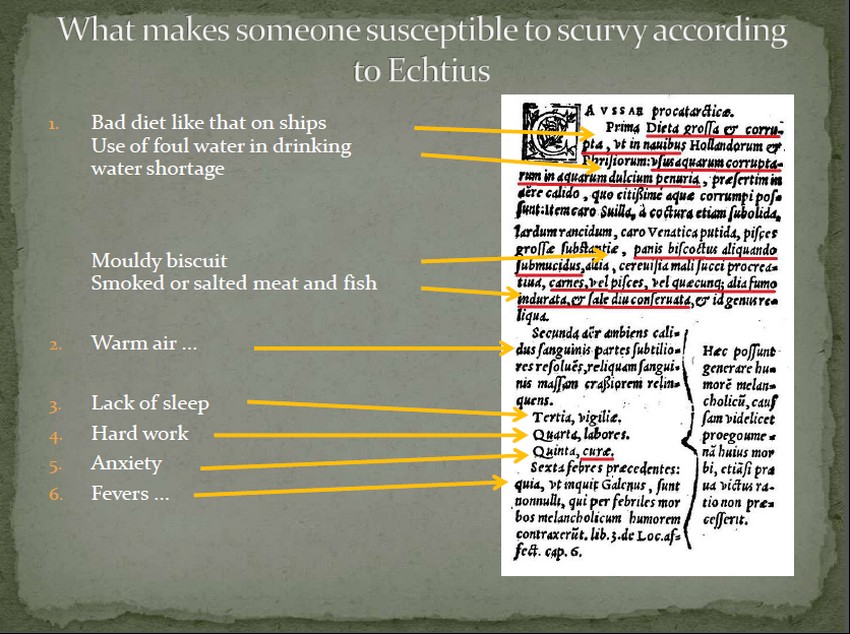
Metellus mentioned another witness during Boucherus’ narration of their terrifying journey and Vesalius’ end. With him was his friend Johannes Echtius, an esteemed physician. Echtius was one of only a handful of doctors who had studied this new deadly disease, scurvy, and the very first person to write a treatise on it . In that treatise he had given the illness a name: scorbutus.
Click for a larger image
It is hard not to feel that this meeting between Echtius and Boucherus was not by chance, but, since nothing is known about it, any hypothesis made, however reasonable, will remain no more than a supposition.
Fortunately, Echtius’ presence in that meeting gives us the opportunity to discern, through his friend’s letters, whether the 16th century expert believed that scurvy was Vesalius’ cause of death. Echtius had identified six conditions that made someone susceptible to scurvy, which he believed was contagious. The first was gross and corrupt diet, like the one on board ships, and the use of corrupt water in conditions of clean water shortage. The remaining five could all lead to scurvy independently, even if the diet had been good, because they generated an excess of melancholic humour, which in his opinion was the cause of the disease. As number five he had listed worrying.
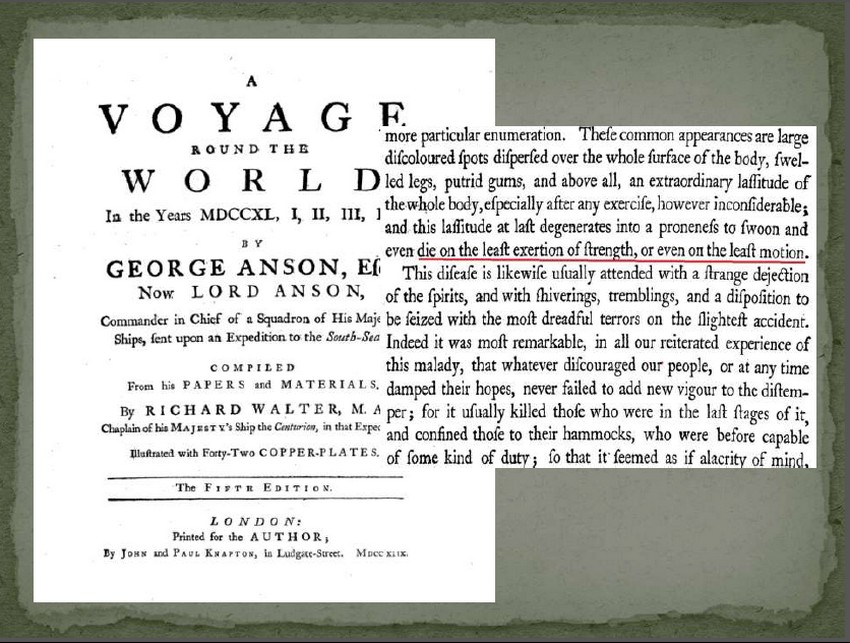
It is easy to see what Metellus was pointing at when he accused Vesalius of having failed to provide adequately for himself. Pilgrims used to take with them their own supplies to complement the ship’s often unpalatable food. Echtius and Metellus believed that the ship’s food put Vesalius in danger of scurvy and he failed to take enough of his own. The subsequent shortages made things worse and, additionally, forced Vesalius to resort to drinking stale and foul water. His extreme worrying, after the disease appeared in others, made it almost inevitable that he too would contract scurvy. His sudden collapse and death did not come as a surprise either since this frequent scorbutic outcome is mentioned in Echtius’ treatise .
By expressing his conviction about the reasons that led to Vesalius’ death Metellus shows that he must have held a firm opinion on which precisely disease had killed him. Yet, incredibly, he fails in both his letters to name it expressly. Again, only scurvy can convincingly explain this failure. Echtius had written his treatise on scurvy in 1541 in the form of a letter , which for a long time had remained unknown even to some of the few doctors that had shown a keen interest in the disease. The treatise was not published until 1564, the year Vesalius died, in a book by Balduinus Ronsseus , and even then it was wrongly attributed to Johannes Wierus, who had sent it to Ronsseus. This error was only possible because Ronsseus, although he had been interested in scurvy for at least a decade , had not until then become aware of it. Consequently he had probably never come across the name scorbutus either. When the doctors of that time did not confuse scurvy with St Anthony’s fire, icterus niger, syphilis or leprosy, those who had a vague idea what they were dealing with, called it magni lienes, or stomacace and sceletyrbe. It would have been pointless for Metellus to inform his correspondents, a publisher and a theologian, that Vesalius had died from an illness Echtius called scorbutus when the word was meaningless even to well informed physicians.
Click for a larger image
Echtius may have been the world authority on scurvy but there were aspects of Boucherus’ story he must have found puzzling. The disease had broken out in the Mediterranean, an area that was believed to be free of scurvy. The diet of the crew had been bad, they worked hard and often spent the night sleepless – numbers 1, 3 and 4 respectively in his list of preliminary causes of scurvy – yet they did not get infected. Scorbutic Nostalgia remained unobserved for another two centuries, so Vesalius’ weird behaviour must have also caused him to wonder. Echtius then, along with Metellus, could not have invented this story, simply because they were unable to see that everything in it actually made sense. Neither could Boucherus have made up the story, because he knew much less about scurvy, if he knew anything at all. The probability that the events had been invented and put together randomly is absolutely negligible, given their perfect correlation with conditions that favoured an outbreak of scurvy, the timing of the outbreak, and the described symptoms; more so if all these are combined with the story having been afterwards presented to the planet’s most experienced scurvy expert.
Therefore, it is suggested that Metellus’ letters give a true account of Vesalius’ last days, and, simultaneously, that Vesalius, suffering from scurvy and seriously affected by scorbutic Nostalgia, managed to reach the southern part of the mythical kingdom of Odysseus – the land foremost associated with nostalgia since the dawn of history – and deposited there his own lifeless body.
Initial page of this article here.
Personal note: My sincere thanks to Pavlos Plessas for contributing this article to "Medical Terminology Daily". His theory and the evidence he presents is compelling, and although not proven, a powerful case is made for the cause of Vesalius' death at the gates of the port of Zakynthos, Greece. The fate and lost location of the illustrious anatomist's body is also researched in another article in this blog. I am proud to have been one of the many international attendees to the 2014 meeting in the island of Zakynthos. Dr. Miranda.
UPDATE: The case made by Pavlos Plessas is compelling, robust, and makes sense. Still, there are others that do not agree to his position, creating a discussion on the subject. In 2017, three years after his presentation in Zakynthos, Theo Dirix and Dr. Rudi Coninx published the article "Did Andreas Vesalius really die from scurvy?" which you can read here.
Sources and author's comments:
27. De Scorbuto, vel Scorbutica passione Epitome in 1541.
28. “… aliquoties vero desinit subito, ac mortali deliquio animi”.
29. The letter was addressed to a Dr Blienburchius of Utrecht. See Petrus Forestus, Observationum et Curationum Medicinalium, Tomus Secundus, Libri decem posteriores, Rouen 1553, p. 419.
30. De magnis Hippocratis Lienibus Libellus, Antwerp 1564, pp. 26a – 31b.
31. See De magnis lienibus Hippocratis, Plinique stomacace seu sceletryrbe epistola of 1555 in page 152 of Ronsseus’ De hominis primordiis hystericisque affectibus centones, published in 1559. I am indebted to Theodoor Goddeeris for pointing this out.