
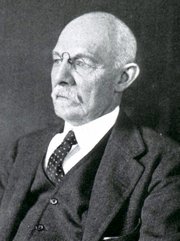



This article is part of the series "A Moment in History" where we honor those who have contributed to the growth of medical knowledge in the areas of anatomy, medicine, surgery, and medical research.
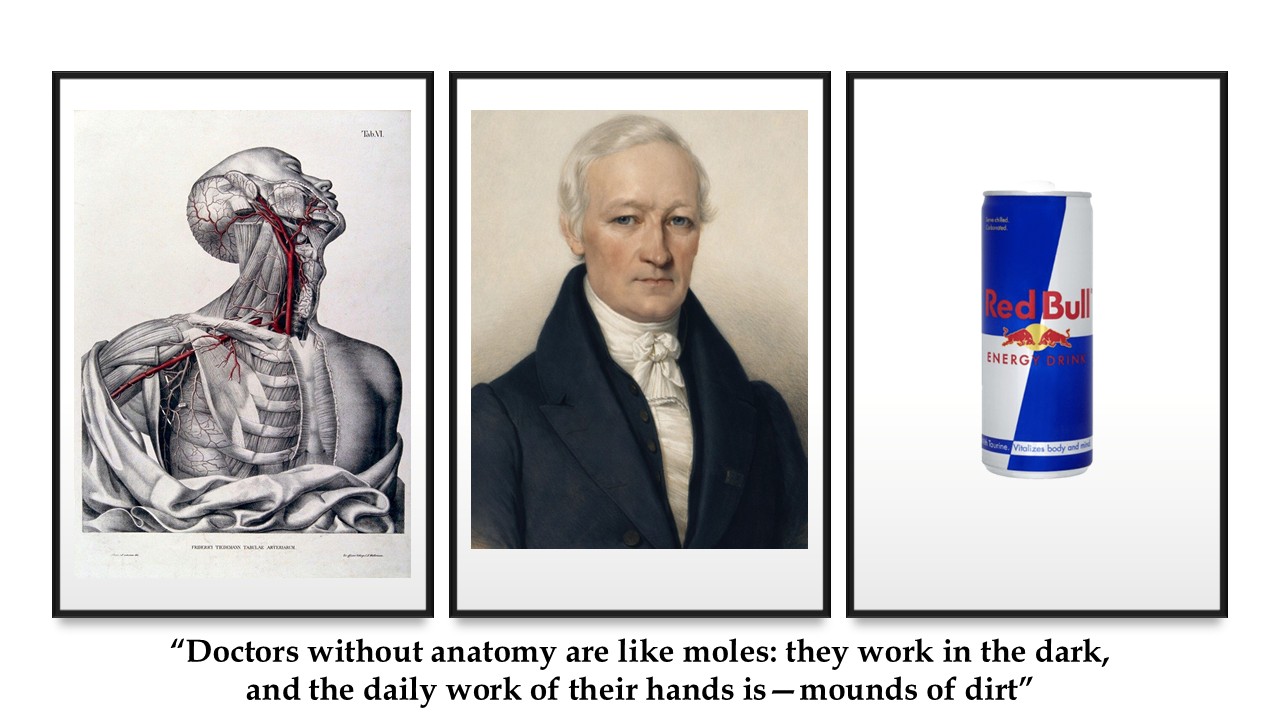
In late March 2026, I was reading an article on the Journal of Clinical Anatomy written by R. Shane Tubbs PhD. MS, PA-C, past president of the American Association of Clinical Anatomists. The article was titled “Doctors Without Anatomy Are Like Moles: They Work in the Dark…”.
He was referring to a dictum by Friedrich Tiedeman, MD. His original dictum was:
“Ärzte ohne Anatomie gleichen Maulwürfen: sie arbeiten im Dunkeln, und ihrer Hände Tagewerk sind — Erdhügel”
The translation is in the first image in this post. Dr. Tubbs journal article led me to research Tiedemann’s life, scientific work, and legacy, where besides his famous sentence (which is very common use in Germany medical schools) I found a correlation between Tiedemann' work and a famous energy drink!
Friedrich Tiedemann (1781–1861) was a German physician, anatomist, physiologist, and zoologist. Born in Kassel, Germany. He studied medicine at the University of Marburg, where he graduated with an MD in 1804. Soon after graduation he abandoned medical practice and dedicated himself to scientific research and academic teaching, focusing particularly on anatomy and physiology.
At the University of Marburg, he taught physiology and comparative osteology. In 1805, at only twenty-four years of age, he was appointed Professor of Zoology, Human Anatomy, and Comparative Anatomy at the University of Landshut.
Later, in 1816 he took the chair of anatomy and physiology at the University of Heidelberg until his retirement in 1854. During these three decades he served as director of the anatomical institute, including various university administrative roles including dean and prorector. He took retirement because of increasing blindness, and he was forced to sell his library which contained thousands of books,
During his tenure he expanded the anatomical collections substantially. By the time of his retirement in 1849, the institute contained more than 2,000 anatomical and pathological specimens, including injected vascular preparations and comparative zoological material used for teaching and research.
Tiedemann was elected to several scientific societies, including:
• Royal Society of London
• Royal Swedish Academy of Sciences
• American Academy of Arts and Sciences
• Royal Society of Edinburgh
Tiedemann’s early research focused on the development and comparative structure of the brain. His work "Anatomie und Bildungsgeschichte des Gehirns im Foetus des Menschen" (Anatomy and developmental history of the brain in the human fetus ), published in 1816., examined embryonic brain development and compared human brain structures with those of animals, providing insights into morphological development.
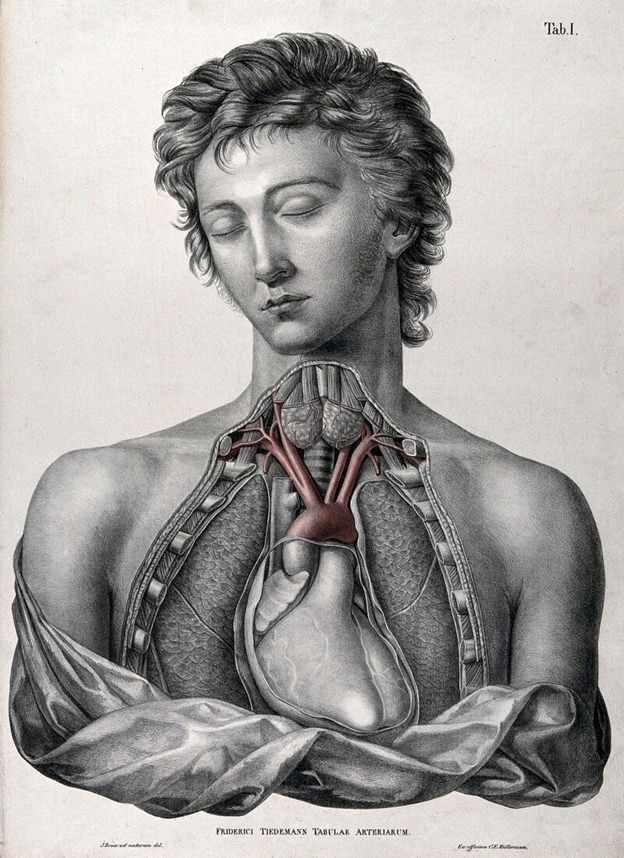
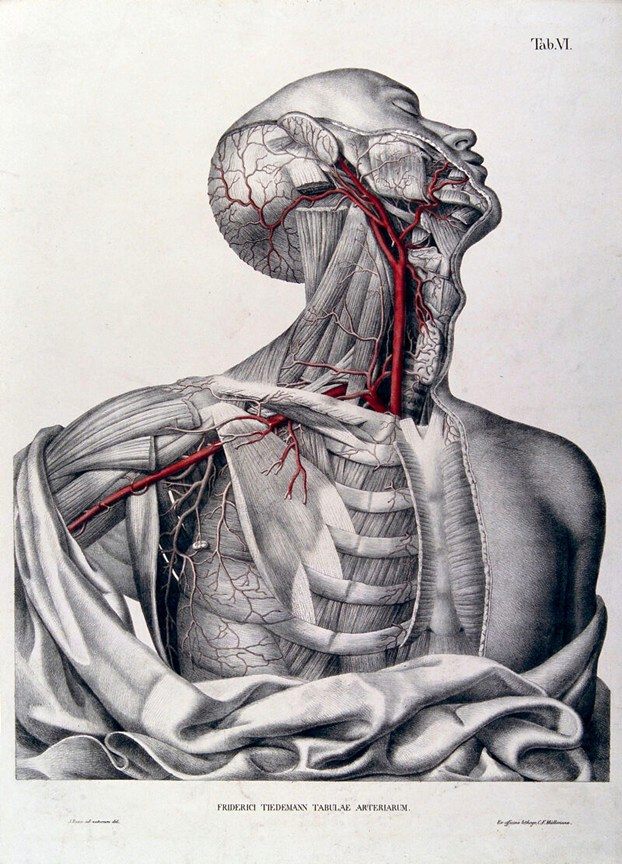
He authored several publications, but probably the most famous was his work “Tabulae Arteriarum Corporis Humani” (Plates of the arteries of the human body) published in 1822 with illustrations by Jacob Wilhelm Christian Roux is a folio-size anatomical atlas devoted entirely to the arterial system. The atlas has 38 large lithographic plates, many originally hand-colored, making it one of the earliest works devoted exclusively to the arteries of the human body. This book is in two different volumes, one with the images (available here) and one with the listing of the structures in both Latin and German (available here)
He was one of the first to challenge racial anthropology, arguing with scientific facts, that social inequalities were products of historical and political circumstances, including slavery, rather than biological differences. Among Tiedemann’s most historically notable publications was “On the Brain of the Negro, Compared with That of the European and the Orang-Outang” (1836–1837)", published in the Philosophical Transactions of the Royal Society.
An interesting side of Tiedemann’s research was the result of his research on the physiology of digestion. In collaboration with the chemist Leopold Gmelin (1788–1853), Tiedemann conducted experimental studies on digestion and metabolism. Their work “Die Verdauung nach Versuchen" (Experiments on Digestion- published on 1827) examined the physiological mechanisms of digestion and helped confirm the role of chemical processes in gastric activity. They analyzed the composition of bile in the bull (Lat: Taurus) and discovered one of its main components (2-aminoethanesulfonic acid) which they called “Taurine” a word derived from the Latin "taurus" meaning bull, because it was discovered in the bull gallbladder and intestine.
Although not an essential dietary component, this compound is used today as a dietary supplement and, believe it or not, it is one of the components of an energy drink … Red Bull! Talk about coincidences!
Sources:
1. Tubbs, R.S. (2026), Doctors Without Anatomy Are Like Moles: They Work in the Dark…. Clinical Anatomy
2. LaTourelle J. Friedrich Tiedemann (1781–1861). Embryo Project Encyclopedia. Arizona State University; 2015.
3. University of Heidelberg Library. Friedrich Tiedemann (1781–1861) digital collections overview. (ub.uni-heidelberg.de)
4. Encyclopaedia Britannica (9th ed.). Tiedemann, Friedrich.
5. Heirs of Hippocrates Collection, University of Iowa Libraries. Tabulae arteriarum corporis humani bibliographic record.
6. Encyclopedia.com. Tiedemann, Friedrich (1781–1861).
7. Royal Society. Friedrich Tiedemann—Fellowship record.
Image of Dr. Tiedemann public domain, AI enhanced for color. Images of Tiedemann's book public domain.