
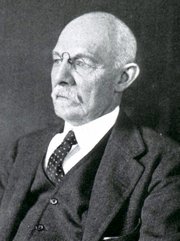



This article is part of the series "A Moment in History" where we honor those who have contributed to the growth of medical knowledge in the areas of anatomy, medicine, surgery, and medical research.
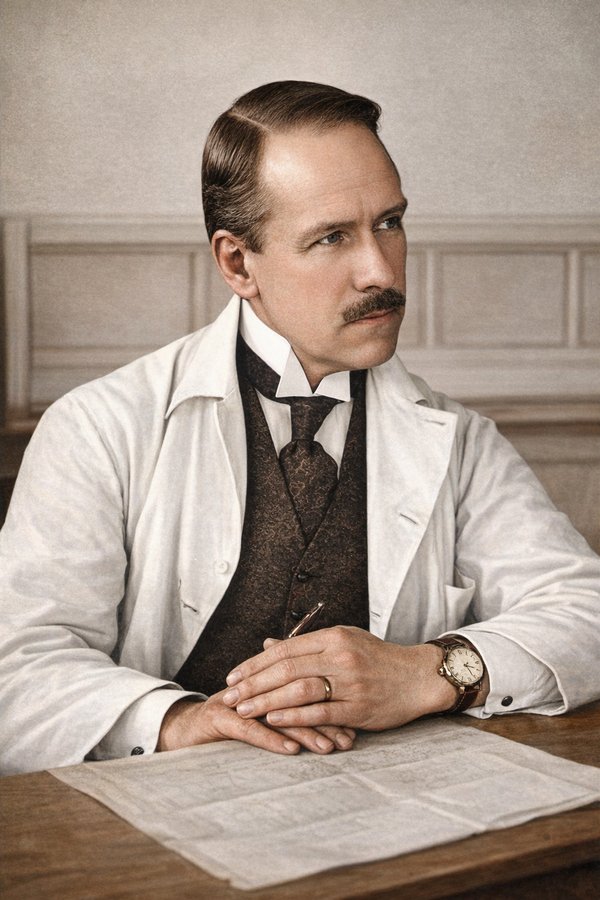
K.F. Wenckebach
Karel Frederik Wenckebach (1864–1940) Dutch physician and anatomist born in 1864, in The Hague, Netherlands. Wenckebach enrolled at the University of Utrecht’s School of Medicine, obtaining his degree in 1888.
While at medical school, he developed interest in physiological research, training in laboratory techniques and cardiac rhythm analysis under the mentorship of physiologist Theodor Wilhelm Engelmann (1843 -1909). His early work focused on embryology and rhythm disturbances observed in isolated frog hearts—a critical foundation for his later discoveries in human cardiac conduction and cardiac arrhythmias.
After graduation, Wenckebach briefly practiced medicine in rural Netherlands, where he encountered patients with irregular heartbeats. Through careful observational analysis of arterial pulse tracings—without the benefit of electrocardiographs—he identified a pattern of progressive prolongation in pulse intervals followed by a “dropped beat.” In 1899, he described this arrhythmic sequence, initially termed "Luciani periods", that later came to be recognized as second-degree atrioventricular (AV) block, Mobitz type I, or the Wenckebach phenomenon.
The pattern of this arrhythmia reflected a progressive delay in conduction through the AV node until one impulse failed to be conducted, resetting the cycle. Wenckebach’s work provided early evidence that conduction properties intrinsic to the myocardium and its specialized tissues underlay certain rhythm disturbances rather than ectopic beats alone.
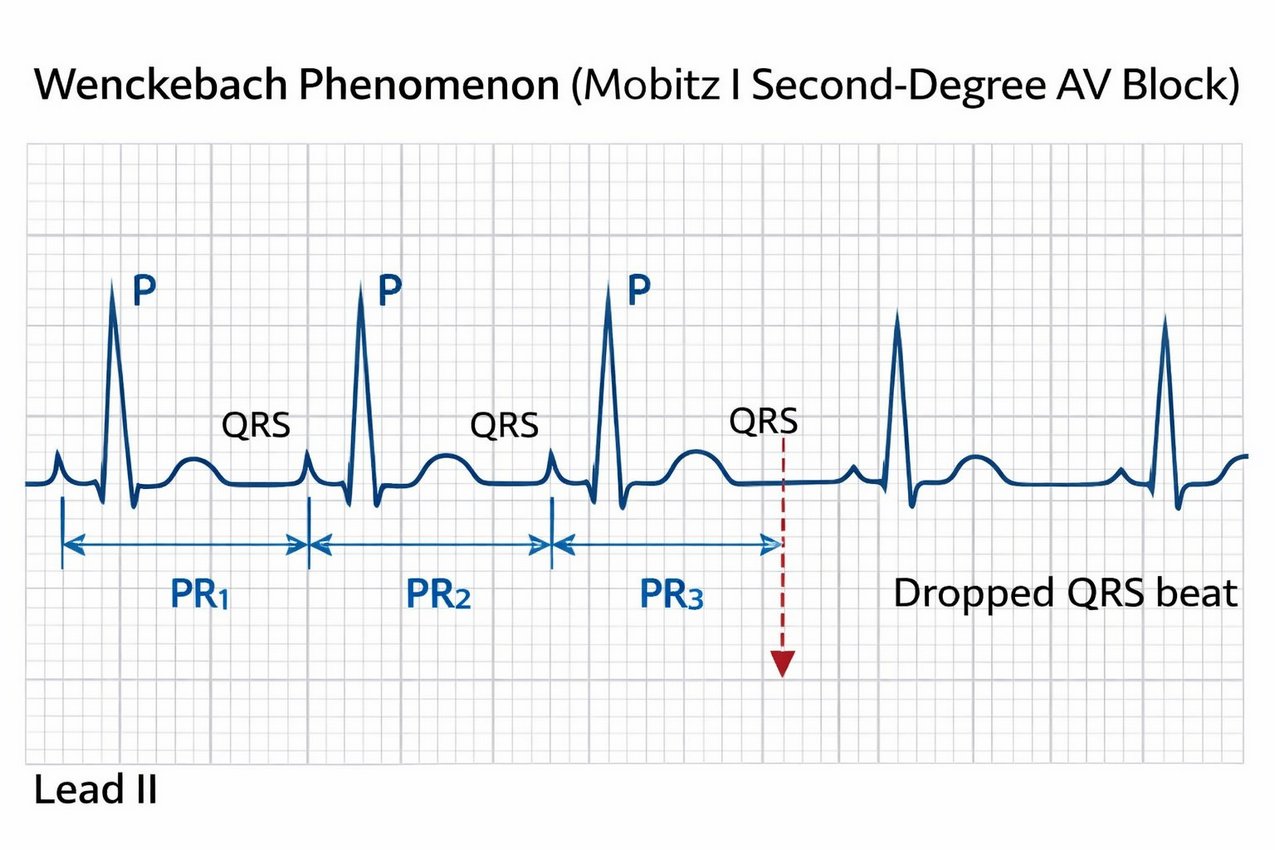
Wenckebach’s insight was notable for preceding the advent of clinical electrocardiography and the anatomical identification of the sinoatrial (SA) node and the atrioventricular (AV) node by Tawara, Keith and Flack and other researchers in the early 20th century.
In addition to describing rhythm phenomena, Wenckebach contributed to early understanding of internodal conduction pathways. In his later work, he described an anatomical tract—now referred to as Wenckebach’s bundle or the middle internodal tract—as part of the internodal conduction system that links the SA node to the AV node.
Wenckebach’s academic career included professorships at the University of Groningen (1901), University of Strasbourg (1911–1914), and University of Vienna (1914–1929). He authored influential texts including Die Arhythmie als Ausdruck bestimmter Funktionsstörungen des Herzens (1903) and Die unregelmässige Herztätigkeit und ihre klinische Bedeutung (1914), which integrated clinical observations with physiological concepts. Wenckebach also investigated pharmacological interventions in arrhythmia, notably promoting the use of quinine for paroxysmal atrial fibrillation.
His contributions earned numerous honors, including honorary fellowships and international recognition. Wenckebach retired in 1929 and continued to study cardiac physiology, including investigations on heart failure in the Dutch East Indies. He died in Vienna on November 11, 1940.
Dr. A.R. Perez-Riera (Brazil) quotes Wenckeback as follows:
“In medical science there are vast realms of which I have no special knowledge and, again, no, I am not a great man; I am a happy man.”
Sources and references:
1. Wenckebach KF. Die Arhythmie als Ausdruck bestimmter Funktionsstörungen des Herzens. Leipzig: Verlag; 1903.
2. Upshaw CB Jr. The Wenckebach phenomenon: a salute and comment on the centennial of its original description. Ann Intern Med. 1999;131(8):634. PubMed PMID: 9890852.
3. Mendoza-Davila N, Varon J. Resuscitation great. Karel Wenckebach: the story behind the block. Resuscitation. 2008;79(2):189-192.
4. Cadogan M. Karel Frederick Wenckebach. LITFL Medical Eponym Library. 2025.
5. Pérez-Riera AR, et al. Median bundle of Wenckebach and internodal conduction pathways in cardiac anatomy. Via Medica (PDF).
6. Zhao Y, Wan J, Liao B, Qi M. The Neglected Internodal Tract-A Cardiac Conduction System Structure Homologous to the Development and Regulation of the Sinoatrial Node. Rev Cardiovasc Med. 2025 Apr 22;26(4):27882. doi: 10.31083/RCM27882. PMID: 40351691; PMCID: PMC12059794.
7. José L. Fresquet. Karel Frederik Wenckebach (1868-1940) Instituto de Historia de la Ciencia y Documentación (Universidad de Valencia-CSIC). Marzo, 2010.
Image of Dr. Wenckebach public domain, AI enhanced for color.