
Medical Terminology Daily (MTD) is a blog sponsored by Clinical Anatomy Associates, Inc. as a service to the medical community. We post anatomical, medical or surgical terms, their meaning and usage, as well as biographical notes on anatomists, surgeons, and researchers through the ages. Be warned that some of the images used depict human anatomical specimens.
You are welcome to submit questions and suggestions using our "Contact Us" form. The information on this blog follows the terms on our "Privacy and Security Statement" and cannot be construed as medical guidance or instructions for treatment.
We have 2285 guests online
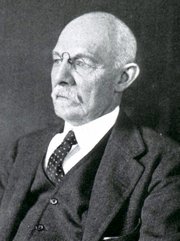
William S. Halsted, MD
(1852 – 1922)
American anatomist, teacher, and surgeon, William Stewart Halsted was born in New York City, USA to a wealthy family of English origin. His father was involved in charitable work and Governor and trustee to a city hospital. Not a brilliant student initially, Halsted took an undergraduate in Liberal Arts in Yale, CT., after which he entered the Medical College of Physicians at the Columbia College, where he excelled.
As a second-year medical student Halsted applied and obtained a position in surgery at a local hospital. In here he learned about Lister’s antiseptic technique and became an adamant proponent of it to reduce infection. In 1877 Halsted obtained his MD. After a short time as House Physician at the New York Hospital, Halsted traveled to Europe to further his education studying for two years at the Universities of Vienna, Leipzig, and W?rzburg.
Besides being at the forefront of surgical and antiseptic techniques (introducing the use of rubber gloves in surgery), Halsted was extremely concerned with the way medical students were taught in the US. He pioneered bedside clinical round discussions with the medical students after two years of basic sciences studies. Halsted developed the idea of a patient chart; he also developed the residency program for medical students in use today.
Halsted is probably the most influential researcher and surgeon at the turn of the century. He dedicated time to the study of intestinal anastomoses and the use of silk as a suture material. His experimental work in 1887 proved that the inclusion of the submucosa layer in an anastomosis was mandatory, as well that a single layered anastomosis was enough to attain closure. Perhaps Halsted’s most important contribution was the application and use of the scientific method to surgical questions. Halsted’s principles set the standards used today in surgical suturing and surgical stapling.
He also pioneered the development and surgical techniques for radical mastectomy as a treatment for breast cancer.
As a side effect of this studied in anesthesia and the use of cocaine for anesthesia, Halsted became addicted to this substance, a problem that followed him through the years. Without impairing his capacity as a researcher and a surgeon, Halsted eventually recovered. He died in Baltimore in 1922 as a complication to surgery.
Sources:
1. Dubay, A. D., & Franz, G. M. (2003). Acute Wound Healing: The Biology of Acute Wound Failure. Surg Clin NA, 83, 463-481.
2. Halsted, W. S. (1887). Circular Suture of the Intestine - An Experimental Study. Am J Med Sci, 436-461.
3. “William Stewart Halsted: his life and contributions to surgery” Osborne, P. Lancet Oncol 2007; 8: 256–65
4. “William Stewart Halsted: Surgical pioneer” Burress, P Endoc Today (2010), 8: (2) 22
5. “William Stewart Halsted (1852–1922) Neurological stamp” Haas, LF J Neurol Neurosurg Psych 2000;69:641
Original image courtesy of "Images from the History of Medicine" at www.nih.gov

"Clinical Anatomy Associates, Inc., and the contributors of "Medical Terminology Daily" wish to thank all individuals who donate their bodies and tissues for the advancement of education and research”.
Click here for more information


- Details

The root term [-cheil-] derivates from the Greek word [χείλος (keilos]] meaning "lip". There are other medical root terms that also mean lip, but they arise from the Latin words [labellum, labrum, and labra]. There are many medical terms that include the root [-cheil-]:
• Cheilitis: The suffix [-itis] means "inflammation". Inflammation of the lips
• Cheilitis simplex: A very medical way of saying "chapped lips". See accompanying image.
• Cheiloplasty: The suffix [-(o)plasty] means "surgical reshaping". A surgical reshaping or plastic surgery of the lips
• Angular cheilitis: Inflammation of the angle of the mouth, sometimes causing a fissure
• Cheilognathopalatoschisis: This wors combines several roots: [-cheil-], meaning "lip", [-gnath-] meaning "jaw", [-palat-], meaning "palate", while the suffix [-schisis] means "to split". A split or separation of the lip, jaw, and the hard and soft palate.
- Details
The root term [-lapar-] arises from the Greek word [λαπάρα] which means "flank or "loin"". It refers to the lateral region of the abdomen between the costal margin superiorly and the iliac crest inferiorly. In its pure etymological meaning the root term [lapar], as in "laparotomy" or "laparoscopy" should be used to denote a surgical action in only two of the abdominal regions, the right and left lumbar abdominal regions (or flank regions). The suffix [-otomy] originates from the Greek [τέμνω] (tomos) which means "to cut" or "to open".
The first modern use of the term [laparotomy] referring to "an abdominal incision" was in January 1878 by Thomas Bryant, FRCS in his book "A Manual for the Practice of Surgery". This of course caused an upheaval with language purists, as a true laparotomy is a flank incision only. Nonetheless the meaning of the term as suggested by Bryant has been in use since. Today any abdominal incision is a laparotomy.
- Details
This article is part of the series "A Moment in History" where we honor those who have contributed to the growth of medical knowledge in the areas of anatomy, medicine, surgery, and medical research.

Insert text here
Giovanni Domenico Santorini (1681 – 1737). Italian anatomist, Santorini was born in 1681 in Venice. The son of an apothecary, Santorini studied medicine at Bologna and Padua, receiving his doctorate in Pisa in 1701. He was appointed Public Professor of Anatomy at the Physicomedical College of Medicine when he was 22 years of age.
Santorini was praised for the clarity of his lectures and his dexterity as an anatomist. He used magnifying glasses to study minute anatomical details, allowing him to clearly describe small structures hitherto unknown. Most of Santorini’s biographical data was written by Michael Girardi (1731 – 1797), one of his students. Girardi published Santorini’s work posthumously in 1775 in the book “Anatomici Summi-Septendecim Tabulae”.
Santorini’s himself wrote “Opuscula medica de structura” (Minute Medical Structures) in 1705. His most important book was “Observationes anatomicae”, published in Venice in 1724. One of the most interesting chapters in this book was “De mulierum partis procreationes datis” (Data on the female procreational structures ), making him a pioneer in the teaching of obstetrics. Santorini was physician to the Spedaletto (Hospital) of Venice, where he taught midwifery.
Santorini died in 1737 because of an infection he acquired during the dissection of a cadaver. At that time the rationale for infection and cadaver embalming were unknown.
With his posthumous publications, Santorini’s name and teachings became popular. Today his name is eponymically tied to several structures in the human body:
• Duct of Santorini: An accessory pancreatic duct that opens into a secondary duodenal papilla in the second portion of the duodenum
• Santorini’s valves: Mucosal folds found in the lumen of the primary duodenal papilla (of Vater) or hepatopancretic ampulla
• Santorini’s muscle: Risorius muscle • Santorini’s cartilages: The laryngeal corniculate cartilages
• Santorini’s veins: A plexus of vesicoprostatic veins found in the retropubic space) of Retzius
• Santorini’s concha: The superior nasal turbinate
Sources:
1. “The Dorsal Venous Complex: Dorsal Venous or Dorsal Vasculature Complex? Santorini’s Plexus revisited” Power NE, et al. BJU Inter (2011) 108: 930-932
2. “Giovanni Domenico Santorini: Santorini’s Duct” Edmonson, JM Gastrointest Endosc (2001) 53:6; 25A
3. "Santorini of the duct of Santorini" Haubrich, WS Gastroenterol 120:4, 805
4. “Wirsung and Santorini: The Men Behind the Ducts” Flati, G; Andren-Sandberg, A. Pancreatology (2002)2:4-11
5. "A Historical Perspective: Infection from Cadaveric Dissection from the 18th to the 20th Centuries" Shoja, MM et al. Clin Anat (2013) 26:154-160
- Details
The [conjoint tendon] (sometimes called the conjoined tendon] is the common tendinous attachment of the internal oblique muscle and the transverse abdminis muscle into the pubic tubercle. Some of these tendinous attachments extend also to the pectineal (Cooper's) ligament, the inguinal ligament, and the superior ramus of the pubic bone. In the classical anatomical description these tendons mix to the point that they cannot be separated one from the other, hence the term [conjoint tendon].
The conjoint tendon is important in open hernia repair, where some surgical techniques require the surgeon to pass a surgical needle and suture through this tendinous structure, to attach or close the gap between the conjoint tendon and the inguinal ligament.
In spite of being described in many anatomy books, a true "conjoint tendon" is only found in about 4% of the cases (varying from 3 to 6%, depending on the author). What is usually found are slightly tendinous discrete structures that attach to the pubic tubercle. Because of this, Skandalakis, et al proposed to change the name to the "conjoined area".
Sources:
1. "Le Tendon Conjoint: Memoire realise dans le cadre du certificat d'anatomie, d'imagerie et de morphogenese" Leroux, H. Universite D' Nantes, 2005
2. "Hernia; Surgical Anatomy and Techniques" Skandalakis, J. et al. 1989 McGraw Hill
3. "Tratado de Anatomia Humana" Testut et Latarjet 8 Ed. 1931 Salvat Editores, Spain
- Details
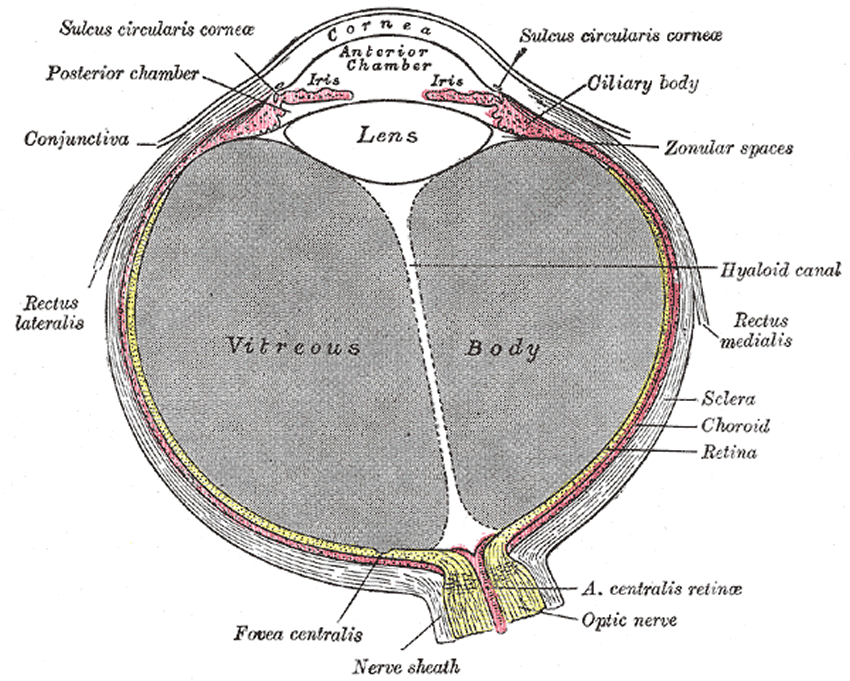
Horizontal section of the eye
The word "hyaline" is a derivate of the Greek [υαλώδης] (yalódis) meaning "glassy". It refers to a glassy, transparent substance. Although it is usually associated with hyaline cartilage, this term can be used by itself in daily English.
Galen of Pergamon used the term [hyaloid] (glassy, or similar to glass) to refer to the vitreous humor of the eye. As a result of this early anatomical term, today we have the following:
• Hyaloid membrane: also known as the vitreous membrane. It is a collagenous membrane separating the vitreous humor from the rest of the structures of the eye
• Hyaloid artery: a branch of the opthalmic artery which dissapears before birth
• Hyaloid canal: a small membranous canal in the vitrous humor extending between the lens and the optic disc. This can be seen in the accompanying image of a horizontal section of the eye.
Sources:
1. “Gray’s Anatomy” Henry Gray, 1918
2. "Tratado de Anatomia Humana" Testut et Latarjet 8th Ed. 1931 Salvat Editores, Spain
3. "Gray's Anatomy" 38th British Ed. Churchill Livingstone 1995
4. "The Origin of Medical Terms" Skinner, HA 1970 Hafner Publishing Co.
Image modified from the original by Henry VanDyke Carter, MD. in the book "Grays's Anatomy" by Henry Gray FRS. Public domain
Note: Google Translate includes the symbol (?). Clicking on it will allow you to hear the pronunciation of the word.
- Details
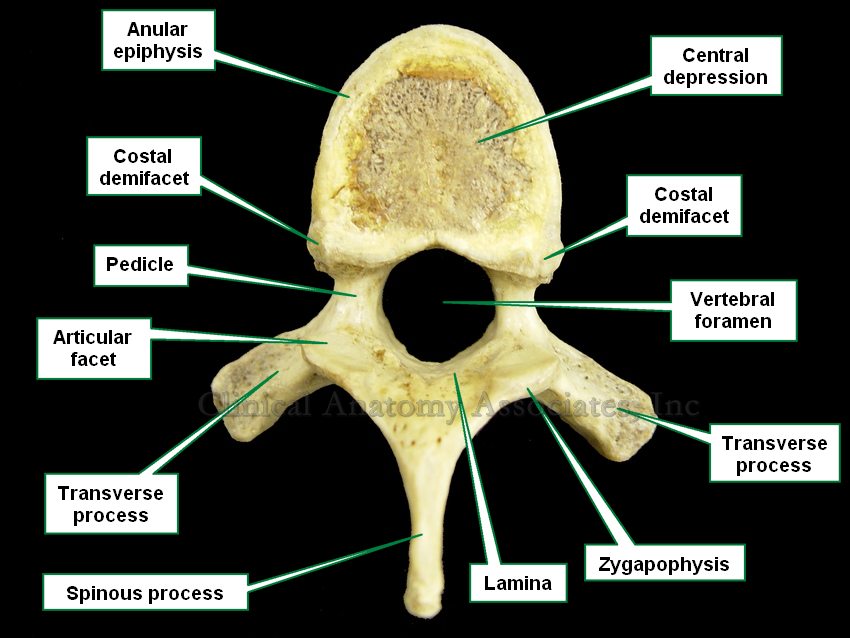
Click for a larger image
[Anular] means "ring" or "ring-shaped". The word [epiphysis] is composed of the preffix [epi-] meaning "outer" or "above", while [-physis] means "growth". The term [anular epiphysis] means the "outer ring-shaped growth".
The [anular epiphysis], sometimes also called the [anular apophysis], is a bony ring found on the superior and inferior aspect of the vertebrae. This outer ring is formed by thickened cortical bone and leaves a central depression which has a more porous surface. In this central depression the vertebrae present with a thin layer of hyaline cartilage, which forms part of the vertebral endplate.
In a lateral view the presence of the anular epiphysis causes the superior and inferior borders of the vertebral body to protrude. This protrusion is called by some anatomists the "lips" of the vertebrae. To see these "lips" click here.
Image property of: CAA.Inc.Photographer: David M. Klein