
Medical Terminology Daily (MTD) is a blog sponsored by Clinical Anatomy Associates, Inc. as a service to the medical community. We post anatomical, medical or surgical terms, their meaning and usage, as well as biographical notes on anatomists, surgeons, and researchers through the ages. Be warned that some of the images used depict human anatomical specimens.
You are welcome to submit questions and suggestions using our "Contact Us" form. The information on this blog follows the terms on our "Privacy and Security Statement" and cannot be construed as medical guidance or instructions for treatment.
We have 2812 guests online
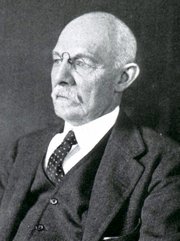
William S. Halsted, MD
(1852 – 1922)
American anatomist, teacher, and surgeon, William Stewart Halsted was born in New York City, USA to a wealthy family of English origin. His father was involved in charitable work and Governor and trustee to a city hospital. Not a brilliant student initially, Halsted took an undergraduate in Liberal Arts in Yale, CT., after which he entered the Medical College of Physicians at the Columbia College, where he excelled.
As a second-year medical student Halsted applied and obtained a position in surgery at a local hospital. In here he learned about Lister’s antiseptic technique and became an adamant proponent of it to reduce infection. In 1877 Halsted obtained his MD. After a short time as House Physician at the New York Hospital, Halsted traveled to Europe to further his education studying for two years at the Universities of Vienna, Leipzig, and W?rzburg.
Besides being at the forefront of surgical and antiseptic techniques (introducing the use of rubber gloves in surgery), Halsted was extremely concerned with the way medical students were taught in the US. He pioneered bedside clinical round discussions with the medical students after two years of basic sciences studies. Halsted developed the idea of a patient chart; he also developed the residency program for medical students in use today.
Halsted is probably the most influential researcher and surgeon at the turn of the century. He dedicated time to the study of intestinal anastomoses and the use of silk as a suture material. His experimental work in 1887 proved that the inclusion of the submucosa layer in an anastomosis was mandatory, as well that a single layered anastomosis was enough to attain closure. Perhaps Halsted’s most important contribution was the application and use of the scientific method to surgical questions. Halsted’s principles set the standards used today in surgical suturing and surgical stapling.
He also pioneered the development and surgical techniques for radical mastectomy as a treatment for breast cancer.
As a side effect of this studied in anesthesia and the use of cocaine for anesthesia, Halsted became addicted to this substance, a problem that followed him through the years. Without impairing his capacity as a researcher and a surgeon, Halsted eventually recovered. He died in Baltimore in 1922 as a complication to surgery.
Sources:
1. Dubay, A. D., & Franz, G. M. (2003). Acute Wound Healing: The Biology of Acute Wound Failure. Surg Clin NA, 83, 463-481.
2. Halsted, W. S. (1887). Circular Suture of the Intestine - An Experimental Study. Am J Med Sci, 436-461.
3. “William Stewart Halsted: his life and contributions to surgery” Osborne, P. Lancet Oncol 2007; 8: 256–65
4. “William Stewart Halsted: Surgical pioneer” Burress, P Endoc Today (2010), 8: (2) 22
5. “William Stewart Halsted (1852–1922) Neurological stamp” Haas, LF J Neurol Neurosurg Psych 2000;69:641
Original image courtesy of "Images from the History of Medicine" at www.nih.gov

"Clinical Anatomy Associates, Inc., and the contributors of "Medical Terminology Daily" wish to thank all individuals who donate their bodies and tissues for the advancement of education and research”.
Click here for more information


- Details
This term can be a suffix or a word by itself. It arises from the Greek Arabic [στάσις] (stasis) and means "to stand still" or "to stop". This term can be found in several medical words:
- Hemostasis: Stoppage of blood flow
- Metastasis: The prefix [meta-] means "beyond", or "at a distance". Something that stops at a distance, such as a cancer tumor that stops away from the primary tumor
- Bacteriostasis: To stop bacteria. A [bacteriostatic] agent stops bacterial invasion
- Intestinal stasis: Stoppage of flow of intestinal content
- Details
Click for a larger image
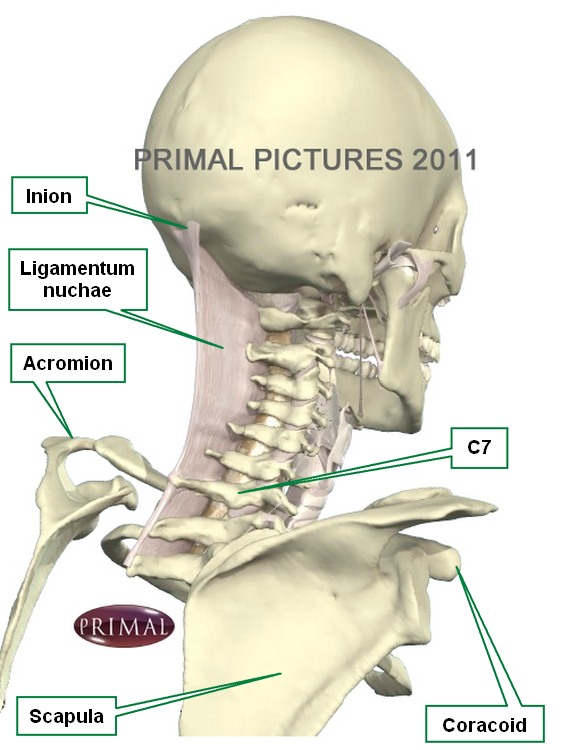
The [ligamentum nuchae] is the Latin term to describe the nuchal ligament. It arises from the word [nucha] meaning the “back” or “nape” of the neck.
The ligamentum nuchae is a midline or median structure found in the posterior aspect of the neck. It is a fibroelastic tendon-like bilaminar structure with a triangular shape. Because of its location the ligamentum nuchae froms a septum that divides the posterior aspect of the neck in the midline providing an attachment for several muscles. These muscles are the trapezius, splenius capitis, rhomboid minor and serratus posterior superior.
The ligamentum nuchae attaches superiorly to the inion (external occipital protuberance) and the midline of the occipital bone. Inferiorly it attaches to the spinous process of C7 (vertebra prominens). Anteriorly it attaches to the posterior tubercle of C1 and all the cervical vertebrae in the midline. Interestingly, anatomical studies have shown the ligamentum nuchae to have small attachments to the spinal dural (thecal) sac superior and inferior to C1
There is a discussion as to the relationship of the ligamentum nuchae and the supraspinous and interspinous ligaments. Some say that the ligamentum nuchae is a discrete structure distinct from the supraspinous and interspinous ligaments, while others contest that the ligamentum nuchae is a continuation of the supraspinous and interspinous ligaments.
Thanks to Jackie Miranda-Klein for suggesting this article.
- Details
This article is part of the series "A Moment in History" where we honor those who have contributed to the growth of medical knowledge in the areas of anatomy, medicine, surgery, and medical research.
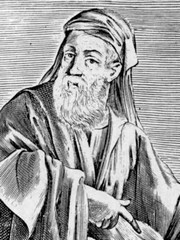
Empedocles of Agrigentum
Empedocles of Agrigentum (ca. 495–430 BC). Greek philosopher, poet, physician, physiologist, politician, Empedocles was born in the city of Agrigentum, a Greek colony in Sicily.
Empedocles presented himself as an immortal god. Versed in magic and incantations, he was seen as a healer by people that followed him.
A philosopher, Empedocles developed the theory that nature consists of the combination of four “elements”— earth, water, air, and fire —with each of these elements being a combination of two qualities: water is wet and cold, air is dry and cold, fire is dry and hot, and earth is wet and hot. Empedocles went further to explain that the combination of these elements is based on the balance of love and hate. The balance of the elements represented balance in life.
Further development of this theory by observation of the human body, led to the “Humor theory” or “bodily fluids” theory based on four fluids whose imbalance led to disease. The four humors were “blood” or sanguineous, which belongs to the air element, “phlegm”, which belongs to water, “yellow bile”, which corresponds to fire, and “black bile” or “melancholy” which corresponds to earth. This theory dominated human physiology and medicine until the 17th century.
Because the humor theory also explained moods and temperaments, Empedocles’ influence is still seen in our language as we refer to people and personalities as “phlegmatic”, “sanguine”, “bilious”, and “melancholy”.
Empedocles’ death is the stuff of legend. To maintain his image as a god, he threw himself into the Etna volcano to disappear. This was foiled as it is said that the volcano spew one of his golden sandals. Others said that he made a “divinity” party and after dinner when everyone was asleep he disappeared, making everyone believe he had risen to heaven. Fact is, we do not know.
Sources
1. “Mythical Conceptions of the Problem of the Unity of Culture” Tagliacozzo, G. Am Behav Scient Apr 1963; 6-8
2. “The Nature and Formation of Teeth According to Spanish Authors from the 16th to the 18th Centuries” Romero-Maroto, M. J Dent Res (2008) 87(2):103-106
3. “The evolution of Modern Medicine” Osler, W. 2nd Ed. Yale University Press 1922
4. “Empedocles” N Brit Rev Vol LXV (1866) 420-440
- Details
This term is originally Arabic [nukha] and at the time of its first use it meant "spinal marrow". It was used by Avicenna with this meaning around 1000 A.D.
Today it is used to mean the "nape" or the "back of the neck". Apparently at some point in time the Arab word [nukha] was confused with another Arab term [nugraf] which actually means "back of the neck". The error has persisted to our times. In French the word is [nuque] and in Spanish [nuca]. The term is used in some medical and anatomical terms such as:
• Ligamentum nuchae: Nuchal ligament. A thick ligament in the back of the neck that reinforces the supraspinous ligament
• Nuchal cord: An obstetrical condition where the umbilical cord is wrapped around the neck of the fetus
- Details
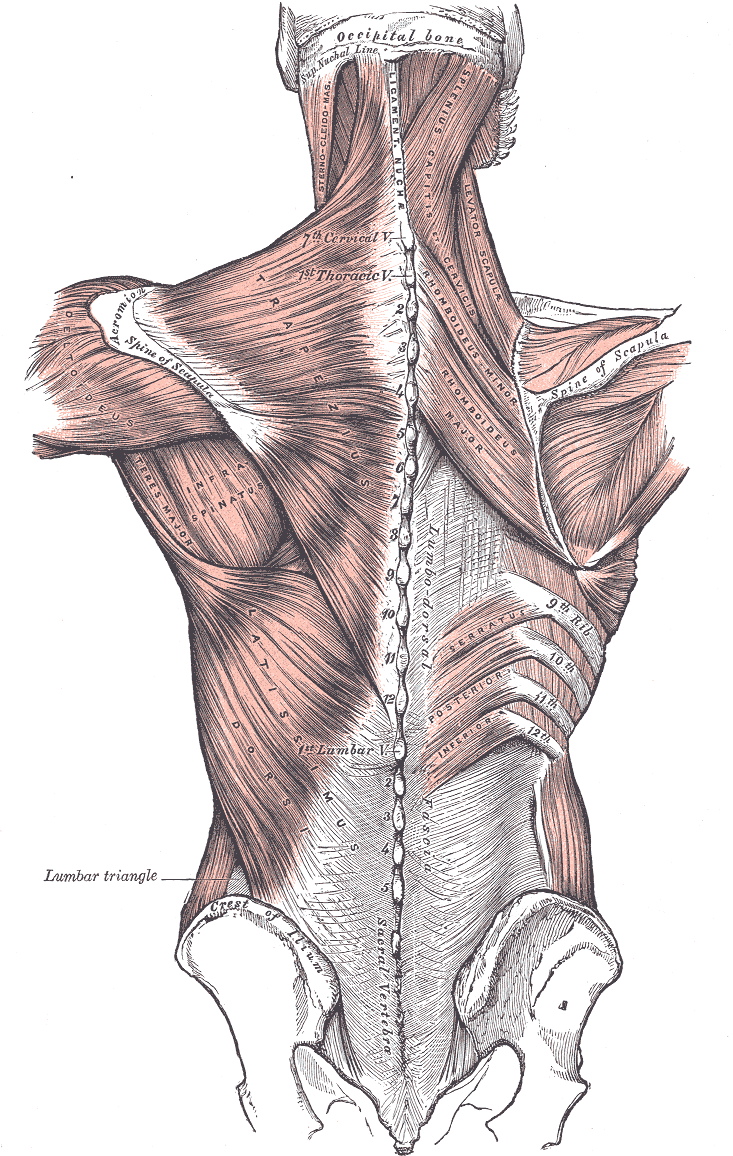
Posterior view of the superficial and
intermediate muscle layers of the back
The [trapezius] is a bilateral muscle belonging to the superficial muscles of the back. On each side it is a flat, thin triangular muscle that spans the neck, shoulders and the superior and middle aspect of the back. When seen together these two triangular muscles form a diamond-shaped quadrangle from which its name derives. The word originates in the Greek [τραπεζι] meaning "a four-legged table" (four sides). This word later evolved into the New Latin [trapezium].
In the midline the trapezius muscle attaches to the inion (external occipital protuberance), the ligamentum nuch?, the spinous processes of the seventh cervical vertebra (vertebra prominens), and the spinous processes of all the thoracic vertebr?.
The trapezius’ muscle fibers have three orientations. From the midline the superior fibers course inferolaterally to attach to the posterior border of the lateral third of the clavicle. The middle fibers course laterally to attach to the medial margin of the acromion, and posterior border of the spine of the scapula. The inferior fibers course superolaterally to attach to the spine of the scapula by way of an aponeurosis.
Because of their attachments, the superior and inferior fibers of the trapezius act coordinatedly to rotate the scapula, while the middle fibers act to retract the scapula. The superior fibers also act to slightly elevate the scapula. The trapezius muscle is sometimes described as an accessory respiratory muscle.
The trapezius muscle receives muscular innervation by way of the spinal accessory nerve (11th Cranial Nerve) which courses on the deep aspect of the muscle along with the superficial branch of the transverse cervical artery and vein. The muscle also receives sensory innervation by way of nerves arising from the ventral rami of the 3rd and 4th spinal nerves.
The trapezius is one of the 17 muscles that attach to the scapula.
Sources:
1 "Tratado de Anatomia Humana" Testut et Latarjet 8 Ed. 1931 Salvat Editores, Spain
2. "Anatomy of the Human Body" Henry Gray 1918. Philadelphia: Lea & Febiger
Original images courtesy of bartleby.com
- Details
Click for a larger image
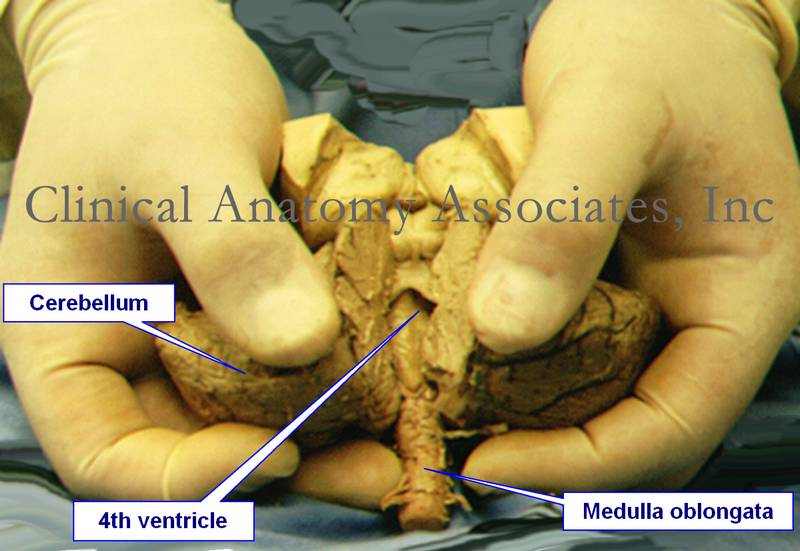
The fourth ventricle is one of the components of the ventricular system of the brain. It is a rhomboidal-shaped cavity located between the pons of the brain stem anteriorly and the cerebellum posteriorly.
The fourth ventricle is the last of the components of the ventricular system of the brain. It receives cerebrospinal fluid (CSF) from the Acqueduct of Sylvius, adds CSF produced in the choroid plexuses located in the roof of the fourth ventricle, and allows passageway of CSF to the external aspect of the brain and the subarachnoid space by way of a posteroinferior midline opening called the "foramen of Magendie". There are two small and sometimes absent or non-functional lateral openings to the fourth ventricle which also connect with the subarachnoid space called the "foramina of Luschka". These foramina are found at the end of the lateral recesses of the ventricle.
The accompanying image shows a posterior view of the brain stem and the cerebellum which has been opened in the median plane to expose the 4th ventricle. Click on the image to see a larger version.
Image property of: CAA.Inc. Photography: E. Klein