
Medical Terminology Daily (MTD) is a blog sponsored by Clinical Anatomy Associates, Inc. as a service to the medical community. We post anatomical, medical or surgical terms, their meaning and usage, as well as biographical notes on anatomists, surgeons, and researchers through the ages. Be warned that some of the images used depict human anatomical specimens.
You are welcome to submit questions and suggestions using our "Contact Us" form. The information on this blog follows the terms on our "Privacy and Security Statement" and cannot be construed as medical guidance or instructions for treatment.
We have 1721 guests online
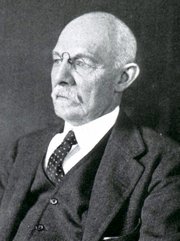
William S. Halsted, MD
(1852 – 1922)
American anatomist, teacher, and surgeon, William Stewart Halsted was born in New York City, USA to a wealthy family of English origin. His father was involved in charitable work and Governor and trustee to a city hospital. Not a brilliant student initially, Halsted took an undergraduate in Liberal Arts in Yale, CT., after which he entered the Medical College of Physicians at the Columbia College, where he excelled.
As a second-year medical student Halsted applied and obtained a position in surgery at a local hospital. In here he learned about Lister’s antiseptic technique and became an adamant proponent of it to reduce infection. In 1877 Halsted obtained his MD. After a short time as House Physician at the New York Hospital, Halsted traveled to Europe to further his education studying for two years at the Universities of Vienna, Leipzig, and W?rzburg.
Besides being at the forefront of surgical and antiseptic techniques (introducing the use of rubber gloves in surgery), Halsted was extremely concerned with the way medical students were taught in the US. He pioneered bedside clinical round discussions with the medical students after two years of basic sciences studies. Halsted developed the idea of a patient chart; he also developed the residency program for medical students in use today.
Halsted is probably the most influential researcher and surgeon at the turn of the century. He dedicated time to the study of intestinal anastomoses and the use of silk as a suture material. His experimental work in 1887 proved that the inclusion of the submucosa layer in an anastomosis was mandatory, as well that a single layered anastomosis was enough to attain closure. Perhaps Halsted’s most important contribution was the application and use of the scientific method to surgical questions. Halsted’s principles set the standards used today in surgical suturing and surgical stapling.
He also pioneered the development and surgical techniques for radical mastectomy as a treatment for breast cancer.
As a side effect of this studied in anesthesia and the use of cocaine for anesthesia, Halsted became addicted to this substance, a problem that followed him through the years. Without impairing his capacity as a researcher and a surgeon, Halsted eventually recovered. He died in Baltimore in 1922 as a complication to surgery.
Sources:
1. Dubay, A. D., & Franz, G. M. (2003). Acute Wound Healing: The Biology of Acute Wound Failure. Surg Clin NA, 83, 463-481.
2. Halsted, W. S. (1887). Circular Suture of the Intestine - An Experimental Study. Am J Med Sci, 436-461.
3. “William Stewart Halsted: his life and contributions to surgery” Osborne, P. Lancet Oncol 2007; 8: 256–65
4. “William Stewart Halsted: Surgical pioneer” Burress, P Endoc Today (2010), 8: (2) 22
5. “William Stewart Halsted (1852–1922) Neurological stamp” Haas, LF J Neurol Neurosurg Psych 2000;69:641
Original image courtesy of "Images from the History of Medicine" at www.nih.gov

"Clinical Anatomy Associates, Inc., and the contributors of "Medical Terminology Daily" wish to thank all individuals who donate their bodies and tissues for the advancement of education and research”.
Click here for more information


- Details
Click for the Facebook article
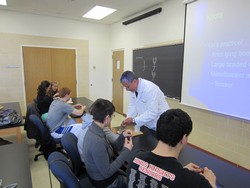
Today, instead of writing an article for this blog I prepared and delivered a lecture on "Surgical Sutures, Needles, and Knots" which included a short hands-on lab on knots and wound closure on simulated tissue.
This was presented at the request of the Pre-Health club of the College of Mount Saint Joseph in Cincinnati, OH. I am always glad to be invited to do these presentations as they allow me to maintain contact with the future generation of Health Care Professionals.
Of course this is a very short presentation compared to the longer course that Clinical Anatomy Associates, Inc. delivers for medical companies, but it shows these future professionals the complexity of the world of wound closure, healing, surgical sutures, needles, and knots.
We ended the lab with the challenge to do a two-layer closure of a simulated wound. Most of the attendees did a pretty good job. Congratulations!
My personal thanks to Dr. Eric Johnson who coordinated the meeting, and to the Pre-Health Club for their invitation. For more pictures of the meeting, see the Facebook album page of "Medical Terminology Daily"
- Details
The root term [-rachi-] comes from the Greek word [?άχις] (rhakhis) and means "a spine" or "a ridge". It is used to denote the spinal or vertebral column. This root term is used in many sciences such as botany, zoology, comparative anatomy, etc. Some of these uses can be read here.
The plural for is rachides. Examples of its use in human anatomy and pathology are:
• Rachitic: An individual with spine pathology. A patient with cachexia so severe that the spine is clearly seen
• Rachischisis: A congenital separation or cleft usually found in the lower portion of the spinal colum
- Details
The suffix [-schisis-] comes from the Greek word [σχίσις] and means "to tear" or "to separate". In Medicine today its meaning is that of "a cleft", a "split", or "a separation".
Examples of its use are:
- Palatoschisis: A cleft or separation of the palate, also known as uranoschisis
- Cheilognathopalatoschisis: This word combines several roots: [-cheil-], meaning "lip", [-gnath-] meaning "jaw", [-palat-], meaning "palate", while the suffix [-schisis] means "to split". A split or separation of the lip, jaw, and the hard and soft palate.
- Cranioschisis: A congenital cleft in the cranium
- Rachischisis: A congenital separation or cleft usually found in the lower portion of the spinal column
- Gastroschisis: A congenital condition where the abdominal wall does not complete its normal closure and the baby is born with an incomplete abdominal wall allowing for the extrusion of abdominal viscera usually in a right paraumbilical position
- Details

Click for a larger image
The pelvic brim is an oval-shaped bony ridge in the pelvis formed by components of the sacrum, ilium, pubic bone, and symphysis pubis.
Also known as the "linea terminalis" the pelvic brim is formed from posterior to anterior by:
• Sacral promontory: An anterior ledge formed by a protrusion caused by the anular epiphysis of the first sacral vertebra
• Arcuate line: A medial border in the iliac bone. The anterior edge of the arcuate line where it continues with the pectineal line of the pubis is not clear
• Pectineal line of the pubis: A sharp posteromedial bony ledge in the superior aspect of the superior pubic ramus
• Pubic tubercle: A small bony protrusion in the superior aspect of the pubic bone
• Pubic crest: The superior aspect of the body (corpus) of the pubic bone, site of attachment for the rectus abdominis and pyramidalis muscles
• Pubic symphysis: The superior aspect of the pubic symphysis and related ligaments
The pelvic brim serves as an anatomical landmark that separates the abdminopelvic cavity into its two components: Superior to the pelvic brim is the abdominal cavity and inferior to it is the pelvic cavity. The gender differences in the shape of the pelvic brim as well as its measurements and dimensions will be covered in a separate article.
Images modified from the original courtesy of Wikipedia

- Details
This article is part of the series "A Moment in History" where we honor those who have contributed to the growth of medical knowledge in the areas of anatomy, medicine, surgery, and medical research.

Ambroise Pare
Ambroise Paré (1510 - 1590) was a French barber-surgeon. He studied at the Hótel-Dieu, a hospital in Paris. In 1537 he started work as an army surgeon. At the time, the general belief was that gunshot wounds were poisoned by the gunpowder, so the standard procedure was to cauterize bleeding vessels with red hot irons and then burn the open wound with boiling oil. During a battle in Turin he ran out of oil, and in despair, tried to ease the pain and suffering of the soldiers that could not be treated "appropriately" by using the only elements available to him at the moment: a paste made with rose oil, turpentine, and egg yolks.
To his surprise, the soldiers thus treated recuperated faster and with less pain. Paré decided to treat his patients more humanely, and try to reduce pain as much as possible in this pre-anesthesia world. He started using ligatures instead of cautery, and soothing salves and pastes with clean bandages to promote healing.
Paré published several books and is considered by many the first modern surgeon.
Image courtesy of the US National Library of Medicine
- Details
Click for a larger image
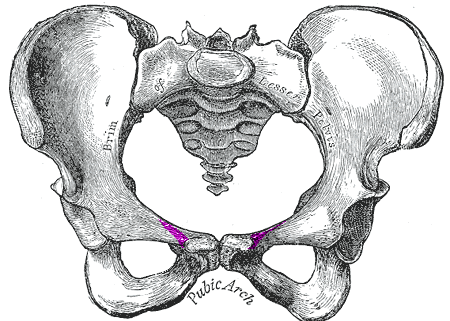
The pectineal line of the pubis is a sharp bony ridge located on the superior ramus of the pubic bone, forming part of the pelvic brim.
The pectineal line of the pubis begins at the pubic tubercle and extends posterolaterally for a short (variable) distance. As it moves posterolaterally its height shortens until it dissapears.
This structure serves as the superior origin of the pectineus muscle. The inferior attachment of this muscle is the pectineal line of the femur.
The periostium over the pectineal line of the pubis is thicker and reinforced by collagenous fibers from the lacunar ligament (Gimbernat's) and the inguinal ligament (Poupart's), forming the pectineal ligament, also known as Cooper's ligament.
Images in the public domain, courtesy of Wikipedia