
Medical Terminology Daily (MTD) is a blog sponsored by Clinical Anatomy Associates, Inc. as a service to the medical community. We post anatomical, medical or surgical terms, their meaning and usage, as well as biographical notes on anatomists, surgeons, and researchers through the ages. Be warned that some of the images used depict human anatomical specimens.
You are welcome to submit questions and suggestions using our "Contact Us" form. The information on this blog follows the terms on our "Privacy and Security Statement" and cannot be construed as medical guidance or instructions for treatment.
We have 172 guests online
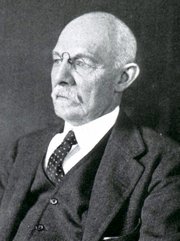
William S. Halsted, MD
(1852 – 1922)
American anatomist, teacher, and surgeon, William Stewart Halsted was born in New York City, USA to a wealthy family of English origin. His father was involved in charitable work and Governor and trustee to a city hospital. Not a brilliant student initially, Halsted took an undergraduate in Liberal Arts in Yale, CT., after which he entered the Medical College of Physicians at the Columbia College, where he excelled.
As a second-year medical student Halsted applied and obtained a position in surgery at a local hospital. In here he learned about Lister’s antiseptic technique and became an adamant proponent of it to reduce infection. In 1877 Halsted obtained his MD. After a short time as House Physician at the New York Hospital, Halsted traveled to Europe to further his education studying for two years at the Universities of Vienna, Leipzig, and W?rzburg.
Besides being at the forefront of surgical and antiseptic techniques (introducing the use of rubber gloves in surgery), Halsted was extremely concerned with the way medical students were taught in the US. He pioneered bedside clinical round discussions with the medical students after two years of basic sciences studies. Halsted developed the idea of a patient chart; he also developed the residency program for medical students in use today.
Halsted is probably the most influential researcher and surgeon at the turn of the century. He dedicated time to the study of intestinal anastomoses and the use of silk as a suture material. His experimental work in 1887 proved that the inclusion of the submucosa layer in an anastomosis was mandatory, as well that a single layered anastomosis was enough to attain closure. Perhaps Halsted’s most important contribution was the application and use of the scientific method to surgical questions. Halsted’s principles, also known as "Halsted's Rules of Surgery", set the standards used today in surgical suturing and surgical stapling.
He also pioneered the development and surgical techniques for radical mastectomy as a treatment for breast cancer.
As a side effect of this studied in anesthesia and the use of cocaine for anesthesia, Halsted became addicted to this substance, a problem that followed him through the years. Without impairing his capacity as a researcher and a surgeon, Halsted eventually recovered. He died in Baltimore in 1922 as a complication to surgery.
Sources:
1. Dubay, A. D., & Franz, G. M. (2003). Acute Wound Healing: The Biology of Acute Wound Failure. Surg Clin NA, 83, 463-481.
2. Halsted, W. S. (1887). Circular Suture of the Intestine - An Experimental Study. Am J Med Sci, 436-461.
3. “William Stewart Halsted: his life and contributions to surgery” Osborne, P. Lancet Oncol 2007; 8: 256–65
4. “William Stewart Halsted: Surgical pioneer” Burress, P Endoc Today (2010), 8: (2) 22
5. “William Stewart Halsted (1852–1922) Neurological stamp” Haas, LF J Neurol Neurosurg Psych 2000;69:641
Original image courtesy of "Images from the History of Medicine" at www.nih.gov

"Clinical Anatomy Associates, Inc., and the contributors of "Medical Terminology Daily" wish to thank all individuals who donate their bodies and tissues for the advancement of education and research”.
Click here for more information


- Details
Click for a larger image
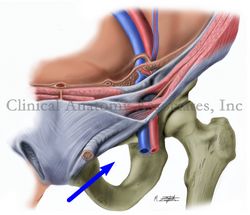
The word [ramus] is Latin and means “branch”. The plural form for [ramus] is [rami]. This word is used to denote “branches” or “divisions” in anatomical structures such as:
• Dorsal and ventral rami: the posterior (dorsal) and anterior (ventral) branches or divisions of a spinal nerve.
• Rami communicantes: small nerve connections between the spinal nerve and the sympathetic chain. These tiny nerve branches are part of the autonomic nervous system. Some are present at all levels of the spinal cord (gray rami communicans) and some only at levels T1 through L2 (white rami communicans)
• Pubic rami: the superior and inferior lateral extensions of the pubic bone, which form the superior and inferior boundaries of the obturator foramen (see image)
Image property of:CAA.Inc.Artist:M. Zuptich
- Details

Click for a larger image
The word [proptosis] is composed of the prefix [pro-] meaning “forward”, the root term [-pt-] from the Greek [πτώση] (ptosi) which meaning “to fall”, and the suffix [-osis] meaning “condition”. Literal interpretation of the term would be “condition of falling forward”. Sometimes [–ptosis] can be considered a suffix, meaning “to sag” or "to droop".
Proptosis is used in medical terminology to describe a forward bulging to the eyes, similar to exophthalmos. The only difference is that the term exophthalmos is usually reserved to forward displacement of the eye related to or secondary to endocrinological dysfunction. All other eye protrusions are referred to as [proptosis
Proptosis can be caused by trauma, localized inflammation of the orbital tissues not related to thyroid dysfunction, tumors, etc.
- Details
Click for a larger image
The word [exophthalmos] is composed of the prefix [ex-] meaning “outer” or “outside”, the root term [-ophthalm-] which arises from the Greek word [οφθαλμός] (ophthalm?s) meaning “eye”, and the adjectival suffix [-os] meaning “pertaining to”. Literal interpretation of the term would be “pertaining to outside the eye”.
In reality the word [exophthalmos] is used to describe a condition where the eye is pushed anteriorly, protruding or bulging within the eye orbit. This condition can be unilateral or bilateral.
The term exophthalmos is usually reserved to forward displacement of the eye related to or secondary to endocrinological dysfunction. All other eye protrusions are referred to as [proptosis]. More on this word can be read on this article.
Thyroid dysfunction can lead to inflammation of the orbital tissues, including muscle and fatty tissues, causing edema and forward displacement of the eye.
- Details
Click for a larger image
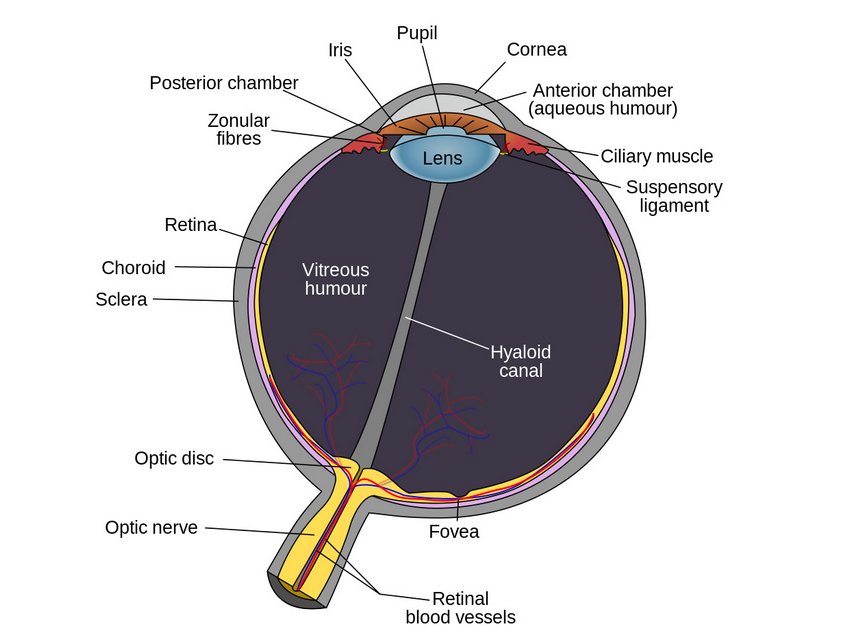
The root term [-ophthalm-] arises from the Greek word [οφθαλμός] (ophthalm?s) meaning “eye” or "optic". It is used in several medical terms such as:
- Ophthalmology: The suffix [-ology] means “to study”. The study of the eye
- Ophthalmologist: A health care professional who specialized in eye diseases
- Ophthalmic: The adjectival suffix [-ic] means “pertaining to” and can be seen in anatomical terms such as the ophthalmic artery
- Ophthalmitis: The suffix [-itis] means “inflammation” or “infection”.
- Ophthalmoscope: An instrument to view the eye
- Anophthalmia: The prefix [an-] means "without" or "absence of". A congenital condition where one or both eyes do not develop
- Exophthalmos: The prefix [ex-] means "outer" or "outside". A protrusion of the eyes
Image by Rhcastilhos [Public domain], via Wikimedia Commons.
- Details
Click for a larger image
UPDATED: The root term [-mast-] arises from the Greek [μαστός] or [mastos] meaning "breast". A synonymous prefix is [mamm-] from the Latin [mamma], also meaning "breast". This prefix is used in medical terms such as:
- Mastectomy: The suffix [ectomy] means "removal of". Removal of the breast. This is an old operation, the first known records are from 180 A.D. The modern operation for radical mastectomy with careful removal of the related lymphatics was developed by William Halsted (1852 - 1922). The synonym [mammectomy] is correct, though rarely used. The word [masectomy] to refer to this procedure is incorrect and should not be used
- Mastoptosis: The suffix [-(o)ptosis] means "to fall", "to sag" or "go down". A falling or sagging of the breast. (Syn. mammoptosis)
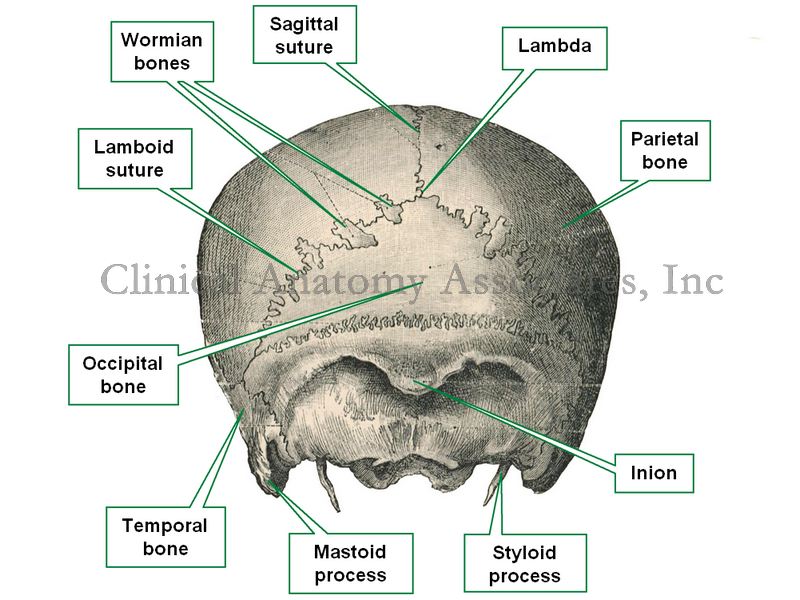
- Mastoid: The suffix [oid] means "similar to". Similar to a breast or with the shape of a breast, such as the mastoid process, a bony prominence of the temporal bone. See accompanying image
- Mastoplasty: The suffix [-(o)plasty] is used to mean "surgical reshaping". Surgical reshaping of the breast. Better known as a mammoplasty
- Mastopexy: A type of mastoplasty. The suffix "opexy" is used to mean "surgical fixation". Surgical fixation of the breast. In a mastopexy, the breast is "fixed" higher to reduce the mastoptosis. (Syn. mammopexy)
There is an interesting evolution of this word. The above applies only when the term [-mast-] is used as a root term, and combined with other word components. From the Greek, this term was passed on to Latin and thence evolved with the German term [m?sten] meaning "to feed" or "to fatten". This is why we have [mast cells] in histology. These are a type of mononuclear leukocyte described by Paul Ehrlich (1814 - 1915) in 1879, who named them [maztellen], which in German means "a well-fed cell".
For images of mastoptosis and mastopexy, CLICK HERE. Warning: images depict nude bodies.
Sources:
1. "The Origin of Medical Terms" Skinner, HA 1970 Hafner Publishing Co.
2. "Dorland's Illustrated Medical Dictionary" 28th Ed. W.B. Saunders. 1994
3. "Medical Terminology; Exercises in Etymology" Dunmore CW, Fleischer RM 2nd Ed. 1985
4. "Medical Meanings; A Glossary of Word Origins" Haubrich, WS. Am Coll Phys 1997

- Details

Click for a larger image
UPDATED: The term [fascia] means "band or bandage". It is derived from the Latin word [fascis] meaning "bundle", therefore a fascia is the bandage that ties a bundle. A bundle of sticks tied around an ax was the symbol of the lictors, the Roman imperial bodyguards. Many fasciae (Pl.) are eponymic, such as Camper's Fascia, Scarpa's fascia, Colle's fascia, etc.
In anatomy, the word [fascia] refers to a sheet of connective tissue. The term encompasses many types of fasciae (plural for fascia) which range from the thin deep or muscular fascia to the tendon-like thick fascia lata of the thigh. The image shows the anterior aspect of the thigh and its covering, the fascia lata. The opening shown in the fascia lata is the fossa ovalis of the thigh. Do not confuse with the fossa ovalis found in the interatrial wall of the heart. Click on the image for a larger depiction.
In the extremities, some fasciae may contain more than one muscle, creating fascial compartments. Trauma or vascular pathology in a fascial compartment may cause the muscles to swell to the point that the edema starts causing ischemia compromising the muscles to the point of necrosis. This is called "compartment syndrome" and may require a surgeon to cut open the fascia to relieve the pressure, a procedure called a "fasciotomy". For more information on [-otomy], click on this link.
Original images by Henry VanDyke Carter, MD and links courtesy ofbartleby.com