
Medical Terminology Daily (MTD) is a blog sponsored by Clinical Anatomy Associates, Inc. as a service to the medical community. We post anatomical, medical or surgical terms, their meaning and usage, as well as biographical notes on anatomists, surgeons, and researchers through the ages. Be warned that some of the images used depict human anatomical specimens.
You are welcome to submit questions and suggestions using our "Contact Us" form. The information on this blog follows the terms on our "Privacy and Security Statement" and cannot be construed as medical guidance or instructions for treatment.
We have 1003 guests online
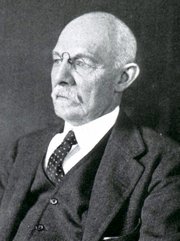
William S. Halsted, MD
(1852 – 1922)
American anatomist, teacher, and surgeon, William Stewart Halsted was born in New York City, USA to a wealthy family of English origin. His father was involved in charitable work and Governor and trustee to a city hospital. Not a brilliant student initially, Halsted took an undergraduate in Liberal Arts in Yale, CT., after which he entered the Medical College of Physicians at the Columbia College, where he excelled.
As a second-year medical student Halsted applied and obtained a position in surgery at a local hospital. In here he learned about Lister’s antiseptic technique and became an adamant proponent of it to reduce infection. In 1877 Halsted obtained his MD. After a short time as House Physician at the New York Hospital, Halsted traveled to Europe to further his education studying for two years at the Universities of Vienna, Leipzig, and W?rzburg.
Besides being at the forefront of surgical and antiseptic techniques (introducing the use of rubber gloves in surgery), Halsted was extremely concerned with the way medical students were taught in the US. He pioneered bedside clinical round discussions with the medical students after two years of basic sciences studies. Halsted developed the idea of a patient chart; he also developed the residency program for medical students in use today.
Halsted is probably the most influential researcher and surgeon at the turn of the century. He dedicated time to the study of intestinal anastomoses and the use of silk as a suture material. His experimental work in 1887 proved that the inclusion of the submucosa layer in an anastomosis was mandatory, as well that a single layered anastomosis was enough to attain closure. Perhaps Halsted’s most important contribution was the application and use of the scientific method to surgical questions. Halsted’s principles, also known as "Halsted's Rules of Surgery", set the standards used today in surgical suturing and surgical stapling.
He also pioneered the development and surgical techniques for radical mastectomy as a treatment for breast cancer.
As a side effect of this studied in anesthesia and the use of cocaine for anesthesia, Halsted became addicted to this substance, a problem that followed him through the years. Without impairing his capacity as a researcher and a surgeon, Halsted eventually recovered. He died in Baltimore in 1922 as a complication to surgery.
Sources:
1. Dubay, A. D., & Franz, G. M. (2003). Acute Wound Healing: The Biology of Acute Wound Failure. Surg Clin NA, 83, 463-481.
2. Halsted, W. S. (1887). Circular Suture of the Intestine - An Experimental Study. Am J Med Sci, 436-461.
3. “William Stewart Halsted: his life and contributions to surgery” Osborne, P. Lancet Oncol 2007; 8: 256–65
4. “William Stewart Halsted: Surgical pioneer” Burress, P Endoc Today (2010), 8: (2) 22
5. “William Stewart Halsted (1852–1922) Neurological stamp” Haas, LF J Neurol Neurosurg Psych 2000;69:641
Original image courtesy of "Images from the History of Medicine" at www.nih.gov

"Clinical Anatomy Associates, Inc., and the contributors of "Medical Terminology Daily" wish to thank all individuals who donate their bodies and tissues for the advancement of education and research”.
Click here for more information


- Details
Click for a larger image
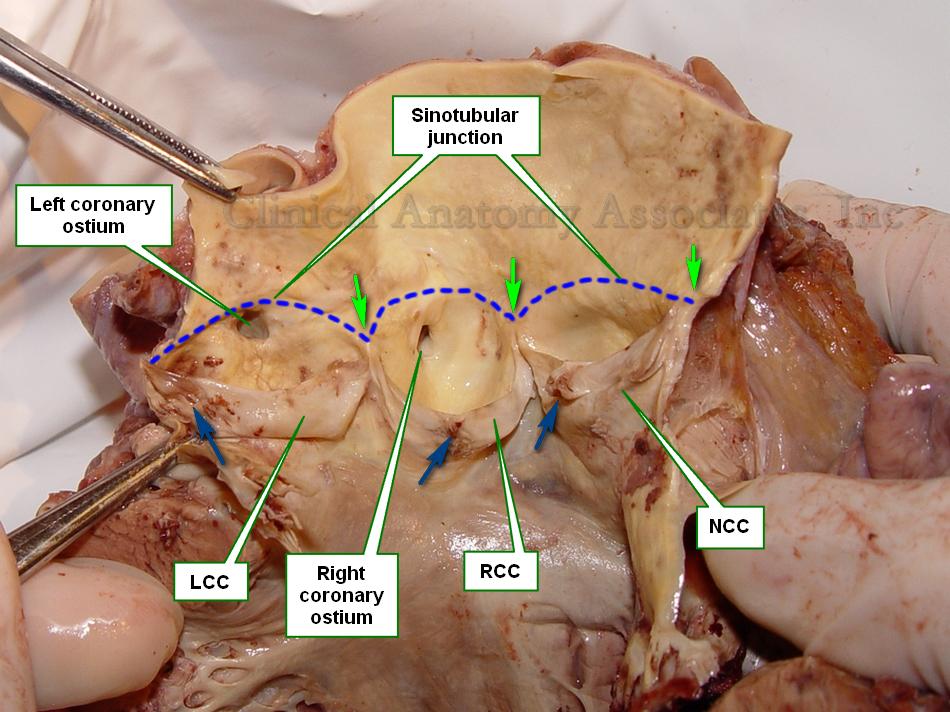
The sinotubular junction (STJ) is a well-defined circular ridge found between the superior or tubular segment of the ascending aorta and the inferior, bulbous segment of the ascending aorta, known as the aortic root.
The STJ follows the superior contour of the three sinuses of Valsalva that form the bulbs of the aortic root and intersects the commissures of the aortic valve. In the accompanying image the STJ is depicted by a blue dotted line and the commissures are depicted by green arrows.
The ostia of the coronary arteries are usually found inferior to the STJ, although they can be on it or superior to the STJ. There seems to be a correlation with anomalous origins of the coronary ostia and sudden-death syndrome.
The image also shows the three cusps of the aortic valve: the non-coronary cusp (NCC), the right coronary cusp (RCC) and the left coronary cusp (LCC). The blue arrows indicate the location of the nodules of Arantius.
Medical terminology notes: There are many scholarly texts that hyphenate the word as [sino-tubular]. This is incorrect, as the root term is [-sin-], meaning "sinus". The addition of the [-o-] to the root term creates the combining form [-sino-] which is then used to connect to the root term [-tubul-]. Since it is a vowel and a consonant combining and they are euphonic, there is no need to add the hyphen. In fact, a word should use as a combining element either a hyphen or an [-o-], but not both. The word with the hyphen then should be [sin-tubular] which is definitely not euphonic. For more information on combining root terms, click here.
Others write [sinutubular]. The paragraph above clearly explains why this is a mistake. The root term is [-sin-] meaning "sinus" and the addition of the [-o-] creates the combining form [-sino-] and not [-sinu-].
Sources:
1. “Clinical Anatomy of the Aortic Root” Anderson, RH Heart 200; 84: 670–673
2. “The Anatomy of the Aortic Root” Loukas, E et al. Clin Anat 2014; 27:748-756
3: "Tratado de Anatomia Humana" Testut et Latarjet 8th Ed. 1931 Salvat Editores, Spain
Image property of: CAA.Inc.Photographer: D.M. Klein
- Details
In many of the articles on this blog we study a specific root term associated with a meaning or a word. In this case we have to do it differently. The English word [man] has different root terms.
The first one is the root term [-antrhop-] derived from the Greek [άνθρωπος] (anthropos) meaning “man”. In this case it refers to the term [man] as in a cultural group or a species. Use of this term can be found in the words
- Anthropoid: The suffix [-oid] means “similar to”. Similar to the species of man (homo sapiens)
- Antropocentric: Centered on man
- Antropology: The suffix [-ology] means “study of".The study of man (as a cultural group or as a species)
- Misanthropic: The prefix [mis-] means “to hate” or “despise. To hate man
The second one is [-andr-], arising from the Greek [άνδρας] (andras), also meaning “man”. In this case it refers more to the gender and to an individual and can be found in the words
- Androgen: The suffix [-(o)gen] means “to generate” or “create”. It is used as a generic term for hormones (natural or synthetic) that can stimulate, control, or generate gender-specific characteristics.
- Android: The suffix [-oid] means “similar to”. Similar to a man
- Polyandry: The prefix [poly-] means “many. Refers to a woman marrying more than one man. The opposite would be [poligyny]
- Details
Click for a larger image
First used by Galen, the term [menynx] is Greek and means "membrane", referring initially to any body membrane. Erasistratus (c. 300 B.C.) used the term [menynx] to refer to a membrane covering of the brain and spinal cord and has been used so since then.
The plural form of [menynx] is [meninges]. The plural form is common, but the singular form [menynx] is usually used incorrectly as [meninge].
There are three meninges that cover the spinal cord and brain. From deep to superficial:
•Pia Mater: Latin terms meaning "tender mother" it is a thin membrane covering the outer layer of the spinal cord and brain intimately and not easily dissectable from the organ.
•Arachnoid mater: The term refers to the spider-web look of this vascular menynx.
Click for a larger image
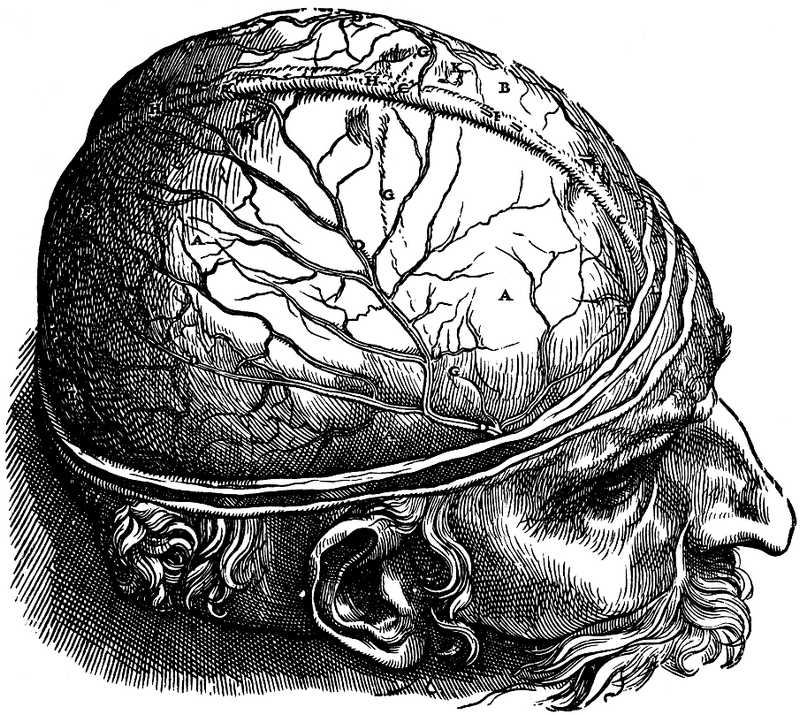
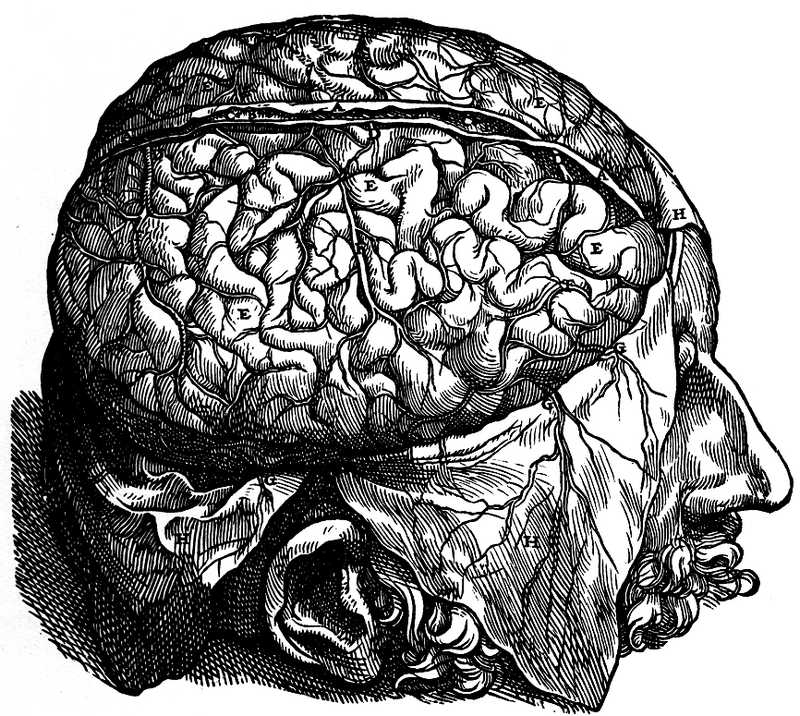
•Dura mater: Latin terms meaning "tough mother". The dura mater is the outermost layer and is quite tough, forming a sac containing the spinal cord and brain, the dural sac or thecal sac. The images depict two famous sketches by Andrea Vesalius.
The superior image shows a head with the dura mater in situ (label "A"). The second image show the dura mater open (label "H") and the vessels associated with the arachnoid layer.
Between the arachnoid mater and pia mater there is a "space" filled with fluid. The space is called the subarachnoid space and the fluid is the cerebrospinal fluid.
Original images from Andreas Vesalius'"De Humani Corporis Fabrica; Libri Septem" (1543)
- Details
The root term [-men-] originates from the Latin word [mensis] meaning “month”. Earlier forms of this term probably arise from the Greek [μήνας] (minas), also meaning “month”, but with the connotation of “lunar month” or “moon”.
Since a woman’s menstrual cycle is on average 28 days (ranging from 31 to 35 days) and a lunar month is 29 days and 12 hours in length, the root term [-men-] has been associated with a woman’s menstrual cycle, and menstruation. The term can be found in many words such as:
• Menses: The period of flow in a menstrual cycle. The “period”
• Amenorrhea: The prefix [a-] means “without” or “absence of”. The suffix [-(o)rrhea] means "flow". Without menstrual flow.
• Dysmenorrhea: The prefix [dys-] means “abnormal”. Abnormal menstrual flow
• Catamenial: Being or feeling sick during menses. Read more here
- Details
Click for a larger image
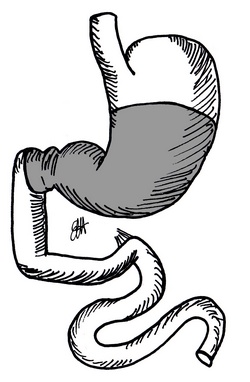
The Billroth II procedure is a variation to the Billroth I procedure pioneered by Dr. Theodor Billroth in 1881. The procedure is a a "subtotal gastrectomy" where gastrointestinal continuity after the resection is attained with an anastomosis between the stomach and the jejunum, a gastrojejunostomy.
The procedure was originally performed as a way to resect peptic ulcers caused by hyperacidity. Billroth removed up to 70% of the stomach. Modern variations of the procedure are less agressive, resecting only 50% of the distal stomach (a hemigastrectomy), or an antrectomy.
The reason for the Billroth II variation is the difficulty performing a gastroduodenostomy. This can be caused by a short abdominal esophagus, a short proximal gastric pouch or other reasons. The accompanying image shows the digestive tract before the resection. The area to the resected (specimen) is grayed out. If you hover your cursor over the image you will see the completed Billroth II procedure.
In the completed procedure you can see A: The stapled-closed duodenal stump. B: The gastrojejunostomy that allows passage of food from the stomach into the jejunum, and C: the staple-closed gastric stump that is not part of the gastrojejunostomy. Bear in mind that this sketch depicts only one of the many ways of performing this procedure
Images property of:CAA.Inc. Artist:Dr. E. Miranda
- Details
Hover your mouse on the image
The Billroth I procedure was pioneered by Dr. Theodor Billroth in 1881. The original procedure was described as a "subtotal gastrectomy" where gastrointestinal continuity after the resection was attained with an anastomosis between the stomach and the duodenum, a gastroduodenostomy.
The procedure was originally performed as a way to resect peptic ulcers caused by hyperacidity. Billroth removed up to 70% of the stomach. Modern variations of the procedure are less agressive, resecting only 50% of the distal stomach (a hemigastrectomy), or an antrectomy.
After Billroth's pioneering work, several variations on the procedure appeared (Polya, Hofmeister) as well as different techniques (open vs. laparoscopic), and the use of different materials, starting with carbolized silk to the modern endolaparoscopic surgical staplers.
The accompanying image shows the digestive tract before the resection. The area to the resected (specimen) is grayed out. If you hover your cursor over the image you will see the completed Billroth I procedure.
In the completed procedure you can see A: The stapled-closed proximal gastric pouch. B: The duodenum. The red arrow points to the gastroduodenostomy, that is, the anastomosis between the stomach and the duodenum which in this case was done in the posterior aspect of the proximal gastric pouch. Bear in mind that this sketch depicts only one of the many ways of performing this procedure
Images property of: CAA.Inc. Artist:Dr. E. Miranda