
Medical Terminology Daily (MTD) is a blog sponsored by Clinical Anatomy Associates, Inc. as a service to the medical community. We post anatomical, medical or surgical terms, their meaning and usage, as well as biographical notes on anatomists, surgeons, and researchers through the ages. Be warned that some of the images used depict human anatomical specimens.
You are welcome to submit questions and suggestions using our "Contact Us" form. The information on this blog follows the terms on our "Privacy and Security Statement" and cannot be construed as medical guidance or instructions for treatment.
We have 437 guests online
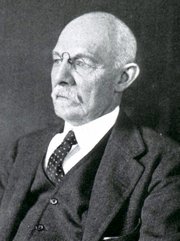
William S. Halsted, MD
(1852 – 1922)
American anatomist, teacher, and surgeon, William Stewart Halsted was born in New York City, USA to a wealthy family of English origin. His father was involved in charitable work and Governor and trustee to a city hospital. Not a brilliant student initially, Halsted took an undergraduate in Liberal Arts in Yale, CT., after which he entered the Medical College of Physicians at the Columbia College, where he excelled.
As a second-year medical student Halsted applied and obtained a position in surgery at a local hospital. In here he learned about Lister’s antiseptic technique and became an adamant proponent of it to reduce infection. In 1877 Halsted obtained his MD. After a short time as House Physician at the New York Hospital, Halsted traveled to Europe to further his education studying for two years at the Universities of Vienna, Leipzig, and W?rzburg.
Besides being at the forefront of surgical and antiseptic techniques (introducing the use of rubber gloves in surgery), Halsted was extremely concerned with the way medical students were taught in the US. He pioneered bedside clinical round discussions with the medical students after two years of basic sciences studies. Halsted developed the idea of a patient chart; he also developed the residency program for medical students in use today.
Halsted is probably the most influential researcher and surgeon at the turn of the century. He dedicated time to the study of intestinal anastomoses and the use of silk as a suture material. His experimental work in 1887 proved that the inclusion of the submucosa layer in an anastomosis was mandatory, as well that a single layered anastomosis was enough to attain closure. Perhaps Halsted’s most important contribution was the application and use of the scientific method to surgical questions. Halsted’s principles, also known as "Halsted's Rules of Surgery", set the standards used today in surgical suturing and surgical stapling.
He also pioneered the development and surgical techniques for radical mastectomy as a treatment for breast cancer.
As a side effect of this studied in anesthesia and the use of cocaine for anesthesia, Halsted became addicted to this substance, a problem that followed him through the years. Without impairing his capacity as a researcher and a surgeon, Halsted eventually recovered. He died in Baltimore in 1922 as a complication to surgery.
Sources:
1. Dubay, A. D., & Franz, G. M. (2003). Acute Wound Healing: The Biology of Acute Wound Failure. Surg Clin NA, 83, 463-481.
2. Halsted, W. S. (1887). Circular Suture of the Intestine - An Experimental Study. Am J Med Sci, 436-461.
3. “William Stewart Halsted: his life and contributions to surgery” Osborne, P. Lancet Oncol 2007; 8: 256–65
4. “William Stewart Halsted: Surgical pioneer” Burress, P Endoc Today (2010), 8: (2) 22
5. “William Stewart Halsted (1852–1922) Neurological stamp” Haas, LF J Neurol Neurosurg Psych 2000;69:641
Original image courtesy of "Images from the History of Medicine" at www.nih.gov

"Clinical Anatomy Associates, Inc., and the contributors of "Medical Terminology Daily" wish to thank all individuals who donate their bodies and tissues for the advancement of education and research”.
Click here for more information


- Details
Click for a larger image
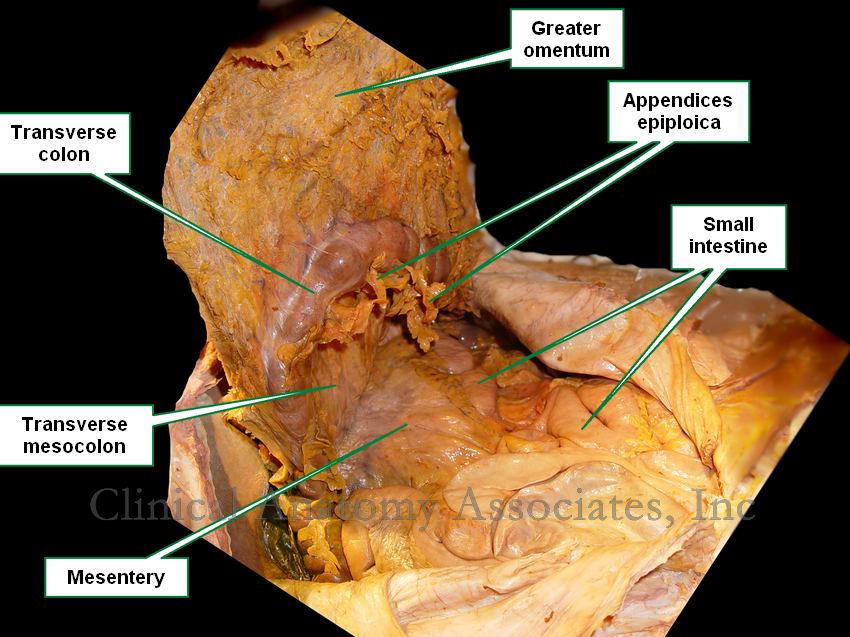
UPDATED: The term [mesentery] is of Greek origin. The prefix [mes(o)-] arises from the Greek [μέσο] meaning "middle", the root term [-enter-] means "small intestine" or "intestine", and the suffix [-y] means "process" or "structure". Thus, the mesentery is "a structure in the middle".
The term [mesentery] can be used as a generic word to denote a double-layered peritoneal membrane that stretches between an abdominal viscus and the abdominal wall. A more precise use of the term is that of mesentery proper, which extends between the posterior abdominal wall and the jejunum and ileum. The superior mesenteric artery and veins are found at the root of the mesentery proper, along with a large accumulation of lymphatic nodes, and sympathetic and parasympathetic nerves.
Between the two layers of the mesentery proper, there are jejunal and ileal arteries and veins, a complex system of arterial and venous arches, as well as lymphatic vessels, autonomic nerves, and varying degrees of fat. Because of the presence of the mesentery proper, the jejunum and ileum are mobile or intraperitoneal, that is, they can slither, turn and twist with the movements of peristalsis. This movement is helped by the presence of a small amount of peritoneal fluid.
Click for a larger image
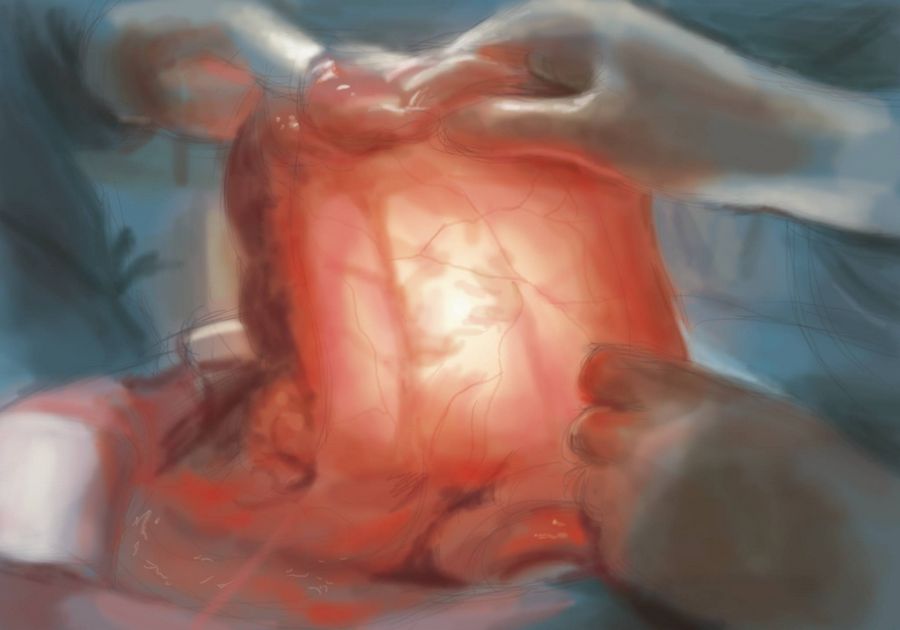
The fact that the mesentery is intraperitoneal is important in surgery. If the organ can already move around because of its mesentery, then it does not need to be "mobilized", it is already mobile!! If the organ (jejunum or ileum) have adhesions that limit their mobility within the abdominal cavity, the surgeon may have to perform and adhesiolysis to restore their mobility.
The first image shows an anatomical dissection where the greater omentum has been pulled anteriorly, exposing the small intestine and its mesentery, as well as the transverse mesocolon. Click on the image for a larger depiction. The second image (courtesy of Dr. Michiaki Akashi) is artwork depicting the surgical technique of transillumination, where the surgeon will shine a light through the mesentery to visualize the blood supply to the intestine prior to ligation and transection. The mesentery-like structure being transilluminated is the transverse mesocolon
WARNING: The first image is a photograph of a human dissection and can be considered descriptive.
NOTE: My personal thanks to Michiaki Akashi, M.D.for allowing us to use his artwork in this article. Dr. Akashi works as a surgeon and pathologist in the Saga Prefectural Hospital Koseikan in Saga, Japan.Dr. Miranda
First image property of: CAA.Inc. Photographer: David M. Klein
- Details
UPDATED: The suffix [-(o)megaly] means "enlargement". It is related to the root term [-megal-], which is a derivate of the Greek word [μεγάλος] (megalos), meaning "large" or "big". The suffix component [-y] means "process". Usually used to refer to the abnormal or pathological enlargement of an organ.
Some applications of this suffix are:
- Cardiomegaly: Enlargement of the heart
- Splenomegaly: Enlargement of the spleen
- Lienomegaly: Enlargement of the spleen. the root term [-lien-] also means "spleen"
- Acromegaly: From the Greek prefix [acro-], meaning "top" or "extremity". Enlargement of the face, hands, and feet, caused by dysfunction of the hypophysis
- Hepatomegaly: Enlargement of the liver
Note: The links to Google Translate include an icon that will allow you to hear the Greek or Latin pronunciation of the word.
Thanks to our contributor Dr. Sanford Osher for inspiring this update.
- Details
The prefix (sometimes used as a root term) [hydr-] has a Greek origin [υδωρο], meaning "water". It can be found in many common and scientific terms such as "hydrostatic", "hydroelectric", and "hydroplaning". It is also used in medical terms such as:
- Hydrocephalus: Literally "water in the head". Refers to a pathology where there is excess cerebrospinal fluid in the ventricular system of the brain
- Hydrocele: The suffix [-(o)cele] means "bulge" or "hernia". A watery mass or bulge, usually found in the scrotum.
- Hydrops or hydropsy: The excessive accumulation of serous fluid in a body cavity, such as ascites.
- Hydramnios: Excessive accumulation of fluid in the amniotic cavity during pregnancy
- Details
This article is part of the series "A Moment in History" where we honor those who have contributed to the growth of medical knowledge in the areas of anatomy, medicine, surgery, and medical research.

Arantius
Giulio Cesare Aranzio (1530 -1589) Italian surgeon and anatomist. Born in Bologna, Giulio Cesare Aranzio is better known by the Latinized version of his name Julius Caesar Arantius. His Italian last name is sometimes spelled Aranzi.
Born in a poor family, Aranzio began his medical studies under the tutelage of his uncle, Bartolommeo Maggi (1477 – 1552), studied medicine at the University of Bologna where he graduated MD in 1556. The same year he became a Professor of Anatomy and Surgery at the in 1556. Arantius was the first lecturer at the University of Bologna to hold a separate professorship of anatomy. Before him, the University would allow any surgeon to perform dissection and lectures.
Arantius had several publications that include:
• Observationes Anatomicas (Anatomical Observations)
• De Humano Foetu Opusculum (On the Human Fetus)
• De Tumoribus Secundum Locos Affectos (Tumors according to the affected places)
• Hippocratis librum de vulneribus capitis commentarius brevis (Short commentary on Hippocrates’ book on head wounds)
Arantius was the first to describe the foramen ovale (fossa ovalis) and the ductus arteriosus, discoveries that were later erroneously ascribed to Leonardo Bottalus (Botal). He also described the nodules in the leaflets of the aortic valve that today bear his name (nodules of Arantius) which he described as being “cartilaginous” in nature. This is not as farfetched as it seems as these nodules can become hypertrophic and harden with age. Arantius was also the first to describe the hippocampus, a formation on the brain associated with the limbic system, mood disorders, and depression.
Arantius was a consummate anatomist and a great surgeon. Apparently he treated nasal polyps, performed nasal reconstructions and a number of surgeries ahead of his time. One of his great anatomical observations was that the blood in the heart did not pass through “invisible pores” in the interventricular septum, but rather exits the heart through the pulmonary trunk, setting the stage for the discovery of circulation by William Harvey (1578 – 1609)
We have not been able to find a portrait of Arantius and the only reference is a a bust with the name “Aranzio” located at the Biblioteca comunale dell'Archiginnasio in Bologna, Italy. The bust is found in the anatomical amphitheater, built in 1637. Unfortunately, the theater was severly damaged in January 29, 1944 during WWII. It has been meticulously restored over the years. Here is an article (in Italian) on the amphitheater.
Sources:
1. “Giulio Cesare Arantius (1530-1589): a surgeon and anatomist: his role in nasal reconstruction and influence on Gaspare Tagliacozzi” . Gurunluoglu R, Gurunluoglu A Ann Plast Surg. 2008 Jun;60(6):717-22
2. “Giulio Cesare Aranzio (Arantius) (1530-89) in the pageant of anatomy and surgery” Gurunluoglu R, Shafighi M, Gurunluoglu A, Cavdar S. J Med Biogr. 2011 May;19(2):63-9
3. “Hippocampus – Why is it studied so frequently?” Radonjic, V. et al Vojnosanit Pregl 2014; 71(2): 195–201
4: “The history of Bologna University's Medical School over the centuries, A Short Review” Moroni, P. Acta Dermatoven APA Vol 9, 2000, No 2 73-75
- Details
Click for a larger image
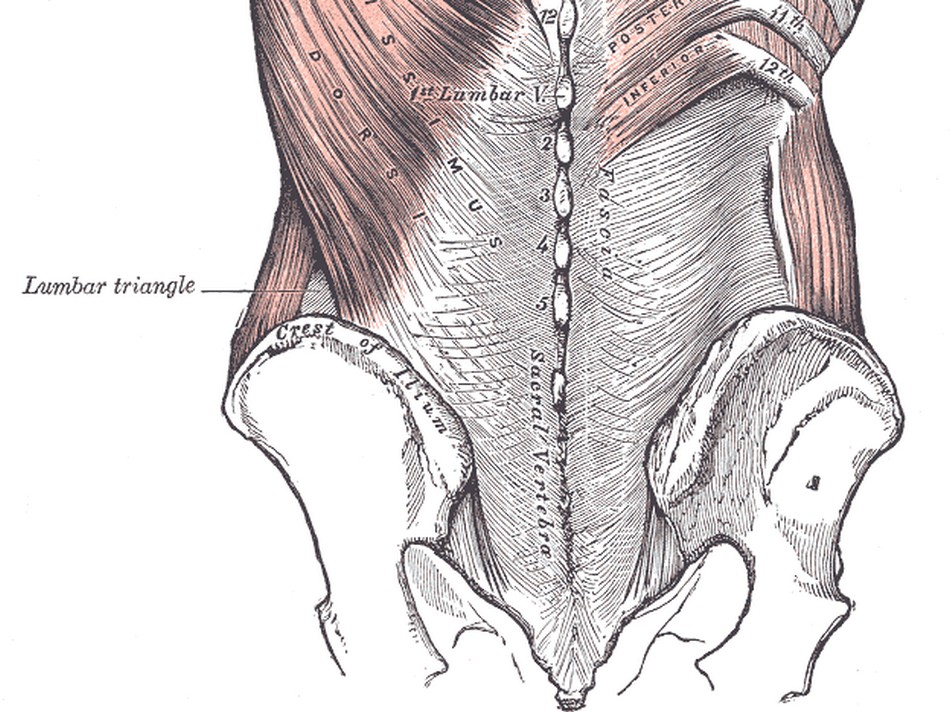
The [lumbar triangle] is a well-defined triangular space in the posterolateral lumbar region. Also known as the inferior lumbar triangle, its boundaries are: inferior, the iliac crest; anteromedial: latissimus dorsi muscle; posterolateral: posterior border of the external oblique muscle. The triangle has a superior apex, and the floor of the triangle is the internal oblique muscle.
The triangle is named after Jean-Louis Petit (1674 - 1750), a French Surgeon who is said to have been an anatomy teacher at an early age and became a surgeon when he was only eighteen!
The lumbar triangle is an area that is not as thick as the rest of the abdominal wall and as such it is a site of potential weakness that can lead to a lumbar hernia, also known as Petit’s hernia.
Sources:
1. “Jean Louis Petit – A Sketch of his Life, Character, and Writings” Hayne, AP San Fran Western Lancet 1875 4: 446-454
2. “Oeuvres compl?tes de Jean-Louis Petit” 1837 Imprimerie de F. Chapoulaud
3. Extraits de l'eloge de Jean-Louis Petit Ius dans Ia seance publique de I' Academie Royale de Chirurgie du 26 mai 1750” Louis A. Chirurgie 2001: 126 : 475- 81
- Details

Click for a larger image
The anatomical term [crista terminalis] is Latin. [Crista] refers to the crest of a helmet, a tuft (of hair or feathers), or a ridge. The word [terminalis] means "end" or "terminal". The term then means "the terminal or end ridge".
The crista terminalis is a superoinferior muscular ridge found in the right atrium marking the boundary between the smooth wall of the right atrium, also known as the "sinus venarum" (venous sinus), and the muscular wall of the right atrial appendage. The muscular wall of the right atrial appendage is comb-shaped and is called the pectinate muscle.
Because of the longitudinal direction of the muscular fibers of the crista terminalis, it is considered to be one of the internodal pathways for electrical transmission of the cardiac depolarization between the sinoatrial (SA) node and the atrioventricular (AV) node.
The crista terminalis causes a superoinferior longitudinal depression on the surface of the heart known as the sulcus terminalis.
The accompanying image is a dissection of a human heart and shows the crista terminalis, pectinate muscle, fossa ovalis, the ostium of the coronary sinus, the right atrial smooth wall of the sinus venarum. Click on the image for a larger version. The animated image does a slow pass trough all these and other structures.
Sources:
1. "The origin of Medical Terms" Skinner, AH, 1970
2. "Terminologia Anatomica: International Anatomical Terminology (FCAT)" Thieme, 1998
3. "Tratado de Anatomia Humana" Testut et Latarjet 8th Ed. 1931 Salvat Editores, Spain
Image courtesy of Rocky Vista University,College of Osteopathic Medicine, Parker, CO