
Medical Terminology Daily (MTD) is a blog sponsored by Clinical Anatomy Associates, Inc. as a service to the medical community. We post anatomical, medical or surgical terms, their meaning and usage, as well as biographical notes on anatomists, surgeons, and researchers through the ages. Be warned that some of the images used depict human anatomical specimens.
You are welcome to submit questions and suggestions using our "Contact Us" form. The information on this blog follows the terms on our "Privacy and Security Statement" and cannot be construed as medical guidance or instructions for treatment.
We have 252 guests online
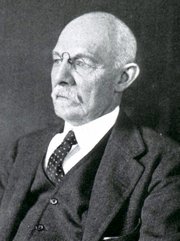
William S. Halsted, MD
(1852 – 1922)
American anatomist, teacher, and surgeon, William Stewart Halsted was born in New York City, USA to a wealthy family of English origin. His father was involved in charitable work and Governor and trustee to a city hospital. Not a brilliant student initially, Halsted took an undergraduate in Liberal Arts in Yale, CT., after which he entered the Medical College of Physicians at the Columbia College, where he excelled.
As a second-year medical student Halsted applied and obtained a position in surgery at a local hospital. In here he learned about Lister’s antiseptic technique and became an adamant proponent of it to reduce infection. In 1877 Halsted obtained his MD. After a short time as House Physician at the New York Hospital, Halsted traveled to Europe to further his education studying for two years at the Universities of Vienna, Leipzig, and W?rzburg.
Besides being at the forefront of surgical and antiseptic techniques (introducing the use of rubber gloves in surgery), Halsted was extremely concerned with the way medical students were taught in the US. He pioneered bedside clinical round discussions with the medical students after two years of basic sciences studies. Halsted developed the idea of a patient chart; he also developed the residency program for medical students in use today.
Halsted is probably the most influential researcher and surgeon at the turn of the century. He dedicated time to the study of intestinal anastomoses and the use of silk as a suture material. His experimental work in 1887 proved that the inclusion of the submucosa layer in an anastomosis was mandatory, as well that a single layered anastomosis was enough to attain closure. Perhaps Halsted’s most important contribution was the application and use of the scientific method to surgical questions. Halsted’s principles, also known as "Halsted's Rules of Surgery", set the standards used today in surgical suturing and surgical stapling.
He also pioneered the development and surgical techniques for radical mastectomy as a treatment for breast cancer.
As a side effect of this studied in anesthesia and the use of cocaine for anesthesia, Halsted became addicted to this substance, a problem that followed him through the years. Without impairing his capacity as a researcher and a surgeon, Halsted eventually recovered. He died in Baltimore in 1922 as a complication to surgery.
Sources:
1. Dubay, A. D., & Franz, G. M. (2003). Acute Wound Healing: The Biology of Acute Wound Failure. Surg Clin NA, 83, 463-481.
2. Halsted, W. S. (1887). Circular Suture of the Intestine - An Experimental Study. Am J Med Sci, 436-461.
3. “William Stewart Halsted: his life and contributions to surgery” Osborne, P. Lancet Oncol 2007; 8: 256–65
4. “William Stewart Halsted: Surgical pioneer” Burress, P Endoc Today (2010), 8: (2) 22
5. “William Stewart Halsted (1852–1922) Neurological stamp” Haas, LF J Neurol Neurosurg Psych 2000;69:641
Original image courtesy of "Images from the History of Medicine" at www.nih.gov

"Clinical Anatomy Associates, Inc., and the contributors of "Medical Terminology Daily" wish to thank all individuals who donate their bodies and tissues for the advancement of education and research”.
Click here for more information


- Details
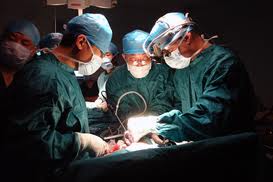
Image courtesy of Dr. Randall Wolf
UPDATED: This Latin aphorism is at the core of Medicine and Surgery. It means "Above all, do no harm". Another translation would be "First, do no harm". The works of Hippocrates mentions the concept in his book Epidemics , and it has been presented in one way or another trough the ages. Thomas Sydenham (1624 - 1689), an English physician, is probably the first one to use it in an English publication, although his Latin phrase was "Primum est ut, non nocere". The first use of the modern phrasing "Primum Non Nocere" was by Lewis Atterbury Stimson (1844 - 1917), an American surgeon in 1879.
It seems almost counterintuitive that surgery would attempt to do no harm, but this is what moves innovation. From sharper needles that require less force to penetrate, and sharper scalpels that cause less trauma to tissues, to surgical staplers and minimally invasive techniques that attempt to reduce the size of the incision and the overall damage to the tissues.
The design of new surgical devices and new surgical techniques should always attempt to answer to this most important rule of surgery: "Primum Non Nocere".
As a point of interest, the Latin term [nocere] is the basis for the medical term [noxa] means "injury", "harm", or damage", this being the root for the term [noxious]
Sources
1. "Origin and Uses of Primum Non Nocere — Above All, Do No Harm!" Smith, CM J Clin Pharmacol 2005 45 (4): 371–377
2. "On abdominal drainage of adherent portions of ovarian cysts as a substitute for completed ovariotomy" Stimson LA Am J Med Sci 1879;78:88-100.
- Details
Since it's my birthday, I am taking the day off!
Not really, I am traveling to the "Vesalius and the Invention of the Modern Body" symposium in St. Louis. Looking forward to this meeting and the "Fabrica Vitae" exhibit by Pascale Pollier!!
I will post from the meeting and let you know what is going on!
See you tomorrow!
- Details
This word has three combined roots. [Chol-] or [chole-] meaning "bile", [-doch-] meaning "duct", and [-lith-], meaning " stone". The initial two combined roots [choledoch-] mean "bile duct." Many teach that [choledoch-] means "common bile duct'; although this is an accepted use of the term, it is not its true meaning.
The suffix [-iasis] means "condition". Therefore, the medical word [choledocholithiasis] means "condition of stones in the bile duct" , or more commonly understood as, "condition of stones in the common bile duct".
- Details

The term [myopectineal orifice] was coined originally by Dr. Henri Fruchaud, and refers to a "distinct area of weakness in the pelvic region". The term [myopectineal] arises from two root terms which are combined. The root term [-my-] means "muscle" and the term [-pect-] means "comb"or "pectinate". The word [pectineal] in this case refers to the pelvic bone area of origin of the pectinate muscle of the thigh.
Fruchaud postulated that the anterior abdominal wall has an area that is inherently weak, and that this area is genetically determined. As such, hernias are part of human nature, or as he stated, "a healthy man is, unknown to himself, a hernia bearer".
The myopectineal orifice, or MPO, is bound superiorly by the arching fibers of the transversus abdominis and internal oblique muscles, and inferiorly by the pectineal line.
The MPO is then composed by two regions separated by the inguinal ligament; the suprainguinal region, marked by one asterisk and site for direct and indirect inguinal hernias, and a small subsegment of the subinguinal region, (marked by two asterisks), site for femoral hernias.
In the accompanying sketch, the subinguinal region looks large, but this area is closed off by muscles, arteries, veins, and nerves, leaving only a small area of weakness (the femoral ring) where femoral hernias can arise.
Fruchaud advanced the separate concepts of inguinal hernias and femoral hernias and provided a new (for the time) concept of the repair of these hernias. Today, with laparoscopic herniorrhaphy, a surgeon attempts to repair the weak MPO instead of only the herniated locus.
Image property of:CAA.Inc.. Artist:David M. Klein
Source:
"Henri Fruchaud (1894–1960): A man of bravery, an anatomist a surgeon" Stoppa,R and Wantz,G. Hernia 1998,Vol 2,(1) 45 - 47
Clinical anatomy of the inguinofemoral hernias, as well as abdominal and perineal hernias are some of the lecture topics developed and delivered to the medical devices industry by Clinical Anatomy Associates, Inc. For more information Contact Us.
- Details
Click for a larger image
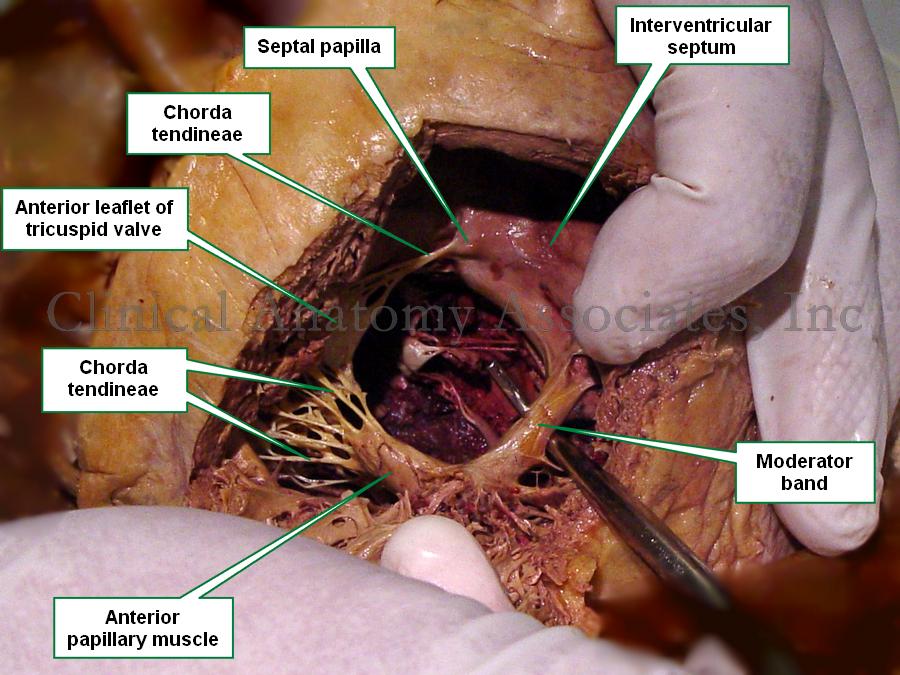
Also known as the [septomarginal trabecula], the [moderator band] is part of the conduction system of the heart.
The moderator band is found in the right ventricle of the heart and extends from the the interventricular septum to the base of the anterior papillary muscle. Although always present, it can have interesting anatomical variations, ranging from being double or triple, to being extremely thin or thick. In some cases, it can be confused as one of the trabeculae carnae.
The moderator band, usually clean on its superior aspect, may present with thin bands of tissue that extend towards the anterior wall of the right heart.
It was initially described by Leonardo Da Vinci, and English anatomists called it the "moderator band", because of its location. The initial belief was that the function of this structure was to prevent excessive ballooning of the right ventricle, "moderating" its dilation. Its descriptive name, the "septomarginal trabecula" was coined by Julius Tandler (1869 - 1936).
The moderator band as part of the conduction system of the heart, allows for some of the fibers of the right bundle branch to reach the wall of the right side of the heart. Its structure and function is similar to the atria internodal tracts, only in this case the conduction is not between the sinoatrial node and the interventricular node. The moderator band bypasses the apex of the heart and facilitates the passage of the electrical impulse from the interventricular septum to the right ventricular wall. is Click on the image for a larger version
Sources:
1. "Tratado de Anatomia Humana" Testut et Latarjet 8 Ed. 1931 Salvat Editores, Spain
2. "Gray's Anatomy"38th British Ed. Churchill Livingstone 1995
- Details
Click for a larger image
The word [trachelectomy] is composed of the root term [-trache-] which arises from the Greek word [τράχηλος] (trahelos), meaning “neck”, and the suffix [-ectomy] meaning “removal of”. The word [trachelectomy] then means “removal of the neck”.
Another way to refer to this procedure is [cervicectomy], where the root term [-cervic-] arises fron the Latin term [cervix], also meaning neck.
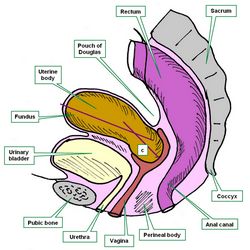
The procedure refers to the removal of the neck or cervix of the uterus. It can be performed as a procedure where the cervix is removed leaving the body of the uterus or [uterus proper] in place. This is done is younger females where there is a cervical cancer, but there is still the possibility of attaining pregnancy. The procedure carries a higher chance of miscarriage and the baby must be delivered via a Cesarean section.
A second reason to remove the cervix of the uterus is as a secondary procedure, after the uterus proper has been removed as part of a supracervical hysterectomy and the cervix, left behind, shows signs of cancer.
Medical terminology note: Trachelectomy and cervicectomy… why are there two terms for the same procedure? That is actually quite common in medical terminology, where you have words having the same meaning that arise from Latin and Greek. In fact, there are cases where there are more than two terms for the same organ or procedure, and let’s not count the vernacular terms on top! This makes medical terminology and interesting and fascinating topic. I would suggest that you click around the links for this article, you will find some interesting information. Dr. Miranda