
Medical Terminology Daily (MTD) is a blog sponsored by Clinical Anatomy Associates, Inc. as a service to the medical community. We post anatomical, medical or surgical terms, their meaning and usage, as well as biographical notes on anatomists, surgeons, and researchers through the ages. Be warned that some of the images used depict human anatomical specimens.
You are welcome to submit questions and suggestions using our "Contact Us" form. The information on this blog follows the terms on our "Privacy and Security Statement" and cannot be construed as medical guidance or instructions for treatment.
We have 173 guests online
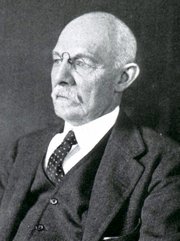
William S. Halsted, MD
(1852 – 1922)
American anatomist, teacher, and surgeon, William Stewart Halsted was born in New York City, USA to a wealthy family of English origin. His father was involved in charitable work and Governor and trustee to a city hospital. Not a brilliant student initially, Halsted took an undergraduate in Liberal Arts in Yale, CT., after which he entered the Medical College of Physicians at the Columbia College, where he excelled.
As a second-year medical student Halsted applied and obtained a position in surgery at a local hospital. In here he learned about Lister’s antiseptic technique and became an adamant proponent of it to reduce infection. In 1877 Halsted obtained his MD. After a short time as House Physician at the New York Hospital, Halsted traveled to Europe to further his education studying for two years at the Universities of Vienna, Leipzig, and W?rzburg.
Besides being at the forefront of surgical and antiseptic techniques (introducing the use of rubber gloves in surgery), Halsted was extremely concerned with the way medical students were taught in the US. He pioneered bedside clinical round discussions with the medical students after two years of basic sciences studies. Halsted developed the idea of a patient chart; he also developed the residency program for medical students in use today.
Halsted is probably the most influential researcher and surgeon at the turn of the century. He dedicated time to the study of intestinal anastomoses and the use of silk as a suture material. His experimental work in 1887 proved that the inclusion of the submucosa layer in an anastomosis was mandatory, as well that a single layered anastomosis was enough to attain closure. Perhaps Halsted’s most important contribution was the application and use of the scientific method to surgical questions. Halsted’s principles, also known as "Halsted's Rules of Surgery", set the standards used today in surgical suturing and surgical stapling.
He also pioneered the development and surgical techniques for radical mastectomy as a treatment for breast cancer.
As a side effect of this studied in anesthesia and the use of cocaine for anesthesia, Halsted became addicted to this substance, a problem that followed him through the years. Without impairing his capacity as a researcher and a surgeon, Halsted eventually recovered. He died in Baltimore in 1922 as a complication to surgery.
Sources:
1. Dubay, A. D., & Franz, G. M. (2003). Acute Wound Healing: The Biology of Acute Wound Failure. Surg Clin NA, 83, 463-481.
2. Halsted, W. S. (1887). Circular Suture of the Intestine - An Experimental Study. Am J Med Sci, 436-461.
3. “William Stewart Halsted: his life and contributions to surgery” Osborne, P. Lancet Oncol 2007; 8: 256–65
4. “William Stewart Halsted: Surgical pioneer” Burress, P Endoc Today (2010), 8: (2) 22
5. “William Stewart Halsted (1852–1922) Neurological stamp” Haas, LF J Neurol Neurosurg Psych 2000;69:641
Original image courtesy of "Images from the History of Medicine" at www.nih.gov

"Clinical Anatomy Associates, Inc., and the contributors of "Medical Terminology Daily" wish to thank all individuals who donate their bodies and tissues for the advancement of education and research”.
Click here for more information


- Details
This article is part of the series "A Moment in History" where we honor those who have contributed to the growth of medical knowledge in the areas of anatomy, medicine, surgery, and medical research.

Original image courtesy of the
National Library of Medicine
Jean Louis Petit (1674 – 1750). French surgeon and anatomist, Jean Louis Petit was born in Paris in on March 13, 1674. His family rented an apartment at his house to Alexis Littre (1658 – 1726), a French anatomist. Petit became an apprentice of Littre at seven years of age, helping him in the dissections for his lectures and at an early age became the assistant in charge of the anatomic amphitheater.
Because of Petit’s dedication to anatomy and medicine, in 1690 at the age of sixteen, became a disciple of a famous Paris surgeon, Castel.
In 1692, Petit entered the French army and performed surgery in two military campaigns. By 1693 he started delivering lectures and was accepted as a great surgeon, being invited to the most difficult operations. In 1700 he was appointed Chief Surgeon of the Military School in Paris and in the same year he received the degree of Master of Surgery from the Faculty of Paris.
In 1715 he was made a member of the Royal Academy of Sciences and an honorary member of the Royal Society of London. He was appointed by the King as the first Director General of the Royal Academy of Surgery when it was founded in 1731.
Petit’s written works are of historical importance. “Traite des Maladies des Os” ( A Treatise on Bone Diseases); “Traite des Maladies Chirurgicales et des Operation” (A Treatise on Surgical Diseases and their Operations” This last book was published posthumously in 1774. He also published a monograph on hemorrhage, another on lachrymal fistula, and others.
He was one of the first to perform choIecystotomy and mastoidotomy. His original tourniquet design for amputations saved many in the battlefield and the design of the same surgical instrument today has not changed much since its invention by him.
His name is remembered in the lumbar triangle, also called the "triangle of Petit", and the abdominal hernia that can ensue through that area of weakness, the lumbar hernia or "Petit's hernia".
Sources:
1. “Jean Louis Petit – A Sketch of his Life, Character, and Writings” Hayne, AP San Fran Western Lancet 1875 4: 446-454
2. “Oeuvres compl?tes de Jean-Louis Petit” 1837 Imprimerie de F. Chapoulaud
3. Extraits de l'eloge de Jean-Louis Petit Ius dans Ia seance publique de I' Academie royale de chirurgie du 26 mai 1750” Louis A. Chirurgie 2001: 126 : 475- 81
- Details
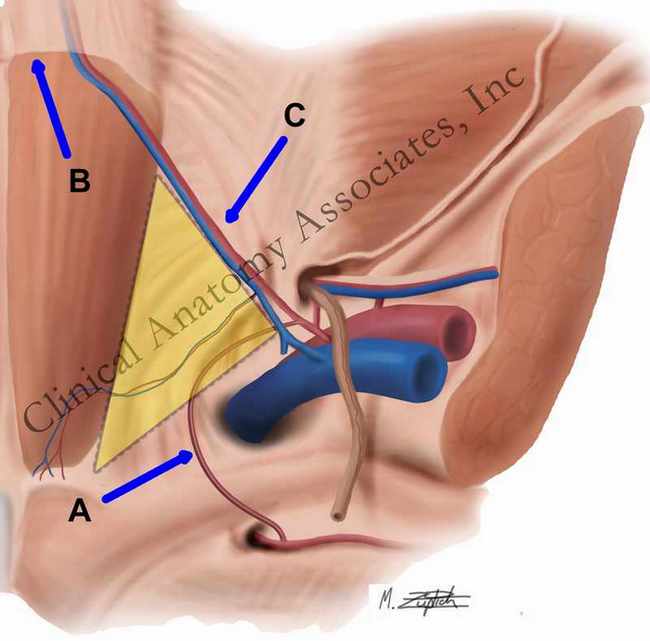
Corona mortis (A)
Important for inguinal hernia anatomy and surgery, this term is Latin from [corona] meaning "crown' and [mortis] meaning "death'; the "crown or circle of death". The corona mortis (blue arrow) refers to an anatomical variation1, a vascular anastomosis between the obturator and the external iliac vascular systems that passes over Cooper's pectineal ligament and posterior to the lacunar (Gimbernat's) ligament.
In some cases, the corona mortis is the actual obturator artery that arises from the inferior epigastric artery instead of the internal iliac artery. It can also arise from the external iliac artery. In both cases, it has been called an "aberrant obturator artery". This could be a misnomer, as this anatomical variation can be present in up to 25% of the cases. When present, the corona mortis can be injured when a surgeon looks to enlarge the femoral ring by opening the lacunar ligament from the anterior aspect. In this approach the "corona mortis" is not visible, as it is found immediately posterior to the lacunar ligament. This vascular structure could even be endangered in a laparoscopic procedure for inguinal of femoral hernia repair and a staple or tack is driven blindly into the pectineal (Cooper's) ligament.
Berberoglu states that "although these tiny anastomoses... have been described in classical anatomy textbooks, these texts neglect to mention that theses anastomoses can be life-threatening".
In some rare cases, the corona mortis (aberrant obturator artery) coexists with the normal obturator artery. Although called a [corona], this anatomical structure is an incomplete circle. In the image, the [corona mortis] is labeled "A".
Sources:
1. Rusu et al: "Anatomical considerations on the corona mortis" Surg Radiol Anat (2010) 32:17–24
2. Berberoglu et al: "An anatomic study in seven cadavers and an endoscopic study in 28 patients" Surg Endosc (2001) 15:72-75
Image property of:CAA.Inc.. Artist:M. Zuptich
- Details
UPDATED: The word [catamenial] is Greek. The prefix [cata-] arises from [, from [κάτω] (kato) meaning "down", "down because of", or "down to", the root term )[-men-] from [μήνας] (menas) meaning "month", referring to "lunar month" or to a female's menstrual cycle, which is usually just about a lunar month long, and the adjectival suffix [-ial] means "pertaining to".
[Catamenial] then means "to be down (sick) during a menstrual cycle" and refers to a condition that recurs in reference to menses.
Examples of the use of this word are:
• Catamenial depression or catamenial psychosis
• Catamenial pneumothorax - related to endometriosis
• Catamenial epilepsy or seizures
The links will open scholarly articles that use this word.
- Details
The root term [-asthen-] originates from the Greek word [ασθενεσ] (asthenes), meaning “weak” or “feeble”. It can be used with the adjectival suffixes [-ic] or [-ia], both meaning “pertaining to” to form the medical words [asthenic] and [asthenia], meaning “weak” and “weakness”.
It is also found in other medical words such as:
- Myasthenia: The root term [-my-] means “muscle”. Weak muscles
- Neurasthenia: The root term [-neur-] means “nerve”. Initially used to denote an actual weak nerve, it has evolved today to mean someone with a “weak nerves condition”, with fatigue, headaches or migraines, and sometimes depression.
- Angiasthenia or angioasthenia: Both are correct. The root term [-angi-] means “vessel”. The terms refer to a weak condition of the cardiovascular system.
- Asthenophobia: Fear of being weak
Personal note: There was a time in the 1800’s when the term [asthenic] was used to refer to a person as a “weakling”.
- Details
The root term [-pyr] originates from the Greek [πυροσ] (pyros) meaning “fire”. In medical terminology it is used in reference to high temperature or “fever” as in the following terms:
- Antipyretic: The prefix [anti-] means “against”. A medicine that reduces fever
- Apyretic: No fever
- Pyrexia: Condition of fever. Fever
- Pyretic: That which can cause fever
- Pyrogenic: The suffix [-(o)genic] means “generation” or “cause”. Something that can generate fever
- Pyrolytic: The suffix [-(o)lytic] means “destruction” or “dissolution”. Something that destroys or stops fever
- Pyromaniac: An individual obsessed by fire
The term can also be found in vernacular English is words such as:
- Pyrotechnics: Fireworks
- Pyromancy: The art of divination by the observation of fire
- Details
Click for a larger image
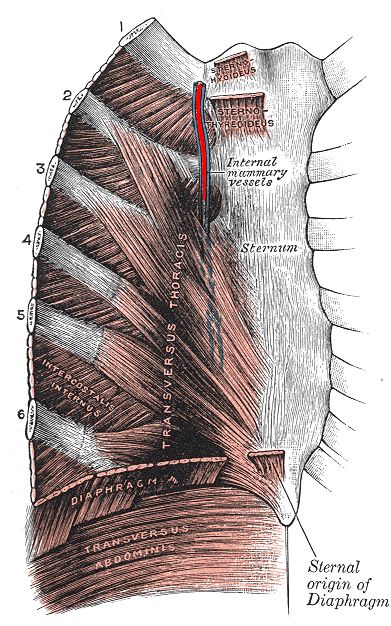
The [internal thoracic artery] is a bilateral artery of the thorax and is known to many as the [internal mammary artery], although this is not its proper anatomical name.
The internal thoracic artery is the first branch to arise off the subclavian artery. It descends inferiorly in a parasternal position, on the posterior aspect of the anterior thoracic cage. It is in contact with the ribs and as it descends it is covered posteriorly by the transversus thoracis muscle.
At the level of the sixth costal cartilage the internal thoracic artery gives off the musculophrenic artery and changes its name, continuing inferiorly as the superior epigastric artery. This artery will pass through one of the hiatuses of the respiratory diaphragm and in turn will become the inferior or deep epigastric artery at the level of the umbilicus. The deep epigastric artery (one of the boundaries of Hesselbach's triangle) will in turn open into the external iliac artery. The internal thoracic artery is part of a longitudinal collateral circulation arterial channel that parallels the aorta.
The internal thoracic artery will give off several branches. The first one is usually the pericardiacophrenic artery, a long artery that descends with the phrenic nerve alongside the parietal pericardium providing blood supply, as its name implies, to the pericardium and the phrenic nerve. Other branches are the anterior intercostal arteries, which communicate with the posterior intercostal arteries and the aorta.
The internal thoracic artery also gives arterial branches to the sternum and provides superficial, perforating branches to the medial side of the breast, hence its clinical name, the internal mammary artery.
The internal thoracic artery can be used to create a cardiac graft when performing a Coronary Artery Bypass Graft (CABG). Because of the two names used to denote this artery, surgeons will refer to the procedure either as a ITA (internal thoracic artery) or an IMA (internal mammary artery) CABG.