
Medical Terminology Daily (MTD) is a blog sponsored by Clinical Anatomy Associates, Inc. as a service to the medical community. We post anatomical, medical or surgical terms, their meaning and usage, as well as biographical notes on anatomists, surgeons, and researchers through the ages. Be warned that some of the images used depict human anatomical specimens.
You are welcome to submit questions and suggestions using our "Contact Us" form. The information on this blog follows the terms on our "Privacy and Security Statement" and cannot be construed as medical guidance or instructions for treatment.
We have 1502 guests online
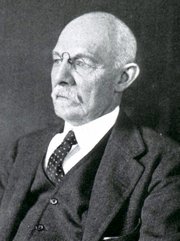
William S. Halsted, MD
(1852 – 1922)
American anatomist, teacher, and surgeon, William Stewart Halsted was born in New York City, USA to a wealthy family of English origin. His father was involved in charitable work and Governor and trustee to a city hospital. Not a brilliant student initially, Halsted took an undergraduate in Liberal Arts in Yale, CT., after which he entered the Medical College of Physicians at the Columbia College, where he excelled.
As a second-year medical student Halsted applied and obtained a position in surgery at a local hospital. In here he learned about Lister’s antiseptic technique and became an adamant proponent of it to reduce infection. In 1877 Halsted obtained his MD. After a short time as House Physician at the New York Hospital, Halsted traveled to Europe to further his education studying for two years at the Universities of Vienna, Leipzig, and W?rzburg.
Besides being at the forefront of surgical and antiseptic techniques (introducing the use of rubber gloves in surgery), Halsted was extremely concerned with the way medical students were taught in the US. He pioneered bedside clinical round discussions with the medical students after two years of basic sciences studies. Halsted developed the idea of a patient chart; he also developed the residency program for medical students in use today.
Halsted is probably the most influential researcher and surgeon at the turn of the century. He dedicated time to the study of intestinal anastomoses and the use of silk as a suture material. His experimental work in 1887 proved that the inclusion of the submucosa layer in an anastomosis was mandatory, as well that a single layered anastomosis was enough to attain closure. Perhaps Halsted’s most important contribution was the application and use of the scientific method to surgical questions. Halsted’s principles, also known as "Halsted's Rules of Surgery", set the standards used today in surgical suturing and surgical stapling.
He also pioneered the development and surgical techniques for radical mastectomy as a treatment for breast cancer.
As a side effect of this studied in anesthesia and the use of cocaine for anesthesia, Halsted became addicted to this substance, a problem that followed him through the years. Without impairing his capacity as a researcher and a surgeon, Halsted eventually recovered. He died in Baltimore in 1922 as a complication to surgery.
Sources:
1. Dubay, A. D., & Franz, G. M. (2003). Acute Wound Healing: The Biology of Acute Wound Failure. Surg Clin NA, 83, 463-481.
2. Halsted, W. S. (1887). Circular Suture of the Intestine - An Experimental Study. Am J Med Sci, 436-461.
3. “William Stewart Halsted: his life and contributions to surgery” Osborne, P. Lancet Oncol 2007; 8: 256–65
4. “William Stewart Halsted: Surgical pioneer” Burress, P Endoc Today (2010), 8: (2) 22
5. “William Stewart Halsted (1852–1922) Neurological stamp” Haas, LF J Neurol Neurosurg Psych 2000;69:641
Original image courtesy of "Images from the History of Medicine" at www.nih.gov

"Clinical Anatomy Associates, Inc., and the contributors of "Medical Terminology Daily" wish to thank all individuals who donate their bodies and tissues for the advancement of education and research”.
Click here for more information


- Details
This is a series of articles on depression and published as a community service. The information in these articles follow our Privacy and Security Guidelines and cannot be construed as medical guidance. For additional information and counseling, consult with your physician or the appropriate health care professional of your choice. You can also find information on Transcranial Magnetic Stimulation (TMS) here. For the initial article on this series click here.
The medical term meaning "cause" is [etiology]. As you talk to a physician or research on the causes of depression knowing this term will come in handy. Most likely, the etiology of depression is a combination of genetic, biological, environmental, and psychological factors.
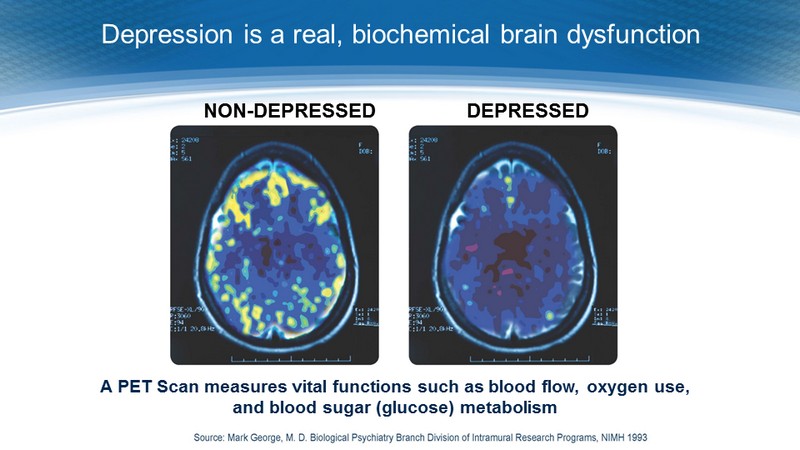
Depressive pathologies are disorders of the brain. Brain-imaging technologies, such as Magnetic Resonance Imaging (MRI), have shown that the brains of patients who have depression are physically different than those of non-depressed individuals. This is important to understand. A depression patient is not a "mental" or "crazy" person in the fact that there is an underlying physical brain disorder causing the depression. They are not "faking it" and the treatment must look into getting the brain back into a normal physical pattern.
The following images show a Positron Emission Tomography (PET) scan of both a non-depressed and a depressed individuals. In these images the areas of the brain involved in mood, thinking, sleep, appetite, and behavior appear different. These images do not reveal why the depression has occurred, only that a depressed brain is physically different from a non-depressed brain.
Click on the image for a larger view
Some types of depression tend to run in families, indicating a genetic base for the pathology. However, depression can occur in people without family history of depression. Scientists are studying certain genes that may make some people more prone to depression. Some genetics research indicates that risk for depression results from the influence of several genes acting together with environmental or other factors. In addition, trauma, the loss of a loved one, a difficult relationship, long winter seasons, or any stressful situation may trigger a depressive episode. Other depressive episodes may occur with or without an obvious trigger.
Who is at risk?
Major depressive disorder is one of the most common mental disorders in the United States. Each year about 6.7% of U.S adults experience major depressive disorder. Women are 70 % more likely than men to experience depression during their lifetime. Non-Hispanic blacks are 40% less likely than non-Hispanic whites to experience depression during their lifetime. The average age of onset is 32 years old. Additionally, 3.3% of 13 to 18 year olds have experienced a seriously debilitating depressive disorder.
Depression also may occur with other serious medical illnesses such as heart disease, stroke, cancer, HIV/AIDS, diabetes, and Parkinson's disease. People who have depression along with another medical illness tend to have more severe symptoms of both depression and the medical illness, more difficulty adapting to their medical condition, and more medical costs than those who do not have co-existing depression. Treating the depression can also help improve the outcome of treating the co-occurring illness
Source: National Institute of Mental Health
Next article: Types of Depression
- Details
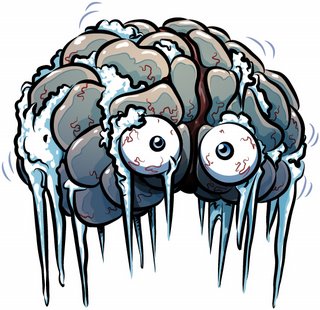
BRRRRRRRR!!
A reminder of one of the joys of summer! The term [sphenopalatine ganglioneuralgia] is a fancy medical term for "brain freeze". which happens when we eat or drink very cold food.
The etymology of the term is complex. [Sphen-] is a term meaning "wedge" and refers to the sphenoid bone. [-palatine-] means "pertaining to the palate" (and to the bones related to the hard palate].
The root term [-gangli-] refer to a ganglion, which is a concentration of neuronal bodies, neurons being the main cells of the nervous system. [-neur-] means "nerve", and the suffix [-algia] means "pain". Simply said, the term [sphenopalatine ganglioneuralgia] means "nerve pain of the sphenopalatine ganglion".
The sphenopalatine ganglion (Meckel's ganglion, nasal ganglion or pterygopalatine ganglion) is a parasympathetic ganglion found in the pterygopalatine fossa. It is largely innervated by the greater petrosal nerve (a branch of the facial nerve); and its neuronal axons innervate the lacrimal glands and nasal mucosa.
Not everybody accepts this theory. Some state that "brain freeze" occurs because of rapid cooling of the blood in the pharynx, causing a drop of temperature of the internal carotid artery, which in turn causes cooling and pain in the meninges related to the base of the cranium.
My thanks to Gina Burg, for bringing this term to my attention. Dr. Miranda
Thanks to Forrest J. Bonjo for the image and additional information. The article was originally stored at pdu.edu, but the server was closed. If you click on the image, this will take you to the article stored at web.archive.org.
- Details

Click for a larger image
There are many in the world that are fascinated by the life and works of Andreas Vesalius (1514 -1564). This has created a market for “Vesaliana”. These are books, art, medals, and works are related to Vesalius. As an example, an original 1543 Fabrica sells today for 400 thousand dollars! Even the “New Fabrica” by Drs. Garrison and Hast has cuadrupled its value in only two years since its publication!
Some of the most coveted items are stamps that celebrate the illustrious anatomist. Probably the most detailed research on the topic was made by Prof. Omer Steeno and Dr. Maurits Biersbrouck, both contributors to this website. Their research is constantly updated and the latest iteration of their work is “Andreas Vesalius in Philately” published in WordPress.com.
In a recent private communication Prof. Steeno regretted that unscrupulous individuals have taken to forge and falsify stamps. A clear case of this is the stamp collection “Les Grands Scientifiques de la Rennaissance” published in November 23, 2006 by the Republic of Djibouti. The stamps (shown in the accompanying image) depict Leonardo da Vinci, Nicolas Copernicus, Galileo Galilei, and Andreas Vesalius. As a Vesaliana collector, who would not want this set of stamps placing Vesalius in such company?
Djibouti is an African country that gained its independence from France in 2007 and is located in the horn of East Africa and the opening of the Red Sea into the Gulf of Aden.
Drs. Steeno and Beisbrocuk contacted the Djibouti postal service and were able to confirm in February, 2016 that indeed these stamps are false and collectors should be aware.
Sources:
1. “Andreas Veslius in Plhilately” Steeno, O; Biesbrouck, M 2016
2. Private communication. Steeno, O. 2016
3. “On the falsification of a Vesalius Stamp wrongfully ascribed to the postal service of Djibouti” Steeno, O; Biesbrouck, M 2016. EMediTheme 2016 Editor: Menzies, S.
- Details
This is a series of articles on depression and published as a community service. The information in these articles follow our Privacy and Security Guidelines and cannot be construed as medical guidance. For additional information and counseling, consult with your physician or the appropriate health care professional of your choice. You can also find information on Transcranial Magnetic Stimulation (TMS) here. For the initial article on this series click here.
UPDATED: People with depressive pathology do not all experience the same symptoms. The severity, frequency, and duration of symptoms vary depending on the individual and his or her particular illness. Because symptoms are subjective, some patients will not express or hide them, making the diagnosis of depressive disorder difficult.
Following are the description of the symptoms by two different patients:
Patient 1
"It was really hard to get out of bed in the morning. I just wanted to hide under the covers and not talk to anyone. I didn't feel much like eating and I lost a lot of weight. Nothing seemed fun anymore. I was tired all the time, and I wasn't sleeping well at night. But I knew I had to keep going because I've got kids and a job. It just felt so impossible, like nothing was going to change or get better."
Patient 2
"I felt dirty and unwashed. All my surroundings felt dirty and I spent hours cleaning the house with no results. I took long baths and even after them I still felt dirty. My sleep was broken with horrible nightmares with gore and destruction. I felt tired, mostly because I could not sleep. I cried every morning because I felt like a total failure. I felt ugly and no amount of makeup could cover this feeling. I did not want to go out in public at all"
Signs and symptoms of depression may include:
• Persistent sad, anxious, or "empty" feelings
• Feelings of hopelessness or pessimism
• Feelings of guilt, worthlessness, or helplessness
• Irritability, restlessness
• Loss of interest in activities or hobbies once pleasurable, including sex
• Fatigue and decreased energy
• Difficulty concentrating, remembering details, and making decisions
• Insomnia, early-morning wakefulness, or excessive sleeping
• Overeating, or appetite loss
• Thoughts of suicide, suicide attempts
• Aches or pains, headaches, cramps, or digestive problems that do not ease even with treatment
Next article: Causes of Depression
- Details
This is a series of articles on depression published as a community service. The information in these articles follow our Privacy and Security Guidelines and cannot be construed as medical guidance. For additional information and counseling, consult with your physician or the appropriate health care professional of your choice. You can also find information on TMS here.
Click for a larger image
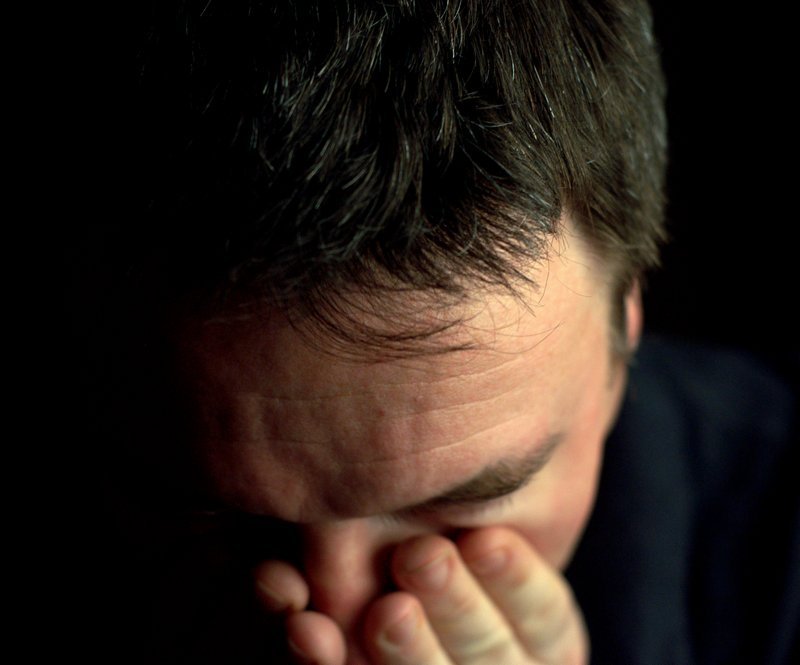
UPDATED: Everyone occasionally feels blue or sad. There are also those dreaded "winter blues". But these feelings are usually short-lived and pass within a couple of days, usually with no problems or persistent symptoms. Some people may even say that they are "depressed". Although this is true, that person is not clinically depressed.
When an individual has clinical depression, there are physical changes that happen within the brain which reflect in attitudes, mood, symptoms, and actions.
Clinical depression is a common but serious mental disorder that affects over 20 million people in the United States, many of which will never seek diagnosis or treatment. Patients present with depressed mood, loss of interest or pleasure, decreased energy, feelings of guilt or low self-worth, abnormal patterns of sleep or appetite, gruesome nightmares, and poor concentration. Moreover, depression may often come with symptoms of anxiety and varying complex presentations of bipolar disorder.
These problems can become chronic or recurrent and lead to substantial impairment in an individual’s ability to take care of his or her everyday responsibilities. At its worst, depression can lead to a patient's attempt on their life. Clinical Depression interferes with daily life and causes pain for both the individual, their families, and loved ones. Patients with depressive disorder often go from one job to another, cannot work, or eventually end in disability, being maintained by their family or loved ones.
Many people afflicted with Major Depressive Disorder (MDD) never seek treatment. This is specially true in males, where the World Health Organization (WHO) estimates that ”fewer than 25% of male sufferers worldwide will seek treatment because of the social stigma associated with mental disorders including depression.”
Properly and timely treated, even those with the most severe depression, can get better. Medications, psychotherapy, and electroconvulsive therapy (ECT) are the most common methods to treat depression. As patients move from one medication to the next level medication as well as augmentation medication, the annual cost for medication can be staggering, as well as the common, insidious, and problematic systemic side effects of both the drug therapy and ECT therapy.
The main objective of all treatments for MDD is to attain remission, but in many cases just reducing the symptoms of MDD and reducing the amount and types of medication used is enough to bring the patient back to a productive life and enhance the relationship with their families and loved ones.
Next article: Symptoms of Depression
- Details
Click for a larger image
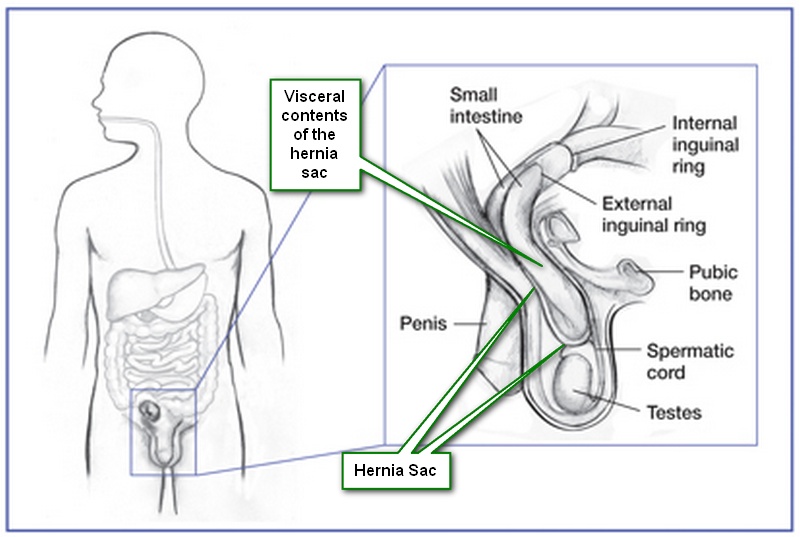
UPDATED: The definition of hernia is "the protrusion of a deep structure through a superficial weakness of defect".
Herniation has many etiologies, but in all cases a weakness of a superficial containing wall (usually layered) or a normal or abnormal opening (defect) must be present. A true hernia usually has a deep sac or hernia sac which contains the herniated viscus or viscera. Repair of a hernia is called a hernioplasty or a herniorrhaphy.
Although with exceptions, a herniation with only weakening of the walls and no hernia sac can be called a "prolapse", the suffix for prolapse (or hernia sometimes) is [-ocele].
• Omphalocele: From the Greek [omphalos] meaning "umbilicus", an omphalocele is a herniation through the umbilicus.
• Cystourethocele: A prolapse of the urinary bladder and urethra with a weakened vaginal wall
There are also "internal' hernias, between bodily compartments. Examples are:
• Esophageal hiatus hernia: Known as a "hiatal hernia", this hernia is a protrusion of a peritoneal sac with abdominal visceral content into the thorax.
• Perineal hernia: The protrusion of abdominopelvic content into the perineal region through a defect in the pelvic diaphragm (levator ani)
A hernia is usually named for the superficial region where it protrudes. An example of this would be a femoral hernia, which starts as an abdominopelvic extrusion, but it ends protruding in the area of the thigh (femoral region). Abdominal or ventral hernias are named according to the abdominal region through which they protrude.
in older times the word "rupture" was used as a synonym for "hernia", as can be seen in a letter written by Dr. Ephraim McDowell in 1829. The image shows an example of an indirect inguinal hernia.
Original Image public domain courtesy of: nih.gov.
