
Medical Terminology Daily (MTD) is a blog sponsored by Clinical Anatomy Associates, Inc. as a service to the medical community. We post anatomical, medical or surgical terms, their meaning and usage, as well as biographical notes on anatomists, surgeons, and researchers through the ages. Be warned that some of the images used depict human anatomical specimens.
You are welcome to submit questions and suggestions using our "Contact Us" form. The information on this blog follows the terms on our "Privacy and Security Statement" and cannot be construed as medical guidance or instructions for treatment.
We have 276 guests online
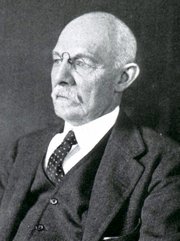
William S. Halsted, MD
(1852 – 1922)
American anatomist, teacher, and surgeon, William Stewart Halsted was born in New York City, USA to a wealthy family of English origin. His father was involved in charitable work and Governor and trustee to a city hospital. Not a brilliant student initially, Halsted took an undergraduate in Liberal Arts in Yale, CT., after which he entered the Medical College of Physicians at the Columbia College, where he excelled.
As a second-year medical student Halsted applied and obtained a position in surgery at a local hospital. In here he learned about Lister’s antiseptic technique and became an adamant proponent of it to reduce infection. In 1877 Halsted obtained his MD. After a short time as House Physician at the New York Hospital, Halsted traveled to Europe to further his education studying for two years at the Universities of Vienna, Leipzig, and W?rzburg.
Besides being at the forefront of surgical and antiseptic techniques (introducing the use of rubber gloves in surgery), Halsted was extremely concerned with the way medical students were taught in the US. He pioneered bedside clinical round discussions with the medical students after two years of basic sciences studies. Halsted developed the idea of a patient chart; he also developed the residency program for medical students in use today.
Halsted is probably the most influential researcher and surgeon at the turn of the century. He dedicated time to the study of intestinal anastomoses and the use of silk as a suture material. His experimental work in 1887 proved that the inclusion of the submucosa layer in an anastomosis was mandatory, as well that a single layered anastomosis was enough to attain closure. Perhaps Halsted’s most important contribution was the application and use of the scientific method to surgical questions. Halsted’s principles, also known as "Halsted's Rules of Surgery", set the standards used today in surgical suturing and surgical stapling.
He also pioneered the development and surgical techniques for radical mastectomy as a treatment for breast cancer.
As a side effect of this studied in anesthesia and the use of cocaine for anesthesia, Halsted became addicted to this substance, a problem that followed him through the years. Without impairing his capacity as a researcher and a surgeon, Halsted eventually recovered. He died in Baltimore in 1922 as a complication to surgery.
Sources:
1. Dubay, A. D., & Franz, G. M. (2003). Acute Wound Healing: The Biology of Acute Wound Failure. Surg Clin NA, 83, 463-481.
2. Halsted, W. S. (1887). Circular Suture of the Intestine - An Experimental Study. Am J Med Sci, 436-461.
3. “William Stewart Halsted: his life and contributions to surgery” Osborne, P. Lancet Oncol 2007; 8: 256–65
4. “William Stewart Halsted: Surgical pioneer” Burress, P Endoc Today (2010), 8: (2) 22
5. “William Stewart Halsted (1852–1922) Neurological stamp” Haas, LF J Neurol Neurosurg Psych 2000;69:641
Original image courtesy of "Images from the History of Medicine" at www.nih.gov

"Clinical Anatomy Associates, Inc., and the contributors of "Medical Terminology Daily" wish to thank all individuals who donate their bodies and tissues for the advancement of education and research”.
Click here for more information


- Details
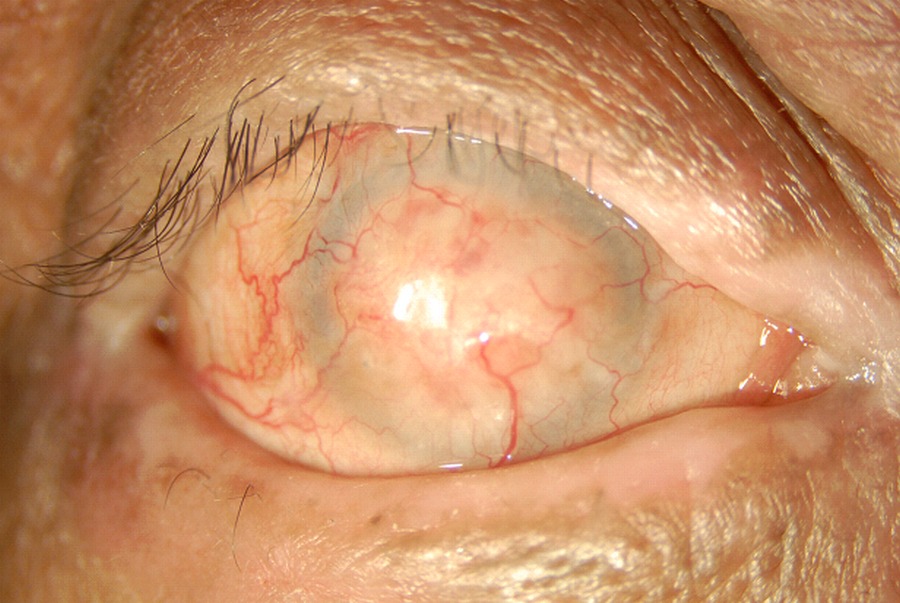
Complete keratinization of the ocular surface
in a patient with ocular cicatricial pemphigoid
The term pemphigus refers to a rare group of autoimmune intraepidermal diseases characterized by blistering, pustules, or vesicles on the skin and mucous membranes. The mode of action of the disease is still not clear, but a key component is acantholysis, the disruption of the normal mechanisms of intercellular adhesion, which leads to intraepidermal blister formation.
There are several types of presentations of this disease such as p. vulgaris, p. foliaceus, p. vegetans, etc. One catastrophic presentation of this disease is ocular cicatricial pemphigoid. The pemphigoid disease progresses creating a symblepharon (adhesive attachments between the conjunctiva covering the sclera and the mucosa covering the posterior aspect of the eyelids. Eventually the disease may extend over the cornea. The accompanying image depicts a case of complete keratinization of the ocular surface in a patient with ocular cicatricial pemphigoid.
The root term pemphig- derives from the Greek [πεμφίγος] meaning a pustule or blister; the suffix -oid is also Greek [ειδής] meaning “similar to” of “kind of”. Therefore the medical term pemphigoid means “similar to blisters”
There is discussion as to when was this word first used, but it looks as though it was first published in 1763 in the book “Pathologia Methodica Practica, seu de Cognoscendis Morbis” by the French physician and botanist Francois Boissier de la Croix de Sauvages (1706 – 1767)
Sources:
1. “Revue D’Histoire Des Sciences” Louis Dulieu, 1969
2. "Etymology of Pemphigus" Holubar, K. J Am Acad Dermat 1989:21, 155-156
3. "Pemphigus" Korman, N. J Am Acad Dermat 1988: 18/6 1219-38
4. “Ocular Cicatricial Pemphigoid” Khan R,. McDermott M., Hwang, F. Am Acad Ophthalm Eye Wiki https://eyewiki.aao.org/Ocular_cicatricial_pemphigoid
Image courtesy of EyeWiki
- Details
The root term [-brachi-] comes from the Latin word [brachium] meaning "arm". Do not confuse with [-brachy-], which means "small" or "short".
It must be pointed out that there is an important discrepancy between the vernacular use of the term "arm" (as the whole upper extremity) and the anatomical "arm". In human anatomy the "arm" is only the portion of the upper extremity found between the shoulder joint superiorly and the elbow joint inferiorly. In some radiology studies, the arm is referred to as the "upper arm" so as not to include the forearm. This use of the term "upper arm" is incorrect and should be avoided by medical professionals.
Examples of the use of this root term in human anatomy and pathology are:
• Brachialis: A flexor muscle in the upper extremity
• Brachial plexus: A plexus of nerves related to the upper extremity
• Brachioradialis: A flexor muscle that extends from the arm to the forearm
- Details

Infraspinatus muscle
The infraspinatus muscle is a thick, triangular muscle and one of the four muscles that forms the rotator cuff. It is found in the posterior aspect of the scapula, in its infraspinous fossa, inferior to the scapular spine. The muscle is covered on its posterior aspect by a thick fascia, the infraspinatus fascia. This fascia separates the infraspinatus muscle from the teres minor and teres major muscles.
The muscle originates from the infraspinous fossa and from the deep aspect of the infraspinatus fascia. The muscular fibers converge superolaterally for form a tendon that inserts into the the greater tubercle of the head of the humerus. The tendon hugs the glenohumeral joint capsule and is separated from it by a small bursa. Some of the tendon fibers insert into the joint capsule.
The infraspinatus is the main external rotator of the shoulder. When the arm is fixed, it adducts the inferior angle of the scapula.
It receives innervation by way of the suprascapular nerve (C5, C6), which arises from the superior trunk of the brachial plexus.
As part of the shoulder’s rotator cuff it helps prevent subluxation of the glenohumeral joint by keeping the head of the humerus in situ. The infraspinatus is one of the 17 muscles that attach to the scapula.
Note: The side image is modified from the original by Henry VanDyke Carter, MD. Public domain. Animated image below by Wikimedia Commons - Anatomography [CC BY-SA 2.1 jp (https://creativecommons.org/licenses/by-sa/2.1/jp/deed.en)]
![Anatomography [CC BY-SA 2.1 jp (https://creativecommons.org/licenses/by-sa/2.1/jp/deed.en)]](https://upload.wikimedia.org/wikipedia/commons/8/8d/Infraspinatus_muscle_animation.gif "Infraspinatus muscle")
Sources:
1. “Gray’s Anatomy” Henry Gray, 1918
2. "Tratado de Anatomia Humana" Testut et Latarjet 8th Ed. 1931 Salvat Editores, Spain
3. "Gray's Anatomy" 38th British Ed. Churchill Livingstone 1995
4. “An Illustrated Atlas of the Skeletal Muscles” Bowden, B. 4th Ed. Morton Publishing. 2015
- Details
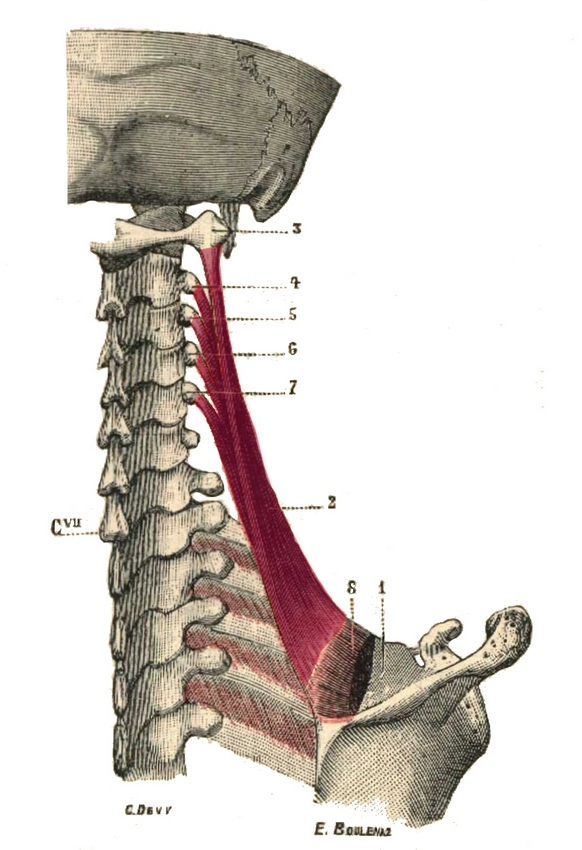
Levator scapulæ muscle
The levator scapulæ muscle (levator anguli scapulæ) is a triangular multipennate muscle which extends between the cervical spine and the scapula. This muscle is deep to the sternocleidomastoid and trapezius muscle.
It is formed by discrete muscular slips that originate from the first four transverse processes (C1-C4). It can have an extra slip from C5 (as shown in the side image).
These muscular slips pass posteroinferiorly, joining, and inserting in the superior scapular angle and the scapular medial border between the superior scapular angle and the medial origin of the scapular spine. It may attach to the scapular spine.
There are other anatomical variations including muscular slips that may extend to the occipital bone or mastoid process, to the trapezius, scalene, or serratus anterior magnus muscles, or to the first or second rib.
It receives nerve supply from the fourth and fifth cervical nerves and by a branch from the dorsal scapular nerve. The dorsal scapular nerve arises from the C5 root of the brachial plexus.
It receives its blood supply from the dorsal scapular artery.
The function of this muscle depends on which bony element is fixed, the scapula or the cervical spine. When the spine is fixed, the levator scapulae elevates the scapula and pulls the superior portion of the medial scapular border superomedially. When only one scapula is fixed, the head and neck flexes and rotates ipsilaterally while it extends the neck contralaterally.
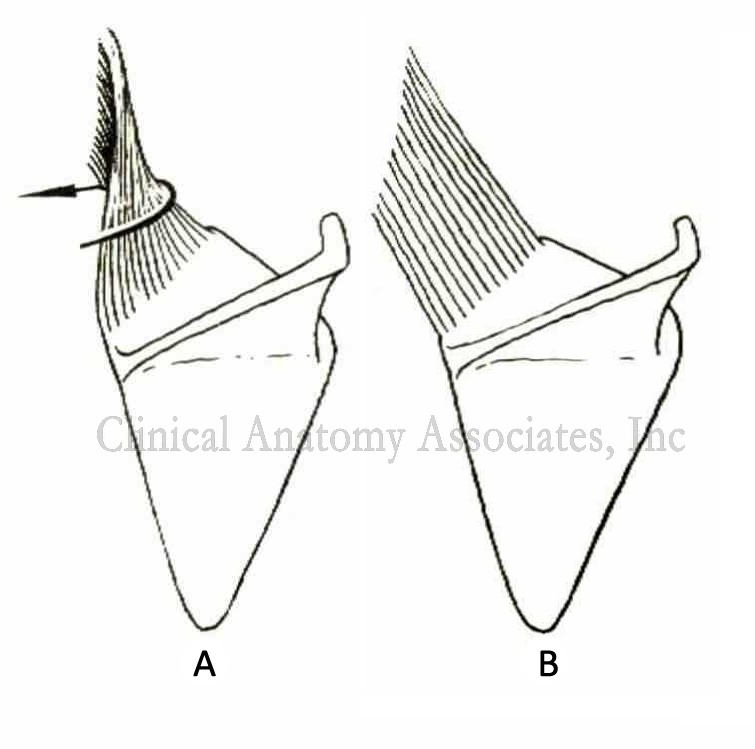
Levator scapulæ muscle fibers
The order and shape of the muscular slips is interesting, as the slip from the transverse process of the Atlas (C1) twists posteriorly and descends to insert as the most posterior and inferior fibers in the medial border of the scapula. The other slips follow a similar pattern, which is what allows this muscle to rotate the neck. This indicates that the fibers of the levator scapulae muscle are spiral and the fibers follow the contour of the neck. This makes (to my knowledge) the levator scapulae the only spiral muscle of the body. This is shown as "A" in the second side image; "B" represents the misconception on the direction of the fibers in this muscle.
Since it is a common sign of stress and bad posture to raise the shoulders, this muscle can spasm, causing neck pain and in some cases be a trigger for headaches.
The Levator scapulæ is one of the 17 muscles that attach to the scapula.
Note: The first side image shown in this article is from “Gray’s Anatomy” (1918) which is in the public domain. The second side image is from Arnold’s “Reconstructive Anatomy” (1968).
Note: Animated image below by Wikimedia Commons - Anatomography [CC BY-SA 2.1 jp (https://creativecommons.org/licenses/by-sa/2.1/jp/deed.en)]
![Anatomography [CC BY-SA 2.1 jp (https://creativecommons.org/licenses/by-sa/2.1/jp/deed.en)]](https://upload.wikimedia.org/wikipedia/commons/a/a1/Levator_scapulae_muscle_animation_small2.gif)
Sources:
1. “Gray’s Anatomy” Henry Gray, 1918 2. "Tratado de Anatomia Humana" Testut et Latarjet 8th Ed. 1931 Salvat Editores, Spain
2. "Tratado de Anatomía Humana" Testut et Latarjet 8th Ed. 1931 Salvat Editores, Spain
3. "Gray's Anatomy" 38th British Ed. Churchill Livingstone 1995
4. “An Illustrated Atlas of the Skeletal Muscles” Bowden, B. 4th Ed. Morton Publishing. 2015
5. “Reconstructive Anatomy, A Method for the Study of Human Structure” Arnold, M. W.B. Saunders. 1968“Gray’s Anatomy” Henry Gray, 1918
- Details
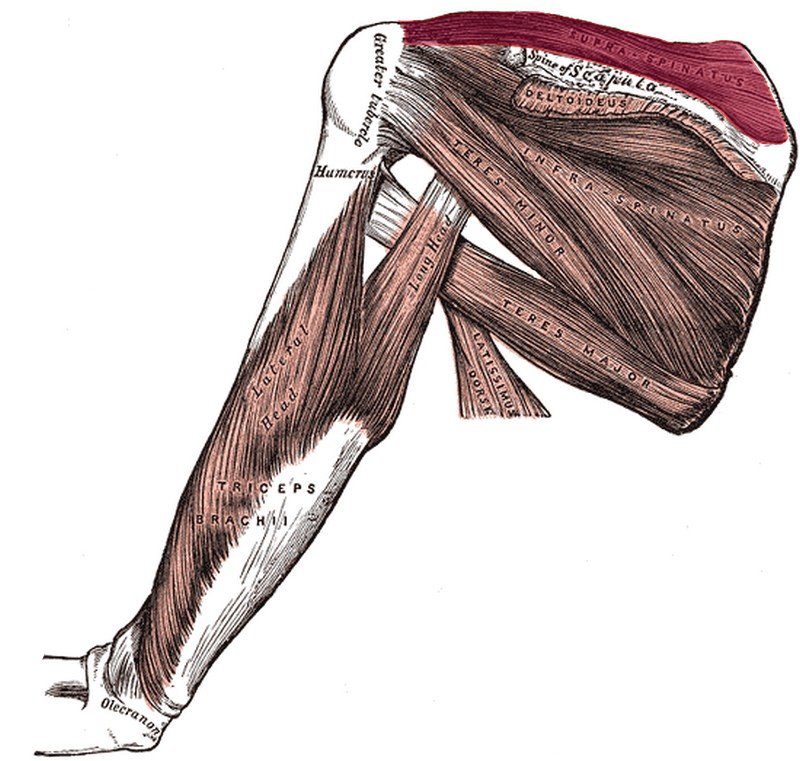
Supraspinatus muscle
The supraspinatus muscle is found in the supraspinatus fossa of the scapula, and one of the four muscles that forms the rotator cuff. The muscle attaches to the medial two thirds of the floor of the fossa directly on the bone and on the deep aspect of the supraspinatus fascia which covers the muscle. The supraspinatus fascia and the supraspinatus fossa form an osteofascial case for the origin of this muscle.
The fibers of the muscle converge and pass deep to the acromion, forming an osseous tunnel that could entrap the muscle and tendon causing a supraspinous impingement syndrome. The side image in this article has the acromion cut off to show the muscle better. The animated image at the bottom of the article shows the supraspinatus muscle and its relation to the acromion process.
The supraspinatus tendon attaches to the capsule of the glenohumeral joint at the level of the highest of the three impressions that form the greater tubercle of the humerus.
It receives innervation by way of the suprascapular nerve (C5, C6), which arises from the superior trunk of the brachial plexus.
The main function of the supraspinatus muscle is to abduct the arm. As part of the shoulder’s rotator cuff it helps prevent subluxation of the glenohumeral joint by keeping the head of the humerus in situ.
The supraspinatus is one of the 17 muscles that attach to the scapula.
Note: The side image modified from the original by Henry VanDyke Carter, MD. Public domain. Animated image below by Wikimedia Commons - Anatomography [CC BY-SA 2.1 jp (https://creativecommons.org/licenses/by-sa/2.1/jp/deed.en)]
![Anatomography [CC BY-SA 2.1 jp (https://creativecommons.org/licenses/by-sa/2.1/jp/deed.en)]](https://upload.wikimedia.org/wikipedia/commons/8/85/Supraspinatus_muscle_animation.gif)
Sources:
1. “Gray’s Anatomy” Henry Gray, 1918
2. "Tratado de Anatomia Humana" Testut et Latarjet 8th Ed. 1931 Salvat Editores, Spain
3. "Gray's Anatomy" 38th British Ed. Churchill Livingstone 1995
- Details
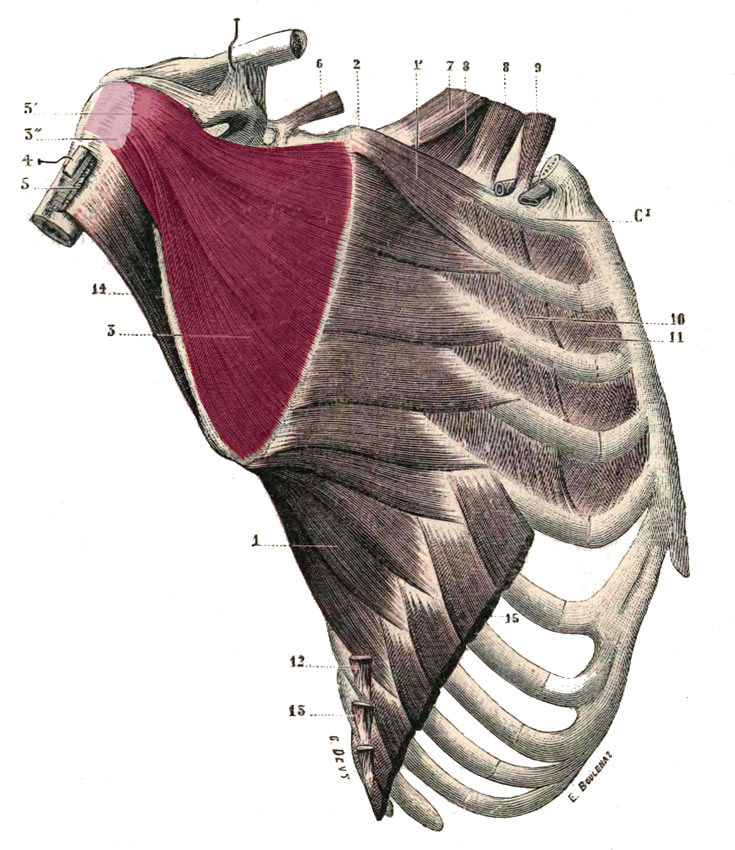
Subscapularis muscle
The subscapular muscle or subscapularis is a large triangular muscle which is found on the anterior aspect of the scapula, in close relation to the posterolateral aspect of the thorax. It is covered by a well-defined fascia layer, the subscapularis fascia. It is one of the muscles that forms the rotator cuff.
It originates from the internal aspect of the medial border of the scapula, in close proximity to the insertion of the serratus anterior (magnus), and the internal aspect of the inferolateral border of the scapula, where it is separated from the teres major muscle by a thick aponeurosis. It also takes origin directly from the subscapular fossa, where some of the muscular fibers attach directly to the bone.
The muscle inserts by way of a tendon in the lesser tubercle of the humerus and the anterior aspect of the glenohumeral joint capsule. The tendon of the muscle is separated from the neck of the scapula by a large bursa (the infratendinous bursa of the subscapularis) which communicates with the cavity of the glenohumeral joint through an aperture in the capsule.
It receives innervation by two subscapular nerves, both branches of the brachial plexus.
The superior suprascapular nerve arises from the ventral rami of C5 and C6 nerve fibers. It branches from the posterior cord of the brachial plexus and supplies the superior aspect of the muscle. The inferior subscapular nerve arises from the ventral rami of C5 and C6 nerve fibers. It branches from the posterior cord of the brachial plexus and supplies the superior aspect of the muscle. Although these nerves have the same origin from the cervical spine, their origin from the posterior cord of the brachial plexus is different.
This muscle rotates the head of the humerus medially. When the upper extremity is raised, it draws the humerus anteroinferiorly. As part of the shoulder’s rotator cuff it helps prevent subluxation of the glenohumeral joint by keeping the head of the humerus in situ.
The subscapularis is one of the 17 muscles that attach to the scapula.
Note: The image shown in this article is from “Gray’s Anatomy” (1918) which is in the public domain
Sources:
1. “Gray’s Anatomy” Henry Gray, 1918
2. "Tratado de Anatomia Humana" Testut et Latarjet 8th Ed. 1931 Salvat Editores, Spain
3. "Gray's Anatomy" 38th British Ed. Churchill Livingstone 1995
4. “An Illustrated Atlas of the Skeletal Muscles” Bowden, B. 4th Ed. Morton Publishing. 2015
Image modified from the original by Henry VanDyke Carter, MD. Public domain