
Medical Terminology Daily (MTD) is a blog sponsored by Clinical Anatomy Associates, Inc. as a service to the medical community. We post anatomical, medical or surgical terms, their meaning and usage, as well as biographical notes on anatomists, surgeons, and researchers through the ages. Be warned that some of the images used depict human anatomical specimens.
You are welcome to submit questions and suggestions using our "Contact Us" form. The information on this blog follows the terms on our "Privacy and Security Statement" and cannot be construed as medical guidance or instructions for treatment.
We have 488 guests online
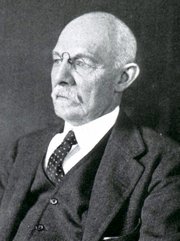
William S. Halsted, MD
(1852 – 1922)
American anatomist, teacher, and surgeon, William Stewart Halsted was born in New York City, USA to a wealthy family of English origin. His father was involved in charitable work and Governor and trustee to a city hospital. Not a brilliant student initially, Halsted took an undergraduate in Liberal Arts in Yale, CT., after which he entered the Medical College of Physicians at the Columbia College, where he excelled.
As a second-year medical student Halsted applied and obtained a position in surgery at a local hospital. In here he learned about Lister’s antiseptic technique and became an adamant proponent of it to reduce infection. In 1877 Halsted obtained his MD. After a short time as House Physician at the New York Hospital, Halsted traveled to Europe to further his education studying for two years at the Universities of Vienna, Leipzig, and W?rzburg.
Besides being at the forefront of surgical and antiseptic techniques (introducing the use of rubber gloves in surgery), Halsted was extremely concerned with the way medical students were taught in the US. He pioneered bedside clinical round discussions with the medical students after two years of basic sciences studies. Halsted developed the idea of a patient chart; he also developed the residency program for medical students in use today.
Halsted is probably the most influential researcher and surgeon at the turn of the century. He dedicated time to the study of intestinal anastomoses and the use of silk as a suture material. His experimental work in 1887 proved that the inclusion of the submucosa layer in an anastomosis was mandatory, as well that a single layered anastomosis was enough to attain closure. Perhaps Halsted’s most important contribution was the application and use of the scientific method to surgical questions. Halsted’s principles, also known as "Halsted's Rules of Surgery", set the standards used today in surgical suturing and surgical stapling.
He also pioneered the development and surgical techniques for radical mastectomy as a treatment for breast cancer.
As a side effect of this studied in anesthesia and the use of cocaine for anesthesia, Halsted became addicted to this substance, a problem that followed him through the years. Without impairing his capacity as a researcher and a surgeon, Halsted eventually recovered. He died in Baltimore in 1922 as a complication to surgery.
Sources:
1. Dubay, A. D., & Franz, G. M. (2003). Acute Wound Healing: The Biology of Acute Wound Failure. Surg Clin NA, 83, 463-481.
2. Halsted, W. S. (1887). Circular Suture of the Intestine - An Experimental Study. Am J Med Sci, 436-461.
3. “William Stewart Halsted: his life and contributions to surgery” Osborne, P. Lancet Oncol 2007; 8: 256–65
4. “William Stewart Halsted: Surgical pioneer” Burress, P Endoc Today (2010), 8: (2) 22
5. “William Stewart Halsted (1852–1922) Neurological stamp” Haas, LF J Neurol Neurosurg Psych 2000;69:641
Original image courtesy of "Images from the History of Medicine" at www.nih.gov

"Clinical Anatomy Associates, Inc., and the contributors of "Medical Terminology Daily" wish to thank all individuals who donate their bodies and tissues for the advancement of education and research”.
Click here for more information


- Details
UPDATED: After a long hiatus, I am happy to report that this website has been updated to a newer version of Joomla!, and still hosted by GoDaddy. The "look" of the website has not changed, but the software is faster and with a higher level of security. This work was done by my good friend from Greece, Christopher Mavros, who is an expert at designing web templates, web sites, and Joomla! extensions. This also meant that my library catalog was left unfinished for a long time and this required lots of additional work.
First, the library needed new and updated bookplates, which were printed by BookplateInk, a USA based company that I strongly recommend. In case anyone wonders, the famous anatomists that are depicted in the bookplate are Harvey, Vesalius, Spigelius, and Albinus. Second, I needed software that could create the code to publish the titles of the library online. This work was done by my daughter Evelyn, to whom I am deeply grateful.
Recataloging the library is an ongoing effort. This will also require repairing and rebinding some of the older and damaged books. Due to this, during the next weeks and months this listing will change, but for a bibliophile this is not work, but pleasure.
As many of you know I am a collector of old and antique medical and anatomy books and I also have several copies of some of these books in different languages.
The oldest book in the library dates from 1696 and is "Opera Chirurgica Anotomica Conformata al Moto Circolare Del Sangue, & Altre Inuenziono De'piu Moderni. Aggivuntovi Un Trattato Della Peste" by Paolo Barbette. I recently acquired the 1713 book by Aulus Cornelius Celsus "De Medicina, Libri Octo".
Another book I am very proud of is not old, but still a rare book. It is "The Fabric of the Human Body, An Annotated Translation of the 1543 and 1555 Editions of “De Humani Corporis Fabrica Libri Septem", by Drs. Garrison and Hast This monumental translation work took twenty years and only 948 copies of this book were published in 2014. Completely sold out, it is today a rare book!
There are many other books that are important to me, either by its rarity (for those who know.... "The Green Book") or its controversy, as are the books by Pernkopf and Stefano Mancini.
You are welcome to peruse my library catalog, but be forewarned; I am not selling any of my books. Should you want to find a copy, you can use Abebooks.com as a great source for old and new books.
- Details
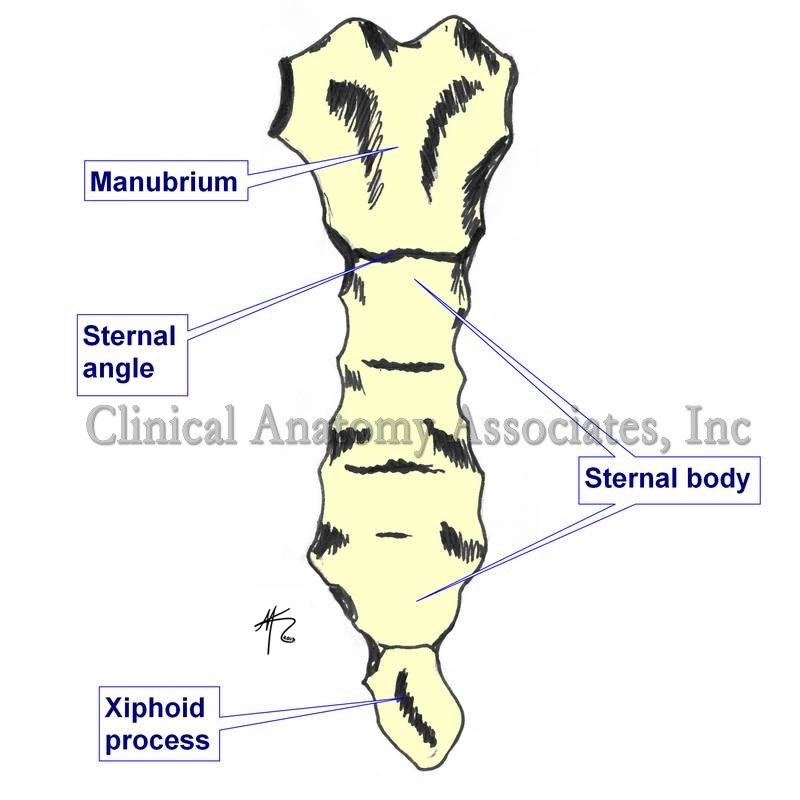
Click on the image for a larger version.
UPDATED: The term [xiphoid] is Greek in origin [ξίφος] and points to the similarity [-oid] of the sternum to a short straight sword used by the Greek. The term xiphoid refers to the lower cartilaginous inferior tip of the sternum. It presents with anatomical variations that include a central opening, or large processes that look like a disc, or even a bifid xiphoid process.
It has been named the xiphisternum, the metasternum, and the ensiform process. It is the last cartilage to ossify in the human, and it is used as a landmark for laparoscopic surgery. i.e. a subxiphoid port is a location for a laparoscopic port in the abdomen.
As a side note, another term used for [sternum] is the Latin word [gladius], referring to the short Roman straight sword of the gladiators. This term is no longer in use, but if it were, the xiphoid appendix would be the tip of the sword.
Think about this: why is a certain plant called a "gladiolus"?
Image property of:CAA.Inc.. Artist:David M. Klein
- Details
This article is part of the series "A Moment in History" where we honor those who have contributed to the growth of medical knowledge in the areas of anatomy, medicine, surgery, and medical research.
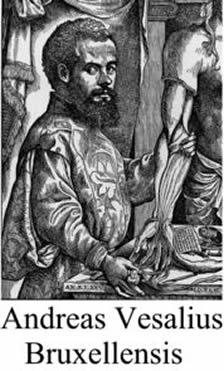
Andreas Vesalius Bruxellensis (1514- 1564). A Flemish anatomist and surgeon, Andreas Vesalius was born on December 31, 1514 in Brussels, Belgium. He is considered to be the father of the science of Anatomy. Up until his studies and publications human anatomy studies consisted only on the confirmation of the old doctrines of Galen of Pergamon (129AD - 200AD). Anatomy professors would read to the students from Galen's work and a demonstrator would point in a body to the area being described, if a body was used at all. The reasoning was that there was no need to dissect since all that was needed to know was already written in Galen's books. Vesalius, Fallopius, and others started the change by describing what they actually saw in a dissection as opposed to what was supposed to be there.
Vesalius had a notorious career, both as an anatomist and as a surgeon. His revolutionary book "De Humani Corporis Fabrica: Libri Septem" was published in May 26, 1543. One of the most famous anatomical images is his plate 22 of the book, called sometimes "The Hamlet". You can see this image if you hover over Vesalius' only known portrait which accompanies this article. Sir William Osler said of this book "... it is the greatest book ever printed, from which modern medicine dates"
After the original 1543 printing, the Fabrica was reprinted in 1555. It was re-reprinted and translated in many languages, although many of these printings were low-quality copies with no respect for copyright or authorship.
The story of the wood blocks with the carved images used for the original printing extends into the 20th century. In 1934 these original wood blocks were used to print 617 copies of the book "Iconaes Anatomica". This book is rare and no more can be printed because, sadly, during a 1943 WWII bombing raid over Munich all the wood blocks were burnt.
One interesting aspect of the book was the landscape panorama in some of his most famous woodcuts which was only "discovered" until 1903.
Vesalius was controversial in life and he still is in death. We know that he died on his way back from a pilgrimage to Jerusalem, but how he died, and exactly where he died is lost in controversy. We do know he was alive when he set foot on the port of Zakynthos in the island of the same name in Greece. He is said to have suddenly collapsed and die at the gates of the city, presumably as a consequence of scurvy. Records show that he was interred in the cemetery of the Church of Santa Maria delle Grazie, but the city and the church were destroyed by an earthquake and Vesalius' grave lost to history. Modern researchers are looking into finding the lost grave and have identified the location of the cemetery. This story has not ended yet.
For a detailed biography of Andreas Vesalius CLICK HERE.
Personal note: To commemorate Andrea Vesalius' 500th birthday in 2014, there were many scientific meetings throughout the world, one of them was the "Vesalius Continuum" anatomical meeting on the island of Zakynthos, Greece on September 4-8, 2014. This is the island where Vesalius died in 1564. I had the opportunity to attend and there are several articles in this website on the presence of Andreas Vesalius on Zakynthos island. During 2015 I also attended a symposium on "Vesalius and the Invention of the Modern Body" at the St. Louis University. At this symposium I had the honor of meeting of Drs. Garrison and Hast, authors of the "New Fabrica". For other articles on Andreas Vesalius, click here. Dr. Miranda
- Details
- Hits: 88936
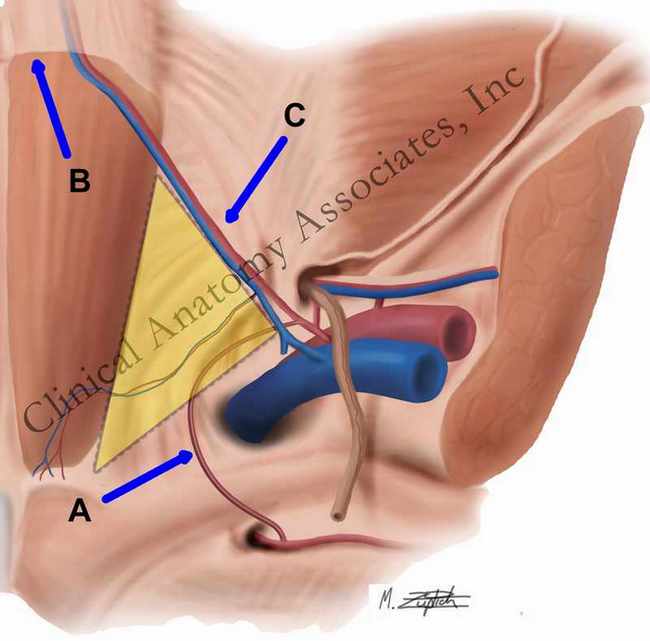
Click for a larger image
UPDATED: The "triangle of doom" is a name given to a roughly triangular area in the posterior aspect of the anterior wall of the lower abdominopelvic region. It is used by surgeons repairing an inguinofemoral hernia with a mesh and they want to avoid large vascular structures, namely the external iliac artery and vein. The "triangle of doom" will be highlighted when you hover your cursor over the image.
The so-called "triangle of doom" is a misnomer perpetuated by the first laparoscopic surgeons who observed the anatomy of the inguinofemoral region from the posterior aspect. It is neither a triangle (as it only has two boundaries), nor is it an eponym (no such person existed - that is why uppercase should not be used). It does indicate an area where it is extremely dangerous to place staples or sutures during laparoscopic hernia surgery.
The "triangle of doom" is an inverted "V" shaped area with its apex at the internal (deep) inguinal ring. The "triangle of doom" is bound laterally by the gonadal vessels, and medially by the vas deferens in the male, or the round ligament of the uterus in the female. Within the boundaries of this area you can find the external iliac artery and vein.
It should be pointed out that although the "triangle of doom" landmark does protect the surgeon from damaging the external iliac vessels, a portion of these vessels lie outside of this area. In fact, there are several other areas of concern for neurovascular damage when performing a laparoscopic herniorrhaphy.
Hover over the image in this article, and the triangle of doom will appear. Clicking on the image will show a larger image of the posteroinferior abdominal region. The image also depicts other structures of anatomical importance for laparoscopic herniorrhaphy:
• Arcuate line (b)
• Hesselbach's triangle (in yellow)
• Aberrant obturator artery (Corona Mortis) (a)
• Inferior (deep) epigastric artery (c)
Image property of: CAA.Inc. . Artist: M. Zuptich.
Clinical anatomy of the inguinofemoral hernias, as well as abdominal and perineal hernias are some of the lecture topics developed and delivered to the medical devices industry by Clinical Anatomy Associates, Inc. For more information Contact Us.
- Details
- Written by: Pascale Pollier-Green
This article is part of the series "A Moment in History" where we honor those who have contributed to the growth of medical knowledge in the areas of anatomy, medicine, surgery, and medical research.
If you arrived directly to this article, the first article in this three-page series can be read HERE
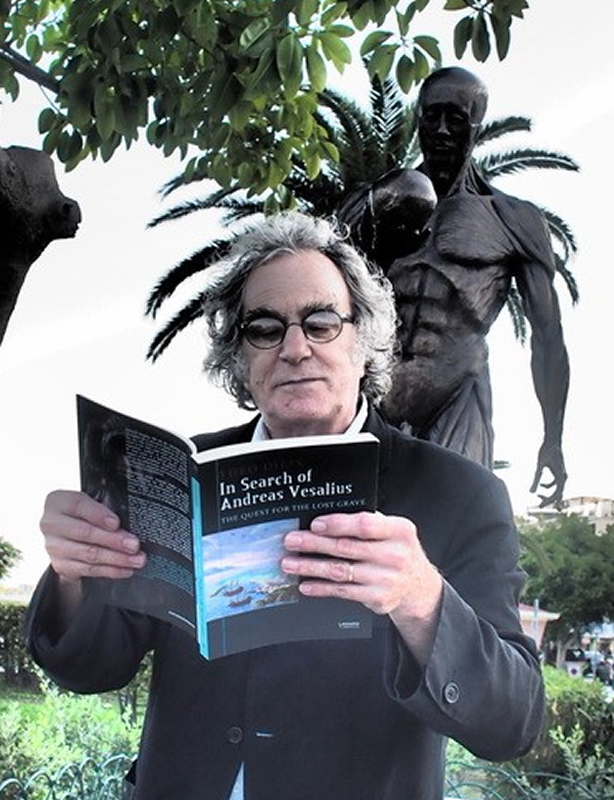
Bryan Green reading his poem in Theo Dirix's
book “ In Search of Andreas Vesalius”
Click on the image for a larger version
I would like to shine a light on my husband poet /sculptor Bryan Green , who wrote a poem on Vesalius that is published in Theo’s book; “In Search of Andreas Vesalius: The Quest for the Lost Grave” and gave a performance at the Fabrica Vitae exhibition opening.. Bryan has constantly worked behind the scenes editing many letters, articles, books, and leaflets, I couldn’t have done it all without his help and advice. He also made the long lorry journey to Zakynthos from Belgium with me and our friend James Gatehouse to deliver the monument.
Vesalius Continuum also marked the start of our touring exhibition “Fabrica Vitae” curated by Eleanor Crook, my sister Chantal Pollier, and myself. The exhibition toured all over Europe and the US with the help and support of Theo Dirix and Belgian Embassies world wide .
The conference and accompanying events could not have happened without financial funds and I hereby would like to thank all our sponsors: Professor Peter Abrahams with his infectious energy and professor Robert Jordan; St Georges University of Grenada, Ruth Richardson and Brian Hurwitz and Mark Gardiner for getting funding from the Wellcome trust, Marie Dauenheimer and the Vesalius Trust, BIOMAB, Ann van the Velde and The University of Antwerp, The AEIMS and MAA, William Nagels, warmly thank the local authorities and the mayor of Zakynthos, ARSIC, Theo Dirix, and Stephen Joffe, and a special thank you also Stephen for writing a beautiful foreword for our book In the Shadow of Vesalius.
You can imagine after such an exciting and wonderful adventure, which took quite a few years to organize, and a quite a few years to reminisce over, we decided we wanted to keep the momentum going and thus the Vesalius triennial was born.
In 2017 BIOMAB, in collaboration with Vesaliana, organized the first triennial in Zakynthos ‘Uniting Medicine with Poetry, History and Culture’
It seems like another world in which we made our plans for the 2nd edition of the Vesalius Triennial Congress, 4 months before the COVID-19 pandemic lock down. From the vain belief that COVID-19 would not hit most countries, to hopes that everything would have blown over by 13th November 2020 (the day when the next Vesalius Triennial Congress would take place in Antwerp) to realizing that we were going to have to take action, the scientific committee has transformed from one in which everyone knew their time-tried and perfected role, to one requiring invention in uncharted territory.
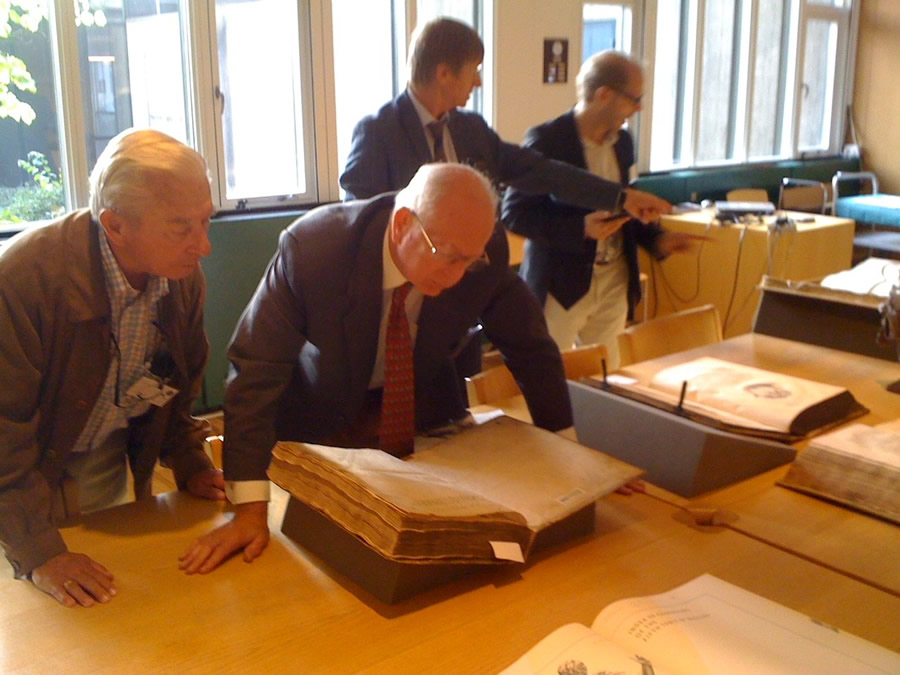
Professors Vivian Nutton and Omer Steeno
looking at a first edition of the Fabrica
Canceling the 2nd Vesalius Triennial was not a welcome prospect , since facilitating human communication is the corner stone of a scientific community. So we set sail for the vast virtual-reality realm. To discover just how far we could delve into virtual communication with a dedicated but small organising committee, was an eventful, insightful voyage. Sadly after long and careful consideration and several online meetings we finally decided to postpone all international congress keynote lectures and educational sessions until 2023.
However we would like to invite all the friends of Vesalius for a virtual book launch on Nov 13th we will soon post the event details on how to register for this event on social media, and on Vesalius continuum website
The book "In the shadow of Vesalius" can be ordered here: http://garant.be/shadow-of-vesalius/
Finally I would like to thank everyone who has been part of this adventure, special thank you to Professor Dr. Efrain Miranda ( Clinical Anatomy) for his continuous support, EBSA, Prof. Stefanos Geroulos, Vasia Hatzi (MEDinART), Pavlos Plessas, Nicos Varvianis, Maria Sidirokastriti-Kontoni & Fr. Panagiotis Kapodistrias, the many wonderful speakers, the local organisers, our Keynote speaker Professor Martin Kemp for his wonderful contribution, Eleni Andrianaki; ibis el greco , the wonderful delegates, the artists of the Fabrica Vitae exhibition, the museum and universities where we took our exhibition, a special thank you to Juris Salaks and Ieva Lebiete for hosting our exhibition at the Stradins museum and for all the help and support, Apostolis Sarris, Nikos Papadopoulos, Sylviane Déderix, Jan Driessen, Theo Dirix, Chr. Merkouri.and to the all the friends of Vesalius who like to keep his spirit alive.
Pascale Pollier-Green
Oct 2020
Personal note: I would like to thank Pascale Pollier-Green for authoring this series of articles and wish Professor Robrecht Van Hee the best success publishing this new book on the history and influence of Andreas Vesalius on anatomy, medicine, science, and the Arts. Dr. Miranda.
- Details
- Written by: Pascale Pollier-Green
This article is part of the series "A Moment in History" where we honor those who have contributed to the growth of medical knowledge in the areas of anatomy, medicine, surgery, and medical research.
If you arrived directly to this article, the first article in this three-page series can be read HERE
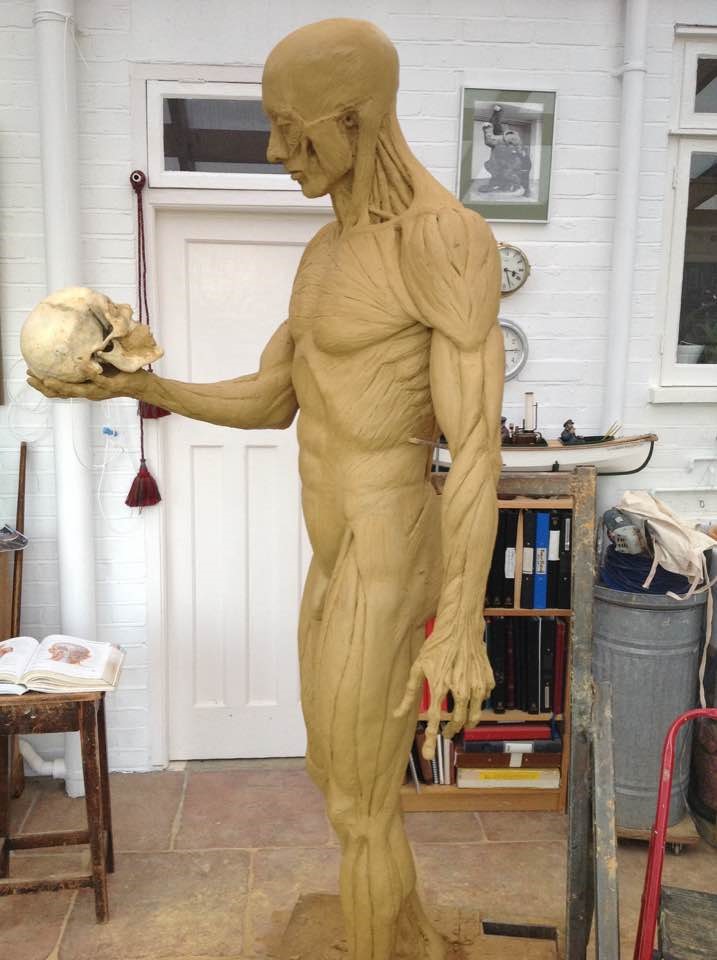
Sculpting the monument in Richard Neave’s studio
One of the most important conferences that BIOMAB initiated and co-organized was without doubt “Vesalius Continuum” which took place in 2014 on the island of Zakynthos . This joint AEIMS conference was organized in collaboration with Dr Mark Gardiner and the then Consul at the Belgian Embassy in Greece - Theo Dirix, and brought together many prominent scholars and Vesalius experts who presented papers on the life, work and death of Vesalius, and the influence of the Fabrica on modern anatomy, and on medical art and contemporary art (pdf file).
Without the organizing skills and drive and energy of Dr. Mark Gardiner and the countless meetings and emails with Theo Dirix, the conference Vesalius Continuum would not have been the huge world class event it became.
In 2013 Dr. Mark Gardiner and I first introduced ourselves to Professor Vivian Nutton who was giving a lecture at Warwick University about the incredible find of a hand written (by Vesalius himself !) edited version of the Fabrica’s second edition, which would have become the third edition, …had Vesalius not met his untimely death. Mark and I were blown away by this wonderfully exciting lecture and we asked Professor Nutton to be a speaker at our conference in 2014, which he accepted gladly. He was invited again in 2017 for the triennial and has now especially for this publication written an exciting account of Vesalius in England, 1544 to 1547.
Vesalius’s 500 th anniversary celebrations did not end with the organization of the conference, but became a collection of several events.
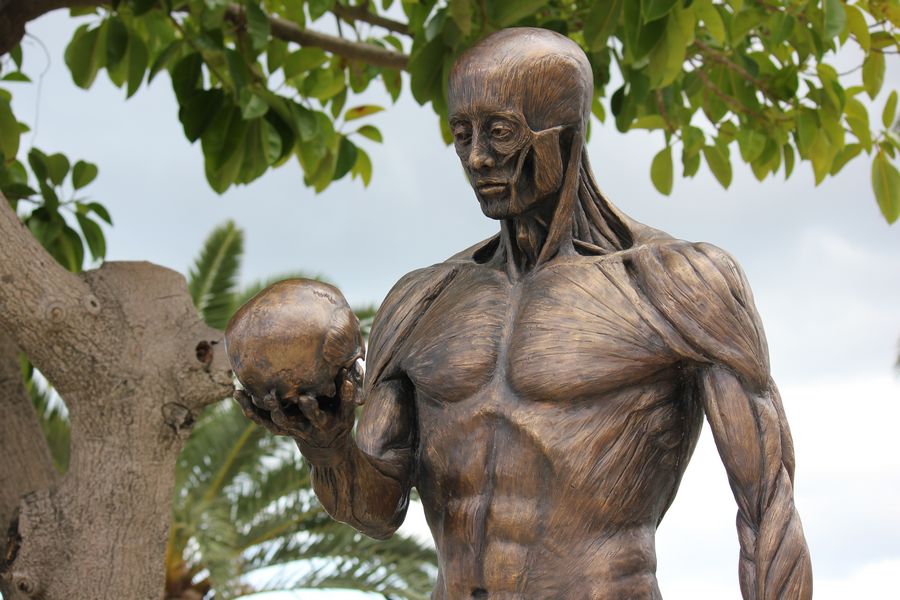
My colleague and dear friend forensic medical artist Richard Neave and I sculpted a bronze monument to commemorate Vesalius’s death on the Island of Zakynthos on 15th Oct 1564. This monument might never have been erected if it were not for the wonderful idea of Antwerp GP and president of Vesaliana Dr Marc de Roeck together with William Nagels, who devised a way of self-funding this large undertaking. We had countless meetings discussing the monument and agreed with Dr. de Roeck that by making a bronze facial reconstruction portrait (made by Richard Neave and myself) and selling 12 copies we would gather enough money together to make the monument, pay to have it cast in Bronze and drive the sculpture from Belgium to Zakynthos ready to have its grand inauguration at the start of the conference. This was all achieved successfully and the sculpture now stands on the Island of Zakynthos’s Vesalius square, facing the Ionian sea.
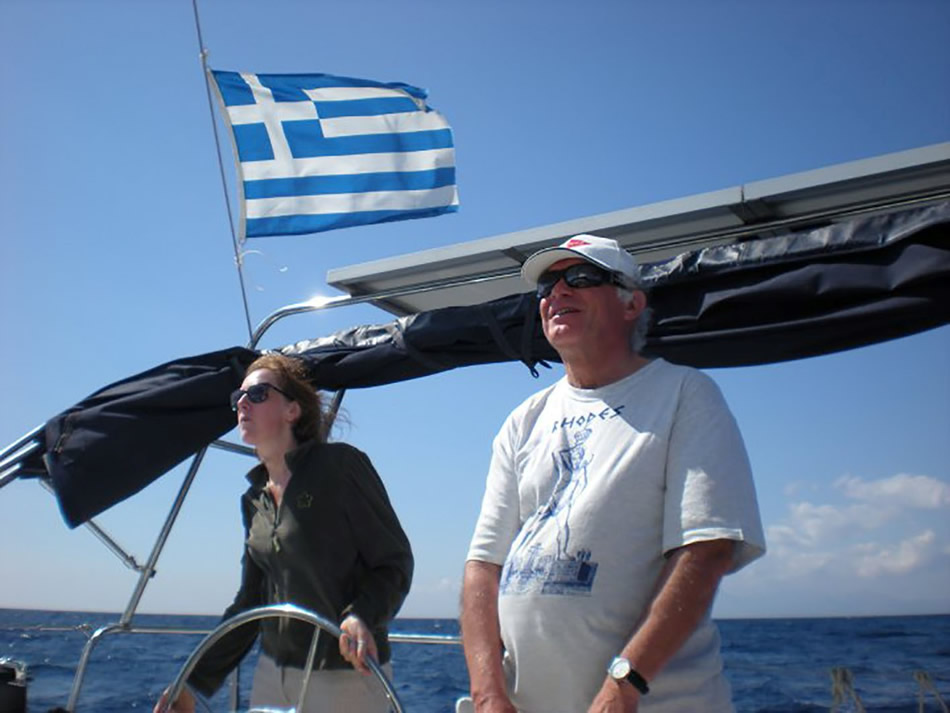
Dr. Marc De Roeck and Pascale Pollier
sailing to Zakynthos
In 2009 I had completed a facial reconstruction course at the academy of fine arts in Maastricht , the Netherlands, and as Vesalius had always been my big inspiration and the reason why I chose to become a medical artist, it was my dream to make a facial reconstruction of Vesalius. The dream soon turned into a passion, and the passion into an obsession to go in search of the grave of Vesalius and find his skull.
Ann suggested to Marc we sailed to Zakynthos with the MYC-Medical Yachting Club to start the quest for the grave. I will never forget the day that Marc gave me the ships wheel as we got closer to the island and I sailed into the harbor of Zakynthos! An amazing feeling!
After our first visit to “what we thought then was the grave site“ at Laganas, I wrote a letter to the Belgian embassy in Greece, asking for help with our quest, a year later when Theo Dirix took office as Consul he wrote back to me, my letter had ignited a flame in the heart of taphophile Theo Dirix.
Soon the quest became an official scientific research collaborative project between the Belgian School of Athens (Jan Driessen, Apostolis Sarris, Sylviane Déderix) and the Greek authorities, together with the invaluable research of Omer Steeno, Maurits Biesbrouk and Theodoor Godeeris, who all share their latest findings in this book. With this wonderful collaborative effort, even though we have not yet found the actual grave, we can truly claim that we have made some history.
Theo Dirix wrote 2 books on the quest of the grave and now will reveal some new insights with his article in the book “In the Shadow of Vesalius”.
This article continues HERE