
Medical Terminology Daily (MTD) is a blog sponsored by Clinical Anatomy Associates, Inc. as a service to the medical community. We post anatomical, medical or surgical terms, their meaning and usage, as well as biographical notes on anatomists, surgeons, and researchers through the ages. Be warned that some of the images used depict human anatomical specimens.
You are welcome to submit questions and suggestions using our "Contact Us" form. The information on this blog follows the terms on our "Privacy and Security Statement" and cannot be construed as medical guidance or instructions for treatment.
We have 524 guests online
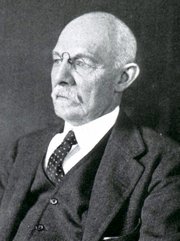
William S. Halsted, MD
(1852 – 1922)
American anatomist, teacher, and surgeon, William Stewart Halsted was born in New York City, USA to a wealthy family of English origin. His father was involved in charitable work and Governor and trustee to a city hospital. Not a brilliant student initially, Halsted took an undergraduate in Liberal Arts in Yale, CT., after which he entered the Medical College of Physicians at the Columbia College, where he excelled.
As a second-year medical student Halsted applied and obtained a position in surgery at a local hospital. In here he learned about Lister’s antiseptic technique and became an adamant proponent of it to reduce infection. In 1877 Halsted obtained his MD. After a short time as House Physician at the New York Hospital, Halsted traveled to Europe to further his education studying for two years at the Universities of Vienna, Leipzig, and W?rzburg.
Besides being at the forefront of surgical and antiseptic techniques (introducing the use of rubber gloves in surgery), Halsted was extremely concerned with the way medical students were taught in the US. He pioneered bedside clinical round discussions with the medical students after two years of basic sciences studies. Halsted developed the idea of a patient chart; he also developed the residency program for medical students in use today.
Halsted is probably the most influential researcher and surgeon at the turn of the century. He dedicated time to the study of intestinal anastomoses and the use of silk as a suture material. His experimental work in 1887 proved that the inclusion of the submucosa layer in an anastomosis was mandatory, as well that a single layered anastomosis was enough to attain closure. Perhaps Halsted’s most important contribution was the application and use of the scientific method to surgical questions. Halsted’s principles, also known as "Halsted's Rules of Surgery", set the standards used today in surgical suturing and surgical stapling.
He also pioneered the development and surgical techniques for radical mastectomy as a treatment for breast cancer.
As a side effect of this studied in anesthesia and the use of cocaine for anesthesia, Halsted became addicted to this substance, a problem that followed him through the years. Without impairing his capacity as a researcher and a surgeon, Halsted eventually recovered. He died in Baltimore in 1922 as a complication to surgery.
Sources:
1. Dubay, A. D., & Franz, G. M. (2003). Acute Wound Healing: The Biology of Acute Wound Failure. Surg Clin NA, 83, 463-481.
2. Halsted, W. S. (1887). Circular Suture of the Intestine - An Experimental Study. Am J Med Sci, 436-461.
3. “William Stewart Halsted: his life and contributions to surgery” Osborne, P. Lancet Oncol 2007; 8: 256–65
4. “William Stewart Halsted: Surgical pioneer” Burress, P Endoc Today (2010), 8: (2) 22
5. “William Stewart Halsted (1852–1922) Neurological stamp” Haas, LF J Neurol Neurosurg Psych 2000;69:641
Original image courtesy of "Images from the History of Medicine" at www.nih.gov

"Clinical Anatomy Associates, Inc., and the contributors of "Medical Terminology Daily" wish to thank all individuals who donate their bodies and tissues for the advancement of education and research”.
Click here for more information


- Details
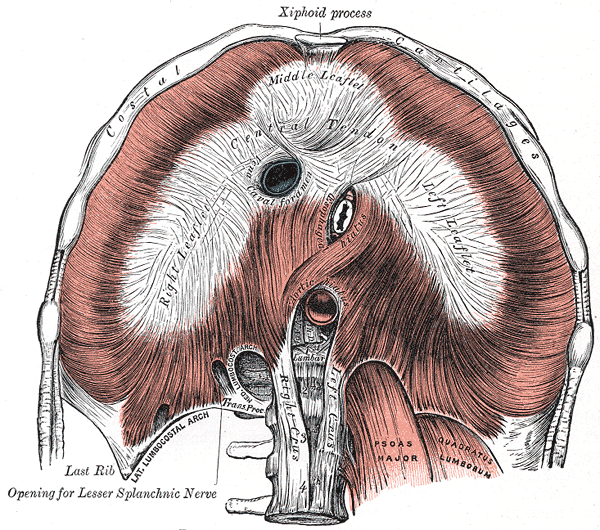
Respiratory diaphragm
The term [hiatus] derives from the Latin word [hiare], meaning to "gape" or to "yawn". In human anatomy this term is used to mean an "opening" or a "defect". It must be pointed out that in anatomy (and surgery) the term "defect" does not necessarily mean "defective". In most cases a "defect" is a normal opening in a structure, such as the esophageal hiatus. The plural form is either [hiatus] or [hiatuses].
In the case of the respiratory diaphragm, there are seven such openings, seven normal hiatuses. On top of this, you can find an abnormal opening caused by incomplete congenital closure of the dome of the diaphragm, a congenital diaphragmatic hernia (CDH), also known as Bochdalek's hernia, found in the posterior aspect of the respiratory diaphragm.
The seven hiatuses of the respiratory diaphragm are:
• Aortic hiatus
• Inferior vena cava hiatus
• Hiatuses (2) for the superior epigastric vessels, which are the inferior continuation of the internal thoracic (mammary) vessels. Also known as the hiatuses of Morgagni. A hernia in a newborn through this hiatus is also considered a CDH.
• Hiatuses (2) for the splanchnic nerves
Based on the above it is wrong (maybe not wrong, but incomplete) to say that a patient has a "hiatal hernia", as the term does not include which hiatus is involved. In fact the hernia of Morgagni is also a "hiatal hernia" as the hernia passes through a normal defect in the respiratory diaphragm. Come to think of it, it could also be a hernia in a hiatus somewhere else in the body, such as a hernia of Schwalbe, a type or pelvic diaphragm hernia.
Note: Thanks to DHREAMS of the Columbia University Medical Center for the link on CDH.
Sources:
1. "The Origin of Medical Terms" Skinner, HA 1970 Hafner Publishing Co.
2. "Medical Meanings - A Glossary of Word Origins" Haubrich, WD. ACP Philadelphia
3 "Tratado de Anatomia Humana" Testut et Latarjet 8 Ed. 1931 Salvat Editores, Spain
4. "Anatomy of the Human Body" Henry Gray 1918. Philadelphia: Lea & Febiger Image modified by CAA, Inc. Original image by Henry Vandyke Carter, MD., courtesy of bartleby.com
- Details
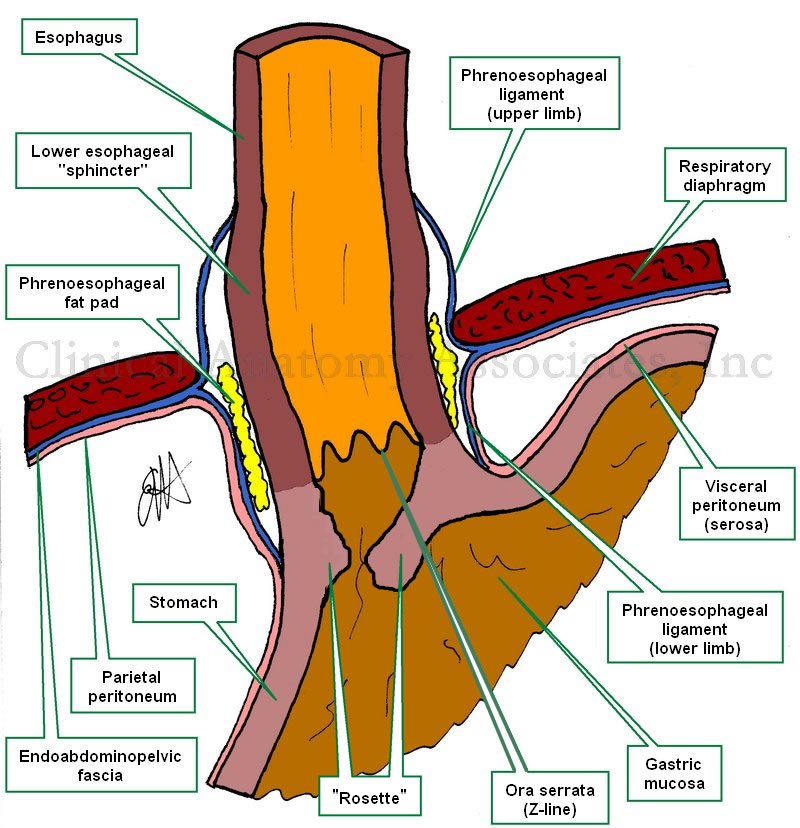
Esophagogastric junction
UPDATED: The esophageal hiatus is one of the seven hiatuses found in the respiratory diaphragm allowing passage of structures between the thorax and abdomen. As it name implies, the esophageal hiatus is the passageway for the esophagus. It also allows passage of the anterior and posterior vagus nerves, (CN X).
The hiatus is bound by two muscular crura, both of which arise from the right tendinous aortic crus. Since the intraabdominal pressure is higher than the intrathoracic pressure, there is a series of structures at the phrenoesophagogastric junction to close the esophageal hiatus.
The infradiaphragmatic parietal peritoneum reflects off the diaphragm towards the stomach to form its serosa layer (visceral peritoneum). At the same time the infradiaphragmatic fascia, also known as the endoabdominopelvic fascia, splits into two components or limbs. These are the superior and inferior phrenoesophageal ligaments or phrenoesophageal membranes. (the root [-phren-] means "diaphragm"). These phrenoesophageal ligaments create a disc-like plug between the abdomen and the thorax. This "plug" is reinforced by a circular infradiaphragmatic fat pad. The phrenoesophageal ligaments are reinforced on their thoracic aspect by the endothoracic fascia.
The lower esophagus has a dilation (evident in the image) called the "esophageal ampulla", in relation to this dilation the circular muscle layer of the esophagus slightly thickens creating the so-called "lower esophageal sphincter". This area is not a true anatomical sphincter, but rather is a functional sphincter.
The esophagogastric mucosal junction shows a marked transition in the shape of a wavy line. This is called the Z-line or the ora serrata. Extensions of the gastric mucosa and submucosa inferior to the ora serrata create a valve-like flap called the "gastroesophageal flap valve". When viewing this mucosal flap through and endoscope, it looks corrugated and flower-like, hence it is also called the "rosette".
The congenital or pathological dilation of the esophageal hiatus can predispose to esophageal hiatus hernia.
Sources:
1 "Tratado de Anatomia Humana" Testut et Latarjet 8 Ed. 1931 Salvat Editores, Spain
2. "Anatomy of the Human Body" Henry Gray 1918. Philadelphia: Lea & Febiger
Original image by Dr. E. Miranda
- Details
Esophagogastric junction
The esophagogastric junction is a complex anatomical region found at the esophageal hiatus of the respiratory diaphragm. It allows passage of he esophagus from the thorax into the abdomen.
The hiatus is bound by two muscular crura, both of which arise from the right tendinous aortic crus. Since the intraabdominal pressure is higher than the intrathoracic pressure, there is a series of structures at the phrenoesophagogastric junction to close the esophageal hiatus.
The infradiaphragmatic parietal peritoneum reflects off the diaphragm towards the stomach to form its serosa layer (visceral peritoneum). At the same time the infradiaphragmatic fascia, also known as the endoabdominopelvic fascia, splits into two components or limbs. These are the superior and inferior phrenoesophageal ligaments or phrenoesophageal membranes. (the root [-phren-] means "diaphragm"). These phrenoesophageal ligaments create a disc-like plug between the abdomen and the thorax. This "plug" is reinforced by a circular infradiaphragmatic fat pad. The phrenoesophageal ligaments are reinforced on their thoracic aspect by the endothoracic fascia.
The lower esophagus has a dilation (evident in the image) called the "esophageal ampulla", in relation to this dilation the circular muscle layer of the esophagus slightly thickens creating the so-called "lower esophageal sphincter". This area is not a true anatomical sphincter, but rather is a functional sphincter.
The esophagogastric mucosal junction shows a marked transition in the shape of a wavy line. This is called the Z-line or the ora serrata. Extensions of the gastric mucosa and submucosa inferior to the ora serrata create a valve-like flap called the "gastroesophageal flap valve". When viewing this mucosal flap through and endoscope, it looks corrugated and flower-like, hence it is also called the "rosette".
The congenital or pathological dilation of the esophageal hiatus can predispose to esophageal hiatus hernia.
Sources:
1 "Tratado de Anatomia Humana" Testut et Latarjet 8 Ed. 1931 Salvat Editores, Spain
2. "Anatomy of the Human Body" Henry Gray 1918. Philadelphia: Lea & Febiger
Original image by Dr. E. Miranda
- Details

Click for a larger image
The word acetabulum is formed by the combination of the Latin root [acetum], meaning "vinegar", and the Latin suffix [-abulum] a diminutive of [abrum], meaning a "cup", "holder", or "receptacle". Thus formed, the word acetabulum means "a small vinegar cup".
Roman soldiers liked to drink their water mixed with a small quantity of vinegar, so as to reduce the sensation of thirst. This mix was called "Posca". An acetabulum was used to add specific quantities of vinegar to the water, so over time the acetabula (plural form of acetabulum) were considered measuring devices. It is said that they measured one cup, or 2 1/2 oz. of wine.
The anatomical acetabula are bilateral cup-like depressions in the os coxae which serve as a component of the coxofemoral joint (hip joint). They are found at the intersection of the three bony components of the os coxae, the ilium, ischium, and pubic bone and look anteroinferiorly.
The acetabulum has several components:
• Acetabular margin: An incomplete circular bony edge or border that marks the edge of the acetabulum
• Acetabular notch: The area where the acetabular margin is incomplete
• Acetabular labrum: Labrum (Lat. :lip). The acetabular labrum is a complete circular ring of fibrocartilage found on the acetabular margin that helps maintain the head of the femur in place. It is not shown in the accompanying image
• Lunate surface: A smooth, half-moon shaped area on the floor of the acetabulum. It is covered with hyaline cartilage and allows for articulation with the head of the femur
• Acetabular fossa: The non-articular region of the floor of the acetabulum. It contains fat, vessels, and the ligament of the head of the femur
Interesting fact: You may find that in older English anatomy books the acetabulum is referred to as the cotyloid cavity. The word cotyloid arises from the Greek [κοτυλοειδές] and means "similar to a cup". This separation in terms still exists when studying anatomy in other languages. For example, in Spanish the acetabulum is called "cavidad cotiloídea" or "cotilo", and in French it is called "cavité cotyloïde" or "cotyle". I guess the Greek soldiers did not drink vinegar with their water...
Image property of: CAA, Inc. Photographer: David M. Klein
- Details
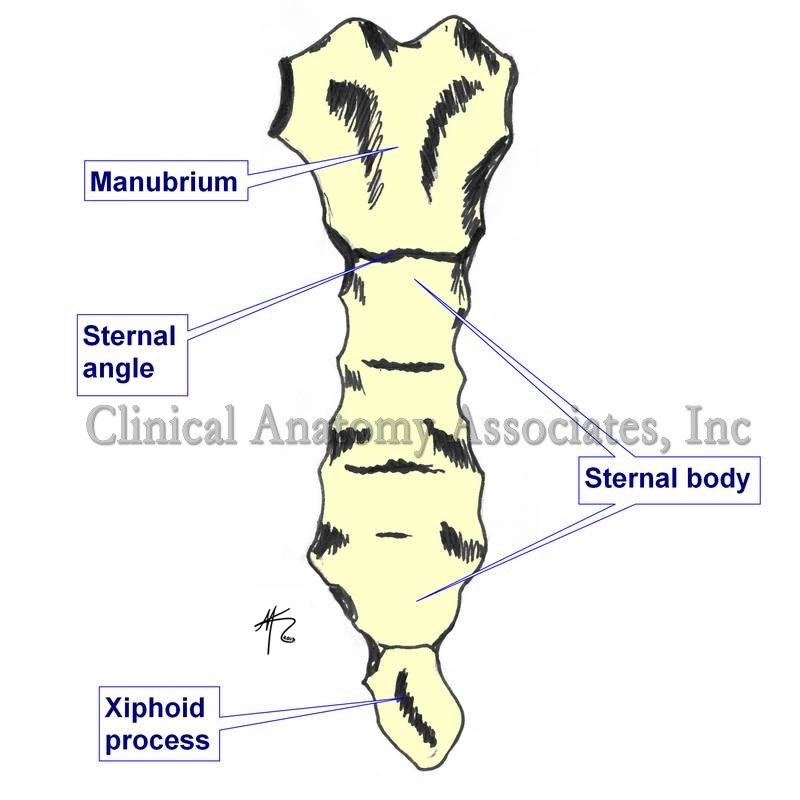
Sternum, anterior view
UPDATED:The sternal angle is the term used to denote the angulation at the joint between the manubrium and the body of the sternum. This transverse joint is called the "manubriosternal joint" and is a secondary cartilaginous joint of a type known as a symphysis. The angle varies between 160 and 169 degrees.
It is know eponymously as the "angle of Louis" named after Antoine Louis1 (1723-1792), a French physician. The importance of the sternal angle is that of an anatomical superficial landmark, which forms a horizontal plane which indicates a series of anatomical occurrences, as follows:
• Location of the cartilages of the second rib
• Beginning and end of the aortic arch
• Boundary between the inferior and superior mediastinum
• Location of the bifurcation of the trachea
• Posteriorly, the plane of the sternal angle passes trough the T4-T5 intervertebral disc (sometimes a little lower, through the superior aspect of T5)
• Highest point of the pericardial sac.
• It is the point where the right and left pleurae meet in the midline. They touch, but their pleural spaces do not communicate (usually).
1. Some authors contest the eponym, adjudicating it to Pierre Charles Alexander Louis (1787-1872), another French physician.
Image property of: CAA.Inc.. Artist: David M. Klein
Thoracic anatomy, pathology and surgery, are some of the many lecture topics developed and presented by Clinical Anatomy Associates, Inc. For more information Contact Us.
- Details
- Written by: Pascale Pollier
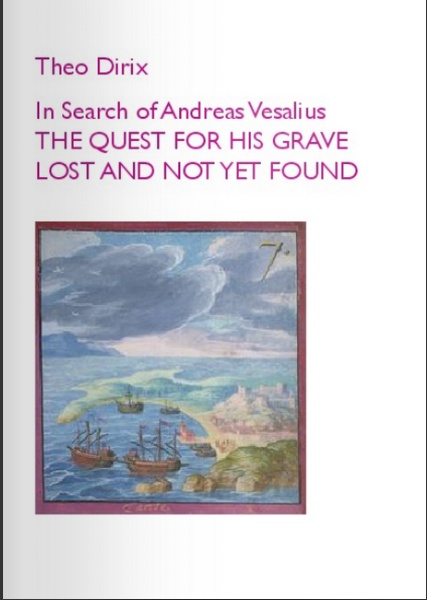
Cover of the book by Theo Dirix
My partner in crime and fellow traveler, Theo Dirix, has just published a new account of our common quest for the lost grave of Andreas Vesalius. Until the scientific results of our latest mission in Zakynthos in September 2017, will become public, this collection of articles published since 2014 represents a detailed and complete status quaestionis of a search that will never be the same anymore.
I'm proud and grateful to be part of a team he describes a most tenacious.
Following is a remarkable quote from the book: "The beast you have in your hands may appear as aged and stubborn: indeed, the texts collected here are not new and they regularly echo each other. The beast barks and growls: these words do not intend to examine or research but were meant to sell a project to potential sponsors. I feel the taste of the creature’s spit in my face, but pleading not guilty to any accusation of self-glorification, I do hope I managed to teach it a few tricks you will enjoy. While continuing to write about Vesalius’s death and his grave, black dogs may still be scratching at my hermitage. When I will finally throw open the doors to the beauty beyond, here’s hoping the encounter with the female spider will taste as fresh as a first kiss and be the beginning of something else."
No surprise some have described the book as: "a truly captivating story (a Live Adventure!) written in a fascinating, passionate and inspiring way. Theo Dirix, with his unique style is describing facts from his adventure to locate the grave of Vesalius and he is mentioning with great respect all his collaborators, the friends of Vesalius and those who share the same passion for Anatomy and Art." (Vasia Hatzi on Med in Art).
The book can be ordered here: https://www.shopmybooks.com/US/en/book/theo-dirix-32/in-search-of-andreas-vesalius. (English version of the website). More information about the author on his website www.theodirix.com. or here.
Personal note: Thanks to Pascale Pollier, a contributor to this website, for allowing us to publish this article, originally published on Vesalius Continuum.
I received a personalized copy from the author, Theo Dirix; Thank you very much for the recognition and the use of this website as reference in some of your comments. It is a great read for anyone even mildly interested in the life and specially the death and disappearance of the grave of Andreas Vesalius. There are several passages in the book that I will have to research and transform in articles for this blog.
For those who collaborated in the GoFundMe campaign because or our article entitled Do you want your name in a book? The Quest for the Lost Grave.... this is the book and the name of all the contributors are listed in it!
The quest continues... Dr. Miranda