
Medical Terminology Daily (MTD) is a blog sponsored by Clinical Anatomy Associates, Inc. as a service to the medical community. We post anatomical, medical or surgical terms, their meaning and usage, as well as biographical notes on anatomists, surgeons, and researchers through the ages. Be warned that some of the images used depict human anatomical specimens.
You are welcome to submit questions and suggestions using our "Contact Us" form. The information on this blog follows the terms on our "Privacy and Security Statement" and cannot be construed as medical guidance or instructions for treatment.
We have 478 guests online
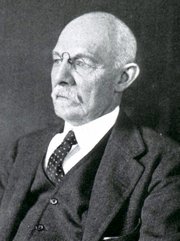
William S. Halsted, MD
(1852 – 1922)
American anatomist, teacher, and surgeon, William Stewart Halsted was born in New York City, USA to a wealthy family of English origin. His father was involved in charitable work and Governor and trustee to a city hospital. Not a brilliant student initially, Halsted took an undergraduate in Liberal Arts in Yale, CT., after which he entered the Medical College of Physicians at the Columbia College, where he excelled.
As a second-year medical student Halsted applied and obtained a position in surgery at a local hospital. In here he learned about Lister’s antiseptic technique and became an adamant proponent of it to reduce infection. In 1877 Halsted obtained his MD. After a short time as House Physician at the New York Hospital, Halsted traveled to Europe to further his education studying for two years at the Universities of Vienna, Leipzig, and W?rzburg.
Besides being at the forefront of surgical and antiseptic techniques (introducing the use of rubber gloves in surgery), Halsted was extremely concerned with the way medical students were taught in the US. He pioneered bedside clinical round discussions with the medical students after two years of basic sciences studies. Halsted developed the idea of a patient chart; he also developed the residency program for medical students in use today.
Halsted is probably the most influential researcher and surgeon at the turn of the century. He dedicated time to the study of intestinal anastomoses and the use of silk as a suture material. His experimental work in 1887 proved that the inclusion of the submucosa layer in an anastomosis was mandatory, as well that a single layered anastomosis was enough to attain closure. Perhaps Halsted’s most important contribution was the application and use of the scientific method to surgical questions. Halsted’s principles, also known as "Halsted's Rules of Surgery", set the standards used today in surgical suturing and surgical stapling.
He also pioneered the development and surgical techniques for radical mastectomy as a treatment for breast cancer.
As a side effect of this studied in anesthesia and the use of cocaine for anesthesia, Halsted became addicted to this substance, a problem that followed him through the years. Without impairing his capacity as a researcher and a surgeon, Halsted eventually recovered. He died in Baltimore in 1922 as a complication to surgery.
Sources:
1. Dubay, A. D., & Franz, G. M. (2003). Acute Wound Healing: The Biology of Acute Wound Failure. Surg Clin NA, 83, 463-481.
2. Halsted, W. S. (1887). Circular Suture of the Intestine - An Experimental Study. Am J Med Sci, 436-461.
3. “William Stewart Halsted: his life and contributions to surgery” Osborne, P. Lancet Oncol 2007; 8: 256–65
4. “William Stewart Halsted: Surgical pioneer” Burress, P Endoc Today (2010), 8: (2) 22
5. “William Stewart Halsted (1852–1922) Neurological stamp” Haas, LF J Neurol Neurosurg Psych 2000;69:641
Original image courtesy of "Images from the History of Medicine" at www.nih.gov

"Clinical Anatomy Associates, Inc., and the contributors of "Medical Terminology Daily" wish to thank all individuals who donate their bodies and tissues for the advancement of education and research”.
Click here for more information


- Details
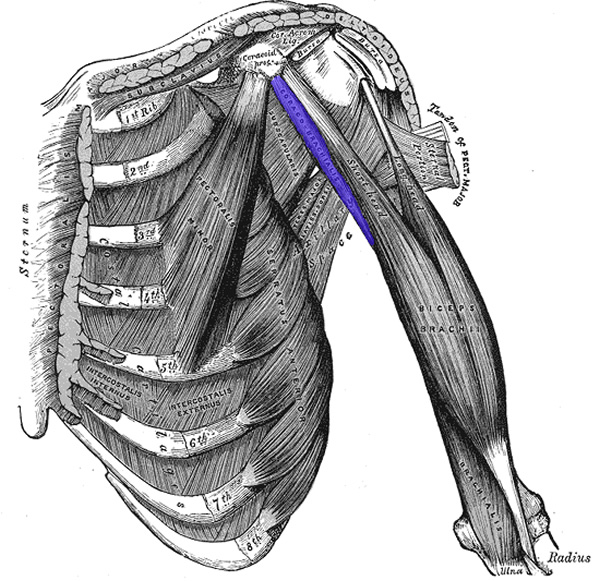
Coracobrachialis muscle.
Click on the image for a larger depiction
The coracobrachialis muscle is a thin, elongated bilateral flexor muscle that extends between the coracoid process of the scapula and the humerus bone. It is the shortest of the three muscles that attach to the coracoid process, the others being the pectoralis minor muscle and the tendon of the short head of the biceps brachii muscle. The coracobrachialis muscle attaches by way of a tendon into the middle third of the medial surface of humerus between the origins of the triceps brachii and brachialis. Its tendon mixes with the tendon of the pectoralis minor.
The coracobrachialis id one of the three muscles contained in the anterior compartment (flexor compartment) of the arm, the other two being the brachialis and the biceps brachii.
The coracobrachialis muscle helps to flex and adduct the arm as well as to stabilize the shoulder joint, helping prevent dislocation. It receives innervation from the musculocutaneous nerve (C5-C7). This nerve, as it continues distally pierces the muscle and appears on its anterior aspect coursing inferiorly, The muscle is used when you reach with your hand and forearm to the contralateral aspect of your body, as in reaching to scratch your opposite ear, or doing a bench press.
It is found deep to the pectoralis major and anterior to the axillary artery and the brachial plexus. Along with the humerus and the short head of the biceps brachii, the coracobrachialis muscle forms the lateral wall of the axilla.
The coracobrachialis is one of the 17 muscles that attach to the scapula.
Note: The side image modified from the original in "Gray's Anatomy" by Henry VanDyke Carter, MD. Public domain. Animated image below by Wikimedia Commons - Anatomography [CC BY-SA 2.1 following Creative Commons attributes.

Sources:
1. “Gray’s Anatomy” Henry Gray, 1918
2. "Tratado de Anatomia Humana" Testut et Latarjet 8th Ed. 1931 Salvat Editores, Spain
3. "Gray's Anatomy" 42nd British Ed. Churchill Livingstone 2021
4. “An Illustrated Atlas of the Skeletal Muscles” Bowden, B. 4th Ed. Morton Publishing. 2015
5. "Trail Guide to The Body" 4th. Ed. Biel, A. Books of Discovery. 2010
- Details
This article is part of the series "A Moment in History" where we honor those who have contributed to the growth of medical knowledge in the areas of anatomy, medicine, surgery, and medical research.
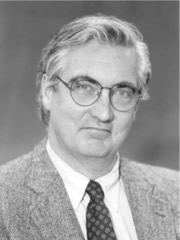
William J. Larsen, PhD (1942-2000). An American scientist, Dr. Larsen was a gifted scientist, consistently producing research at the forefront of cell, developmental, and reproductive biology. Early in his career he published a landmark paper that conclusively established mitochondrial fission as the mechanism of mitochondrial biogenesis. He went on to become the first to demonstrate the endocytosis of gap junctions. Moreover, his work on the hormonal regulation of gap junction formation and growth culminated in an authoritative review article in Tissue and Cell, “Structural Diversity of Gap Junctions (1988)”, which became a citation classic.
Throughout his 25 year teaching career, his sixty-seven peer reviewed publications—not to mention numerous invited reviews, abstracts, and book chapters—covered a wide range of research areas including adrenal cortical tumor cells, human ovarian carcinomas, preterm labor, cumulus expansion, oocyte maturation, ovulation, folliculogenesis, and in-vitro fertilization.
In addition to his many contributions to basic research, Dr. Larsen loved to teach and was much appreciated by his students. His exceptional ability was reflected in the four teaching awards he received as a professor at the University of Cincinnati.
Notably, he was the author of Human Embryology, a textbook for medical students that was the first to incorporate modern experimental research into a subject that had traditionally been taught in a strictly descriptive style. On its initial publication in 1998 it was hailed as, “a magnificent book…” by the European Medical Journal. With the release of the fourth edition in 2008, the book was renamed “Larsen’s Human Embryology” in recognition of Dr. Larsen's place as the originator of this revolutionary text. This book is today in it's 6th Edition.
His stellar scientific career would be enough for most people, but Dr. Larsen pursued his numerous and varied interests with such extraordinary passion, energy, and skill that he seemed to have more hours in a day than the ordinary person. He was fascinated with the American Southwest and studied and collected traditional arts and crafts of the Hopi, Zuni, and Navajo peoples. He was a woodworker who built three harpsichords and a fortepiano for his wife, and, with his two children, over 100 pieces of gallery-quality furniture. In addition, he loved to regale his friends, colleagues, and students with jokes and stories, and to share his love for gourmet cooking.
The William J. Larsen Distinguished Lecture Series
An annual lecture series was created for the Department of Cancer & Cell Biology at the University of Cincinnati to honor Dr. Larsen's research which was at the forefront of cell developmental and reproductive biology. This series recognizes forward-thinking research scientists in the field of developmental biology and asks that they share their research and findings with students and faculty of the University of Cincinnati, College of Medicine.
Personal note: I had the opportunity to meet and attend Dr. Larsen’s embryology lectures as he and I worked in the Anatomy, Embryology, and Histology program at the University of Cincinnati Medical College. Unfortunately, I never had the opportunity to have Dr. Larsen sign my personal copy of his book. He is sorely missed, Dr. Miranda
Sources:
1. "The William J. Larsen Distinguished Lecture Series" University of Cincinnati, College of Medicine.
2. https://www.larsenbooks.com
3. 2022 Larsen Lecture Series brochure (download here)
4. Dr. Larsen's family personal communications
- Details
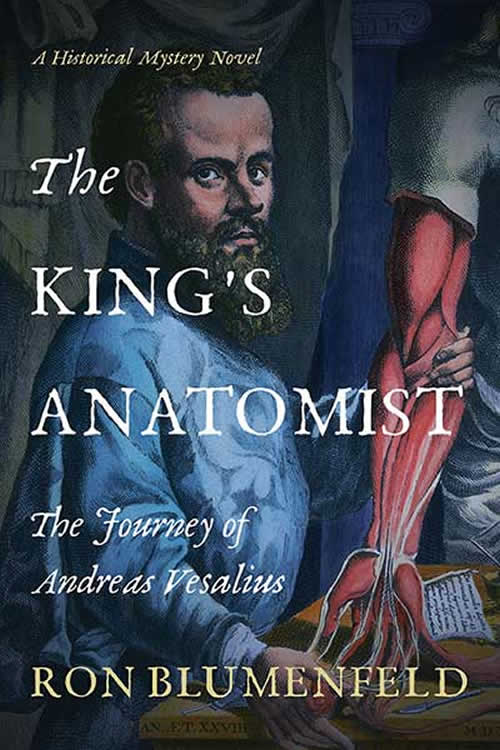
The King's Anatomist - Book Cover
Click on the image for a larger version
[UPDATED 11/30/2023] “In 1565 Brussels, the reclusive mathematician Jan van den Bossche receives shattering news that his lifelong friend, the renowned and controversial anatomist Andreas Vesalius, has died on the Greek island of Zante (today’s Zakynthos) returning from a pilgrimage to the Holy Land. Jan decides to journey to his friend’s grave to offer his last goodbye…” Thus begins the saga and the book the “King’s Anatomist”.
In June 2022 during the annual American Association of Clinical Anatomists (AACA) meeting in Fort Worth, TX, I was lucky to bid and win this, one of the latest books on Andreas Vesalius. This book, written by Ron Blumenfeld, MD. proved to be not only a great read, but also an quite historically accurate story. Let me explain this statement.
The book belongs to the genre of Historical Fiction, where the author does detailed research on a topic and then writes on accurate background but adds fictional characters and situations. Sometimes, as in this book, it follows a mystery that slowly unravels leading to shocking situations. To be fair, the author does explain what is not necessarily quite historically accurate, so as to leave no doubt about what is real or not.
The book is enthralling, the plot well developed, and the description of the academic environment, the details of the scenery for the travelers, the pettiness of war, etc., is not only interesting, but also portrays the times during the life of Andreas Vesalius in such a way that I felt transported there. It was very difficult to put the book down until I finished it.
The author does a great job getting us a little bit closer to who was Andreas Vesalius, the child at school, the youngster, the anatomist, the friend, the father, and the husband.
I should probably stop here and let you decide on the book for yourself without giving too much away. I strongly recommend this book and hope that you will enjoy it as much as I did. You can visit Ron’s website here to buy his book.
Ron and I both attended the 2014 “Vesalius Continuum” meeting in the Greek island of Zakynthos. This meeting celebrated the 500th anniversary of the birth of Andreas Vesalius. Part of the book he wrote is based on the discussions and presentations at this meeting.
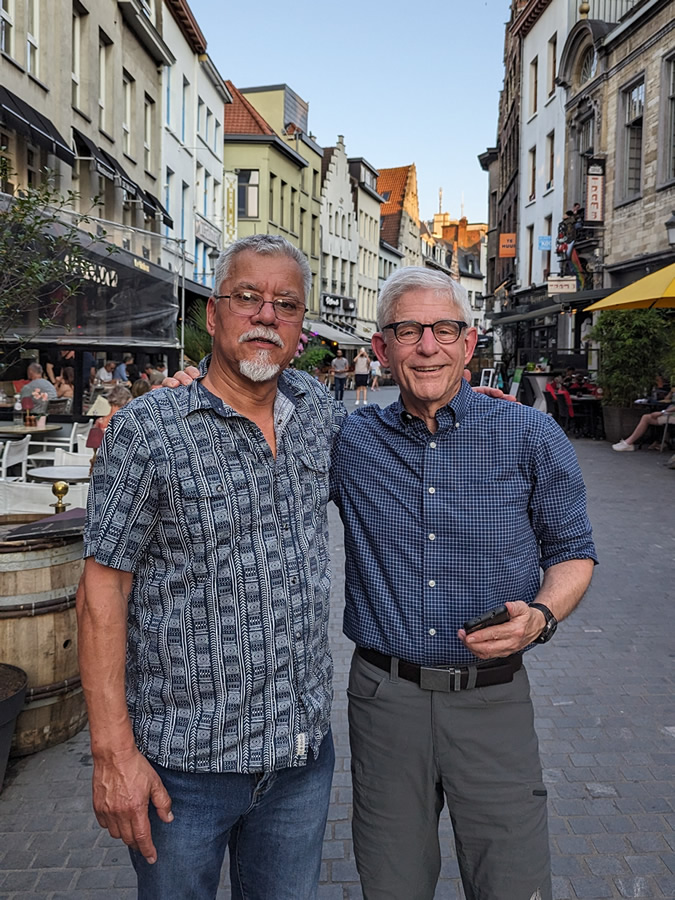
Ron Blumenfeld
Following are some excerpts of Ron’s bio and website in his own words:
“I’m a native New Yorker, pediatrician and health care executive who reunited with his inner writer in retirement. I surrendered the pleasure of writing columns on various topics for my local newspaper in Connecticut to focus on my debut novel, The King’s Anatomist”
“There always was a writer cooped up inside me, but he got loose only after I retired. I had permitted him to show up only in school classes, health and business writing, and newspaper columns, but I realize now that I kept him on a short leash because I was afraid of him – afraid of his disruptive potential and afraid of what he would look like to the world. But at this point in my life, I got past those excuses and let him out to see what he could do.
"The King’s Anatomist, it turned out, was an ideal writing project, anchored in facts, but with ample room for creativity. Thank you, Andreas Vesalius, for being such an interesting guy.”
UPDATE: I was glad to see Ron Blumenfeld again when he attended the 2023 Vesalius Triennial Meeting in the city of Antwerp, Belgium where I had been invited to participate. We had a great time in the conference, walking around the city, and at local restaurants! Also, thank you, Ron, for signing and dedicating my personal copy of your book. It has a nice place in my library. Dr. Miranda.
Should you want to look for more information on Andreas Vesalius in this website click here.
- Details
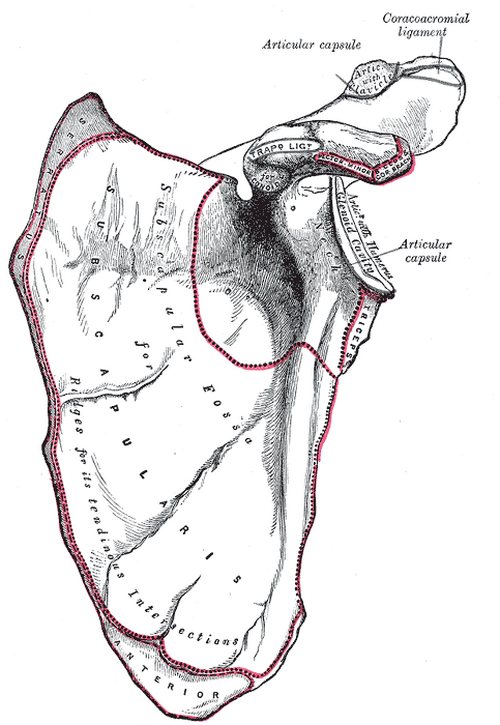
Anterior view of the left scapula
UPDATED: The scapula, known vernacularly as the "shoulder blade", is a flat, triangular bone that forms the posterior portion of the shoulder girdle. It is described with two surfaces, three borders, and three angles. The scapula attaches to the clavicle by way of the acromioclavicular joint and ligaments. Seventeen muscles attach to the scapula and are discussed in a different article.
This bone actually has two names depending on the language used. In English we use the word [scapula] which has a Latin origin, while in some Latin-based languages the word [omóplato] (Spanish, in this case) has a Greek origin!
[Scapula] originates from the Latin [scapula] (scapula), meaning “shoulder”, also “the back”. The later derivation into “shoulder blade” in English has no known history, except perhaps for the primitive use of animal scapulae as a blade or a spatula in daily chores.
In Greek the term [ωμοπλάτη] (omopláti) was used to name the scapula. The origin of the word was the combination of the terms [ώμος] (ómos) meaning “shoulder”, and the word [πλάτη] (pláti) meaning “back”. One of the seventeen muscles that attach to the [scapula] is the [omohyoid], where the root term [-omo-] indicates its relation to the scapula.
It was Andreas Vesalius who popularized the name [scapula] selecting it from the many names this bone had at the time (1543), and is today the the accepted “Nomina Anatomica” term.
There is still discrepancy on the name of the bone in other languages.
• English: scapula
• Spanish: omóplato, also escápula
• Italian: scapula
• French: omoplate
• Romanian: omoplat
• Portuguese: escápula
In German, they used the word [schulterblatt] which means "shoulder blade".
The anatomical description of this bone continues in this article
Sources:
1. "Tratado de Anatomia Humana" Testut et Latarjet 8 Ed. 1931 Salvat Editores, Spain
2. "Gray's Anatomy" 38th British Ed. Churchill Livingstone 1995
3. “The Origin of Medical Terms” Skinner HA 1970 Hafner Publishing Co.
4. "Terminologia Anatomica: International Anatomical Terminology (FCAT)" Thieme, 1998
Image in Public Domain, by Henry Vandyke Carter - Gray's Anatomy
Note: The links to Google Translate include an icon that will allow you to hear the Greek or Latin pronunciation of the word.
- Details
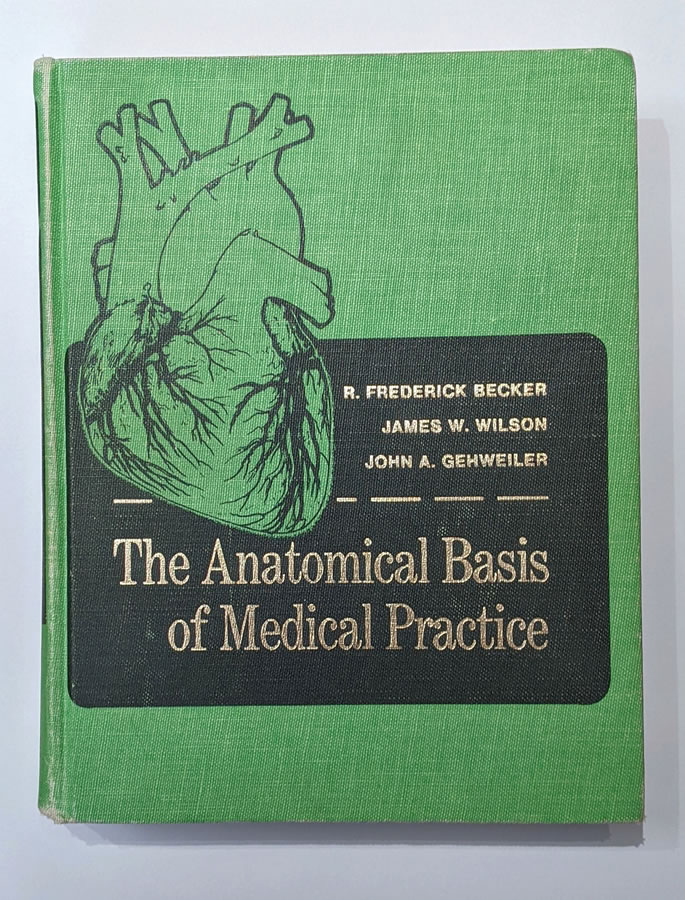
The Anatomical Basis of Medical Practice - Book Cover
Click on the image for a larger version
The title of this article paraphrases the title of a paper authored by Edward Halperin, MD, MA., and published in “Academic Medicine,” the Journal of the Association of American Medical Colleges in February 2009. More information in the "Sources" section of this article. I have also used other sources to complete this "strange tale."
"The Anatomical Basis of Medical Practice" was published in 1971 by Williams & Wilkins. A large and heavy book, it is one of the many anatomy books written for medical students. This one however, stirred a controversy because of the "tongue-in-cheek" writing style of the authors and mostly because of the photographs of female nude models in seductive poses pretending to depict surface anatomy. The pictures were taken by a famous photographer, Peter Gowland.
Initial reviews were positive, as stated in the British Journal of Surgery, where the book is praised saying: "one only wishes that such a book was available when one was a student in the dissecting room."
Other reviews were more negative, as Dr. Edward A. Edwards in 1972 states: "...I feel compelled to say that the numerous photographs of comely young women, while enticing, no not well demonstrate the muscles and bony points the legends suggest as their purpose." He also says: "The book is marred by a waggishness expressed in facetiousness and in long digressions...."
Soon negative reactions to the book took place, many of them from anatomy professors who saw the illustrations as "out of place" and "not needed". Interestingly only a small percentage of the total images were of the "Playboy" style, while the rest of the images, photographs and sketches are of high educational quality.
Estelle R. Ramey, Emeritus Professor of Physiology and Biophysics at the Georgetown University School of Medicine, in a letter to the Association of Women in Science stated “In effect, the entire book is a calculated insult to women and men alike. It demeans the whole profession of medicine and is openly contemptuous of middle-aged women whose breasts are not so round and may even be rotting with cancer.” The AWIS as a whole threatened to boycott Williams and Wilkins Publishing, and as a result, the book was pulled off the market.
The story gets more interesting. Because of public pressure, angry letters to the publisher, and boycotts, the publisher agreed to stop all promotion, marketing, and sales of the book. Many assumed that they pulled the book off the market when, apparently because of low sales, they just let the initial run sell out by December 1972 and never republished it.
I do agree that the book transgresses the lines of decorum and respect for women that exist today. At the time of its publication the feminine movement was starting, and I think the authors tried (and failed) to have a humorous approach to what is at best, a difficult subject.
The book itself is a great book on anatomy and superficial anatomy, notwithstanding the images and comments. Since it was published and because of its scarcity, it has become a rare book, and as Dr. Halperin states “a minor collector’s item.” When published, this book sold for US$23.00. In 2009, at the time Dr. Halperin published his paper, the book was valued between US$ 89.00 and US$ 300.00; today (2025,) the book is valued between US$ 575.00 and US$1,000.00 in Abebooks.com.
"The Anatomical Basis of Medical Practice" by Becker, R; Frederick; Wilson, James W; and Gehweiler, John, A. is one of the many books in my library and it has become known as “the green book” among my colleagues because of its bright green cloth hardcover. The image in this article is from the book in my library.
Sources:
1. “The Pornographic Anatomy Book? The Curious Tale of The Anatomical Basis of Medical Practice" Halperin, E. Academic Medicine: February 2009 - Volume 84 - Issue 2 - p 278-283
2. "The anatomical basis of medical practice." By R. Frederick Becker, Ph.D., James W. Wilson, Ph.D., M.D., and John A. Gehweiler, M.D. 11 × 8¼ in. Pp. 907 + xv. Illustrated. 1971. Edinburgh: Churchill Livingstone.
3: "Five centuries of gender bias in anatomy" Elisabeth Brander — December 9, 2021
4. " The Anatomical Basis of Medical Practice (NSFW)" September 10th, 2012
5. "The Anatomical Basis of Medical Practice" by Becker, R; Frederick; Wilson, James W; and Gehweiler, John, A. 1971. The Williams & Wilkins Company
6. "The Anatomical Basis of Medical Practice" Book Review by Edwards, E. Ach. Surg. 1972
- Details
This article is part of the series "A Moment in History" where we honor those who have contributed to the growth of medical knowledge in the areas of anatomy, medicine, surgery, and medical research.
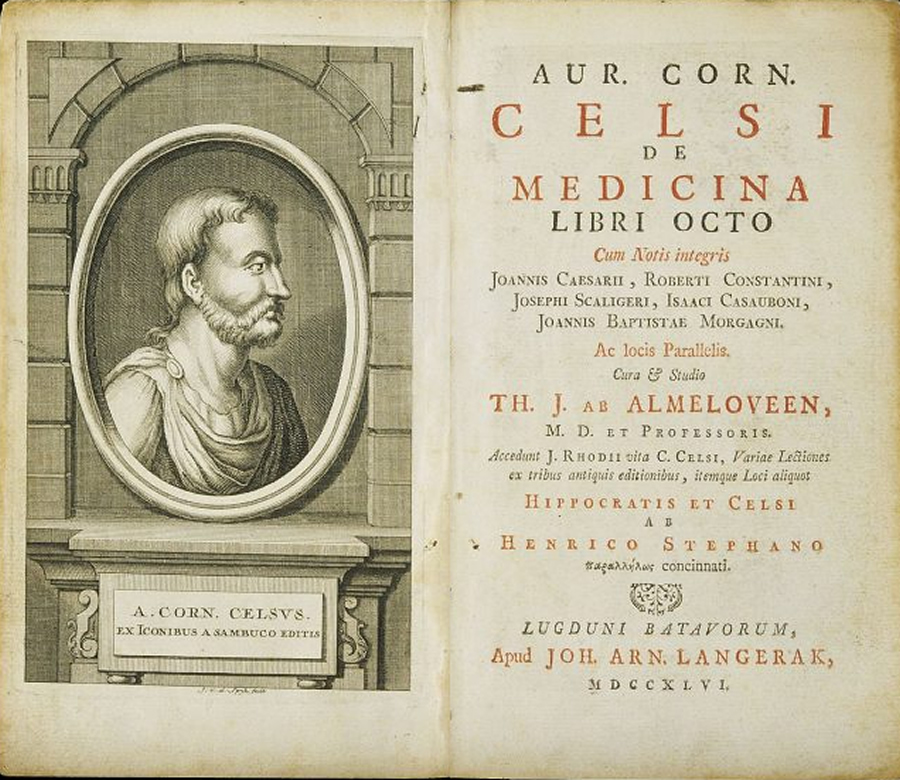
Celsus and Title Page De Medicina Libri Octo”
Click on the image for a larger version
Aulus Cornelius Celsus (25 BC - 45 AD) was Roman, probably born in the south of France. A controversial character, many dispute that he was even a physician or that he actually did what is mentioned in his opus magnum “De Medicina Libri Octo.” According to some, he was what today would be considered a compiler and editor of larger books where each chapter is written by a different author. Others present Celsus as a learned scholar of noble origin, a famous physician, either way, he influenced Medicine and Surgery for centuries. Some of his canons and medical terms he coined are in use today. such as omentum, cancer, vertebra, scalpel, etc.
He is the first to describe the four pillars of inflammation: dolor (pain), rubor (redness), calor (fever), and tumor (swelling) , and in passing criticizes Erasistratus on being wrong about inflammation. In his book he states “Notæ vero inflammationis sunt quatuor, rubor, et tumor, cum calore et dolore. Quo magis erravit Erasistratus, qui febre nullam sine hac esse dixir.” Translates as: “Note that there are four signs of inflammation: redness and swelling, with heat and pain. So much was Erasistratus mistaken, when he declared there was no fever without it.” Celsus popularized the use of the term “cancer”. although it was first used by Galen of Pergamon.
Not much is known about his life or work. Quintilian mentions a work of Celsus on rhetoric, but that work is lost. Quintilian, who apparently was not a fan of Celsus, writes: “…when even Cornelius Celsus, a man of a moderate share of genius, has not only composed treatises on all these arts, but has also left precepts of the military art, agriculture, and medicine.” His quote is what leads Alexander of Padua to state that his book “De Medicina, Libri Octo” is but a small part of a larger treatise that was called “The Arts.” Celsus is known by his book “De Medicina, Libri Octo,” (On Medicine, eight books). This book is sometimes presented as “De Re Medicina, Libri Octo.” Apparently, this book was part of a larger work by Celsus that has disappeared from History. This medical book was handwritten and was lost to history until one copy was discovered in the Vatican Library and released for copying as manuscripts. Of interest is the fact that the book found was titled "Aulii Cornelii Celsi liber sextus. idemque medicinæ primus," making it understood that these were six books, not eight! This was one of the first medical books to be printed upon the invention of the printing press by Gutenberg.
The first book begins with the principles for the preservation of health; the second is dedicated to the symptoms of diseases; the third is describes treatment of diseases which affect the whole organism and the fourth is focused on the diseases where the cause is found only in certain parts of the body, such as in head, lungs etc. The fifth book is dedicated to pharmacology. The sixth, seventh, and the eighth book deal with surgery, wounds, and fractures.
His book describes the importance of cleanliness of a wound and the use of topical treatment that today would be considered antiseptics. His contributions to surgery are many including anatomy of the eye, the description of ophthalmic diseases, methods of preventive treatment and surgery including eyelid surgery. He is probably the first to describe cataract surgery.
The eighth book, almost entirely dedicated to dislocations and fractures, provides an extensive description of head injuries such as extradural hematomas, lesions distant from the impact point, and intracranial damage in cases with no overlying fractures. He also provided the first description of brain swelling exceeding the level of the skull, described several surgical indications and craniotomy techniques, recommended treatment for depressed fractures (which had been previously considered untreatable), and detailed the surgical instruments employed.
De Medicina was among the first medical books to be printed (Florence, 1478), and more than 50 editions have appeared; it was required reading in most medical schools to the present century. It is the principal historical authority for the doctrinal medical teachings of Roman antiquity. The surgical section, which even Joseph Lister studied in the 19th century, is perhaps the best part of the treatise.
W. G. Spencer, the most recent translator of his works, supports an older, minority view that the details of medical procedure, the experienced judgment shown in the selection of treatment, and the frequent use of the first person reveal an author with an intimate acquaintance of clinical medicine who must have been himself a practitioner of the medical arts.
Because of this book and the clarity of the disease descriptions and treatments both pharmacological and surgical. Celsus has been lauded as one of the Fathers of Medicine and Surgery. His influence has stood the test of time and was read well into the 1800’s.
Personal note: This article was motivated by the recent acquisition of a 1713 copy of De Medicina, that is now part of my library. The book belonged to Dr. Harry Kaufmann Hines, a renown radiologist who lived and worked in Cincinnati, OH. The book was a gift to him from his sister-in-law Erma Wright Tateman neé Sharkey in August 1961. Dr. Miranda
Sources:
1. “The Contribution of Aulus Cornelius Celsus (25 B.C.–50 A.D.) to Eyelid Surgery” Davide Lazzeri, Tommaso Agostini, Michele Figus, Marco Nardi, Giuseppe Spinelli, Marcello Pantaloni & Stefano Lazzeri (2012), Orbit, 31:3, 162-167
2. “Aulus Cornelius Celsus and the Head Injuries” GiuseppeTalamonti Giuseppe D'Aliberti, MarcoCenzato World Neurosurgery Volume 133, January 2020, Pages 127-134
3. “A. Cornelius Celsus of medicine. In eight books.” Translated, with notes critical and explanatory, by James Greive, M.D. 1756
For anyone interested in reading an online copy of this book, you can find it here. For the translation by Greive click here.