
Medical Terminology Daily (MTD) is a blog sponsored by Clinical Anatomy Associates, Inc. as a service to the medical community. We post anatomical, medical or surgical terms, their meaning and usage, as well as biographical notes on anatomists, surgeons, and researchers through the ages. Be warned that some of the images used depict human anatomical specimens.
You are welcome to submit questions and suggestions using our "Contact Us" form. The information on this blog follows the terms on our "Privacy and Security Statement" and cannot be construed as medical guidance or instructions for treatment.
We have 336 guests online
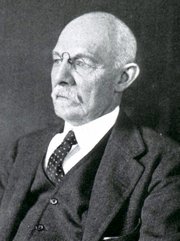
William S. Halsted, MD
(1852 – 1922)
American anatomist, teacher, and surgeon, William Stewart Halsted was born in New York City, USA to a wealthy family of English origin. His father was involved in charitable work and Governor and trustee to a city hospital. Not a brilliant student initially, Halsted took an undergraduate in Liberal Arts in Yale, CT., after which he entered the Medical College of Physicians at the Columbia College, where he excelled.
As a second-year medical student Halsted applied and obtained a position in surgery at a local hospital. In here he learned about Lister’s antiseptic technique and became an adamant proponent of it to reduce infection. In 1877 Halsted obtained his MD. After a short time as House Physician at the New York Hospital, Halsted traveled to Europe to further his education studying for two years at the Universities of Vienna, Leipzig, and W?rzburg.
Besides being at the forefront of surgical and antiseptic techniques (introducing the use of rubber gloves in surgery), Halsted was extremely concerned with the way medical students were taught in the US. He pioneered bedside clinical round discussions with the medical students after two years of basic sciences studies. Halsted developed the idea of a patient chart; he also developed the residency program for medical students in use today.
Halsted is probably the most influential researcher and surgeon at the turn of the century. He dedicated time to the study of intestinal anastomoses and the use of silk as a suture material. His experimental work in 1887 proved that the inclusion of the submucosa layer in an anastomosis was mandatory, as well that a single layered anastomosis was enough to attain closure. Perhaps Halsted’s most important contribution was the application and use of the scientific method to surgical questions. Halsted’s principles, also known as "Halsted's Rules of Surgery", set the standards used today in surgical suturing and surgical stapling.
He also pioneered the development and surgical techniques for radical mastectomy as a treatment for breast cancer.
As a side effect of this studied in anesthesia and the use of cocaine for anesthesia, Halsted became addicted to this substance, a problem that followed him through the years. Without impairing his capacity as a researcher and a surgeon, Halsted eventually recovered. He died in Baltimore in 1922 as a complication to surgery.
Sources:
1. Dubay, A. D., & Franz, G. M. (2003). Acute Wound Healing: The Biology of Acute Wound Failure. Surg Clin NA, 83, 463-481.
2. Halsted, W. S. (1887). Circular Suture of the Intestine - An Experimental Study. Am J Med Sci, 436-461.
3. “William Stewart Halsted: his life and contributions to surgery” Osborne, P. Lancet Oncol 2007; 8: 256–65
4. “William Stewart Halsted: Surgical pioneer” Burress, P Endoc Today (2010), 8: (2) 22
5. “William Stewart Halsted (1852–1922) Neurological stamp” Haas, LF J Neurol Neurosurg Psych 2000;69:641
Original image courtesy of "Images from the History of Medicine" at www.nih.gov

"Clinical Anatomy Associates, Inc., and the contributors of "Medical Terminology Daily" wish to thank all individuals who donate their bodies and tissues for the advancement of education and research”.
Click here for more information


- Details

Click for a larger image
The [gastroduodenal artery] arises from the common hepatic artery, which itself is a branch of the celiac trunk. Immediately after the gastroduodenal artery arises, the common hepatic artery changes its name to proper hepatic artery.
The gastroduodenal artery courses inferiorly, passing posterior to the first portion of the duodenum, and descends dividing into the anterosuperior and posterosuperior pancreaticoduodenal arteries. These branches provide supply to the duonenum and pancreas.
An ulcer of the posterior aspect of the first portion of the duodenum is dangerous, for if undiagnosed and untreated, could perforate into the gastroduodenal artery, which can bleed uncontrolled into the duodenum.
The image is an anteroinferior view of the liver and stomach. The duodenum and stomach are reflected anteriorly. CT= Celiac trunk, CHA= Common hepatic artery, PHA= Proper hepatic artery, GDA= Gastroduodenal artery
Image property of: CAA.Inc. Photographer: David M. Klein
- Details
Click for a larger image
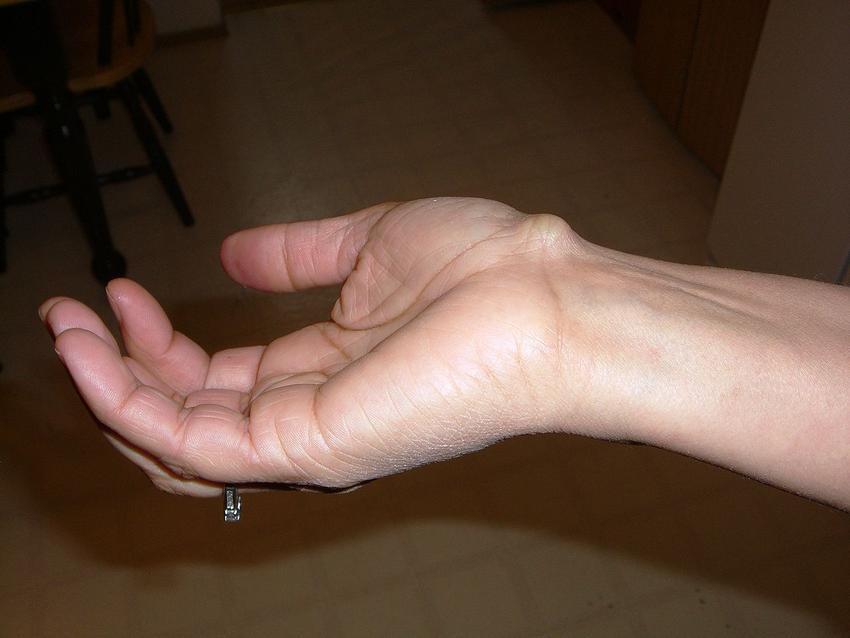
A [cyst] is a small sac-like structure, usually characterized by a distinct membrane that separates the content from its surroundings. It usually contains serous fluid, but it can also contain semisolid materials. If the cyst contains pus, then it will be called an "abscess".
There are many types of cysts. One of them, shown in the accompanying image is a "ganglion cyst", a serous accumulation of fluids that is usually found near a joint or a tendon in the hands or feet. You can also read the article on "Nabothian cysts".
The image shows a ganglion cyst in the anterior aspect of the wrist.
The same word can be used as a root term, [-cyst-] arises from the Greek word [κύστη], pronounced(kisti), meaning "bladder". It is used in many words such as:
- Cholecystectomy: Removal of the gallbladder
- Cystic duct: The evacuation duct of the gallbladder
- Dacryocystolithiasis: Presence of stones in the lacrimal sac
- Cystoscope: An instrument to view into the urinary bladder
- Cystitis: Inflammation or infection of the urinary bladder
There is similar root term used for bladder: [-vesic] from the Latin [vesicae], also meaning "bladder".
Original image by GEMalone (Own work) [GFDL (http://www.gnu.org/copyleft/fdl.html) or CC BY 3.0 (http://creativecommons.org/licenses/by/3.0)], via Wikimedia Commons. Public domain.
- Details
Hesselbach's triangle
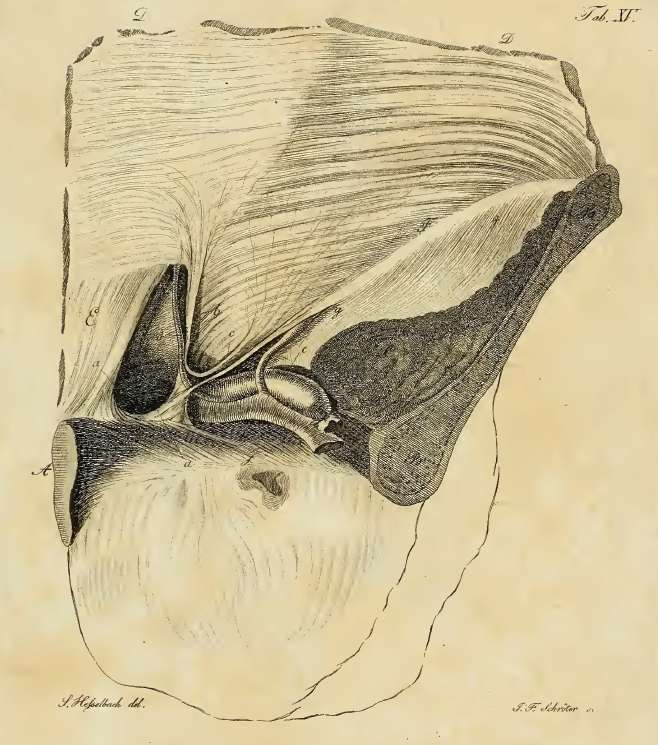
Hesselbach’s triangle is a triangular region in the lower posterior aspect of the anterior abdominal wall (see yellow inset in the image). It is bound medially by the lateral border of the rectus abdominis muscle, superolaterally by the inferior (deep) epigastric vessels (label “C”) and by the inguinal ligament inferolaterally.
Hesselbach’s triangle is described as the area where a direct inguinal hernia will extrude from posterior to anterior, to protrude directly (hence the name) through the external (superficial) inguinal ring.
Franz Kaspar Hesselbach (1759-1816) was a German surgeon and anatomist who described inguinofemoral hernias in detail, publishing several books on the subject. His name is attached to several regions and structures:
• Hesselbach’s triangle, described in this article
• Hesselbach’s fascia. Known as the cribriform fascia, this perforated fascia covers the saphenous opening in the superior femoral region.
• Hesselbach’s ligament. Also known as the interfoveolar ligament, this is a thickening of the transversalis fascia in relation to the inferior (deep) epigastric vessels.
If you click on the picture, an original image by Hesselbach will appear. This image shows a defect in Hesselbach’s triangle, setting the stage for a direct inguinal hernia, as well as the interfoveolar ligament. Incidentally, Hesselbach's triangle as described today is not the area described originally by Dr. Hesselbach, where the lower border of the triangle was Cooper's ligament.
Initial image property of:CAA.Inc.. Artist:M. Zuptich. Secondary image by F.K. Hesselbach.
Clinical anatomy of the inguinofemoral hernias, as well as abdominal and perineal hernias are some of the lecture topics developed and delivered to the medical devices industry by Clinical Anatomy Associates, Inc. For more information Contact Us.
- Details
The suffix [-plasia] originates from the Greek word [plasis] or [plassein], meaning "to form", or "to develop". In medical terminology the suffix [-plasia] is used to mean "development". Here are some applications of this term:
- Aplasia: the prefix [a-] means "absence of" or "no", therefore "no development", or "no formation"
- Dysplasia: the prefix [dys-] means "abnormal" - abnormal development
- Hyperplasia: the prefix [hyper-] means "excessive" - excessive development
- Neoplasia: the prefix [neo-] means "new", therefore "a new development" or a "new formation". The term [neoplasia] is used to denote a malignant condition, a cancer tumor.
- Details
Click for a larger image
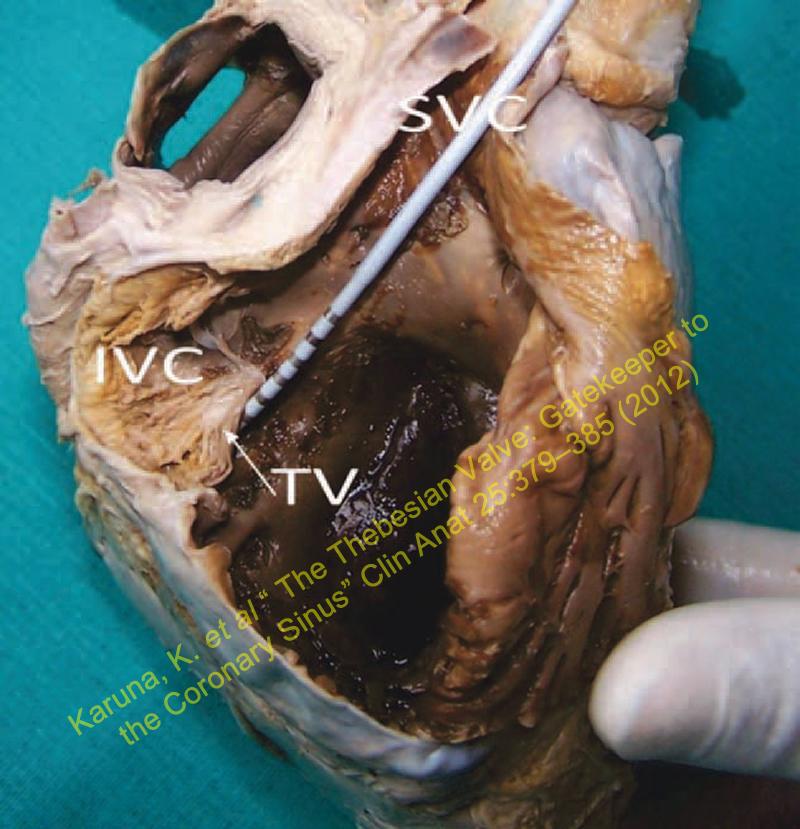
UPDATED: The eponymic [Thebesian valve], or valve of the coronary sinus is a fold of endocardial tissue situated at the exit ostium of the coronary sinus. Named after Adam Christian Thebesius, the morphology of the valve presents with anatomical variations that go from total absence (see image here) to endocardial folds that cover up to 65% of the coronary sinus opening (see image in this article). The variations of the Thebesian valve include fenestrations, cribiriform valves, and the presence of pectineal cardiac muscle.
The Thebesian valve is important because it can be an obstruction to the passage of a catheter performing retrograde cardioplegia in electrophysiological studies, catheter ablation, and percutaneous mitral valve repair.
Thanks to Dr. Karuna Katti for allowing us the use of the image in this article. The image shows the interior of the right atrium with the inferior vena cava removed to demonstrate the Thebesian valve. In this case, the Thebesian valve covers >65% of the coronary sinus ostium. A catheter is being passed from the superior vena cava into the coronary sinus ostium.
The image shown a human heart with the right atrium and ventricle opened. VC, inferior vena cava; SVC, superior vena cava; TV, Thebesian valve.
Source:"The Thebesian Valve: Gatekeeper to the Coronary Sinus"Karuna Katti and Nikhil Prakash PatilClin Anat 25:379–385 (2012)
- Details

Click for a larger image
[Dysmorphism] is a medical term formed by the prefix [dys-] meaning "abnormal", the root term [-morph-], arising from the Greek word [μορφος] (morfos), meaning "form" or "shape", and the suffix [-ism], also of Greek origin, in this case meaning "condition". A condition of abnormal shape, or "misshapen".
The term dysmorphism is used to denote an anatomical anomaly, usually superficial, that goes beyond the objective (and sometimes subjective) boundaries of normalcy. An example of these are craniofacial dysmorphisms associated with specific congenital disorders, such as Crouzon syndrome; birth defects such as hemifacial microsomia, or as in the case of the image on this article, Mevalonate Kinase Deficiency, a metabolic disease.
Some craniofacial dysmorphisms can affect articulation and speech, such as cleft palate, cleft lip (harelip), prognathism, and retrognathism.
Dysmorphism is also used in some mental disorders where the patient has an abnormal self-image, seeing his/her body or body parts as abnormal, when they are not. This is known as Body Dysmorphic Disorder (BDD), and can be associated with obsessive-compulsive behavior, anxiety, or depression. In some cases BDD can be associated or found in eating disorders such as Anorexia Nervosa, or bulimia.
The image shows a small child with mevalonic aciduria, a deficiency of mevalonate kinase deficiency. This is a rare genetic autosomal recessive metabolic disorder.
Thanks to Maria E. Gallegos, Chair of the Speech Pathology School, Iberoamerican University, Santiago Chile, for suggesting this article. Dr. Miranda
Image Source: Haas D, Hoffmann GF. Mevalonate kinase deficiencies: from mevalonic aciduria to hyperimmunoglobulinemia D syndrome. Orphanet J Rare Dis. 1, 13. 2006. PMID 16722536. DOI:10.1186/1750-1172-1-13 Image in the public domain
