
Medical Terminology Daily (MTD) is a blog sponsored by Clinical Anatomy Associates, Inc. as a service to the medical community. We post anatomical, medical or surgical terms, their meaning and usage, as well as biographical notes on anatomists, surgeons, and researchers through the ages. Be warned that some of the images used depict human anatomical specimens.
You are welcome to submit questions and suggestions using our "Contact Us" form. The information on this blog follows the terms on our "Privacy and Security Statement" and cannot be construed as medical guidance or instructions for treatment.
We have 421 guests online
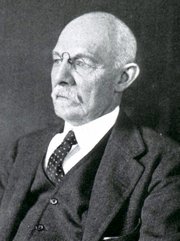
William S. Halsted, MD
(1852 – 1922)
American anatomist, teacher, and surgeon, William Stewart Halsted was born in New York City, USA to a wealthy family of English origin. His father was involved in charitable work and Governor and trustee to a city hospital. Not a brilliant student initially, Halsted took an undergraduate in Liberal Arts in Yale, CT., after which he entered the Medical College of Physicians at the Columbia College, where he excelled.
As a second-year medical student Halsted applied and obtained a position in surgery at a local hospital. In here he learned about Lister’s antiseptic technique and became an adamant proponent of it to reduce infection. In 1877 Halsted obtained his MD. After a short time as House Physician at the New York Hospital, Halsted traveled to Europe to further his education studying for two years at the Universities of Vienna, Leipzig, and W?rzburg.
Besides being at the forefront of surgical and antiseptic techniques (introducing the use of rubber gloves in surgery), Halsted was extremely concerned with the way medical students were taught in the US. He pioneered bedside clinical round discussions with the medical students after two years of basic sciences studies. Halsted developed the idea of a patient chart; he also developed the residency program for medical students in use today.
Halsted is probably the most influential researcher and surgeon at the turn of the century. He dedicated time to the study of intestinal anastomoses and the use of silk as a suture material. His experimental work in 1887 proved that the inclusion of the submucosa layer in an anastomosis was mandatory, as well that a single layered anastomosis was enough to attain closure. Perhaps Halsted’s most important contribution was the application and use of the scientific method to surgical questions. Halsted’s principles, also known as "Halsted's Rules of Surgery", set the standards used today in surgical suturing and surgical stapling.
He also pioneered the development and surgical techniques for radical mastectomy as a treatment for breast cancer.
As a side effect of this studied in anesthesia and the use of cocaine for anesthesia, Halsted became addicted to this substance, a problem that followed him through the years. Without impairing his capacity as a researcher and a surgeon, Halsted eventually recovered. He died in Baltimore in 1922 as a complication to surgery.
Sources:
1. Dubay, A. D., & Franz, G. M. (2003). Acute Wound Healing: The Biology of Acute Wound Failure. Surg Clin NA, 83, 463-481.
2. Halsted, W. S. (1887). Circular Suture of the Intestine - An Experimental Study. Am J Med Sci, 436-461.
3. “William Stewart Halsted: his life and contributions to surgery” Osborne, P. Lancet Oncol 2007; 8: 256–65
4. “William Stewart Halsted: Surgical pioneer” Burress, P Endoc Today (2010), 8: (2) 22
5. “William Stewart Halsted (1852–1922) Neurological stamp” Haas, LF J Neurol Neurosurg Psych 2000;69:641
Original image courtesy of "Images from the History of Medicine" at www.nih.gov

"Clinical Anatomy Associates, Inc., and the contributors of "Medical Terminology Daily" wish to thank all individuals who donate their bodies and tissues for the advancement of education and research”.
Click here for more information


- Details

Coccyx, anterior view
The word [coccyx] arises from the Greek term [κούκος] (pronounced koúkos)and means "cuckoo". It is the name of the lower segment of the spinal column, and was named by Herophilus of Alexandria (325-255BC) because of a resemblance of this structure to the bill of the cuckoo bird. Vesalius also used the same analogy. There is another structure of the body named after the beak of a bird, do you know it? If not, click here.
The coccyx (vernacularly known as "tailbone") is usually represented by four rudimentary vertebrae, although the number varies between 3 to 5 vertebrae. There have been reported cases of "human tails" but these do not have a bony structure and are usually related to congenital abnormalities such as spina bifida.
The coccyx has a well-formed superior component, which usually presents with two cornua (horns) which serve as part of a rudimentary zygapophyseal (facet) joint. The lower coccygeal vertebra is usually a small bony node.
The coccyx has an anterior sacrococcygeal ligament, which is continued with the anoccygeal raphe, a ligamentous structure that serves as a posterior attachment for muscular components of the pelvic diaphragm, and helps anchor the anal canal. The coccygeus muscle, the posterior component of the pelvic diaphragm and part of the sacrospinous ligament also attach to the anterolateral aspect of the coccyx.
Coccygeal pain is referred to as coccydynia.
Sources:
1. "The Origin of Medical Terms" Skinner, HA 1970 Hafner Publishing Co.
2. "Medical Meanings - A Glossary of Word Origins" Haubrich, WD. ACP Philadelphia
3. "Dorlands's Illustrated Medical Dictionary" 26th Ed. W.B. Saunders 1994
5 "Tratado de Anatomia Humana" Testut et Latarjet 8 Ed. 1931 Salvat Editores, Spain
6. "Anatomy of the Human Body" Henry Gray 1918. Philadelphia: Lea & Febiger
Image modified by CAA, Inc. Original image courtesy of bartleby.com
Note: Google Translate includes the symbol (?). Clicking on it will allow you to hear the pronunciation of the word.
- Details
Click for a larger image
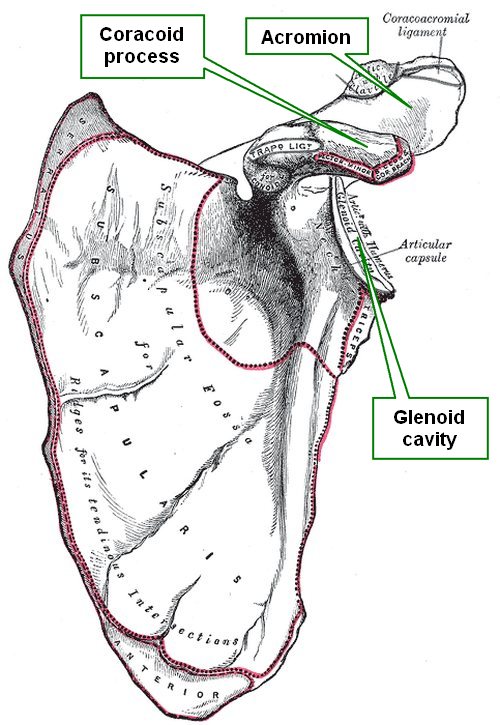
The [coracoid process] is a curved bony projection that attaches to the superior aspect of the neck of the scapula . At its origin it has a broad base continuous with a segment that projects slightly superomedially, it then continues anterolaterally with a narrower distal segment.
The pectoralis minor and coracobrachialis muscles attach to the coracoid process as well as the tendon of the short head of the biceps brachii muscle. The trapezoid and conoid ligaments, which also attach to the clavicle, attach to the coracoid process.
The root term [-corac-] originates from the Greek word [κοράκι] (koríki), meaning “raven” or “crow. The suffix [-oid], also of Greek origin, means “similar to". The word [coracoid] was coined because of the similarity of the coracoid process to a raven’s beak.
Trivia question: What other part of the body is named after a bird’s beak? For the answer, click here. What other parts of the body are named after birds? For the answer, click here.
The image shows the anterior view of the left scapula. Modified from image in Public Domain, by Henry Vandyke Carter - Gray's Anatomy
Source:
“Gray’s Anatomy” Henry Gray, 1918
- Details
Click for a larger image
The [acromion] is a bony process found at the superolateral end of the spine of the scapula forming the highest point of the shoulder. It is a flattened somewhat triangular bony process that is found superior to the glenoid cavity. The trapezius and deltoid muscles attach to the acromion.
The term [acromion] is formed by two Greek roots; [άκρο] (ákro), meaning “end” or “point”, and [ώμος] (omos), meaning “shoulder”. The term [acromion] is quite descriptive, as it means the “point of the shoulder.
The image shows the anterior view of the left scapula. Modified from image in Public Domain, by Henry Vandyke Carter - Gray's Anatomy
Source:
“Gray’s Anatomy” Henry Gray, 1918
- Details
UPDATED: From the Greek, the prefix [ana-] meaning "trough" or "up", the root term [-tom-], arising from [τομή] (tomi) meaning "to cut", and the suffix [-y], meaning "process". The word [anatomy] means then, "a process of cutting up", a very good description of what anatomists do. What is interesting is that the word anatomy describes an action, and as such can be used as a verb. It is correct to say "to anatomize" when referring to the act of dissecting a body or body part.
The word "anatomy" has the same meaning as "dissection", a word with Latin roots. The prefix [dis-] means "apart", while the root term [-section] means "to cut". [-section] arises from the Latin [sectis] or [secare]. both meaning "to cut".
Today the term [anatomy] is used to describe one of the basic medical sciences; in the Middle Ages the terms to "dissect" or to "anatomize" were interchangeable.
Anatomy is "the study of the human body, its parts and components, and the spatial relationship between this components". For many, anatomy is at the basis of the Science of Surgery
There are many subspecialties in anatomy, including:
• Gross anatomy: That anatomy that can be seen with the naked eye
• Surface anatomy: The correlation between superficial landmarks and internal structures and organs
• Clinical anatomy: The study of anatomy and its relation to physiology, pathology, and surgical treatment
Personal note: The improper pronunciation of the term [dissection] is one of my pet peeves!
- Details
Click for a larger image
UPDATED: The word [anesthesia] is formed by the prefix [an-] meaning "without" or absence of", and the Greek root term [-esthesia-] meaning "sensation". Skinner (1970) mentions that the suffix [-ia] means "condition". Thus analyzed, the word [anesthesia] means "a condition of absence of sensation". The word was coined and first used by Oliver W. Holmes Sr. (1809 - 1894).
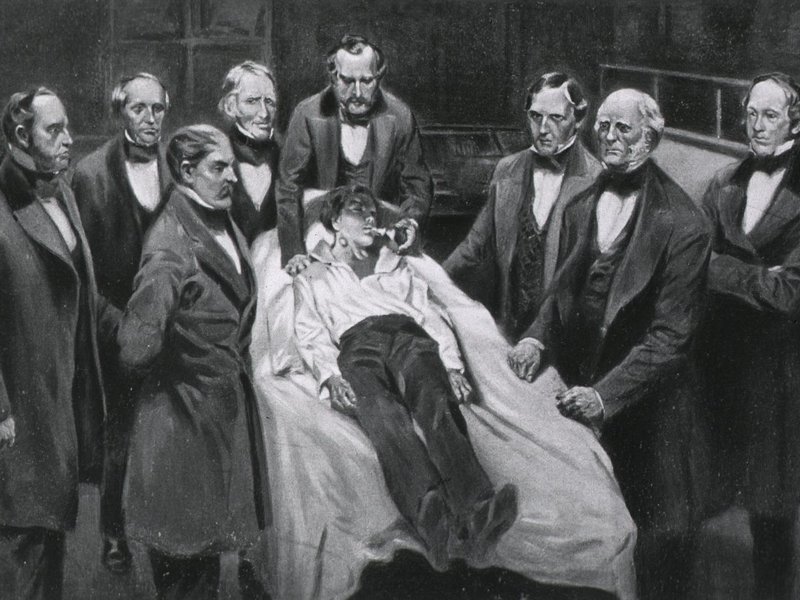
The search for an anesthetic agent that could alleviate pain and help surgery has ancient origins, potions, alcohol, and herbal remedies had been used until the discovery of nitrous oxide (laughing gas) first, and ether second. It was this latter element, pioneered by William T.G. Morton (1819–1868), that started a revolution in surgery.
In 1846 Morton working as the anesthetist helped a public demonstration of surgery at the Massachusetts General Hospital. This was the first use of anesthesia in surgery. The event was so important that drawings and paintings were made. See the accompanying image.
After this demonstration, research was continued and the anesthetic properties of many compounds were discovered, leading to modern anesthetics.
The operation took place on October 16, 1846, in the first operating room built at the Massachusetts General Hospital. This room has been preserved and is today known as the "Ether Dome". You can read an article on a visit I made to this historic place. Dr. Miranda
Original image (public domain) courtesy of "Images from the History of Medicine" at www.nih.gov

- Details
|
UPDATED: The suffix [-esthesia] is Greek, arising from the word [αίσθηση] (a?sthi?si?) meaning "sensation". Some of the applications of the term are as follows:
Note: The links to Google Translate include an icon that will allow you to hear the Greek or Latin pronunciation of the word. |
|
| MTD Main Page | Subscribe to MTD |