
Medical Terminology Daily (MTD) is a blog sponsored by Clinical Anatomy Associates, Inc. as a service to the medical community. We post anatomical, medical or surgical terms, their meaning and usage, as well as biographical notes on anatomists, surgeons, and researchers through the ages. Be warned that some of the images used depict human anatomical specimens.
You are welcome to submit questions and suggestions using our "Contact Us" form. The information on this blog follows the terms on our "Privacy and Security Statement" and cannot be construed as medical guidance or instructions for treatment.
We have 3020 guests online
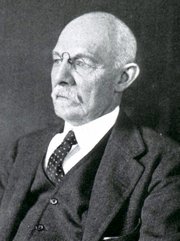
William S. Halsted, MD
(1852 – 1922)
American anatomist, teacher, and surgeon, William Stewart Halsted was born in New York City, USA to a wealthy family of English origin. His father was involved in charitable work and Governor and trustee to a city hospital. Not a brilliant student initially, Halsted took an undergraduate in Liberal Arts in Yale, CT., after which he entered the Medical College of Physicians at the Columbia College, where he excelled.
As a second-year medical student Halsted applied and obtained a position in surgery at a local hospital. In here he learned about Lister’s antiseptic technique and became an adamant proponent of it to reduce infection. In 1877 Halsted obtained his MD. After a short time as House Physician at the New York Hospital, Halsted traveled to Europe to further his education studying for two years at the Universities of Vienna, Leipzig, and W?rzburg.
Besides being at the forefront of surgical and antiseptic techniques (introducing the use of rubber gloves in surgery), Halsted was extremely concerned with the way medical students were taught in the US. He pioneered bedside clinical round discussions with the medical students after two years of basic sciences studies. Halsted developed the idea of a patient chart; he also developed the residency program for medical students in use today.
Halsted is probably the most influential researcher and surgeon at the turn of the century. He dedicated time to the study of intestinal anastomoses and the use of silk as a suture material. His experimental work in 1887 proved that the inclusion of the submucosa layer in an anastomosis was mandatory, as well that a single layered anastomosis was enough to attain closure. Perhaps Halsted’s most important contribution was the application and use of the scientific method to surgical questions. Halsted’s principles set the standards used today in surgical suturing and surgical stapling.
He also pioneered the development and surgical techniques for radical mastectomy as a treatment for breast cancer.
As a side effect of this studied in anesthesia and the use of cocaine for anesthesia, Halsted became addicted to this substance, a problem that followed him through the years. Without impairing his capacity as a researcher and a surgeon, Halsted eventually recovered. He died in Baltimore in 1922 as a complication to surgery.
Sources:
1. Dubay, A. D., & Franz, G. M. (2003). Acute Wound Healing: The Biology of Acute Wound Failure. Surg Clin NA, 83, 463-481.
2. Halsted, W. S. (1887). Circular Suture of the Intestine - An Experimental Study. Am J Med Sci, 436-461.
3. “William Stewart Halsted: his life and contributions to surgery” Osborne, P. Lancet Oncol 2007; 8: 256–65
4. “William Stewart Halsted: Surgical pioneer” Burress, P Endoc Today (2010), 8: (2) 22
5. “William Stewart Halsted (1852–1922) Neurological stamp” Haas, LF J Neurol Neurosurg Psych 2000;69:641
Original image courtesy of "Images from the History of Medicine" at www.nih.gov

"Clinical Anatomy Associates, Inc., and the contributors of "Medical Terminology Daily" wish to thank all individuals who donate their bodies and tissues for the advancement of education and research”.
Click here for more information


- Details
Click for a larger image
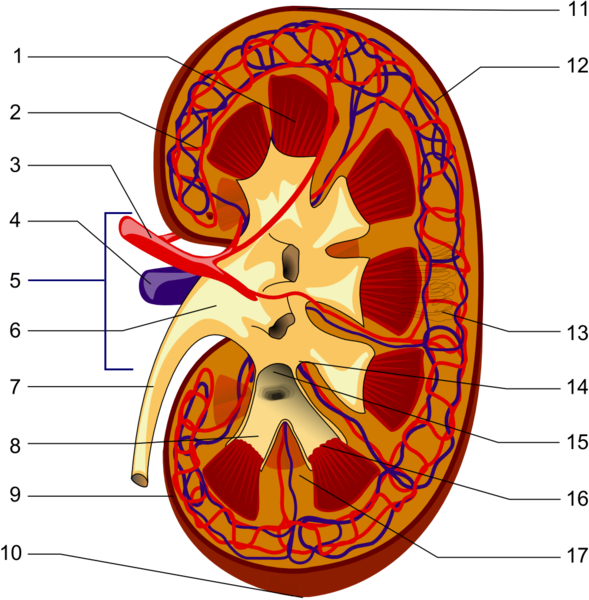
The [ureters] are two long, thin, bilateral muscular tubes that extend from the pelvis of the ipsilateral kidney to the posteroinferior aspect of the urinary bladder. The ureters are retroperitoneal structures and their function is the transport of urine between the kidney and the urinary bladder.
The word arises from the Greek [ουρητήρ], meaning "urinary duct". The term was originally used to denote both the urethra (in its singular form) and the ureters (in its plural form). Because of the problems using the term, the word [urethra] was created.
The ureter is composed of three layers: a mucosa, a thick muscular layer, and an adventitia. The muscular layer is itself composed of an deep longitudinal layer and a superficial circular layer formed by spiral smooth muscle fibers. In the distal portion of the ureter there is a third layer added to the ones mentioned, a thick longitudinal layer that extends into the walls of the urinary bladder. Since the ureter is a retroperitoneal organ, in the areas where the ureter is in contact with the parietal peritoneum, it can be said that the ureter presents with a fourth layer. The muscular construction of the ureters in layers allows for peristalsis that helps the flow of urine.
In the female the pelvic ureter passes just inferior to the uterine artery, as situation that surgeons refer to as "water under the bridge". Proper identification of the ureter is critical to avoid damage to this structure during a total hysterectomy. Surgeons will use the peristaltic movement of the ureter to identify it.
In its trajectory the ureters descend anterior to the psoas major muscle, pass over the pelvic brim, just anterior to the origin of the internal iliac artery, then hug the lateral pelvic wall and enter the urinary bladder from a posteroinferior aspect. As it descends the ureters receive blood supply from different arteries: renal arteries, gonadal (testicular or ovarian) arteries, aorta, common iliac arteries, and the inferior vesical arteries.
The ureters receive sympathetic and parasympathetic innervation from the autonomic nervous system renal plexus. Pieretti (2018) described the presence of intramural neuronal bodies (ganglionated plexi) within the ureter.
The image shows the longitudinal section of a kidney. 1-Renal pyramid, 3-Renal artery, 4-Renal vein, 5-Renal hilum, 6-Renal pelvis, 7- Ureter, 8-Minor calyx, 9-Renal capsule, 14-Minor calyx, 15- Major calyx, 16-Renal papilla, 17-Renal column .
Sources
1. "Gray's Anatomy"38th British Ed. Churchill Livingstone 1995
2. "Tratado de Anatomia Humana" Testut et Latarjet 8 Ed. 1931 Salvat Editores, Spain
3. "The origin of Medical Terms" Skinner, AH, 1970
4. "Histology; a Text and Atlas" Ross MH 3rd Ed. Williams and Wilkins 1995
Images in the public domain, courtesy of Wikipedia
- Details
Click for a larger image
The root term [-mamm-] arises from the Latin [mamma] (Pl. mammae), meaning "breast". The synonymous term [-mast-] arises from the Greek. This prefix is used in medical terms such as:
- Mammal: An animal with breasts or that feeds trough breast milk
- Mammary: Pertaining to the breast
- Mammoplasty: The suffix [-(o)plasty] is used to mean "surgical reshaping". Surgical reshaping of the breast. Can also be referred to as a mastoplasty
- Mammogram: The suffix [-(o)gram] means "to record", or "to write". The results of a breast examination, usually a film obtained with imaging technology
- Mammography: The suffix [-(o)graphy] means "to record", or "to examine". A breast examination, usually with imaging technology
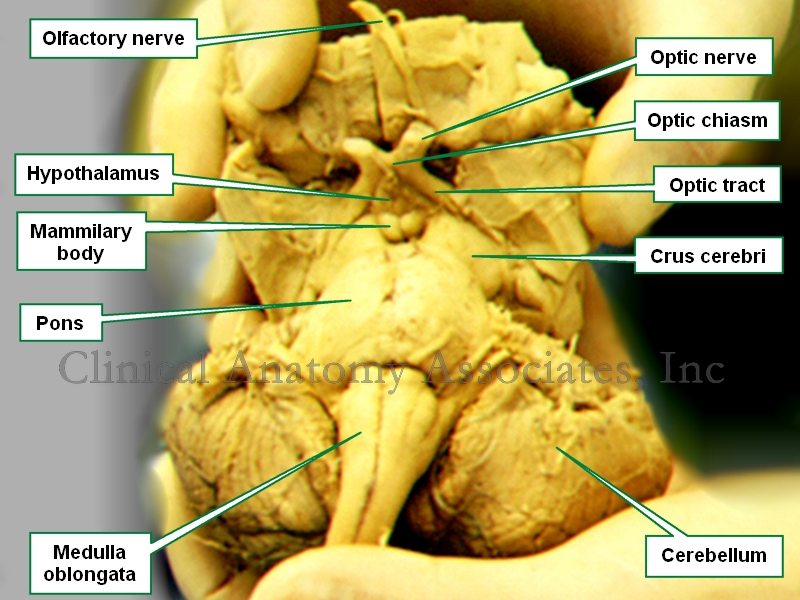
- Mammillary bodies: Two small, round structures found in the anterior aspect of the mesencephalon (midbrain) between the crura cerebri. See accompanying image. Click on the image for a larger depiction.
- Mammillary processes: Also known as the mammilary tubercles. These are small bony processes found in the transverse processes of the lumbar vertebrae
Image property of: CAA.Inc.Photography: E. Klein
- Details
This article is part of the series "A Moment in History" where we honor those who have contributed to the growth of medical knowledge in the areas of anatomy, medicine, surgery, and medical research.
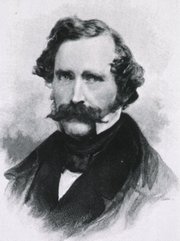
William T.G. Morton
William Thomas Green Morton (1819-1868). American dentist, was born in Charlton, MA. In 1840, He started his studies at the Baltimore College of Dental Surgery. Interestingly, he left college without graduating to study with Horace Wells, DDS, in Hartford, CT. He started Medical school at Harvard, and left without graduating. In 1852 Morton received his honorary MD degree.
In 1846, Morton was able to successfully and painlessly extract a tooth from a patient under ether administration. To this effect he used an ether inhaler of his own invention that he called “Letheon”. This led to his now-famous demonstration of the use of ether as an anesthetic on October 16,1846 at the Massachusetts General Hospital first operating room, today known as the "Ether Dome". This is the first-ever recorded use of anesthesia as a way to reduce or eliminate pain in surgery, one of the revolutions in surgery, the other being Lister’s antiseptic technique.
Morton tried, unsuccessfully, to establish a patent on his discovery against Horace Wells (1815 – 1848). The litigation costs led him to poverty and he died with no money on 1868.
Although the American Dental Association in 1864 passed a formal resolution stating that Horace Wells was the discoverer of anesthesia, the name of William TG Morton has been tied to it since.
Sources
1. “William Thomas Green Morton (1819-1868” Keys. TE. Anesth and Analg (1973) 52: (2) 166
2. ” Morton, dentist, who first publicly demonstrated ether anesthesia; a short biography” Archer WH, William TG. J Am Dent Assoc. 1946 Dec 1;33(23):1528-32
3. “Horace Wells: Discoverer of Anesthesia” Jacobsohn PH. Anesth Prog (1995) 42:73-75
4. “The last days of William Thomas Green Morton” Vandam LD J Clin Anesth (1996) Sep;8(6):431-4334
- Details

Click for a larger image
A [lung] is one of the two main respiratory organs. It is an organ filled with minute air sacs or alveoli, giving its parenchyma the look and feel of a spongy tissue. Its function is the reoxygenation of blood.
Each lung is located on each side of the thoracic cavity, each one surrounded by a serosa membrane called "pleura". The pleura forms a sac that surrounds the lung and also lines the thoracic wall. The pleura that lines the thoracic wall is called "parietal pleura", while the pleura that lines the lung is called the "visceral pleura". An extension of the visceral pleura inferior to the pulmonary hilum forms the pulmonary ligament.
A lung has three surfaces and an apex. The inferior surface, base, or diaphragmatic surface; the medial surface or mediastinal surface, as if forms the lateral wall of the mediastinum; and the lateral or costal surface.
The lungs are also divided into lobes. The right lung has three lobes: superior, middle, and inferior while the left lung only has two lobes: superior and inferior. Because the heart has a left-sided tilt the left lung is slightly smaller than the right lung.
There are four structures that enter or leave the lung and they are found at the pulmonary hilum in the medial surface of the lung. These structures are: the main or primary bronchus, the pulmonary artery, and two pulmonary veins.
After entering the lung through the hilum each bronchus will divide into smaller and smaller bronchi eventually opening into microscopic air sacs called the alveoli. Each alveolus or alveolar sac is surrounded by capillaries. It is here where gas exchange takes place allowing for blood reoxygenation.
When examined, a lung will show the impressions of the organs that are in contact with it. Click on the accompanying image and you will be able to see the impressions left by the aorta and the heart
Image property of: Photographer: David M. Klein
- Details
Click for a larger image
The medical word [atheroma], has the root term [-ather-] arising from the Greek [ath?ra] meaning "gruel", "porridge", or "groats". This refers to the consistency of the content of a soft atheromatous plaque. The suffix [-oma] means "mass", "growth" or "tumor". A mass of soft gruel-like substance. The plural form for atheroma is [atheromata].
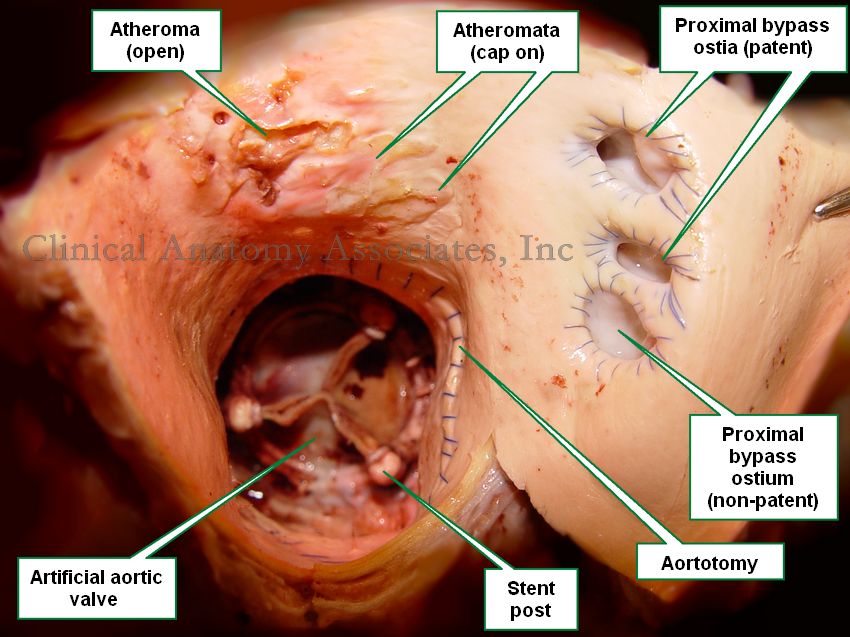
An atheroma is abnormal edema and accumulation of cholesterol and fatty acids with varying amount s of macrophages, fibroblasts and connective tissue in the tunica intima of an artery. It is usually covered by a “cap” of thicker, drier, yellowish fibrous material. An atheroma is a cavity filled with a fatty gruel-like material covered by a cap. Atheromatous disease is characterized by a large number of these masses in the walls of the arteries of a patient.
Atheromata are found in smaller caliber arteries can reduce the lumen of the artery leading to ischemia and in the case of the coronary arteries, myocardial infarction.
The cap in an atheroma can be dislodged by the arterial blood flow in which case the content of the atheroma is emptied into the bloodstream becoming a fatty embolus. Since arteries become arterioles and then capillaries, this fatty embolus will flow distally to the point where it will lodge, blocking blood flow.
WARNING: The image of the pathology in this article is quite descriptive
The accompanying image is a clear depiction of this situation. This is a superior view of the ascending aorta. The patient in this case had an artificial aortic valve implanted and the aortotomy performed for the procedure is also indicated. The patient also had three coronary bypass grafts, one of which was clogged or non-patent. There are at least two atheromata with the cap still on. The image also shows at least one atheroma empty. This indicates that the content of the atheroma became a fatty embolus. Click on the image for a larger depiction.
Image property of: Photographer: David M. Klein
- Details
Click for a larger image
The word [calyx] is Latin, meaning "an outer covering", although it's origin is most probably Greek, from [kylix], meaning "a cup". This is the meaning we use today in medical terminology. The plural form for [calyx] is either [calyces] or [calyxes].
In human anatomy the term is used to denote small, cup-like extensions of the renal pelvis that help collect urine.
Each one of the minor calyces (8-20) surrounds extensions of the renal parenchyma called renal papillae. These papillae are found at the apex of the renal pyramids. This allows the urine to drip into the minor calyx as though into a cup. The minor calyces will then converge into larger calyces, each one known as a major calyx. There are between 2 to 4 major calyces in each kidney.
The major calyces then join together to form the renal pelvis, which continues with the ipsilateral ureter to the urinary bladder.
Sources
1. "Gray's Anatomy"38th British Ed. Churchill Livingstone 1995
3. "Tratado de Anatomia Humana" Testut et Latarjet 8 Ed. 1931 Salvat Editores, Spain
Images in the public domain, courtesy of Wikipedia