
Medical Terminology Daily (MTD) is a blog sponsored by Clinical Anatomy Associates, Inc. as a service to the medical community. We post anatomical, medical or surgical terms, their meaning and usage, as well as biographical notes on anatomists, surgeons, and researchers through the ages. Be warned that some of the images used depict human anatomical specimens.
You are welcome to submit questions and suggestions using our "Contact Us" form. The information on this blog follows the terms on our "Privacy and Security Statement" and cannot be construed as medical guidance or instructions for treatment.
We have 3433 guests online
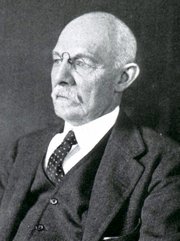
William S. Halsted, MD
(1852 – 1922)
American anatomist, teacher, and surgeon, William Stewart Halsted was born in New York City, USA to a wealthy family of English origin. His father was involved in charitable work and Governor and trustee to a city hospital. Not a brilliant student initially, Halsted took an undergraduate in Liberal Arts in Yale, CT., after which he entered the Medical College of Physicians at the Columbia College, where he excelled.
As a second-year medical student Halsted applied and obtained a position in surgery at a local hospital. In here he learned about Lister’s antiseptic technique and became an adamant proponent of it to reduce infection. In 1877 Halsted obtained his MD. After a short time as House Physician at the New York Hospital, Halsted traveled to Europe to further his education studying for two years at the Universities of Vienna, Leipzig, and W?rzburg.
Besides being at the forefront of surgical and antiseptic techniques (introducing the use of rubber gloves in surgery), Halsted was extremely concerned with the way medical students were taught in the US. He pioneered bedside clinical round discussions with the medical students after two years of basic sciences studies. Halsted developed the idea of a patient chart; he also developed the residency program for medical students in use today.
Halsted is probably the most influential researcher and surgeon at the turn of the century. He dedicated time to the study of intestinal anastomoses and the use of silk as a suture material. His experimental work in 1887 proved that the inclusion of the submucosa layer in an anastomosis was mandatory, as well that a single layered anastomosis was enough to attain closure. Perhaps Halsted’s most important contribution was the application and use of the scientific method to surgical questions. Halsted’s principles set the standards used today in surgical suturing and surgical stapling.
He also pioneered the development and surgical techniques for radical mastectomy as a treatment for breast cancer.
As a side effect of this studied in anesthesia and the use of cocaine for anesthesia, Halsted became addicted to this substance, a problem that followed him through the years. Without impairing his capacity as a researcher and a surgeon, Halsted eventually recovered. He died in Baltimore in 1922 as a complication to surgery.
Sources:
1. Dubay, A. D., & Franz, G. M. (2003). Acute Wound Healing: The Biology of Acute Wound Failure. Surg Clin NA, 83, 463-481.
2. Halsted, W. S. (1887). Circular Suture of the Intestine - An Experimental Study. Am J Med Sci, 436-461.
3. “William Stewart Halsted: his life and contributions to surgery” Osborne, P. Lancet Oncol 2007; 8: 256–65
4. “William Stewart Halsted: Surgical pioneer” Burress, P Endoc Today (2010), 8: (2) 22
5. “William Stewart Halsted (1852–1922) Neurological stamp” Haas, LF J Neurol Neurosurg Psych 2000;69:641
Original image courtesy of "Images from the History of Medicine" at www.nih.gov

"Clinical Anatomy Associates, Inc., and the contributors of "Medical Terminology Daily" wish to thank all individuals who donate their bodies and tissues for the advancement of education and research”.
Click here for more information


- Details
The root term [-blast] arises from the Greek [blastos] meaning "a germ", "seed" or "a sprout". The equivalent term in Latin is [germen], as in "germination". The root term [-blast-] is used in medical terminology to mean "germinative" and "to build". Because of the connotation of "seed" the term is widely used in embryology. Examples of its use are:
- Osteoblast: The root term [-oste-] means "bone". A bone germinative cell
- Odontoblast: The root term [-odont-] means "tooth". A tooth germinative cell
- Fibroblast: The root term [-fibr-] is used to mean "fiber", referring in this case to collagen and connective tissue. A cell that buils tissue with collagen fibers
- Fibroblastocyte: The suffix [-(o)cyte-] means "cell". A better way to denote a cell that builds tissue with collagen fibers
- Details

Click for a larger image
The posterior cerebral artery is a bilateral artery with a common origin from the basilar artery at the level of the mesencephalon (midbrain). The basilar artery itself is formed by the junction of both vertebral arteries.
After the common origin of both posterior cerebral arteries, the posterior communicating arteries arise, forming the posterior aspect of the arterial circle of Willis. The posterior cerebral arteries provide blood supply to the medial aspect of the occipital lobe of the brain, as well the inferior and medial aspect of the temporal lobe. It also provides deep arteries to the thalamus and hypothalamus
For information on the anatomical variations of the posterior cerebral artery click here.
Sources:
1. "An Overview of Intracranial Aneurysms" Keedy, A Mcgill J Med. 2006 July; 9(2): 141–146
2. "Observations on the length and diameter of the arteries forming the circle of Willis" Kamath S 1981 J Anat 133; 3:419-423"
Image in the public domain, modified from the original courtesy of Wikipedia.

- Details
The suffix [-(o)ptosis] arises from the Greek [πτώσηι?] meaning "to fall", "to sag" or "go down". This suffix is used in medical words such as:
- Nephroptosis: The root term [-nephr-] means "kidney". A falling or drooping of a kidney
- Blepharoptosis: The root term [-blephr-] means "eyelid". A falling or drooping of an eyelid
- Hysteroptosis: The root term [-hyster-] is used to mean "uterus". A falling, drooping, or prolapse of the uterus
- Gastroptosis: The root term [-gastr-] means "stomach". A drooping or sagging of the stomach
- Details
This article is part of the series "A Moment in History" where we honor those who have contributed to the growth of medical knowledge in the areas of anatomy, medicine, surgery, and medical research.
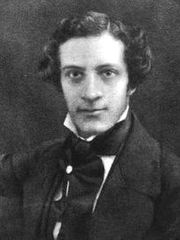
Henry Gray F.R.S
Henry Gray F.R.S. (1827 – 1861). English anatomist, Henry Gray was born in 1827. Not much is known of his early studies. What is known is that on May 6, 1845 Gray was studying as a pupil at St. George’s Hospital in London. At 21 years of age Gray won an award for an anatomical paper on human and comparative anatomy of the eye and its appendages.
In 1850 Henry Gray was appointed as house surgeon to the St. George’s Hospital, and in 1852 he was elected as a Fellow of the Royal Society. He wrote several anatomical papers and in 1852 became a lecturer on Anatomy at the same hospital.
At this time he started work on what would become his legacy to the world. A systematic analysis and treatise on human anatomy that was originally published in 1858, entitled “Anatomy, Descriptive, and Surgical” which was profusely illustrated by Henry Vandyke Carter, M.D.
Unfortunately for the world, Henry Gray was affected by smallpox and died on June 13, 1861 shortly after he was elected as a member of the Royal College of Surgeons. Henry Gray died when he was only 34 years old.
Much of the original work of Henry Gray is today in the public domain. Still, the book that he published is still in print, much modified, but with the same educational purpose. The 40th British Edition of “Gray’s Anatomy: The Anatomical Basis of Clinical Practice” was published in November 2008. The American Edition of the same book was published in 1908, long after his death. The 30thAmerican Edition of Gray’s Anatomy was last published in the USA in 1984.
Sources:
1. “Henry Gray and Henry Vandyke Carter: Creators of a Famous Textbook" Roberts, S. J Med Biog 2000 8: 206-212
2. "Henry Gray, Anatomist: An Appreciation" Boland, F Am J Med Sci 1908 1827-1924
3. "The Anatomist: A True Story of Gray’s Anatomy" Hayes, B. Random House PG 2007
- Details

Galen of Pergamon
The word [pathology] is formed by two components. The root term [-path-] arises from the Greek [πάθος], meaning “suffering”. The term [πάθος], or [pathos] was first used by Galen of Pergamon (129AD - 200AD) (see accompanying image) to denote an alteration of a vital process. The suffix [-(o)logy] also has Greek origin from [logos] or [λόγος], meaning a "book", a "treatise" or "to study". Therefore [pathology] or [παθολογία] is the “study of disease or conditions”. In simpler terms the word [pathology] is also used as a synonym for "sickness", "disease", or "condition".
The root term [-path-] can be found in many medical terms such as:
- Pathology: Study of disease
- Pathophysiology: This combined root adds the root term [-phys-] meaning “function” Study of the function of disease (a disease in action)
- Pathognomonic: See definition here
- Pathogenesis: The suffix [-(o)genesis] means “creation”, or “origin”. Origin of a disease
Original image courtesy of the National Library of Medicine. Public Domain. Clicking on the image will take you to an article on this website on Galen of Pergamon.
- Details
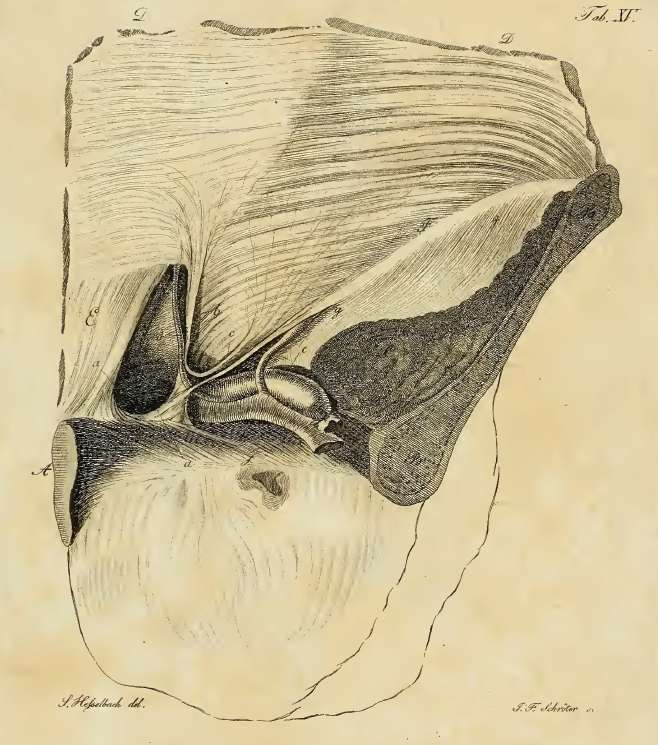
Click for a larger image
Franz Kaspar Hesselbach (1759 – 1816). German physician, surgeon, and anatomist. Hesselbach was born in Bavaria in 1759. At the age of 19 he became an apprentice to Karl Von Siebold (1736 - 1807), a German surgeon, obstetrician and anatomist. He worked with him as an unpaid assistant for six years until 1789 when he was hired as a prosector.
Hesselbach became a lecturer on anatomy at the University of W?rzburg and a surgical assistant at the Juliusspital at W?rzburg. Later Hesselbach became a professor of Surgery at the same university.
Hesselbach’s name is eponymically tied to many structures, most of them related to hernia, an area where he is best known. In 1806 he published a treatise on hernia (Anatomisch-chirurgische Abhandlung ?ber den Urspurng der Leistenbr?che) “Anatomical and surgical treatise on the origin of Hernias”. These structures are:
- Hesselbach’s fascia: the cribriform fascia covering the saphenous hiatus of the thigh
- Hesselbach’s ligament: also known as the interfoveolar ligament
- Hesselbach’s triangle: site for direct inguinal hernia
- Hesselbach’s hernia: a femoral hernia protruding through the cribriform fascia
Hesselbach also described the femoral hernia in 1798 and distinguished between direct and indirect inguinal hernias.
In 1807 Hesselbach’s contributions were acknowledged and he was conferred the degree of Doctor of Surgery. During his life Hesselbach published several books, treatises, and papers.
A depiction of Hesselbach has not been found (yet) so we publish an image of his eponymic “triangle”. If you click on the image, you will see an original image from Hesselbach's book.
Sosurces:
1. "Franz Kaspar Hesselbach (1759–1816): Anatomist and Surgeon" R. Shane Tubbs et al W J Surg (2008) 32:11 2527-2529
2. "Groin Hernia Anatomical and Surgical History" McClusky DA, et al Arch Surg. 2006; 141(10):1035-1042
3. "Eponyms in groin surgery" Ellis, H. Surgery (Oxford) (2006) 24:8, 257–259
4. "Franz Kaspar Hasselbach (1759–1816)" Agarwal, AK; Mukherjee, R. Indian J. Surg (2008); 70:96–98
Primary Image property of: CAA.Inc. Artist: M. Zuptich.