
Medical Terminology Daily (MTD) is a blog sponsored by Clinical Anatomy Associates, Inc. as a service to the medical community. We post anatomical, medical or surgical terms, their meaning and usage, as well as biographical notes on anatomists, surgeons, and researchers through the ages. Be warned that some of the images used depict human anatomical specimens.
You are welcome to submit questions and suggestions using our "Contact Us" form. The information on this blog follows the terms on our "Privacy and Security Statement" and cannot be construed as medical guidance or instructions for treatment.
We have 2863 guests online
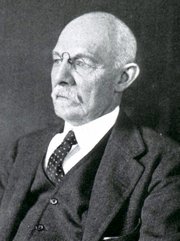
William S. Halsted, MD
(1852 – 1922)
American anatomist, teacher, and surgeon, William Stewart Halsted was born in New York City, USA to a wealthy family of English origin. His father was involved in charitable work and Governor and trustee to a city hospital. Not a brilliant student initially, Halsted took an undergraduate in Liberal Arts in Yale, CT., after which he entered the Medical College of Physicians at the Columbia College, where he excelled.
As a second-year medical student Halsted applied and obtained a position in surgery at a local hospital. In here he learned about Lister’s antiseptic technique and became an adamant proponent of it to reduce infection. In 1877 Halsted obtained his MD. After a short time as House Physician at the New York Hospital, Halsted traveled to Europe to further his education studying for two years at the Universities of Vienna, Leipzig, and W?rzburg.
Besides being at the forefront of surgical and antiseptic techniques (introducing the use of rubber gloves in surgery), Halsted was extremely concerned with the way medical students were taught in the US. He pioneered bedside clinical round discussions with the medical students after two years of basic sciences studies. Halsted developed the idea of a patient chart; he also developed the residency program for medical students in use today.
Halsted is probably the most influential researcher and surgeon at the turn of the century. He dedicated time to the study of intestinal anastomoses and the use of silk as a suture material. His experimental work in 1887 proved that the inclusion of the submucosa layer in an anastomosis was mandatory, as well that a single layered anastomosis was enough to attain closure. Perhaps Halsted’s most important contribution was the application and use of the scientific method to surgical questions. Halsted’s principles set the standards used today in surgical suturing and surgical stapling.
He also pioneered the development and surgical techniques for radical mastectomy as a treatment for breast cancer.
As a side effect of this studied in anesthesia and the use of cocaine for anesthesia, Halsted became addicted to this substance, a problem that followed him through the years. Without impairing his capacity as a researcher and a surgeon, Halsted eventually recovered. He died in Baltimore in 1922 as a complication to surgery.
Sources:
1. Dubay, A. D., & Franz, G. M. (2003). Acute Wound Healing: The Biology of Acute Wound Failure. Surg Clin NA, 83, 463-481.
2. Halsted, W. S. (1887). Circular Suture of the Intestine - An Experimental Study. Am J Med Sci, 436-461.
3. “William Stewart Halsted: his life and contributions to surgery” Osborne, P. Lancet Oncol 2007; 8: 256–65
4. “William Stewart Halsted: Surgical pioneer” Burress, P Endoc Today (2010), 8: (2) 22
5. “William Stewart Halsted (1852–1922) Neurological stamp” Haas, LF J Neurol Neurosurg Psych 2000;69:641
Original image courtesy of "Images from the History of Medicine" at www.nih.gov

"Clinical Anatomy Associates, Inc., and the contributors of "Medical Terminology Daily" wish to thank all individuals who donate their bodies and tissues for the advancement of education and research”.
Click here for more information


- Details

Click for a larger image
The word [hygiene] is defined as the "science of the establishment and maintenance of health"(Merriam-Webster). Another definition is "conditions or practices conducive to maintaining health and preventing disease, especially through cleanliness".
In Greek mythology Hygeiea [Υγιείας] is the goddess of health, one of the daughters of Aesculapius, who is himself the god of Medicine. Aesculapius was represented as a figure leaning on a staff around which a serpent is coiled.
The Greek word [υγιής], a derivative from the name of the goddess Hygieia means "healthy", "sound" or "strong", and became the root for our modern word [hygiene]. Because of its mythological origin, there must be something to the saying "cleanliness is next to godliness".
The image of the statue of Hygieia acompanying this article is known as the "Hope Hygieia" and is on display at the J. Paul Getty Museum. The statue shows Aesculapius' snake, a symbol of renovation. This statue was discovered in 1797 at the port of Ostia in Rome. The statue was restored, de-restored, and re-restored. For more information of this statue's history CLICK HERE.
- Details

Click for a larger image
The term [cancer] is Latin and means "crab". The word was first used by Galen of Pergamon (129AD - 200AD) who used it to describe the crab-like appearence of the veins of a cancerous tumor, probably a breast cancer. Galen said "... as a crab's feet extend from every part of its body, so in this disease are the veins distended, forming a similar figure". The term cancer is also used in other applications, such as astronomy (Tropic of Cancer) and astrology, as in the zodiacal sign of Cancer.
The Latin term [cancer] was probably pronounced "kanker" and this may be the origin of the term [canker] to refer to ulcerations around the mouth or angles of the mouth, canker sores. This is also probably the origin of the term [chancre] used for some dried-out sore wounds.
Greek terms merged into the New Latin, so the Greek terms derived from [karkinos] also made it into modern medical terminology.
The word [cancer] is used today to denote a malignant tumor. There are variations of the term using the root term [-carcin-] as in [carcinoma].
The accompanying image is that of a colon specimen with a cancerous tumor. If you click on the image a larger depiction of a cancer of the breast will appear. WARNING: This secondary image could be disturbing to some of our readers.
Sources
1. “A Dictionary of Medical Derivations" Casselman W. Parthenon Publishing, 1997
2. "The origin of Medical Terms: Skinner, 1970
3. "Cancer - Wikipedia"
Images in the public domain, courtesy of Wikipedia
Personal note: This article is published in memory of my cousin Hugo Barahona who passed away on January 1st 2014 with a cancerous pathology. May he rest in peace. Dr. Miranda
- Details
Click for a larger image
The term [obstetrics] arises from the Latin word [obstare] which means "to stand close to" or "to stand in front of". Since a midwife "stands" in front of the patient for child delivery, the word was used in its feminine singular form [obstetrix]. The Latin plural is [obstetrices]; The evolution of the term into modern "obstetrics" is quite clear.
Through the ages the term used for someone who helps deliver a child has changed. Andreas Vesalius used the term [obstetrices nutrices] meaning "nurse midwife". The term "midwife" was used for a long time, being replaced today for the word "obstetrics" and "obstetrician".
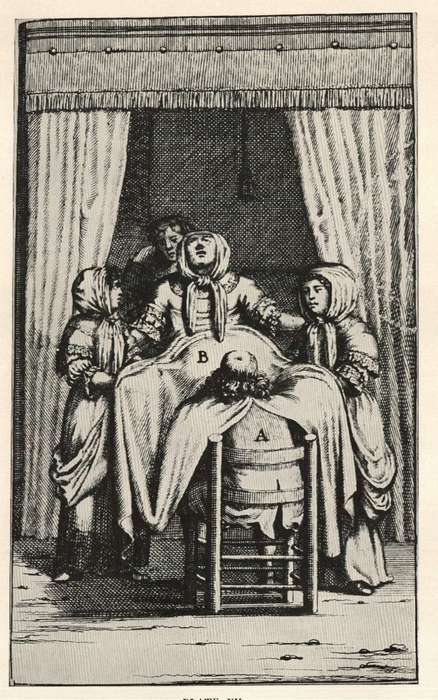
Although all female reproductive system care was originally the domain of midwives, through time two distinct specialties have evolved. Gynecology refers to the medical specialty that studies and treats the female reproductive system. Obstetrics, deals with the care of the pregnant patient and delivery of the fetus. Male-widwives in Europe were allowed access to the patient only with the use of a "modesty blanket". This is plate XV from the 1681 book "Korte en Bondige Van Der Voortteeling en Kinderbaren" by Samuel Janson.
As an interesting side note in history, the first male physician to attempt to work as a man-midwife was Dr. Wertt from Hamburg. Dr Wertt decided to disguise himself as a woman to attend patients. When he was discovered, the punishment was "swift and salutary": He was burned at the stake.
Word suggested and edited by: Dr. Sanford S. Osher , MTD Contributor- Details
This article is part of the series "A Moment in History" where we honor those who have contributed to the growth of medical knowledge in the areas of anatomy, medicine, surgery, and medical research.

Avicenna
Avicenna (980 AD – 1037 AD) Persian physician, philosopher, mathematician, naturalist, geologist, musical theorist, astronomer and poet. Ab? Al? al-Hysayn ibn-‘Abd-All?h ibn-S?na, also known as “ibn-S?na“ and as “Avicenna” was born in Afshaneh, near the city of Bokhara (in old Persia, what today is Iran) in 980AD.
Intellectually gifted, Avicenna studied philosophy and the Islam religion, with early studies in medicine. By age 18 he was already a famous physician. With access to the royal library Avicenna continued his studies and traveled through what today is Iran. Avicenna had government positions, becoming prime minister. Jailed for political reasons Avicenna wrote a large number of his medical, philosophical, and astronomical publications while in jail.
Of over 450 total medical books attributed to Avicenna, his most famous publication was the “al-Qanun-fi-al-Tibb” or the “Canon of Medicine”, consisting of five books on principles of medicine, diseases, drugs, and compound medicines. The Canon was translated into Latin and later into other languages, remaining an important book for at least until the 16th century.
He used the term “vermis” and spoke of the “tailed nucleus”, known to us as the “caudate nucleus”. Avicenna died in 1037AD at 57 years of age. He was buried in the city of Hamadh?n, where his tomb still exists. Avicenna has been called the “prince of physicians”.
Sources
1. “Avicenna” Koontz AR JAMA. 1962;179(1):99
2. "Honoring Avicenna, the Great Persian Physician on the World's Postage Stamps". Afshar, A. Arch Iranian Med (1029-2977), 13 (5), 447
3. "Avicenna and the Canon of Medicine: A millennial tribute" West J Med 133:367-370, Oct 1980
4. “Avicenna (980–1037 AD) Zargaran, A, et al. J Neurol (2012) 259:389–390 5. “Avicenna” JAMA 177:704 (1961)
Original image courtesy of NLM

- Details
Click for a larger image
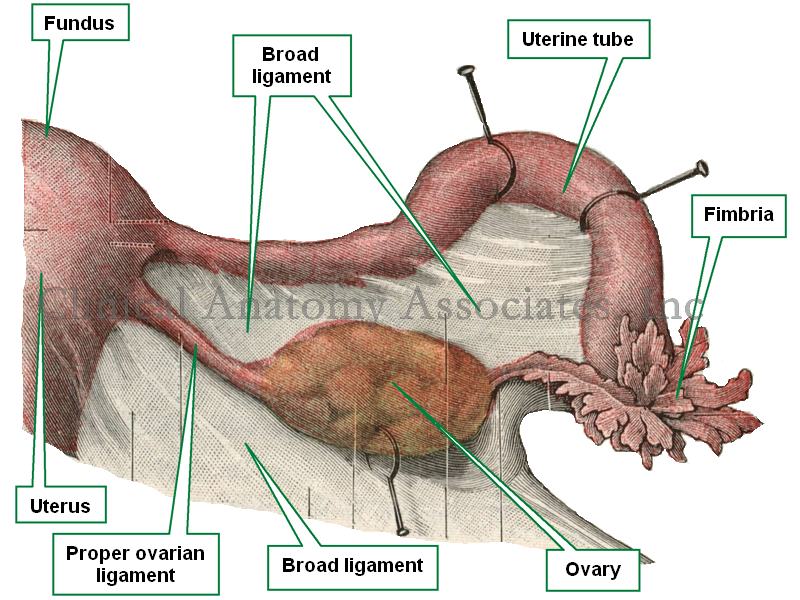
The root term [-salping-] arises from the Greek [σάλπιγγα] or [salpinx], meaning "trumpet" or "bugle". Because of their trumpet shape, there are two anatomical structures where this term applies, one is the uterine or Fallopian tube, and the other is the auditory or Eustachian tube.
This root term is used in medical terms such as:
- Salpingitis: An inflammation or infection of the Fallopian (uterine) tube
- Salpingectomy: Removal of one or both Fallopian tubes
- Salpingopharyngeus: A muscle that extends between the Eustachian (auditory) tube and the pharynx
- Salpingooophorectomy: This combined root term adds the root [-oophor-] meaning ovary. The suffix [-ectomy] means "removal". The removal of the uterine tubes and the ovaries. This operation can be unilateral or bilateral.
Because of the rules of combination for root terms, the commonly used hyphenated [salpingo-oophorectomy] form of this word is not correct and should not be used.
Image modified from the original from Testut and Latajet, 1931. Public domain.
- Details

Click for a larger image
The term [scalpel] arises from the Latin word [scalpellum], meaning “a small knife”. Celsus (c.25BC - c.50BC) in De Re Medicina, uses the term [scalpellus] to refer to a surgeon’s knike.
The use of knives in Medicine is very old. 10,000 year old Mesolithic skulls have been found with craniotomies made with flint stone knives. The first one to describe surgical knives in recorded history was Hippocrates of Cos (460 BC - 370 BC).
Surgical knives were developed in a multitude of shape and forms, some of them veritable works of art. These scalpels were made by cutlery makers on demand by surgeons and had a fixed blade that had to be sharpened constantly, as surgery requires a very sharp blade.
The invention of the disposable razor by King Gillette in 1904 changed this. In 1910, Dr. John Benjamin Murphy (1857 – 1916) invented a handle that could hold a single-sided or a double-sided safety razor blade.
The design was improved by the invention of a disposable, sterilized surgical blade that could be easily installed on a reusable, sterilizable metal handle. Today sterile, disposable handle-blade combination scalpels of varying shapes and sizes are available, ensuring the surgeon the sharpest scalpel every time.
Sources
1. “The surgical knife” Ochsner J. Tex Heart Inst J. 2009; 36(5): 441–443
2. "History of the Surgical Blade" Shuja, A. Indep Rev Oct-Dec 2012;14(10-12)
3. "Masters of the Scalpel: The History of Surgery"" Riedman SR, R MacNally 1962
Images in the public domain, courtesy of Wikipedia