
Medical Terminology Daily (MTD) is a blog sponsored by Clinical Anatomy Associates, Inc. as a service to the medical community. We post anatomical, medical or surgical terms, their meaning and usage, as well as biographical notes on anatomists, surgeons, and researchers through the ages. Be warned that some of the images used depict human anatomical specimens.
You are welcome to submit questions and suggestions using our "Contact Us" form. The information on this blog follows the terms on our "Privacy and Security Statement" and cannot be construed as medical guidance or instructions for treatment.
We have 3538 guests online
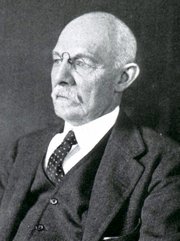
William S. Halsted, MD
(1852 – 1922)
American anatomist, teacher, and surgeon, William Stewart Halsted was born in New York City, USA to a wealthy family of English origin. His father was involved in charitable work and Governor and trustee to a city hospital. Not a brilliant student initially, Halsted took an undergraduate in Liberal Arts in Yale, CT., after which he entered the Medical College of Physicians at the Columbia College, where he excelled.
As a second-year medical student Halsted applied and obtained a position in surgery at a local hospital. In here he learned about Lister’s antiseptic technique and became an adamant proponent of it to reduce infection. In 1877 Halsted obtained his MD. After a short time as House Physician at the New York Hospital, Halsted traveled to Europe to further his education studying for two years at the Universities of Vienna, Leipzig, and W?rzburg.
Besides being at the forefront of surgical and antiseptic techniques (introducing the use of rubber gloves in surgery), Halsted was extremely concerned with the way medical students were taught in the US. He pioneered bedside clinical round discussions with the medical students after two years of basic sciences studies. Halsted developed the idea of a patient chart; he also developed the residency program for medical students in use today.
Halsted is probably the most influential researcher and surgeon at the turn of the century. He dedicated time to the study of intestinal anastomoses and the use of silk as a suture material. His experimental work in 1887 proved that the inclusion of the submucosa layer in an anastomosis was mandatory, as well that a single layered anastomosis was enough to attain closure. Perhaps Halsted’s most important contribution was the application and use of the scientific method to surgical questions. Halsted’s principles set the standards used today in surgical suturing and surgical stapling.
He also pioneered the development and surgical techniques for radical mastectomy as a treatment for breast cancer.
As a side effect of this studied in anesthesia and the use of cocaine for anesthesia, Halsted became addicted to this substance, a problem that followed him through the years. Without impairing his capacity as a researcher and a surgeon, Halsted eventually recovered. He died in Baltimore in 1922 as a complication to surgery.
Sources:
1. Dubay, A. D., & Franz, G. M. (2003). Acute Wound Healing: The Biology of Acute Wound Failure. Surg Clin NA, 83, 463-481.
2. Halsted, W. S. (1887). Circular Suture of the Intestine - An Experimental Study. Am J Med Sci, 436-461.
3. “William Stewart Halsted: his life and contributions to surgery” Osborne, P. Lancet Oncol 2007; 8: 256–65
4. “William Stewart Halsted: Surgical pioneer” Burress, P Endoc Today (2010), 8: (2) 22
5. “William Stewart Halsted (1852–1922) Neurological stamp” Haas, LF J Neurol Neurosurg Psych 2000;69:641
Original image courtesy of "Images from the History of Medicine" at www.nih.gov

"Clinical Anatomy Associates, Inc., and the contributors of "Medical Terminology Daily" wish to thank all individuals who donate their bodies and tissues for the advancement of education and research”.
Click here for more information


- Details
Click for a larger image
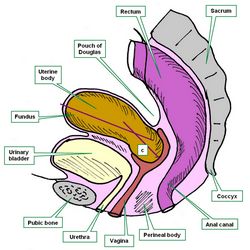
The word [version] comes from the Latin [versum / vertere] meaning "to turn" or "to turn around" (see the use of this Latin root in the word "vertebra"). In anatomy, version is the angulation (or turning) of an organ or a structure as a unit. The term is also used to denote the "turning" of a fetus "in utero" by active manipulation to allow proper birth.
Normally, the cervix of the uterus is anteversed or has an "anterior version". This means that the body and uterine cervix are tilted anteriorly (as a unit). Because of this in a female in the anatomical position, the fundus of the uterus looks almost anteriorly, while the main axis of the cervix points towards the coccyx. See the accompanying image.
The opposite, pathological presentation, is retroversion, where the uterus as a unit is tilted posteriorly. The angulation between the main axis of the uterine body and the main axis of the cervix is normal, but the organ as a unit is tilted posteriorly. Varying degrees of retroversion can cause varying degrees of infertility, a condition known vernacularly as a "slippery uterus".
- Details
Click for a larger image
The word [forceps] is used to denote a grasping-type surgical instrument. The origin of the word has been heavily discussed. It seems that it arises from the combination of the Latin terms [formus], meaning "hot" and [capere]. meaning "to hold", a device to hold something hot. Originally, the word was first used by Roman blacksmiths and was a pair of articulated tongs.
In modern terminology, the singular and plural form for the word is the same: [forceps], although there is an older plural form that is sometimes used: [forcipes]
According to Skinner (1970) the first forceps used in the medical arena were dental extraction forceps. The number of surgical forceps has increased over time. Today there are many types of forceps. Following are some of them:
- Thumb forceps: Tissue (toothed) or dressing (serrated) forceps
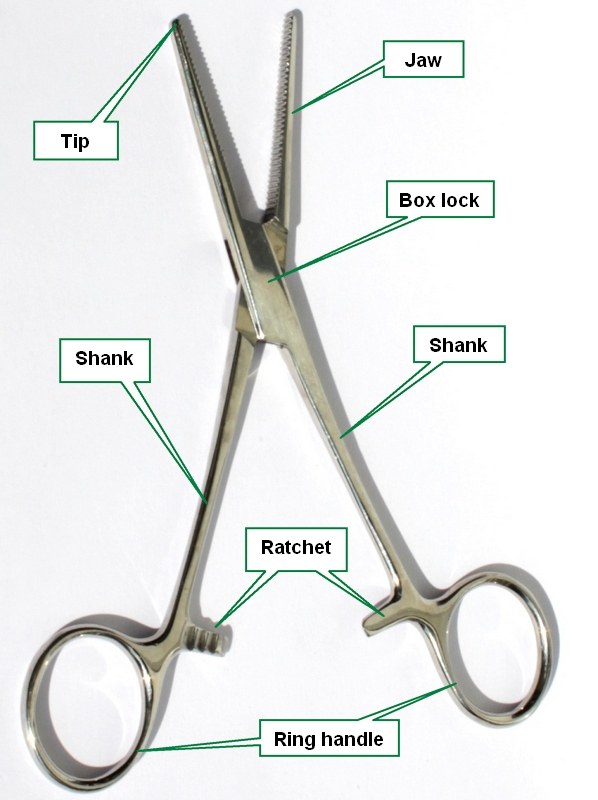
- Hemostatic forceps: Forceps designed for hemostasis and dissection. These usually have a locking mechanism and are of the ring-handle type
- Obstetrical forceps: Articulated forceps use to deliver a fetus
- Sponge forceps: Forceps to be used with swabs and sponges
- Right-angle forceps: A family of forceps which have an angled jaw (not necessarily right-angled) used for dissection, hemostasis, and grasping
- Specialty forceps: Forceps that have been especially designed for use on an organ or a specific step of a surgical procedure, such as hysterectomy forceps, tenacula, lung forceps, liver forceps, etc.
Click on the image to see a better detail of the anatomy of a hemostatic forceps.
Sources:
1. "The Origin of Medical Terms" Skinner 1970
2. Codman: Surgical Product Catalog 2000
- Details

Click for a larger image
The posterior communicating artery is a bilateral artery that communicates the internal carotid artery with the posterior cerebral artery. This creates an anastomosis between the vascular arterial territory of the vertebral artery and that of the internal carotid artery, completing the arterial circle of Willis.
The posterior communicating artery has high variability in its diameter, which can be thin or extremely thick, including the fact that you can find a thin one on one side of the brain and a thick one contralaterally. It is one of the sites for intracranial aneurysm. For more information on the anatomical variations of the posterior communicating artery click here.
Sources:
1. "An Overview of Intracranial Aneurysms" Keedy, A Mcgill J Med. 2006 July; 9(2): 141–146
2. "Observations on the length and diameter of the arteries forming the circle of Willis" Kamath S 1981 J Anat 133; 3:419-423"
3. "Aneurysms of the posterior communicating artery and oculomotor paresis" Sonil, SR J Neurol Neurosurg Psych 1974;37(4): 475–484
Image in the public domain, modified from the original courtesy of Wikipedia.

- Details
The root term [-cost-] arises from the Latin [costa / costalis] meaning "rib". First used by Galen, this root term is used in medical words such as:
- Costochondral: A combination of root terms, adding [-chondr-] meaning "cartilage". Refers to the joint between the bony rib and its cartilage
- Costal margin: Refers to the lower anterior margin of the thorax formed by the cartilage of ribs 7 through 10
- Intercostal: The prefix [inter-] means "between". Between ribs
- Subcostal: The prefix [sub-] means "below". Below the rib
- Costovertebral joint: A joint between the head of a rib(s) and a vertebra(e)
- Costotransverse joint: A joint between the articular portion of the tubercle of a rib and the transverse process of a vertebra
- Details
|
The root term [-chondr-] arises from the Greek [χόνδρος] or [chondros] meaning "cartilage" or "gristle". The Latin equivalent is [cartilago] giving us the synonymous root term [-cartilag-]. This root term is used in medical words such as:
|
|
| Back to MTD Main Page | Subscribe to MTD |
- Details
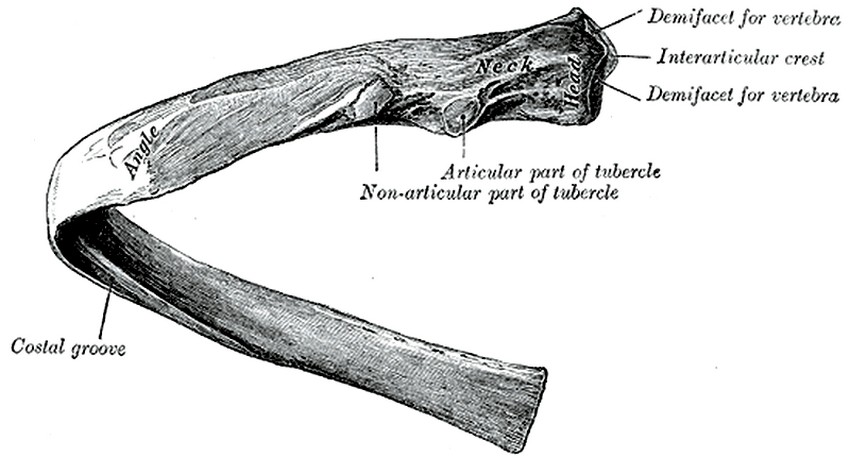
Thoracic rib, Posteroinferior view
The ribs form the lateral bony wall of the thorax. The ribs are paired and there are 12 pairs of ribs in the human thorax, most of them connecting the thoracic spine with the sternum. They are numbered from superior to inferior.
Ribs have different anatomical characteristics depending on their level. A typical rib has the following characteristics from posterior to anterior:
• Head: The head of each rib articulates with one or two ribs depending on their level. Typically ribs number 1,2, 10, 11, and 12 articulate with one vertebra, while the rest articulate with two vertebrae.
• Facets: These are the articular surfaces found in the head of each rib. They are covered by hyaline cartilage and form part of the costovertebral synovial joints. In the case of ribs 3 to 9, since they articulate with two vertebrae, they have two facets, each one called a demifacet, with an interarticular crest between them.
• Neck: A short, somewhat narrower portion of the rib that projects straight posterolaterally.
• Costal tubercle: A bony protuberance, usually with two components, one articular and one non-articular. The articular part of the costal tubercle presents with a facet that articulates with the transverse process of a thoracic vertebra.
• Costal angle: A sharp posterior curvature of the rib. The body when supine rests of these costal angles which deflect pressure from the thoracic spine.
• Costal body: The area of the rib anterior to the costal angle. In most ribs this oval-shaped region of the rib presents with an inferior and internal groove. This is the costal groove or costal sulcus. The corresponding level intercostal artery, vein, and nerve are found in the costal sulcus.
• Costal cartilage: All ribs have an anterior fibrocartilaginous component. Some of them attach directly to the sternum (chondrosternal joints), while some of them attach only to other costal cartilages (chondrochondral joints).
The 12 pairs of ribs are divided as follows:
• True ribs: Ribs 1-7, which attach by way of their costal cartilage directly to the sternum
• False ribs: Ribs 8-10, whose costal cartilage attach only to the cartilage of the superior rib, creating a lower border for the thoracic cage known as the costal margin.
• Free or "floating" ribs: Ribs 11 and 12. Their anterior cartilaginous end does not attach to sternum or other cartilage, so the end is free. The term "floating" although used, is a misnomer as these ribs do attach posteriorly to the thoracic spine.
There can be anatomical variations to the ribs, including the existence of extra cervical or lumbar ribs.
Sources:
1 "Tratado de Anatomia Humana" Testut et Latarjet 8 Ed. 1931 Salvat Editores, Spain
2. "Anatomy of the Human Body" Henry Gray 1918. Philadelphia: Lea & Febiger
Original image courtesy of bartleby.com. For more information: click here