
Medical Terminology Daily (MTD) is a blog sponsored by Clinical Anatomy Associates, Inc. as a service to the medical community. We post anatomical, medical or surgical terms, their meaning and usage, as well as biographical notes on anatomists, surgeons, and researchers through the ages. Be warned that some of the images used depict human anatomical specimens.
You are welcome to submit questions and suggestions using our "Contact Us" form. The information on this blog follows the terms on our "Privacy and Security Statement" and cannot be construed as medical guidance or instructions for treatment.
We have 3373 guests online
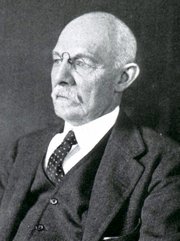
William S. Halsted, MD
(1852 – 1922)
American anatomist, teacher, and surgeon, William Stewart Halsted was born in New York City, USA to a wealthy family of English origin. His father was involved in charitable work and Governor and trustee to a city hospital. Not a brilliant student initially, Halsted took an undergraduate in Liberal Arts in Yale, CT., after which he entered the Medical College of Physicians at the Columbia College, where he excelled.
As a second-year medical student Halsted applied and obtained a position in surgery at a local hospital. In here he learned about Lister’s antiseptic technique and became an adamant proponent of it to reduce infection. In 1877 Halsted obtained his MD. After a short time as House Physician at the New York Hospital, Halsted traveled to Europe to further his education studying for two years at the Universities of Vienna, Leipzig, and W?rzburg.
Besides being at the forefront of surgical and antiseptic techniques (introducing the use of rubber gloves in surgery), Halsted was extremely concerned with the way medical students were taught in the US. He pioneered bedside clinical round discussions with the medical students after two years of basic sciences studies. Halsted developed the idea of a patient chart; he also developed the residency program for medical students in use today.
Halsted is probably the most influential researcher and surgeon at the turn of the century. He dedicated time to the study of intestinal anastomoses and the use of silk as a suture material. His experimental work in 1887 proved that the inclusion of the submucosa layer in an anastomosis was mandatory, as well that a single layered anastomosis was enough to attain closure. Perhaps Halsted’s most important contribution was the application and use of the scientific method to surgical questions. Halsted’s principles set the standards used today in surgical suturing and surgical stapling.
He also pioneered the development and surgical techniques for radical mastectomy as a treatment for breast cancer.
As a side effect of this studied in anesthesia and the use of cocaine for anesthesia, Halsted became addicted to this substance, a problem that followed him through the years. Without impairing his capacity as a researcher and a surgeon, Halsted eventually recovered. He died in Baltimore in 1922 as a complication to surgery.
Sources:
1. Dubay, A. D., & Franz, G. M. (2003). Acute Wound Healing: The Biology of Acute Wound Failure. Surg Clin NA, 83, 463-481.
2. Halsted, W. S. (1887). Circular Suture of the Intestine - An Experimental Study. Am J Med Sci, 436-461.
3. “William Stewart Halsted: his life and contributions to surgery” Osborne, P. Lancet Oncol 2007; 8: 256–65
4. “William Stewart Halsted: Surgical pioneer” Burress, P Endoc Today (2010), 8: (2) 22
5. “William Stewart Halsted (1852–1922) Neurological stamp” Haas, LF J Neurol Neurosurg Psych 2000;69:641
Original image courtesy of "Images from the History of Medicine" at www.nih.gov

"Clinical Anatomy Associates, Inc., and the contributors of "Medical Terminology Daily" wish to thank all individuals who donate their bodies and tissues for the advancement of education and research”.
Click here for more information


- Details

Click for a larger image
The ileum is an intraperitoneal organ, it is the third portion of the small intestine and part of the digestive tract, found distal to the duodenum and jejunum. The ileum is about 6-8 feet in length.
There is no clear anatomical boundary between the jejunum and ileum, as they blend smoothly one into the other. There are several gross changes from jejunum to ileum, one of them being that the complexity of the mesenteric arterial arches increases from proximal to distal.
The term [ileum] has a Greek origin from [ειλεός] meanings "twisted", referring to the "twisted" look of this third portion of the small intestine. When the term was first used Galen did not separate or differentiate jejunum from ileum. He called both the [intestinum tenuis] or "thin or delicate intestine". This term is still used for the smaller arterial and venous branches of the small intestine, the [vasa intestinii tenuis].
It seems that the term "ileum" or "ileus" was originally used to denote the distal portion of the intestine that got sick or "colicky", separating it from the jejunum which was usually found empty or devoid of food.
The terminal ileum ends at the ileocolic or ileocecal valve, where the small intestine empties its contents into the large intestine or colon.
Sources:
1. "Clinically Oriented Anatomy" Moore, KL. 3r Ed. Williams & Wilkins 1992
2. "The origin of Medical Terms" Skinner, AH, 1970
3. "Tratado de Anatomia Humana" Testut et Latarjet 8 Ed. 1931 Salvat Editores, Spain
Image modified from the original from Testut and Latarjet, 1931.
- Details

Click for a larger image
The conus medullaris is the lowest portion of the spinal cord, where it ends in a sharp cone at about the level of L1-L2. The conus medullaris continues inferiorly with a thin cord called the filum terminale (end thread) which attaches to the sacrum.
The fact that the spinal cord is shorter than the corresponding exit of the spinal nerves, causes the corresponding dorsal and ventral roots to create a structure that resembles a horse's tail inferior to the conus medullaris, called the cauda equina.
See the accompanying image. Click on the image for a larger version.
Image property of: Photographer: David M. Klein
- Details
This article is part of the series "A Moment in History" where we honor those who have contributed to the growth of medical knowledge in the areas of anatomy, medicine, surgery, and medical research.

Click for the title page
Johannes Veslingius Mindanus (1598 – 1649). German surgeon, anatomist, botanist, and pharmacologist. Johann Vesling (mostly known by his Latinized name “Johannes Veslingius”) was born in a catholic family in Minden, Westphalia. He studied medicine in Leyden and Bologna. He later moved to the Venice medical college, where he became a professor of Anatomy in 1627. Veslingius had an interest in botany, which he pursued his whole life. Although German-born, Veslingius did most of his work and career in Italy.
In 1628 he traveled to Egypt and Jerusalem as a personal physician of Alvise Cornaro, the Venetian consul in Cairo. In 1632 he became a professor of anatomy and surgery at the University of Padua, in Italy, forcing his return from Jerusalem. At Padua, Veslingius became part of the long list of anatomists that followed Andreas Vesalius’ position.
Veslingius was the first to describe the arterial circle of the brain, eponymically tied today to Thomas Willis, and he was the first to name the soleus muscle, as it resembles the sole fish. In his words: “soleus, a figura piscis denominatus” translated “soleus, named for its fish shape”. Apparently, he was also the first to describe the pancreatic duct which lead to controversy with Wirsung. Veslingius was also the first to describe the four pulmonary veins, described as four of the great vessels.
Veslingius published his most important work, “Syntagma Anatomicum, publicis dissectionibus in auditorum usum diligenter aptatum”, in 1641. This work, which originally had no images, was republished in 1647 with full images in copper plates. This original work is important as it leaves the Vesalian tradition of posing the anatomical images with backgrounds and landscapes, dedicating the image solely to the anatomical information; in fact this is the first book to publish original images not copied or inspired from Vesalius’ Fabrica. This book was the first to influence Japanese anatomy.
Incredibly, Veslingius was accused of murdering Johan Georg Wirsung (1589 - 1643) with whom he had academic conflicts. Veslingius was acquitted of the accusation, and the name of Wirsung is today eponymously attached to the pancreatic duct.
The accompanying image is from the “Syntagma Anatomicum” and shows Veslingius with the following Latin words around him: “Ioannes Veslingius Mindanus Eques Hieros In Patauino Gymnasio Anatom. et Phar. Profess. Primarius” translated as: Johannes Veslingius Mindanus, Knight of Jerusalem, Primary Professor of Anatomy and Pharmacology of the School of Padua.
Below the image you can read: “Talis Apollinea floret Veslingius Arte. Purpureus nives pectore fulget Honor”, translated as: Veslingius flourishes by the art of Apollo who honors him by shining purple snow on his chest. Click on the image for a larger depiction and to see the Latin text.
Personal note: I am proud to have in my library catalog one of Veslingius’ original prints: “Tavole Anatomiche del Veslingio – Spiegate in Lingua Italiana” (Anatomical images from Veslingius, written in Italian), published in 1745 by Giovanni Battista Conzatti. Dr. Miranda
Original image courtesy of NLM. The title page of Syntagma Anatomicum courtesy of archive.org. Both images are in the public domain.
Sources:
1. “The Fabric of the Body. European Tradition of Anatomical Illustration” Roberts KB, Tomlinson JDW (1992) Oxford: Clarendon.
2. “The evolution of anatomical illustration and wax modelling in Italy from the 16th to early 19th centuries” Riva, A. et al. J. Anat. (2010) 216, 209–222
3. “The Anatomical School of Padua” Porzionato, A. et al. Anat Rec (Hoboken). 2012 Jun; 295(6):902-16
4. “The Origin of Medical Terms” Skinner, HA. 1970
5. "Johann Vesling (1598–1649):Seventeenth Century Anatomist of Padua and His Syntagma Anatomicum" SK Ghosh J Clin Anat 2014
Original image courtesy of the National Library of Medicine. The title page of Syntagma Anatomicum courtesy of archive.org. Both images are in the public domain.
- Details
Click for a larger image
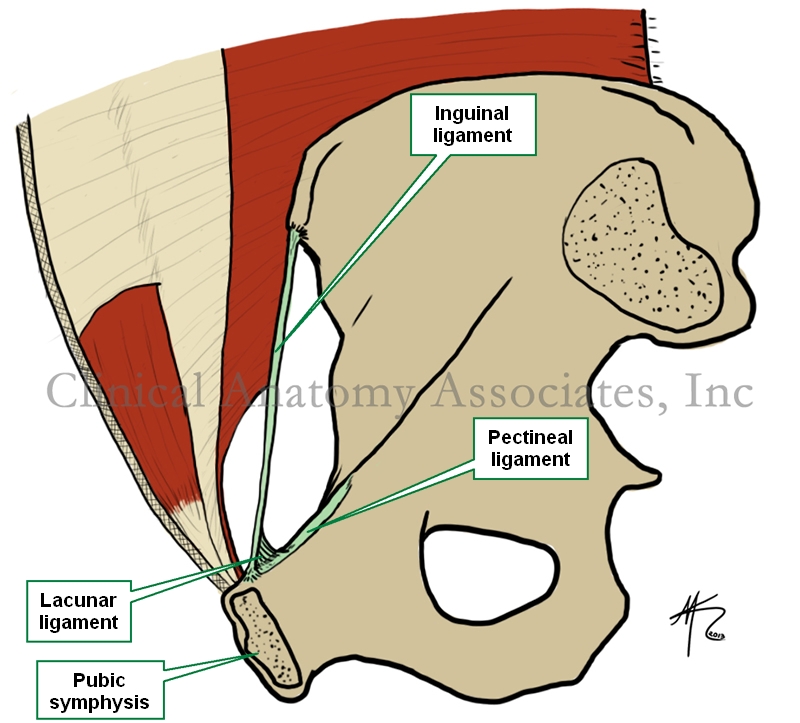
The [lacunar ligament] is a half-moon shaped ligament that extends between the inguinal ligament (Poupart's ligament) superiorly and the pectineal ligament (Cooper's ligament) inferiorly. The lacunar ligament is at its narrowest at the point where the inguinal ligament and the pectineal ligament meet at the pubic tubercle where all three ligaments insert. The lacunar ligament is the medial boundary of the femoral ring.
The lacunar ligament was first described in 1765 by Don Antonio de Gimbernat y Arbós (1734 - 1816), who also described the importance of this ligament in the reduction of a strangulated femoral hernia.
In the anterior (open) approach to a strangulated femoral hernia, there is very little space at the femoral ring to enlarge it and allow reduction of the hernia contents. What Gimbernat did was to carefully cut the ligament from lateral to medial, enlarging the femoral ring and allowing reduction of the hernia. This was against the technique practiced at the time, which was to cut trough the inguinal ligament.
One of concerns when using this technique is the presence of the Corona Mortis, an anatomical variation in the area. Since the Corona Mortis is found posterior to the lacunar ligament, it can be unknowingly transected when repairing a femoral hernia from the anterior aspect.
- Details
Click for a larger image
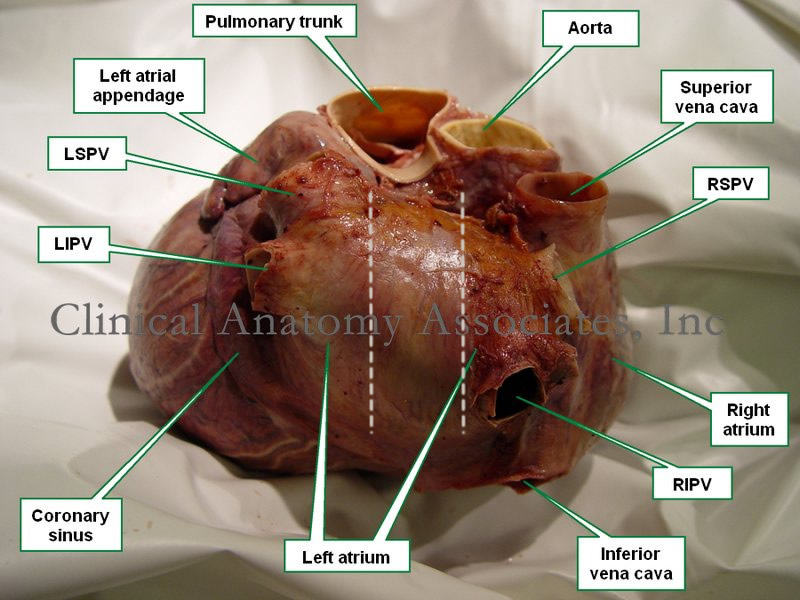
As previously described, the cardiac base is one of the surfaces of the heart, opposite to the cardiac apex.
The cardiac base is formed mostly by the left atrium, which is flanked by the four pulmonary veins. The thoracic esophagus is located posterior to the left atrium, separated from the heart only by the pericardium. This is important for a transesophageal echocarcardiogram (TEE) where there are only soft tissues between the esophageal transducer and the heart. In the accompanying image, two dotted lines show the approximate area of location of the thoracic esophagus.
Other structures that form the cardiac base are a segment of the posterior aspect of the ascending aorta, the superior and inferior vena cavae, and the posterior aspect of the right atrium.
Image property of: Photographer: David M. Klein
- Details
The root term [-clast] arises from the Greek [κλαστός / klastes] meaning "to break". The root term [-clast-] is used in medical terminology to mean "to destroy", or 'to break down". Variations of this term are the suffix [-(o)clasis] and the suffix [-(o)clasia].
A vernacular example of its use is in the word [iconoclast], meaning "to break down icons, images, or idols. Another great example comes from vulcanology (study of volcanoes). The word [pyroclastic] includes the prefix [pyro-] meaning "fire". It refers to a wall of hot gases and ashes spewed from a volcano moving up 450 miles per hour destroying and igniting everything in its path.
Examples of its use in medical terminology are:
- Osteoclast: The root term [-oste-] means "bone". A destroyer of bone
- Osteoclastocyte: The suffix [-(o)cyte-] means "cell". A better way to denote a cell that destroys or breaks down bone
- Osteoclasis: The action of osteoclastocytes