
Medical Terminology Daily (MTD) is a blog sponsored by Clinical Anatomy Associates, Inc. as a service to the medical community. We post anatomical, medical or surgical terms, their meaning and usage, as well as biographical notes on anatomists, surgeons, and researchers through the ages. Be warned that some of the images used depict human anatomical specimens.
You are welcome to submit questions and suggestions using our "Contact Us" form. The information on this blog follows the terms on our "Privacy and Security Statement" and cannot be construed as medical guidance or instructions for treatment.
We have 278 guests online
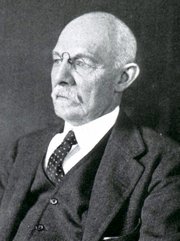
William S. Halsted, MD
(1852 – 1922)
American anatomist, teacher, and surgeon, William Stewart Halsted was born in New York City, USA to a wealthy family of English origin. His father was involved in charitable work and Governor and trustee to a city hospital. Not a brilliant student initially, Halsted took an undergraduate in Liberal Arts in Yale, CT., after which he entered the Medical College of Physicians at the Columbia College, where he excelled.
As a second-year medical student Halsted applied and obtained a position in surgery at a local hospital. In here he learned about Lister’s antiseptic technique and became an adamant proponent of it to reduce infection. In 1877 Halsted obtained his MD. After a short time as House Physician at the New York Hospital, Halsted traveled to Europe to further his education studying for two years at the Universities of Vienna, Leipzig, and W?rzburg.
Besides being at the forefront of surgical and antiseptic techniques (introducing the use of rubber gloves in surgery), Halsted was extremely concerned with the way medical students were taught in the US. He pioneered bedside clinical round discussions with the medical students after two years of basic sciences studies. Halsted developed the idea of a patient chart; he also developed the residency program for medical students in use today.
Halsted is probably the most influential researcher and surgeon at the turn of the century. He dedicated time to the study of intestinal anastomoses and the use of silk as a suture material. His experimental work in 1887 proved that the inclusion of the submucosa layer in an anastomosis was mandatory, as well that a single layered anastomosis was enough to attain closure. Perhaps Halsted’s most important contribution was the application and use of the scientific method to surgical questions. Halsted’s principles, also known as "Halsted's Rules of Surgery", set the standards used today in surgical suturing and surgical stapling.
He also pioneered the development and surgical techniques for radical mastectomy as a treatment for breast cancer.
As a side effect of this studied in anesthesia and the use of cocaine for anesthesia, Halsted became addicted to this substance, a problem that followed him through the years. Without impairing his capacity as a researcher and a surgeon, Halsted eventually recovered. He died in Baltimore in 1922 as a complication to surgery.
Sources:
1. Dubay, A. D., & Franz, G. M. (2003). Acute Wound Healing: The Biology of Acute Wound Failure. Surg Clin NA, 83, 463-481.
2. Halsted, W. S. (1887). Circular Suture of the Intestine - An Experimental Study. Am J Med Sci, 436-461.
3. “William Stewart Halsted: his life and contributions to surgery” Osborne, P. Lancet Oncol 2007; 8: 256–65
4. “William Stewart Halsted: Surgical pioneer” Burress, P Endoc Today (2010), 8: (2) 22
5. “William Stewart Halsted (1852–1922) Neurological stamp” Haas, LF J Neurol Neurosurg Psych 2000;69:641
Original image courtesy of "Images from the History of Medicine" at www.nih.gov

"Clinical Anatomy Associates, Inc., and the contributors of "Medical Terminology Daily" wish to thank all individuals who donate their bodies and tissues for the advancement of education and research”.
Click here for more information


- Details
Click for a larger image
The word [cathedra] is Greek, from [καθέδρα] meaning "a high chair", a "teacher's chair" or a "throne". The term was later accepted into Latin with the same meaning.
In the early pre-Vesalian days of anatomy, the teachers would seat in a high-chair or cathedra from where they would read the anatomy from a book while a prosector or demonstrator would dissect, expose and point to the structures. The professor would not consider coming down from the cathedra to discuss the anatomy shown. This was changed by Andreas Vesalius who did the dissections and demonstrations himself, using the books as reference or to prove a point.
The term cathedra has been brought to our times, where we refer to the position at the head of a group as the "Chair": Chair of the Science Department, Chair of Surgery, etc.
The word cathedra was used to refer to a Bishop's chair in a church, so that large churches (which had a bishop) are now known as [cathedrals]. It is also said that someone of authority speaking in uncontestable terms is speaking ex-cathedra (from the chair)
In other languages the term "cathedratic" means a teacher in a high position, while in English the term refers to a Bishop speaking from the chair.
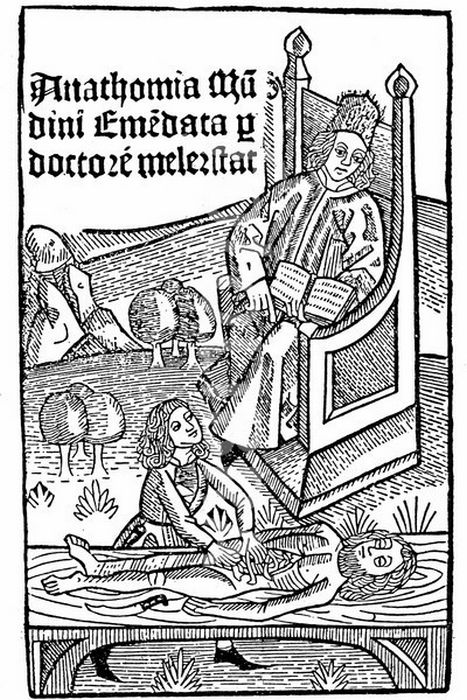
The image in this article is a close up of the title page of Mondino de Luzzi’s “Anothomia Corporis Humani” published in 1478. The person on the image could be Alessandra Giliani (1307 - 1326) who is at the foot of the cathedra following the directions of Mondino de Luzzi. Click on the image for a complete depiction of the title page.
Original image courtesy of NLM

- Details
The term [nystagmus] is derived from the Greek word [νυσταγμένος], (nystagm?nos) meaning "sleepy" or "dizzy". It refers to the sensation of dizziness when you are just awakening from a deep sleep.
In medical terminology nystagmus refers to the rapid, usually lateral, movement of the eyes. This movement has a slower component that moves en eye to one side with a secondary rapid component that brings the eye to the starting point. Nystagmus eye movement is usually bilateral and can be unilateral in rare cases.
Nystagmus is a normal capability of the human visual system where the eyes move slightly to change the location of an image on the retina to avoid fatigue of the retinal components. In some individuals this movement is quite visible but it does not cause a problem and is called physiological or congenital nystagmus as shown in the video..
When nystagmus is pathological it can be the cause for vertigo, as the patient feels that the world is moving, when only the eyes are doing so. This can be caused by a pathology in the abducens nerve system.
Nystagmus can be triggered by using warm fluids in the external ear that will cause flow of the fluid in the semicircular canals of the inner ear. You can also see it if you turn a person around in a swiveling chair for a few turns and then stop and watch their eyes. You will see the rapid nystagmus movement of the eye. If you do this experiment, please be careful, as a person with nystagmus will have poor balance and they can fall with potential for injury.
Thanks to Lashkyrie for the use of her video on YouTube.
Note: The links to Google Translate include an icon that will allow you to hear the Greek or Latin pronunciation of the word.
- Details
Click for a larger image
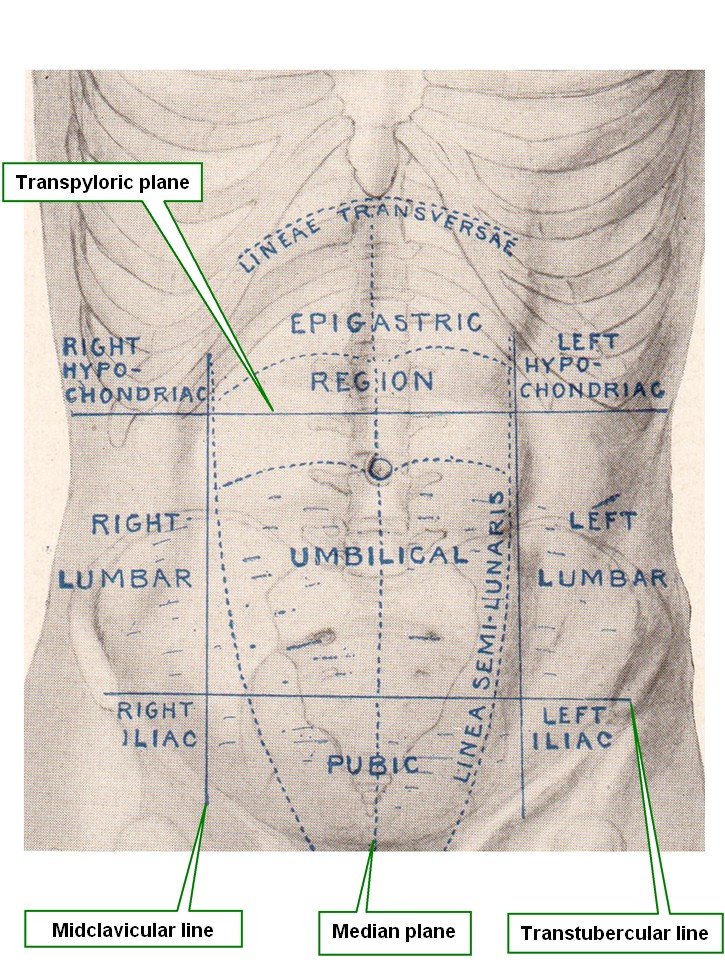
The midclavicular line is one of the surface reference lines used in surface anatomy of the thorax.
It is a parasagittal vertical plane that passes halfway through the body of the clavicle. The lateral portion of the clavicle is close to the highest point of the shoulder joint (the acromioclavicular joint), while the head (medial aspect) of the clavicle is found just lateral to the jugular notch of the sternum, a depression in the superior aspect of the sternal manubrium.
Although it was originally used as a thoracic reference point, the continuation of the midclavicular line into the abdomen is used today as a reference for laparoscopic procedures, to indicate the location where a trocar must be introduced into the abdomen. As an example, in a laparoscopic cholecystectomy, one of the four trocars (in this case a 5mm trocar) is introduced into the abdomen on the right midclavicular line four fingerbreadths inferior to the costal margin (the lower border of the ribs). This trocar is used to manipulate the gallbladder and is placed in the gallbladder infundibulum.
It is also one of the lines used to describe the abdominal regions.
Sources:
1. "Clinical Anatomy" Brantigan, OC 1963 McGraw Hill
2. "Tratado de Anatomia Humana" Testut et Latarjet 8th Ed. 1931 Salvat Editores, Spain
3. Davis, Gwilym G. "Applied Anatomy: The Construction of the Human Body Considered in Relation to Its Functions, Diseases, and Injuries"; Philadelphia: J.B. Lippincott Co., 1910
Image modified from the original Davis, 1910
- Details
Click for a larger image
The transpyloric plane (also called the transpyloric line) is one of the surface reference lines used in surface anatomy. It is one of the lines used to describe the abdominal regions.
It is a horizontal or transverse plane located halfway between the jugular notch of the sternum, a depression in the superior aspect of the sternal manubrium, and the superior aspect of the symphysis pubis.
The transpyloric plane crosses the body of the first lumbar vertebra and approximates the course and location of the pancreas. The plane also transects the kidney horizontally in half at about the region of the renal hilum. This plane also passes through the origin of the superior mesenteric artery, the body of the gallbladder, and of course through the pylorus of the stomach, from whence the name of this plane arises.
To be precise, the pylorus will be found on or slightly above the transpyloric plane, and slightly to the right of the midline
Sources:
1. "Clinical Anatomy" Brantigan, OC 1963 McGraw Hill
2. "Tratado de Anatomia Humana" Testut et Latarjet 8th Ed. 1931 Salvat Editores, Spain
3. Davis, Gwilym G. "Applied Anatomy: The Construction of the Human Body Considered in Relation to Its Functions, Diseases, and Injuries"; Philadelphia: J.B. Lippincott Co., 1910
Image modified from the original Davis, 1910
- Details
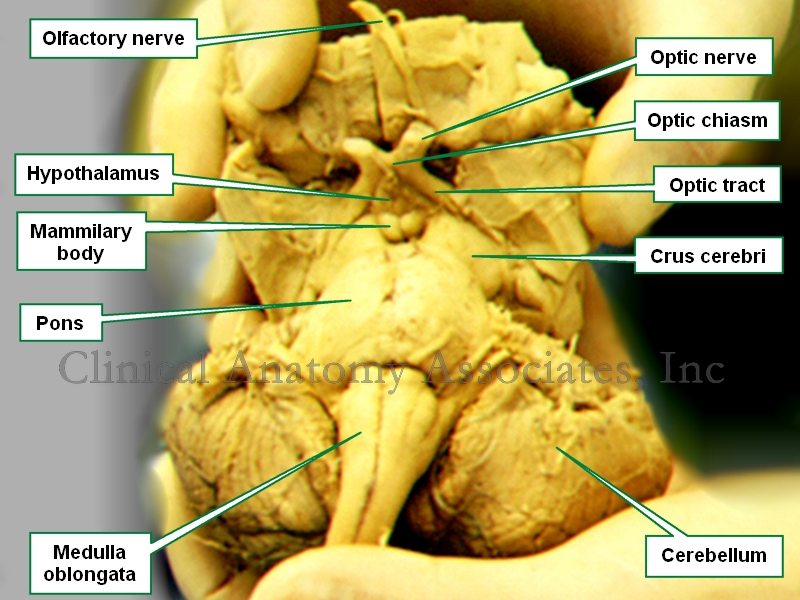
Brainstem. Anteroinferior view
The anatomical term crus cerebri is Latin. The term [crus] means "pillar" or "leg", and [cerebri] means "brain", thus it means the "pillars of the brain" or "the brain legs".
It refers to the anterior view of the midbrain or mesencephalon. There are two slightly divergent columns or pillars separated by the interpeduncular fossa, a space or region that contains in its superior aspect the mammillary bodies. These two columns are also known as the "cerebral peduncles".
The interpeduncular fossa is a dilated region of the subarachnoid space and as such it is a cistern called the "interpeduncular cistern". The oculomotor nerve (third cranial nerve) appears on the lateral aspect of the interpeduncular fossa.
The trochlear nerve (4th cranial nerve) wraps around the lateral aspect of each crura cerebri on its way towards the eye.
Image property of:CAA.Inc.
- Details
Click for a larger image
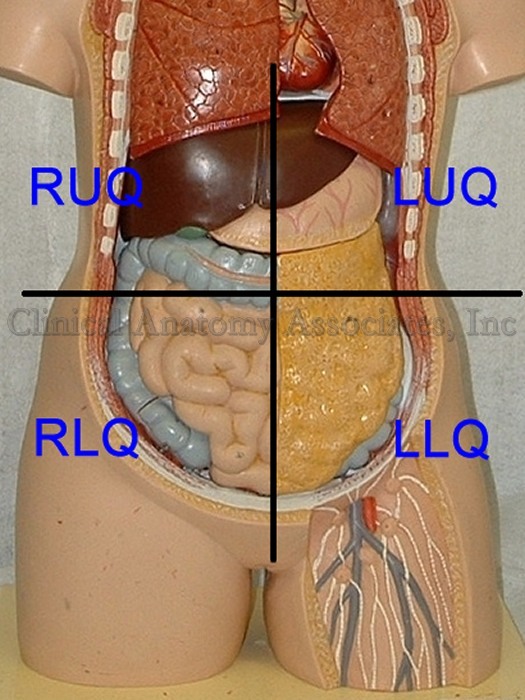
A simple surface anatomy division of the abdomen is into four quadrants. A more detailed division of the abdomen is into nine abdominal regions.
The abdominal quadrants are formed by two planes. The first is the midsagittal or median plane. The second one is a transverse or horizontal plane that passes through the umbilicus. This creates four quadrants with specific content as follows:
Right Upper Quadrant (RUQ): This quadrant contains most of the liver, with the gallbladder, portal vein, the distal portion of the stomach, duodenum, head of the pancreas, part of the ascending colon, part of the transverse colon, the right flexure of the colon, and the right kidney and right adrenal gland
Left Upper Quadrant (LUQ): This quadrant contains the tip of the left lobe of the liver, most of the stomach, spleen, body and tail of the pancreas, part of the transverse colon and the left colic flexure, and the left kidney and left adrenal gland
Right Lower Quadrant (RLQ): This quadrant contains the cecum and ascending colon, vermiform appendix, right ovary, the ileocecal junction, right ureter, part of the small intestine, and the right half of the greater omentum
Left Lower Quadrant (LLQ): This quadrant contains the descending colon, sigmoid colon, left ovary, part of the small intestine, and the left half of the greater omentum