
Medical Terminology Daily (MTD) is a blog sponsored by Clinical Anatomy Associates, Inc. as a service to the medical community. We post anatomical, medical or surgical terms, their meaning and usage, as well as biographical notes on anatomists, surgeons, and researchers through the ages. Be warned that some of the images used depict human anatomical specimens.
You are welcome to submit questions and suggestions using our "Contact Us" form. The information on this blog follows the terms on our "Privacy and Security Statement" and cannot be construed as medical guidance or instructions for treatment.
We have 535 guests online
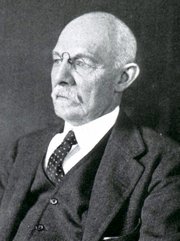
William S. Halsted, MD
(1852 – 1922)
American anatomist, teacher, and surgeon, William Stewart Halsted was born in New York City, USA to a wealthy family of English origin. His father was involved in charitable work and Governor and trustee to a city hospital. Not a brilliant student initially, Halsted took an undergraduate in Liberal Arts in Yale, CT., after which he entered the Medical College of Physicians at the Columbia College, where he excelled.
As a second-year medical student Halsted applied and obtained a position in surgery at a local hospital. In here he learned about Lister’s antiseptic technique and became an adamant proponent of it to reduce infection. In 1877 Halsted obtained his MD. After a short time as House Physician at the New York Hospital, Halsted traveled to Europe to further his education studying for two years at the Universities of Vienna, Leipzig, and W?rzburg.
Besides being at the forefront of surgical and antiseptic techniques (introducing the use of rubber gloves in surgery), Halsted was extremely concerned with the way medical students were taught in the US. He pioneered bedside clinical round discussions with the medical students after two years of basic sciences studies. Halsted developed the idea of a patient chart; he also developed the residency program for medical students in use today.
Halsted is probably the most influential researcher and surgeon at the turn of the century. He dedicated time to the study of intestinal anastomoses and the use of silk as a suture material. His experimental work in 1887 proved that the inclusion of the submucosa layer in an anastomosis was mandatory, as well that a single layered anastomosis was enough to attain closure. Perhaps Halsted’s most important contribution was the application and use of the scientific method to surgical questions. Halsted’s principles, also known as "Halsted's Rules of Surgery", set the standards used today in surgical suturing and surgical stapling.
He also pioneered the development and surgical techniques for radical mastectomy as a treatment for breast cancer.
As a side effect of this studied in anesthesia and the use of cocaine for anesthesia, Halsted became addicted to this substance, a problem that followed him through the years. Without impairing his capacity as a researcher and a surgeon, Halsted eventually recovered. He died in Baltimore in 1922 as a complication to surgery.
Sources:
1. Dubay, A. D., & Franz, G. M. (2003). Acute Wound Healing: The Biology of Acute Wound Failure. Surg Clin NA, 83, 463-481.
2. Halsted, W. S. (1887). Circular Suture of the Intestine - An Experimental Study. Am J Med Sci, 436-461.
3. “William Stewart Halsted: his life and contributions to surgery” Osborne, P. Lancet Oncol 2007; 8: 256–65
4. “William Stewart Halsted: Surgical pioneer” Burress, P Endoc Today (2010), 8: (2) 22
5. “William Stewart Halsted (1852–1922) Neurological stamp” Haas, LF J Neurol Neurosurg Psych 2000;69:641
Original image courtesy of "Images from the History of Medicine" at www.nih.gov

"Clinical Anatomy Associates, Inc., and the contributors of "Medical Terminology Daily" wish to thank all individuals who donate their bodies and tissues for the advancement of education and research”.
Click here for more information


- Details
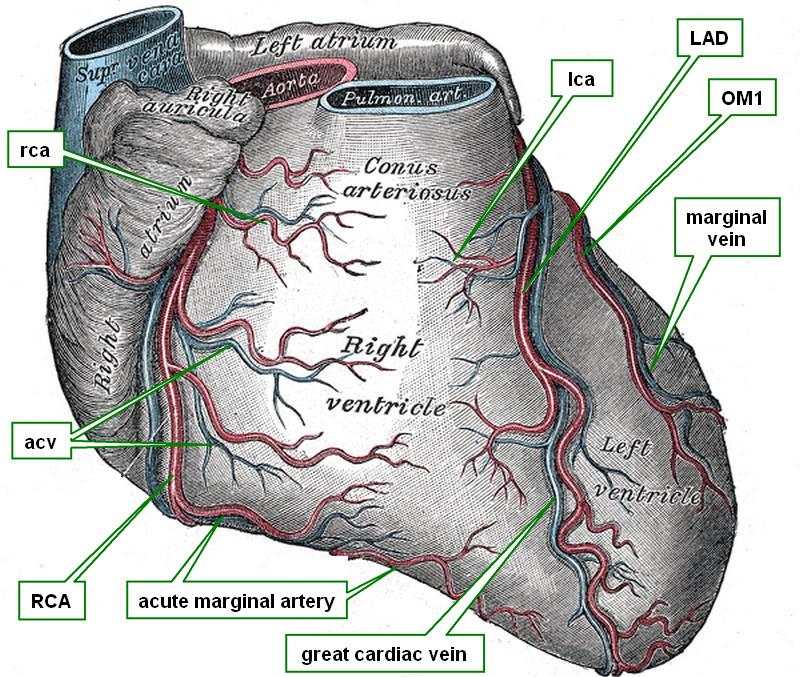
Anterior view of the heart
The marginal veins are usually two (sometimes three) venous branches each which run along or parallel with the obtuse marginal arteries. They represent the venous return from the anterolateral aspect of the left ventricular wall.
The first (obtuse) marginal vein usually anastomoses with the great cardiac vein just before the great cardiac vein empties into the coronary sinus. The other obtuse marginal veins may enter the coronary sinus directly
Sources:
1. "Gray's Anatomy" 38th British Ed. Churchill Livingstone 1995
2. “Variable anatomy of the right coronary artery supply to the left ventricle” Adams, J. Treasure, T. Thorax 1985;40:618-623
4. "Anatomy of the Human Body" Henry Gray 1918. Philadelphia: Lea & Febiger
Image modified by CAA, Inc. Original image courtesy of bartleby.com
- Details

Click for a larger image
This is the name given to a particular anatomical variation of the bifurcation of the left coronary artery (LMCA). Normally the LMCA bifurcates giving origin to the circumflex artery (CFX) and the anterior interventricular artery, also known as the left anterior descending artery (LAD).
In the case of the “ramus intermedius” variation, the LCMA trifurcates, that is, forks into three branches: an LAD, a CFX and an intermediate branch that provides blood supply to the anterolateral aspect of the left ventricular surface and/or the obtuse margin of the heart. The ramus intermedius may take one of two directions. It may behave like a diagonal branch (D1, D2) of the LAD or as an obtuse marginal artery (OM1).
The ramus intermedius anatomical variation is quite common and literature states that it may be present in 20-33% of the cases.
One of my pet peeves (see my top pet peeve here) is that most medical industry providers as well as many surgeons and physicians call this anatomical variation a “ramus”. You see, the Latin term [ramus] means “branch” and by itself is not descriptive. The proper name is the Latin term “ramus intermedius” which means “the intermediate branch”.
Image property of CAA,Inc.
- Details
Click for a larger image
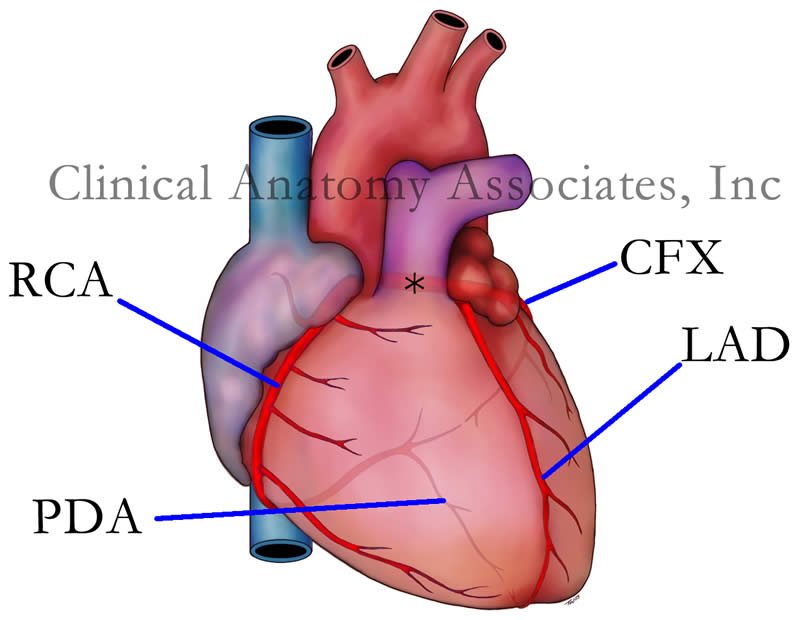
The left coronary artery, sometimes called the [left main coronary artery] or LMCA, is a short artery that arises from the aortic root at the left posterior coronary sinus of Valsalva, usually below the sinotubular junction.
Its length is on average 1.3 cm, although it can be shorter. The LMCA courses between the left atrial appendage and the posterior aspect of the pulmonary trunk. The LMCA provides blood supply to almost 69% of the heart, making it most important in coronary blood supply to the heart. This apparently goes against the concept of coronary dominance if the concept is not clearly understood. You could have a "right dominant heart" and still have the LMCA provide blood supply to more than 50% of the heart.
The left coronary artery bifurcates giving origin to two branches: the circumflex artery (CFX) and the left anterior descending artery (LAD). Each one of these arteries gives origin to several named branches and you can click on the links to follow each one.
The left coronary artery has several anatomical variations, including one where it does not exist and the CFX and LAD arise separately from the aorta. In another common variation (25-33%) the aorta trifurcates giving rise to a [ramus intermedius]
Sources:
1 "Tratado de Anatomia Humana" Testut et Latarjet 8 Ed. 1931 Salvat Editores, Spain
2. "Gray's Anatomy" 38th British Ed. Churchill Livingstone 1995
3. “Anatomical variations in the left coronary artery and its branches” Hosapatna, M et al. Singapore Med J 2013; 54(1) : 49
4. "Quantitative study on the size of coronary artery supplying areas postmortem" Kalbfleisch H. Am Heart J 1977; 94:183-8.
Image property of: CAA.Inc. Artist: Victoria G. Ratcliffe
- Details
Anterior view of the heart
The obtuse marginal arteries are two (sometimes three) branches that arise of the circumflex artery and descend towards the cardiac apex with varying lengths. The first obtuse marginal artery (OM1) is usually found on or close to the obtuse margin of the heart, also known as the “margo obtusus”
The first obtuse marginal artery (OM1) along with the acute marginal artery are used to denote the lower portion of the heart and the location of the cardiac apex in coronary angiography.
There is an anatomical variation of the origin of OM1 where this artery arises at the bifurcation of the left coronary artery where this artery takes the name “ramus intermedius”
Sources:
1. "Gray's Anatomy" 38th British Ed. Churchill Livingstone 1995
2. “Variable anatomy of the right coronary artery supply to the left ventricle” Adams, J. Treasure, T. Thorax 1985;40:618-623
4. "Anatomy of the Human Body" Henry Gray 1918. Philadelphia: Lea & Febiger
Image modified by CAA, Inc. Original image courtesy of bartleby.com
- Details

Click for a larger image
The term "obtuse margin" refers to the superolateral border of the anterior surface of the heart. It is also known by its Latin name [margo obtusus].
The name of this border or margin of the heart is quite descriptive. If you observe the accompanying image, the angle formed between the anterior or sternocostal surface of the heart with the left lateral or left pulmonary surface of the heart, you can see that the angle between these two surfaces is more than 90 degrees, therefore an "obtuse" angle. The corresponding border between these two surfaces has to be called the "obtuse margin"!
In relation to the obtuse margin of the heart we can usually find the first branch that arises from the circumflex artery. This artery is called Obtuse Marginal 1 or OM1.
Click on the image for a larger depiction. Here is a link to an article on the "acute margin" of the heart.
Sources:
1 "Tratado de Anatomia Humana" Testut et Latarjet 8 Ed. 1931 Salvat Editores, Spain
- Details
Anterior view of the heart
The acute marginal artery is the longest branch of the right coronary artery on the anterior aspect of the heart and extends towards the cardiac apex. The name reflects the fact that this artery runs along the anteroinferior border of the heart called the “margo acutus” in Latin or the “acute margin”.
The acute marginal artery is used in coronary angiography to denote the lower border of the heart.
The acute marginal artery may have a higher origin on the right coronary artery or it may arise from one of the lower right ventricular arteries. There are anatomical variations of the acute marginal artery where this artery actually may provide blood supply to the left ventricle of the heart.
Sources:
1. "Gray's Anatomy" 38th British Ed. Churchill Livingstone 1995
2. “Variable anatomy of the right coronary artery supply to the left ventricle” Adams, J. Treasure, T. Thorax 1985;40:618-623
4. "Anatomy of the Human Body" Henry Gray 1918. Philadelphia: Lea & Febiger
Image modified by CAA, Inc. Original image courtesy of bartleby.com