
Medical Terminology Daily (MTD) is a blog sponsored by Clinical Anatomy Associates, Inc. as a service to the medical community. We post anatomical, medical or surgical terms, their meaning and usage, as well as biographical notes on anatomists, surgeons, and researchers through the ages. Be warned that some of the images used depict human anatomical specimens.
You are welcome to submit questions and suggestions using our "Contact Us" form. The information on this blog follows the terms on our "Privacy and Security Statement" and cannot be construed as medical guidance or instructions for treatment.
We have 433 guests online
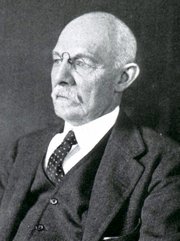
William S. Halsted, MD
(1852 – 1922)
American anatomist, teacher, and surgeon, William Stewart Halsted was born in New York City, USA to a wealthy family of English origin. His father was involved in charitable work and Governor and trustee to a city hospital. Not a brilliant student initially, Halsted took an undergraduate in Liberal Arts in Yale, CT., after which he entered the Medical College of Physicians at the Columbia College, where he excelled.
As a second-year medical student Halsted applied and obtained a position in surgery at a local hospital. In here he learned about Lister’s antiseptic technique and became an adamant proponent of it to reduce infection. In 1877 Halsted obtained his MD. After a short time as House Physician at the New York Hospital, Halsted traveled to Europe to further his education studying for two years at the Universities of Vienna, Leipzig, and W?rzburg.
Besides being at the forefront of surgical and antiseptic techniques (introducing the use of rubber gloves in surgery), Halsted was extremely concerned with the way medical students were taught in the US. He pioneered bedside clinical round discussions with the medical students after two years of basic sciences studies. Halsted developed the idea of a patient chart; he also developed the residency program for medical students in use today.
Halsted is probably the most influential researcher and surgeon at the turn of the century. He dedicated time to the study of intestinal anastomoses and the use of silk as a suture material. His experimental work in 1887 proved that the inclusion of the submucosa layer in an anastomosis was mandatory, as well that a single layered anastomosis was enough to attain closure. Perhaps Halsted’s most important contribution was the application and use of the scientific method to surgical questions. Halsted’s principles, also known as "Halsted's Rules of Surgery", set the standards used today in surgical suturing and surgical stapling.
He also pioneered the development and surgical techniques for radical mastectomy as a treatment for breast cancer.
As a side effect of this studied in anesthesia and the use of cocaine for anesthesia, Halsted became addicted to this substance, a problem that followed him through the years. Without impairing his capacity as a researcher and a surgeon, Halsted eventually recovered. He died in Baltimore in 1922 as a complication to surgery.
Sources:
1. Dubay, A. D., & Franz, G. M. (2003). Acute Wound Healing: The Biology of Acute Wound Failure. Surg Clin NA, 83, 463-481.
2. Halsted, W. S. (1887). Circular Suture of the Intestine - An Experimental Study. Am J Med Sci, 436-461.
3. “William Stewart Halsted: his life and contributions to surgery” Osborne, P. Lancet Oncol 2007; 8: 256–65
4. “William Stewart Halsted: Surgical pioneer” Burress, P Endoc Today (2010), 8: (2) 22
5. “William Stewart Halsted (1852–1922) Neurological stamp” Haas, LF J Neurol Neurosurg Psych 2000;69:641
Original image courtesy of "Images from the History of Medicine" at www.nih.gov

"Clinical Anatomy Associates, Inc., and the contributors of "Medical Terminology Daily" wish to thank all individuals who donate their bodies and tissues for the advancement of education and research”.
Click here for more information


- Details
![Four chamber section of the heart. By BrownCow. [Public domain], from Wikimedia Commons](/images/MTD/LargeImages/ductus_arteriosus_lg.jpg "Four chamber section of the heart")
Click for a larger image
The term [ductus arteriosus] is Latin and means “arterial duct”. The ductus arteriosus a component of fetal circulation and is a communication between the left pulmonary artery, close to its origin from the pulmonary trunk, and the inferior aspect of the aortic arch. This structure is also called the “duct of Botallus”.
The fetus oxygenates its blood using the placenta; therefore it does not need to use its lungs. The fetal blood is diverted from the right atrium to the left atrium through the foramen ovale. Still, some blood will pass from the right atrium to the right ventricle and then through the pulmonary valve into the pulmonary trunk. The ductus arteriosus will divert most of this blood, so that instead of going into the lungs, the blood will go into the aortic arch and then to the systemic circulation.
Once the baby is born, this right to left shunt is not needed and the foramen ovale will close immediately after birth, while the ductus arteriosus will slowly reduce its diameter to be completely closed in a few days. If this closure does not happen, the condition will be referred to as a “patent ductus arteriosus” or PDA.
Once the ductus arteriosus is close it is referred to as the “ligamentum arteriosus” or the “ligament of Botallus”, named after Leonardo Botallus (c.1530-????)
Sources:
1. "Gray's Anatomy"38th British Ed. Churchill Livingstone 1995
2. "Tratado de Anatomia Humana" Testut et Latarjet 8 Ed. 1931 Salvat Editores, Spain
Image by BrownCow. [Public domain], from Wikimedia Commons
- Details
Click for a larger image
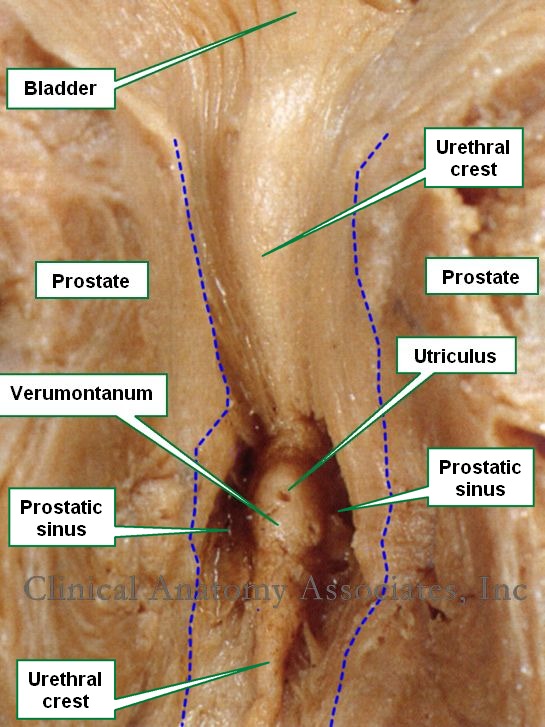
The [prostatic sinuses] (sinus prostaticus) are bilateral depressions found lateral to the inferior portion of the median urethral crest (also known as the verumontanum). There are two prostatic sinuses within the prostatic urethra in the male
On the floor of these sinuses there are several perforations, representing the exit of the prostatic ducts (or ductules). These ducts bring prostatic fluid from the lateral lobes of the prostate into the urethra.
The image also shows the [prostatic utricle], also known as "utriculus prostaticus" or "utriculus", a small 6mm small dead-end channel found in the male prostatic urethra. The blue dotted line shows the cut edge of the urethra.
The word [utriculus] is Latin and means "little sac" or "little uterus".
Sources:
1. "The prostatic utricle is not a M?llerian duct remnant: immunohistochemical evidence for a distinct urogenital sinus origin" Shapiro E, Huang H, McFadden DE, et al. (2004) J Urol 172; 1753–1756
2. "Gray's Anatomy"38th British Ed. Churchill Livingstone 1995
3. "Tratado de Anatomia Humana" Testut et Latarjet 8 Ed. 1931 Salvat Editores, Spain
- Details
The suffix[-ceps] has a Latin origin from the word [caput], meaning "head" or "leader". This word evolved into [-capit-] as in [decapitation], [-capt-] as in [captain], and of course, [-ceps], meaning "head".
This suffix is used in many anatomical and medical terms such as:
• Biceps: Two heads. Both the biceps brachii muscle and the biceps femoris muscle have two muscular heads or components
• Triceps: Three heads. The triceps brachii muscle has three muscular heads or components. There is no triceps femoris in the human.
• Quadriceps: Four heads. The quadriceps femoris muscle has four muscular heads or components
An interesting side note is that the Latin word [caput] evolved through the ages as it was incorporated into other languages. In French it evolved into [chef] as the "head" or "leader" of a group of cooks, and then back to English as [chief].
- Details
![Phlebotomist at work. By Richardelainechambers (Own work) [Public domain], via Wikimedia Commons](/images/MTD/LargeImages/phlebotomist_lg.jpg "Phlebotomist at work.")
Click for a larger image
Count Dracula, Mrs. Dracula, vampires, blood whisperers, etc. These are some of the nicknames given to these professionals who draw blood at medical offices, laboratories and hospitals.
The root term [-phleb-] derives from the Greek [φλέβα] (phleba) meaning "vein", and the suffix [-otomist] has two components. First [-otom-], from the Greek [τομή] (tomi) meaning "to cut" or "to open" and [-ist] from the Latin [-ista] meaning "he/she who makes or does". The medical term [phlebotomist] means "he/she who opens veins", a perfect description for these professionals.
For centuries a standard practice in medicine was to "bleed" a patient, by opening a vein under controlled conditions and letting some blood flow. The practice was known as "bloodletting" or phlebotomy, not in use today.
It is said that excessive bloodletting contributed to the death of George Washington, having removed 5 pints of blood in one day!. Today the professionals who draw blood are called "phlebotomists"
The image shows a phlebotomist at work using the Vacutainer system for drawing blood
Image by Richardelainechambers (Own work) [Public domain], via Wikimedia Commons
- Details
This article is part of the series "A Moment in History" where we honor those who have contributed to the growth of medical knowledge in the areas of anatomy, medicine, surgery, and medical research.

Title page
Martin Naboth (1675 – 1721). Not much is known about this German physician and anatomist. He was born in 1675 in Calau, a town in Southern Brandenburg, Germany. He studied medicine at the University in Leipzig, receiving his doctorate in Philosophy in 1701 and his MD in 1703. Although his interests were based in chemistry, Naboth became an avid anatomist, with interest in the anatomy of the female reproductive system.
His main publication in 1707 was “De Sterilitate Mulierum” (On Sterility in Women). In this book he refers to small pearl-like transparent structures found in the uterine cervix. Believing that he had discovered the way women store eggs, he called these “ovarium novum” (new ovaries). His discovery was accepted by many and these structures came to be known as “Ovula Nabothii “. Only later were to understand these structures as cysts created by clogging of the opening of the glands found around the uterine cervix. These mucus-producing glands are known as the [cervical glands] and also as Nabothian glands. These cysts, which are common and do not represent a sign of cervical cancer, are known today as Nabothian cysts.
Naboth had only rediscovered these cysts first described in 1681 by Guillaume des Noues (1650 – 1735), although the eponym records Naboth’s name.
Naboth published De Organo Auditus in 1703, and was appointed Professor of Chemistry in Leipzig in 1707. He died in Leipzig on May 23, 1721 leaving a large anatomical collection. We have not been able to find an image of Naboth, so we are depicting the title page of his 1707 “De Sterilitate Mulierum”. If you click on the image you can see a larger depiction.
Sources
1. “Histoire de la Mèdecine, depuis son origine jusqu'au dix-neuvime siècle” A. J. L. Jourdan ; E. F. M. Bosquillon 1815
2. DESNOUES, G. Rariora quadam observata in genitalibus mulierum. Zodiacus Medico-GaUicus, sive Miscellaneorum Medico-Physicorum Gallicorum. Annus
Tertius, Geneva. Leonard Chouet. (Feb. 1681) 1682, pp. 20-21.
3. “The Origin of Medical Terms” Skinner HA 1970 Hafner Publishing Co.
- Details

Click for a larger image
You should try to answer this question before reading this article (or looking at your hand) .
In superficial or surface anatomy the hand is the distal component of the superior extremity. Since anatomy is studied with the specimen in the anatomical position, the hand has an anterior (volar) surface represented by the palm and a posterior (dorsal) surface.
Each hand has a thumb and four (not five) fingers. Why does the thumb have a different name? Because it is different. Look at your hand and you will see that the thumb has only two joints while the fingers have three joints, counting the metacarpophalangeal joint at the base of the fingers and the thumb.
Based on the above, it is wrong to say that you have five fingers in each hand. You have five digits in each hand and they are counted from the lateral aspect, so the thumb is your first digit and the most medial and shortest of the digits is the fifth digit, please do not call it “pinky”. Click here to see interesting anatomical trivia regarding the fifth digit.
It is important to call the components and regions of the body appropriately. And more interestingly (you can look at you hand now), it is fun to know that contrary to popular belief, you do not have a “middle finger”.
Take your time thinking about that one!
Images in the public domain, modified from the original, own work, by Evan-Amos
