
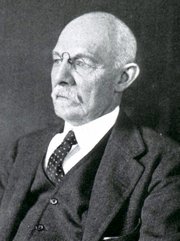



While the components of the conduction system of the heart were all described by now-famous researchers (Sunao Tawara, Wilhelm His Jr, Arthur Keith, Martin Flack, Jan Evangelista Purkinje, Jean George Bachmann), the pathway(s) of the electrical impulses from the sinoatrial (SA) node to the atrioventricular (AV) node have been historically controversial.
Once again, it must be stressed that the conduction system of the heart is not formed by nerves, but rather by specialized cardiomyocytes. The speed of the electrical depolarization of these cells is affected by their structural organization. If the cells are organized in a random, mesh-like style, the flow of electricity will be slow. If these cells are parallel to each other, the flow will be faster.
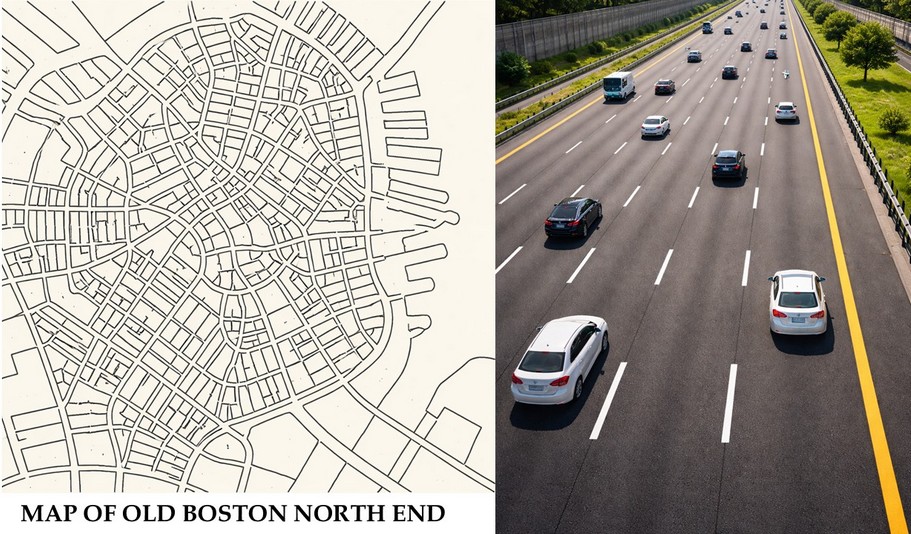
An analogy of this organization can be made by how slow it is to drive in the streets of Old Boston North End versus driving in a five-lane highway. The parallel (anisotropic) organization of the cardiac bundles (interatrial and internodal) allow for faster impulse transmission. The concept of anisotropy refers to direction-dependent conduction velocity, with faster propagation along the longitudinal axis of myocardial fibers than across them.
In 1963 Thomas N. James MD, MACP (1926 -2010), demonstrated consistent bands of atrial myocardium connecting the SA node to the AV node. James described three principal internodal pathways—anterior, middle, and posterior. His work shifted the paradigm from diffuse conduction to anisotropically organized atrial pathways.
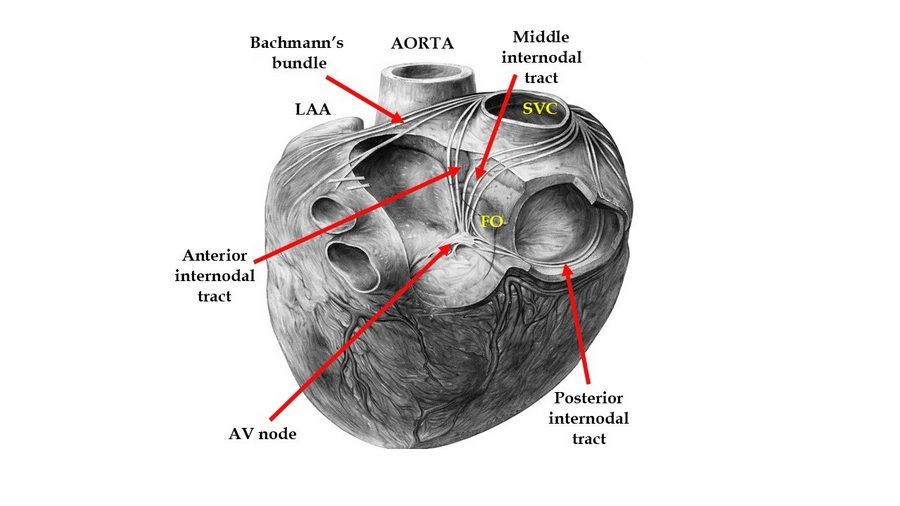
The interatrial and internodal tracts
The anterior internodal tract originates from the anterior margin of the SA node, curves around the superior vena cava and forms Bachmann’s bundle, first described by Jean George Bachmann (1877 - 1959) in 1916. From here the anterior internodal tract leaves Bachmann’s bundle, passes posterior to the aorta and the non-coronary sinus, descends in the anterior portion of the interatrial septum and joins the anterosuperior region of the AV node.
From the SA node the middle internodal tract curves around and posterior to the SVC and descends in the interatrial septum passing anterior to the limbus fossa ovalis to enter the superior aspect of the AV node. This tract is known eponymically as Wenckebach’s bundle, named after Karel Frederik Wenckebach (1864–1940) a Dutch physician and anatomist.
Click for a larger image
The posterior internodal tract courses from the SA node around the base of the SVC and descends in the groove between the right atrial appendage and the right atrium. At this point it forms a cord of tissue at the ostium of the RAA known as the crista terminalis, it continues along an area known as the cavotricuspid isthmus to join the posterior aspect of the AV node. This tract is known eponymically as Thorel’s bundle, named after Christen Thorel (1880 – 1935) a German physician and anatomist who described this structure in 1909.
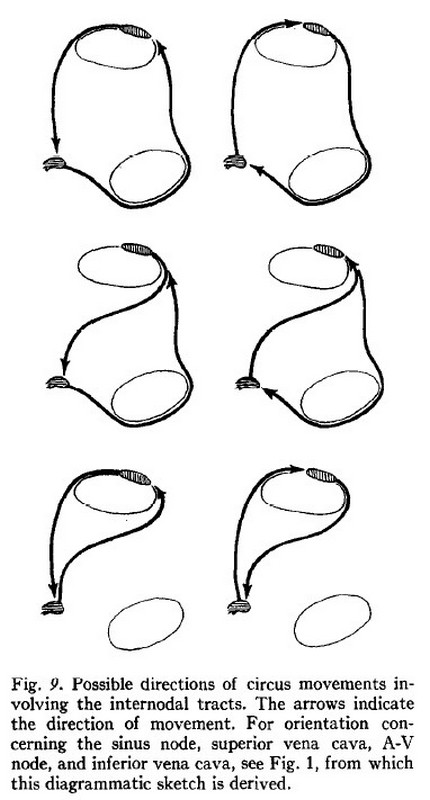
Electrical conduction in a parallel bundle can go either way (same as in an electrical cable). Because the impulses are generated in the SA node, they will go towards the AV node. James argued that because of the fiber arrangement of these internodal tracts, they form circles that can allow the electrical impulse to revert towards the SA node. He calls this a “circus movement” we call that today “reentrant circuits”. These reentrant circuits can be one of the many causes of cardiac arrhythmias, especially atrial fibrillation.
References:
1. His W Jr. Die Tätigkeit des embryonalen Herzens und deren Bedeutung für die Lehre von den Herzbewegungen. Leipzig, Germany: Vogel; 1893.
2. Tawara S. Das Reizleitungssystem des Säugetierherzens. Jena, Germany: Gustav Fischer; 1906.
3. James TN. The connecting pathways between the sinus node and A-V node and between the right and the left atrium in the human heart. Am Heart J. 1963;66(4):498-508.
4. James TN. Anatomy of the cardiac conduction system in the human heart. Prog Cardiovasc Dis. 1961;4(1):1-43
5. Anderson RH, Ho SY. The architecture of the sinus node, the atrioventricular node, and the internodal atrial myocardium. J Cardiovasc Electrophysiol. 1998;9(11):1233-1248.
6. Silverman ME, Grove D, Upshaw CB Jr. Why does the heart beat? The discovery of the electrical system of the heart. Circulation. 2006;113(23):2775-2781.
7. Spach MS, Dolber PC. Relating extracellular potentials and their derivatives to anisotropic propagation at a microscopic level in human cardiac muscle. Circ Res. 1986;58(3):356-371.
8. Kistin AD. Observations on the anatomy of the atrioventricular bundle and the question of other muscular atrioventricular connections. Am Heart J. 1949;38(5):673-688.
9. Cavero, I. Holzgrefe, H Internodal conduction pathways: revisiting a century-long debate on their existence, morphology, and location in the context of 2023 best science Advances in Physiology Education 2023 47:4, 838-850 1
0. Cox JL et al Cardiac anatomy pertinent to the catheter and surgical treatment of atrial fibrillation. J Cardiovasc Electrophysiol 2020 Aug;31(8):2118-2127.