
Medical Terminology Daily (MTD) is a blog sponsored by Clinical Anatomy Associates, Inc. as a service to the medical community. We post anatomical, medical or surgical terms, their meaning and usage, as well as biographical notes on anatomists, surgeons, and researchers through the ages. Be warned that some of the images used depict human anatomical specimens.
You are welcome to submit questions and suggestions using our "Contact Us" form. The information on this blog follows the terms on our "Privacy and Security Statement" and cannot be construed as medical guidance or instructions for treatment.
We have 1194 guests online
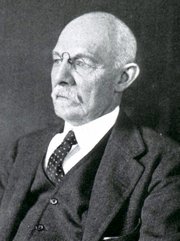
William S. Halsted, MD
(1852 – 1922)
American anatomist, teacher, and surgeon, William Stewart Halsted was born in New York City, USA to a wealthy family of English origin. His father was involved in charitable work and Governor and trustee to a city hospital. Not a brilliant student initially, Halsted took an undergraduate in Liberal Arts in Yale, CT., after which he entered the Medical College of Physicians at the Columbia College, where he excelled.
As a second-year medical student Halsted applied and obtained a position in surgery at a local hospital. In here he learned about Lister’s antiseptic technique and became an adamant proponent of it to reduce infection. In 1877 Halsted obtained his MD. After a short time as House Physician at the New York Hospital, Halsted traveled to Europe to further his education studying for two years at the Universities of Vienna, Leipzig, and W?rzburg.
Besides being at the forefront of surgical and antiseptic techniques (introducing the use of rubber gloves in surgery), Halsted was extremely concerned with the way medical students were taught in the US. He pioneered bedside clinical round discussions with the medical students after two years of basic sciences studies. Halsted developed the idea of a patient chart; he also developed the residency program for medical students in use today.
Halsted is probably the most influential researcher and surgeon at the turn of the century. He dedicated time to the study of intestinal anastomoses and the use of silk as a suture material. His experimental work in 1887 proved that the inclusion of the submucosa layer in an anastomosis was mandatory, as well that a single layered anastomosis was enough to attain closure. Perhaps Halsted’s most important contribution was the application and use of the scientific method to surgical questions. Halsted’s principles, also known as "Halsted's Rules of Surgery", set the standards used today in surgical suturing and surgical stapling.
He also pioneered the development and surgical techniques for radical mastectomy as a treatment for breast cancer.
As a side effect of this studied in anesthesia and the use of cocaine for anesthesia, Halsted became addicted to this substance, a problem that followed him through the years. Without impairing his capacity as a researcher and a surgeon, Halsted eventually recovered. He died in Baltimore in 1922 as a complication to surgery.
Sources:
1. Dubay, A. D., & Franz, G. M. (2003). Acute Wound Healing: The Biology of Acute Wound Failure. Surg Clin NA, 83, 463-481.
2. Halsted, W. S. (1887). Circular Suture of the Intestine - An Experimental Study. Am J Med Sci, 436-461.
3. “William Stewart Halsted: his life and contributions to surgery” Osborne, P. Lancet Oncol 2007; 8: 256–65
4. “William Stewart Halsted: Surgical pioneer” Burress, P Endoc Today (2010), 8: (2) 22
5. “William Stewart Halsted (1852–1922) Neurological stamp” Haas, LF J Neurol Neurosurg Psych 2000;69:641
Original image courtesy of "Images from the History of Medicine" at www.nih.gov

"Clinical Anatomy Associates, Inc., and the contributors of "Medical Terminology Daily" wish to thank all individuals who donate their bodies and tissues for the advancement of education and research”.
Click here for more information


- Details
This is a series of articles on depression published as a community service. The information in these articles follow our Privacy and Security Guidelines and cannot be construed as medical guidance. For additional information and counseling, consult with your physician or the appropriate health care professional of your choice. You can also find information on Transcranial Magnetic Stimulation (TMS) here. For the initial article on this series click here.
This article could also be entitled:
What is the difference between unipolar and bipolar depression?

Click for a larger image
Mood is a range of emotions that describe how we "feel" at a particular point in time. Mood is called a "visceral" (gut-like) sensation and is difficult to describe. It is a sensation dependent on a group of deep brain structures known as the limbic system.
Being a spectrum, there are two ends or "poles" to the range. An one end we have the major depressive mood of darkness, despair, and loathing of one's self. At the other end or "pole" we have the manic feeling of happiness, feeling "high", with extreme irritability and quick actions without measuring potential consequences.
An MDD patient that is "stuck" at the dark end of the spectrum, is said to be "unipolar", as the Latin word unus and uni- mean "one". The patient is always at one pole, therefore "unipolar".
Some depression patients have mood swings going from one end of the mood spectrum to the other. Since the medical prefix [bi-] means "two", these patients are said to have a "bipolar" type depression.
Some authors comment that there is not really a true unipolar depression for even unipolar depression patients move within the mood spectrum as their pathology evolves with treatment.
Experience tells us that as a depression patient starts to come out of their neurologically depressed state they may begin to show anxiety. This is easily treated by adding a secondary prescription course of right-sided low frequency treatment of TMS. As you go through your TMS Therapy treatment you may expect your prescription and dosage to change to accommodate your development towards a life without depression
References:
1. Barbee, J. G. (1998). Mixed symptoms and syndromes of anxiety and depression: Diagnostic, prognostic, and etiologic issues. Annals of Clinical Psychiatry, 10:15–29.
2. Regier, D. A., Rae, D. S., Narrow, W. E., Kaelber, C. T., & Schatzberg, A. F. (1998). Prevalence of anxiety disorders and their comorbidity with mood and addictive disorders. British Journal of Psychiatry. Supplement, 34: 24–28.
- Details
This is a series of articles on depression and published as a community service. The information in these articles follow our Privacy and Security Guidelines and cannot be construed as medical guidance. For additional information and counseling, consult with your physician or the appropriate health care professional of your choice. You can also find information on Transcranial Magnetic Stimulation (TMS) here. For the initial article on this series click here.
Medication
SSRIs and SNRIs
Tricyclics
MAOIs
FDA warning on antidepressants
Psychotherapy
Electroconvulsive therapy
Transcranial magnetic stimulation
The most common treatments for depression are medication and psychotherapy. Drugs are used to treat the primary disorder, but they can be strengthened with augmentation medication. Some patients take so many different medicines that they refer to them as their daily "cocktail". By their own nature drugs are unspecific in that they alter and influence the whole body. Depression drugs have a number of side effects. The side effects of some drugs is a listing of potentially dangerous events, as can be seen in this video.
To illustrate the side effects, following is a list of the side effects listed in the packaging of one of these modern less-side-effect drugs as listed by the manufacturer:
• Symptoms of aggression
• Irritability
• Panic attacks
• Extreme worry
• Restlessness
• Acting without thinking
• Abnormal excitement
• Thoughts of suicide
• If present, glaucoma symptoms may worsen
• May cause liver damage, and may not be taken if the patient has liver disease
• Alcohol consumption may increase some serious side effects
• The patient may feel drowsy
• May cause high blood pressure, dizziness, or lightheadedness

Click for a larger image
Medication
Antidepressants primarily work on brain neurotransmitters, especially serotonin and norepinephrine. Other antidepressants work on the neurotransmitter dopamine. Scientists have found that these particular chemicals are involved in regulating mood, but they are unsure of the exact ways that they work.
SSRIs and SNRIs
Some of the newest antidepressants are called selective serotonin reuptake inhibitors (SSRIs). Fluoxetine (Prozac), sertraline (Zoloft), escitalopram (Lexapro), paroxetine (Paxil), and citalopram (Celexa) are some of the most commonly prescribed SSRIs for depression. Serotonin and norepinephrine reuptake inhibitors (SNRIs) are similar to SSRIs and include venlafaxine (Effexor) and duloxetine (Cymbalta).
SSRIs and SNRIs tend to have fewer side effects than older antidepressants, but they do sometimes produce headaches, nausea, jitters, or insomnia when people first start to take them. These symptoms tend to fade with time. Some people also experience sexual problems with SSRIs or SNRIs, which may be helped by adjusting the dosage or switching to another medication.
One popular antidepressant that works on dopamine is bupropion (Wellbutrin). Bupropion tends to have similar side effects as SSRIs and SNRIs, but it is less likely to cause sexual side effects. However, it can increase a person's risk for seizures.
Tricyclics
Tricyclics are older antidepressants. Tricyclics are powerful, but they are not used as much today because their potential side effects are more serious. They may affect the heart in people with heart conditions. They sometimes cause dizziness, especially in older adults. They also may cause drowsiness, dry mouth, and weight gain. These side effects can usually be corrected by changing the dosage or switching to another medication. However, tricyclics may be especially dangerous if taken in overdose. Tricyclics include imipramine and nortriptyline.
MAOIs
Monoamine oxidase inhibitors (MAOIs) are the oldest class of antidepressant medications. They can be especially effective in cases of "atypical" depression, such as when a person experiences increased appetite and the need for more sleep rather than decreased appetite and sleep. They also may help with anxiety, panic attacks, and other specific symptoms.
However, people who take MAOIs must avoid certain foods and beverages (including cheese and red wine) that contain a substance called tyramine. Certain medications, including some types of birth control pills, prescription pain relievers, cold and allergy medications, and herbal supplements, also should be avoided while taking an MAOI. These substances can interact with MAOIs to cause dangerous increases in blood pressure. The development of a new MAOI skin patch may help reduce these risks.
MAOIs can also react with SSRIs to produce a serious condition called "serotonin syndrome," which can cause confusion, hallucinations, increased sweating, muscle stiffness, seizures, changes in blood pressure or heart rhythm, and other potentially life-threatening conditions. MAOIs should not be taken with SSRIs.
Sometimes stimulants, anti-anxiety medications, or other medications are used together with an antidepressant, especially if a person has a co-existing illness. However, neither anti-anxiety medications nor stimulants are effective against depression when taken alone, and both should be taken only under a doctor's close supervision.
FDA warning on antidepressants
Despite the relative safety and popularity of SSRIs and other antidepressants, studies have suggested that they may have unintentional effects on some people, especially adolescents and young adults. In 2004, the Food and Drug Administration (FDA) conducted a thorough review of published and unpublished controlled clinical trials of antidepressants that involved nearly 4,400 children and adolescents. The review revealed that 4 percent of those taking antidepressants thought about or attempted suicide (although no suicides occurred), compared to 2 percent of those receiving placebos.
This information prompted the FDA, in 2005, to adopt a "black box" warning label on all antidepressant medications to alert the public about the potential increased risk of suicidal thinking or attempts in children and adolescents taking antidepressants. In 2007, the FDA proposed that makers of all antidepressant medications extend the warning to include young adults up through age 24. A "black box" warning is the most serious type of warning on prescription drug labeling.
The warning emphasizes that patients of all ages taking antidepressants should be closely monitored, especially during the initial weeks of treatment. Possible side effects to look for are worsening depression, suicidal thinking or behavior, or any unusual changes in behavior such as sleeplessness, agitation, or withdrawal from normal social situations. The warning adds that families and caregivers should also be told of the need for close monitoring and report any changes to the doctor. The latest information from the FDA can be found on their website.
Results of a comprehensive review of pediatric trials conducted between 1988 and 2006 suggested that the benefits of antidepressant medications likely outweigh their risks to children and adolescents with major depression and anxiety disorders.
Psychotherapy
Two main types of psychotherapies—cognitive-behavioral therapy (CBT) and interpersonal therapy (IPT)—are effective in treating depression. CBT helps people with depression restructure negative thought patterns. Doing so helps people interpret their environment and interactions with others in a positive and realistic way. It may also help you recognize things that may be contributing to the depression and help you change behaviors that may be making the depression worse. IPT helps people understand and work through troubled relationships that may cause their depression or make it worse.
For mild to moderate depression, psychotherapy may be the best option. However, for severe depression or for certain people, psychotherapy may not be enough. For example, for teens, a combination of medication and psychotherapy may be the most effective approach to treating major depression and reducing the chances of it coming back. Another study looking at depression treatment among older adults found that people who responded to initial treatment of medication and IPT were less likely to have recurring depression if they continued their combination treatment for at least 2 years.
Electroconvulsive therapy
For cases in which medication and/or psychotherapy does not help relieve a person's treatment-resistant depression, electroconvulsive therapy (ECT) may be useful. ECT, formerly known as "shock therapy," once had a bad reputation. But in recent years, it has greatly improved and can provide relief for people with severe depression who have not been able to feel better with other treatments.
Before ECT begins, a patient is put under brief anesthesia and given a muscle relaxant. He or she sleeps through the treatment and does not consciously feel the electrical impulses. Within 1 hour after the treatment session, which takes only a few minutes, the patient is awake and alert.
A person typically will undergo ECT several times a week, and often will need to take an antidepressant or other medication along with the ECT treatments. Although some people will need only a few courses of ECT, others may need maintenance ECT—usually once a week at first, then gradually decreasing to monthly treatments.
ECT may cause some side effects, including confusion, disorientation, and memory loss. Usually these side effects are short-term, but sometimes they can linger. Newer methods of administering the treatment have reduced the memory loss and other cognitive difficulties associated with ECT.
FDA cleared in 2008, Transcranial Magnetic Stimulation (TMS) is one of the most promising therapies in the arsenal against depression. One of the key advantages of TMS is that while medical treatment is generalized, affecting the whole body, TMS targets the area of the brain most related in cortical control of mood changes, the left dorsolateral prefrontal cortex. With minimal and very localized side effects, repetitive TMS (rTMS) treatment has proven very effective.
Next: Depression and anxiety
- Details
HAPPY VALENTINE'S DAY!
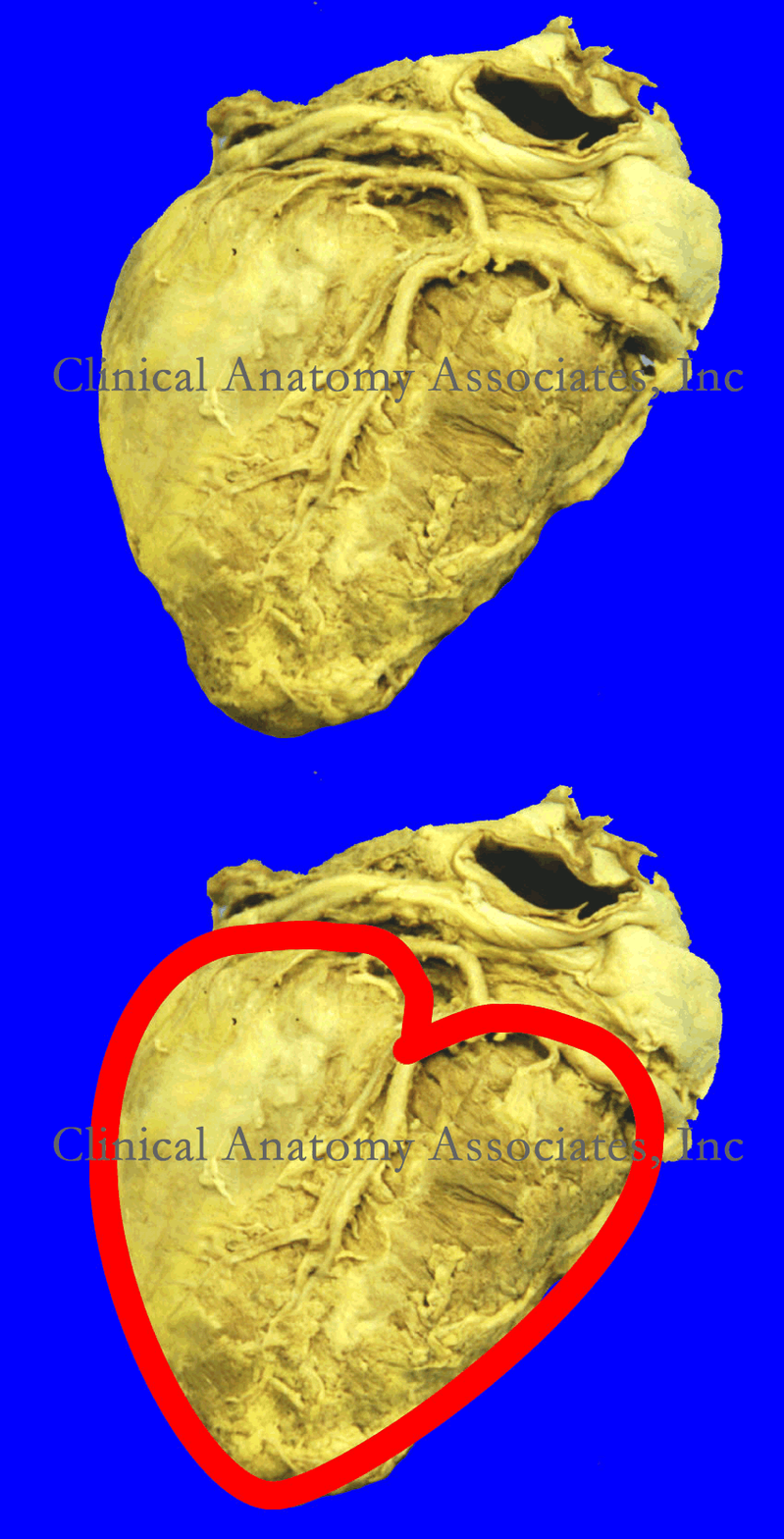
Click for a larger image
For years I tried to understand from where did the classical Valentine's Day heart shape(❤) came. It was not until I was observing a human heart from the posteroinferior aspect, the diaphragmatic surface of the heart that I realized I was looking at it! You see, in the early days of anatomy, the heart was considered to be the ventricles only. This lead to consider the chambers at the "entrance" to the heart to be called "atria". This image of the heart is only valid if you make abstraction of the atria and look at the ventricles only.
Of course, there is a view of the heart, a cross section where you can see all four chambers of the heart. This four-chambered view is called by some the "Valentine's view".
I like my interpretation better. At least now you know that when you draw a [❤] you are being anatomically correct! It is only the ventricles of the heart in a posteroinferior view. Happy Valentine's Day! Dr. Miranda
Image property of:CAA.Inc.Photographer:David M. Klein
- Details
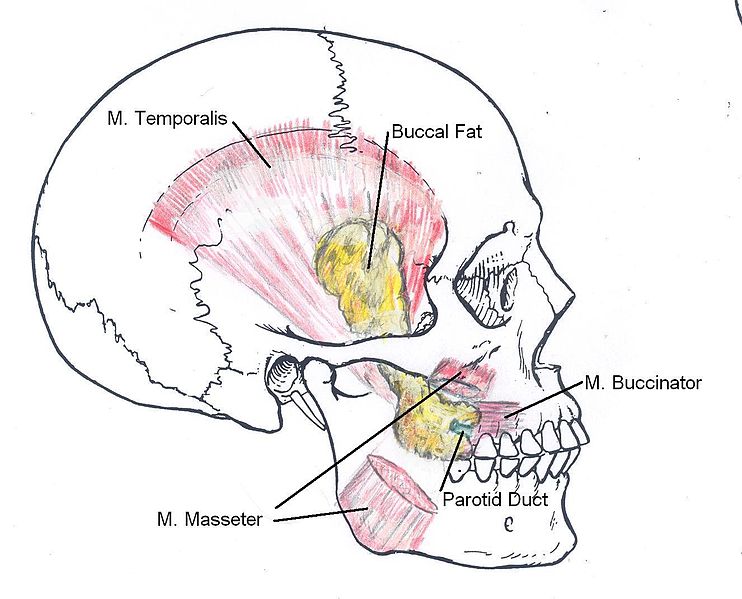
Click for a larger image
The [buccal fat pad] is dense, fatty trigone-shaped pad that is located in the cheek. It is formed by several connective-tissue encapsulated smaller fat pads. It covers partially the posterior aspect of the buccinator muscle, and is found deep to the anterior portion of the masseter muscle. Also known as “Bichat’s fat pad”, it was first described by Marie-François Xavier Bichat in 1802. It is also known as the suctorial fat pad and it helps in the suction process for breast feeding in infants, although because of its location it is also said to help in the gliding motion of the masticatory and facial expression muscles. The buccal fat pad is well developed in newborns and is not as evident in most adults.
Its anatomical description varies according to the authors, but it has a main body and three extensions, namely the anteromalar (anterior), pterygomaxillary (pterygoid), and temporal (posterotemporal) extensions. The blood supply to the buccal fat pad is by way of the anterior deep temporal, buccal, and posterior superior alveolar arteries.
Excessive development of this fat pad can lead to cosmetic surgery to eliminate, or at least reduce its size. This procedure is known in many countries as a “bichectomy”, Bichatectomy” of “cheek reduction surgery”, in some cases this procedure can be performed intraorally.
The buccal fat pad can also be used in maxillofacial reconstructive surgery, as well as the repair of skull base defects. When dissecting the buccal fat pad, care must be taken because of the relation of this structure with the parotid duct, the parotid gland, and branches of the facial nerve
Sources:
1. “Anatomy of the buccal fat pad and its clinical significance” Jackson, IT Plastic and Reconstructive Surgery, 06/1999, Volume 103, Issue 7
2. "A review of the gross anatomy, functions, pathology, and clinical uses of the buccal fat pad" Yousuf, S et al Surg Radiol Anat (2010) 32:427–436
3. "The Endonasal Endoscopic Harvest and Anatomy of the Buccal Fat Pad Flap for Closure of Skull Base Defects" Markey, J et al The Laryngoscope 125: 2247-2252
4. "Bichectomy or Bichatectomy - A Small and Simple Intraoral Surgical Procedure with Great Facial Results" Eber Luis de L S. Adv Dent & Oral Health. 2015; 1(1): 555555. DOI: 10.19080/ADOH.2015.01.555555.
5. "Tratado de Anatomia Humana" Testut et Latarjet 8th Ed. 1931 Salvat Editores, Spain
Image: By Otto Placik (Own work) [CC BY-SA 3.0 (http://creativecommons.org/licenses/by-sa/3.0) or GFDL (http://www.gnu.org/copyleft/fdl.html)], via Wikimedia Commons] Click here for the link to the original image
- Details
The term [quadratus] is Latin and means “square”, it is also the root of the Spanish word “cuadrado”.
It is used to several structures in the body that are of course, square, or at least square-like:
• Quadratus lumborum muscle
• Quadratus femoris muscle
• Pronator quadratus muscle
These muscles will be described in separate articles
Sources: 1. “Understanding Anatomical Terms” Mehta, LA, et al. Clin Anat 9:330-336 (1996)
- Details
The term [suctorial] is based on the Latin [sugere] meaning “sucking” and evolves to modern Latin as the term [suctorius]. It is the base for the English verb “to suck”, the Spanish term [succionar], and the French [succion].
It is used to describe the small fat pad that covers the external and posterior aspect of the buccinator muscle. Also known as Bichat’s fat pads, these pads are said to help the suction activity of the baby. As they are not needed later in life, they tend to reduce in size.
Sources:
1. “Anatomy of the buccal fat pad and its clinical significance” Jackson, IT Plastic and Reconstructive Surgery, 06/1999, Volume 103, Issue 7
2. “Gray’s Anatomy” Henry Gray, 1918
3. “Understanding Anatomical Terms” Mehta, LA, et al. Clin Anat 9:330-336 (1996)