
Medical Terminology Daily (MTD) is a blog sponsored by Clinical Anatomy Associates, Inc. as a service to the medical community. We post anatomical, medical or surgical terms, their meaning and usage, as well as biographical notes on anatomists, surgeons, and researchers through the ages. Be warned that some of the images used depict human anatomical specimens.
You are welcome to submit questions and suggestions using our "Contact Us" form. The information on this blog follows the terms on our "Privacy and Security Statement" and cannot be construed as medical guidance or instructions for treatment.
We have 1193 guests online
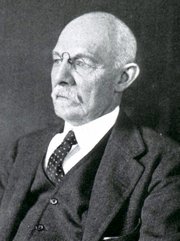
William S. Halsted, MD
(1852 – 1922)
American anatomist, teacher, and surgeon, William Stewart Halsted was born in New York City, USA to a wealthy family of English origin. His father was involved in charitable work and Governor and trustee to a city hospital. Not a brilliant student initially, Halsted took an undergraduate in Liberal Arts in Yale, CT., after which he entered the Medical College of Physicians at the Columbia College, where he excelled.
As a second-year medical student Halsted applied and obtained a position in surgery at a local hospital. In here he learned about Lister’s antiseptic technique and became an adamant proponent of it to reduce infection. In 1877 Halsted obtained his MD. After a short time as House Physician at the New York Hospital, Halsted traveled to Europe to further his education studying for two years at the Universities of Vienna, Leipzig, and W?rzburg.
Besides being at the forefront of surgical and antiseptic techniques (introducing the use of rubber gloves in surgery), Halsted was extremely concerned with the way medical students were taught in the US. He pioneered bedside clinical round discussions with the medical students after two years of basic sciences studies. Halsted developed the idea of a patient chart; he also developed the residency program for medical students in use today.
Halsted is probably the most influential researcher and surgeon at the turn of the century. He dedicated time to the study of intestinal anastomoses and the use of silk as a suture material. His experimental work in 1887 proved that the inclusion of the submucosa layer in an anastomosis was mandatory, as well that a single layered anastomosis was enough to attain closure. Perhaps Halsted’s most important contribution was the application and use of the scientific method to surgical questions. Halsted’s principles, also known as "Halsted's Rules of Surgery", set the standards used today in surgical suturing and surgical stapling.
He also pioneered the development and surgical techniques for radical mastectomy as a treatment for breast cancer.
As a side effect of this studied in anesthesia and the use of cocaine for anesthesia, Halsted became addicted to this substance, a problem that followed him through the years. Without impairing his capacity as a researcher and a surgeon, Halsted eventually recovered. He died in Baltimore in 1922 as a complication to surgery.
Sources:
1. Dubay, A. D., & Franz, G. M. (2003). Acute Wound Healing: The Biology of Acute Wound Failure. Surg Clin NA, 83, 463-481.
2. Halsted, W. S. (1887). Circular Suture of the Intestine - An Experimental Study. Am J Med Sci, 436-461.
3. “William Stewart Halsted: his life and contributions to surgery” Osborne, P. Lancet Oncol 2007; 8: 256–65
4. “William Stewart Halsted: Surgical pioneer” Burress, P Endoc Today (2010), 8: (2) 22
5. “William Stewart Halsted (1852–1922) Neurological stamp” Haas, LF J Neurol Neurosurg Psych 2000;69:641
Original image courtesy of "Images from the History of Medicine" at www.nih.gov

"Clinical Anatomy Associates, Inc., and the contributors of "Medical Terminology Daily" wish to thank all individuals who donate their bodies and tissues for the advancement of education and research”.
Click here for more information


- Details

Cover of the book by Theo Dirix
We are getting closer and closer to the objective, that is, to fund and find the lost grave of Andreas Vesalius, recognized worldwide as the Father of Modern Anatomy. We are setting up the dates for the next phase and preparing the logistics for the crews from Crete and Belgium.
The quest for the lost grave of Andreas Vesalius continues, the permits have been obtained, and we only have the last hurdle to finish, the funding of the project trough our GoFundMe page.
Theo Dirix, a contributor to Medical Terminology Daily, now has an offer that you may like. He wrote the book "In Search of Andreas Vesalius" which relates the beginning of this Quest. The book is out-of-print today, but there are a few copies available. By donating 30 € (US$35)you'll receive one of the last available copies and you'll be mentioned in the sequel of the book that will be dedicated to the next stage of the project.
The project is private and funded by those who believe we still have an opportunity to find the lost grave. For more information, you are welcome to read Theo Dirix's article : "To put it in another way: where do we have to look for Vesalius's grave?"
Here are some reviews for Theo Drix's book "In Search of Andreas Vesalius" :
Vivian Nutton: "I read with pleasure and wry amusement Theo’s account (..) and was reminded of reading the autobiographical account by Stephen Miller of his time as head of the American archaeological school and the boss of the Nemea excavations in the 1980s and 90s (...)
(Professor Vivian Nutton specialises in the history of the classical tradition in medicine, from Antiquity to the present, and particularly on Galen, some of whose works he has edited and translated, and on medicine during the Renaissance.)
Jacqueline Vons: " here is a book " without claim " but well documented, which is committed to tracing the research made to zakynthos by the author and a team of doctors, historians and artists to find the tomb of vesalius (1514-1564).
(Jacqueline Vons est professeur agrégé de lettres classiques, docteur ès études latines, enseignant-chercheur habilité à diriger des recherches. Elle a enseigné le latin et l'histoire de la médecine au CESR et à la faculté de Lettres de Tours et a assuré pendant plusieurs années des enseignements complémentaires en sciences humaines à la faculté de Médecine. Ses thèmes de recherche sont orientés vers l'histoire de la médecine et notamment autour d'André Vésale (éditions, traductions, transcriptions), de la pensée et des pratiques médicales en France à l'époque moderne ainsi que des textes médicaux latins centrés principalement sur l'anatomie.)
Maurits Biesbrouck: in search of Andreas Vesalius is so well researched and written, that if the further search for his grave completely shutting down (something we hope not! ) and only after a few decades be rebooted again, the perfect future researchers would know to where you came, and the wire without wasting time we can again. It is a very detailed history of the search that has already been made, a solid status and simultaneously present an extremely valuable tool for further extrapolating.
(Dr. Maurits Biesbrouck has a lifelong interest in Andreas Vesalius. He translated the first book of the De Humani Corporis Fabrica Libri Septem into Dutch, compiled an annually updated Vesalius-bibliography and wrote many articles on his life and works, many as a co-author with Omer Steeno (Leuven, Belgium) and Theodoor Goddeeris (Kortrijk, Belgium). See www.andreasvesalius.be.)
UPDATE: April 25, 2018. Theo Dirix's new book is already published, the names of the contributors have been incorporated in the book. The title of the new book is "In Search of Andreas Vesalius The Quest for the Grave, Lost and not yet found". Dr. Miranda
- Details
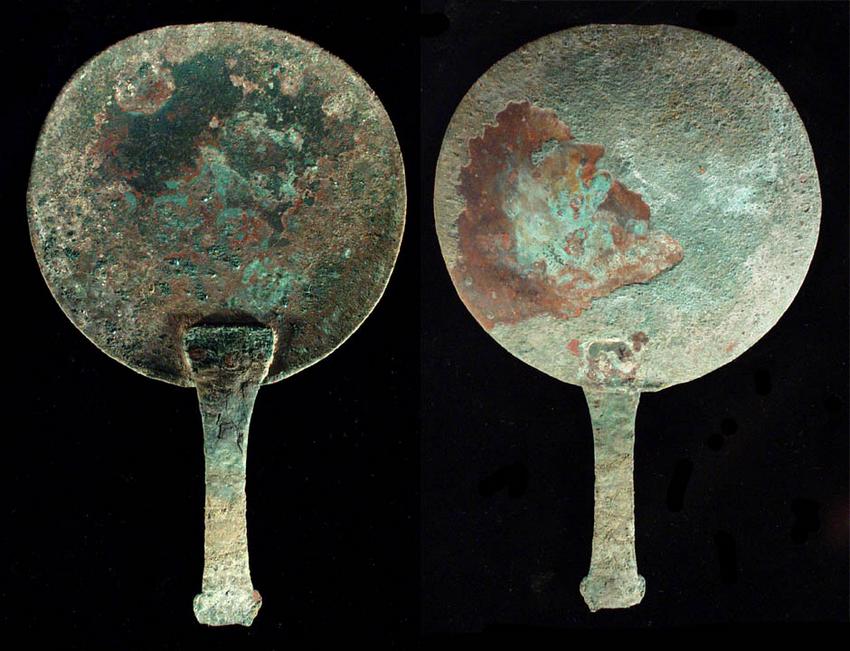
Image courtesy of Ancient Touch
UPDATED: The word [glenoid] is composed of the root term [-glen-] which arises from the Greek [γλήνη] (glíni), meaning “a shallow socket”, and the suffix [-oid], also Greek, meaning “similar to”. Similar to a shallow socket.
The etymology of the word is not clear, as some authors contend that it means “eyeball” or just the “pupil” of the eye. The earliest known use of the term by Homer was referring to a “mirror”. All of these meanings carry the reference to reflection of an image.
The term [glenoid cavity] is the smooth, slightly concave surface of the glenoid process of the scapula that forms part of the shoulder joint. Being so shallow, the glenoid cavity is supplemented by a fibrocartilaginous ring called the [glenoid labrum]. There are other uses of the term [glenoid] in human anatomy.
Personal note: I have read several authors including Skinner (1970) on this word. I noticed that ancient Greek mirrors have one very slightly concave surface (see image) and this could be the origin of this term as well as the later association with reflection. Dr. Miranda
Original image courtesy of www.ancienttouch.com
- Details
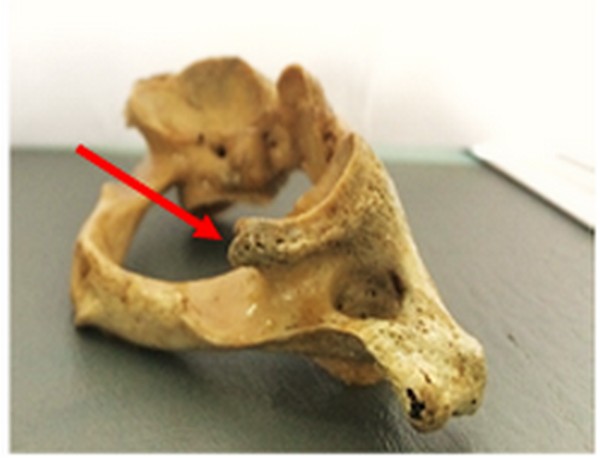
Figure A: Incomplete PP viewed from the
posterior aspect of the articular fossa
related to the retroglenoid tubercle
The Ponticulus Posticus (PP), also known as the pons arcuatus, foramen arcuale, and arcuate foramen, is a bony bridge that connects the retroglenoid tubercle with the posterior arch of the C1 vertebra, also known as the Atlas.
It substitutes the lateral segment of the posterior atlantooccipital ligament or joint capsule (1) on the area which stabilizes the vertebral artery on its emergency of the transverse foramen of the Atlas (2). This bridge or arch could be thick, thin or even incomplete (2). The importance of this calcification relies on the fact that it has been linked with cervicogenic headache (1,3) chronic tension-type headaches, sensorineural hearing loss (4), shoulder and arm pain, neck pain, and vertigo (1, 5).
The presence of a ponticulus posticus could also impact the planning of high cervical surgeries associated with the Atlas [C1] (6). A recent meta-analysis of the prevalence of this condition worldwide found an overall prevalence of a complete PP of 9.1% versus an incomplete PP, which was 13.6%. In males (10.4%) the complete PP was more common than in females (7.3%), but an incomplete PP was more commonly seen in females (18.5%) than in males (16.7%) (7).
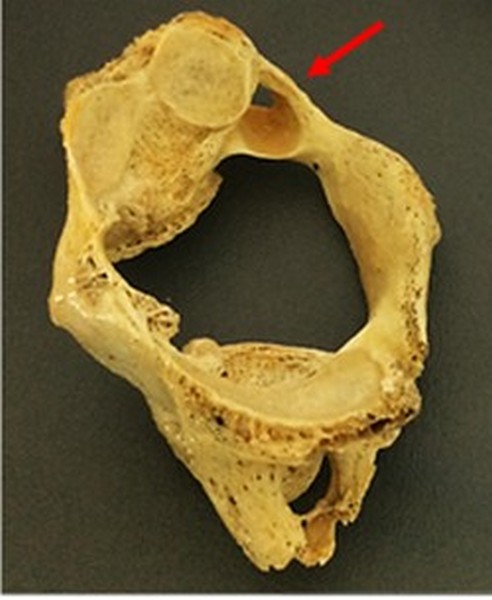
Figure B: Complete PP. It crosses from the
retroglenoid tubercle down to the
posterior arch.
Despite the fact that this calcification has been associated with different painful disorders, some other authors consider it an anatomical condition destined to protect the vertebral artery and not a pathological condition (8). PP is visible on lateral cervical spine and cranial lateral radiographs as thin bony arch on the shape of a ring crossing from the retroglenoid tubercle to the posterior arch of C1, being either partially of fully calcified (Figures C and D).
Note 1: For the etymology of the term glenoid, click here.
Note 2: Figures C and D can be found at the bottom of the article
Sources:
1. Ross JS, Moore KR, editors. Diagnostic Imaging: Spine E-Book. 3rd ed. Philadeplphia: Elsevier; 2015. 31 p.
2. Torres Cueco R. La Columna Cervical: Evaluación Clínica y Aproximaciones Terapéuticas. Principios anatómicos, funcionales, exploración clínica y técnicas de tratamiento. Tomo I. 1° Ed. Madrid: Medica Panamericana; 2008. 124 p.
3. Tambawala SS, Karjodkar FR, Sansare K, Motghare D, Mishra I, Gaikwad S, Dora AC. Prevalence of Ponticulus Posticus on Lateral Cephalometric Radiographs, its Association with Cervicogenic Headache and a Review of Literature. World Neurosurg [Internet]. 2017 Apr 17(cited 02 Jun 2017). pii: S1878-8750(17)30525-9. Available at: doi: 10.1016/j.wneu.2017.04.030. [Epub ahead of print]
4. Koutsouraki E, Avdelidi E, Michmizos D, Kapsali SE, Costa V, Baloyannis S. Kimmerle's anomaly as a possible causative factor of chronic tension-type headaches and neurosensory hearing loss: Case report and literature review. Int J Neurosci. 2010; 120:236-9
5. Cakmak O, Gurdal E, Ekinci G, Yildiz E, Cavdar S. Arcuate foramen and its clinical significance. Saudi Med J. 2005; 26:1409-13.
6. Song MS, Lee HJ, Kim JT, Kim JH, Hong JT. Ponticulus posticus: Morphometric analysis and Its anatomical Implications for occipito-cervical fusion. Clin Neurol Neurosurg [Internet]. 2017 Jun (cited 02 Jun 2017);157:76-81. Available at: doi: 10.1016/j.clineuro.2017.04.001. Epub 2017 Apr 3.
7. Pękala PA, Henry BM, Pękala JR, Hsieh WC, Vikse J, Sanna B, Walocha JA, Tubbs RS, Tomaszewski KA. Prevalence of foramen arcuale and its clinical significance: a meta-analysis of 55,985 subjects. J Neurosurg Spine [Internet]. 2017 Jun (cited 02 Jun 2017); 16:1-15. Available at: doi: 10.3171/2017.1.SPINE161092. [Epub ahead of print]
8. Schilling J, Schilling A, Suazo I. Ponticulus posticus on the Posterior Arch of Atlas, Prevalence Analysis in Asymptomatic PatientsInt. J. Morphol. 2010 Mar; 28(1):317-322.
Acknowledgments: The Atlas [C1] specimens shown on figures A and B belong to the Anatomy department of the Medical College of the Finis Terrae University, Santiago, Chile and are used to show two examples of PP. With permission.
Article written by Prof. M. Fernanda Cortes, DDS, MsC.
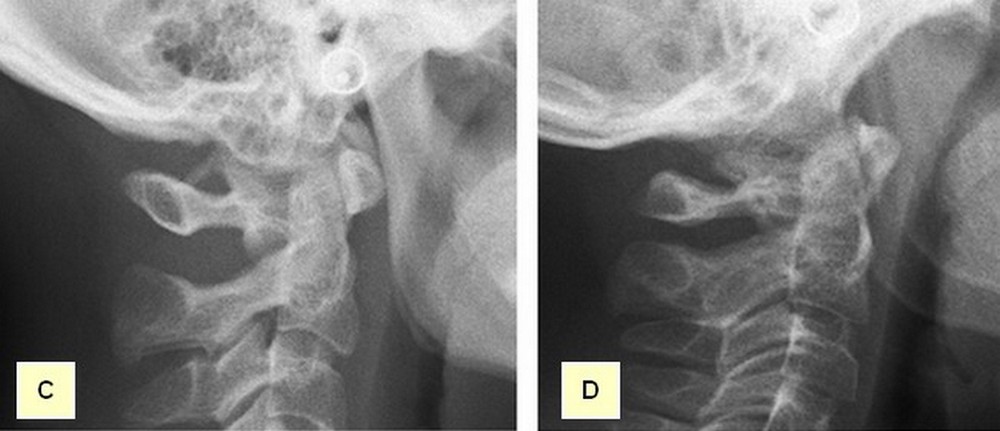 Figure C: Complete PP shown on a lateral radiographic view. Figure D: Partial PP shown on a lateral radiographic view.
- Details
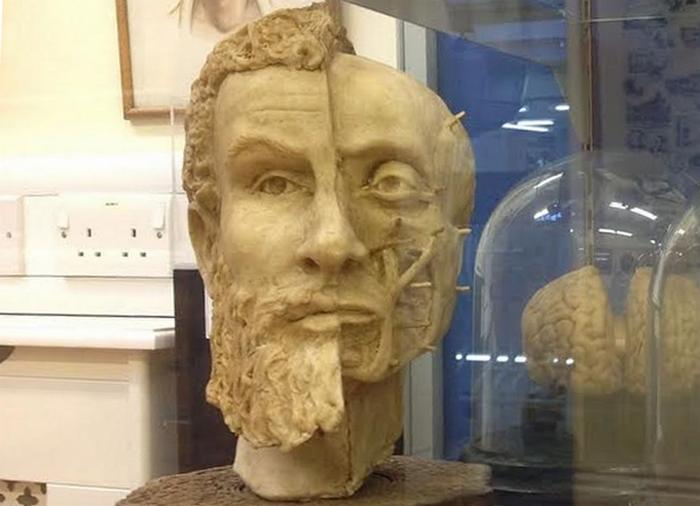
Wax bust of Andreas Vesalius by Pascale Pollier
Friends of Medical Terminology Daily:
As you know, we are part of an incredible quest to find the body of Andreas Vesalius, recognized worldwide as the Father of Modern Anatomy. His life and the story and legends about his death are part now of scientific fact and folklore.
The quest for the lost grave of Andreas Vesalius has been published in this blog several times. Many of the members of this group, such as Pascale Pollier, Theo Dirix, Dr. Sylvianne Déderix, Dr. Maurits Biesbrouck, etc. are contributors to Medical Terminology Daily.
The project has had several stages and you are welcome to follow the above links to the authors to read their contributions which clarify the scope and objectives of this quest, including Theo Dirix's article : "To put it in another way: where do we have to look for Vesalius's grave?".
The project next step is to perform a detailed research on the area where we suspect (actually know with a high degree of certainty) where the cemetery of the Church of Santa Maria delle Grazie (Zakynthos, Greece) used to be.
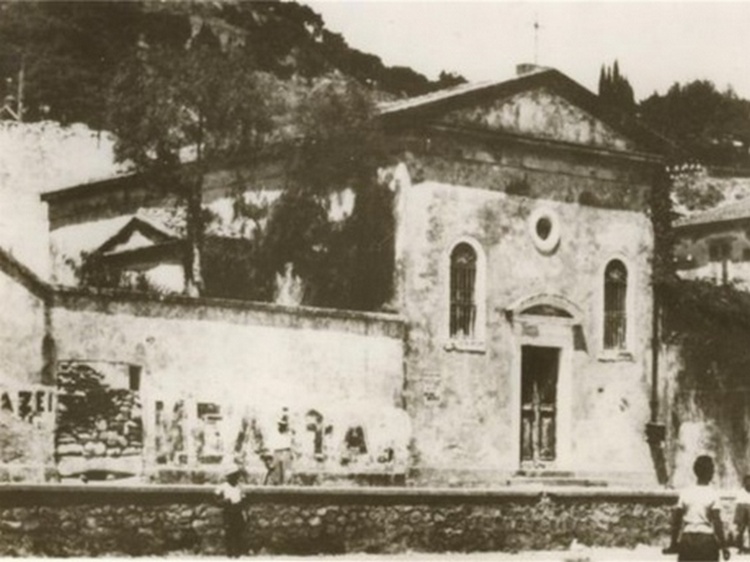
Church of Santa Maria delle Grazie
The problem was to obtain the permits to do the non-invasive radar scan of the grounds in the area... and this is the exciting news! Following is the press release:
"The Belgian School of Archaeology)in Athens (EBSA) just obtained the permission for a new archaeological project at Zakynthos in collaboration with the local Ephorate and Dr Merkouri, as well as the IMS in Rethymnon (Dr A. Sarris). The project, initiated and coordinated by Theo Dirix and Pascale Pollier, concerns the quest for the tomb of the Belgian anatomist, father of modern anatomy, Andreas Vesalius who died and was buried in the island."
Needless to say, we are all excited. Now we have to fund this research, and you can all help by contributing as little or as much as you can to the GoFundMe page. We are very close to our objective and this will allow us to pay the permits, rent the equipment and finally get a little closer to finding Andreas Vesalius.
Personal note: Click on the following link to collaborate with this incredible quest. I already did. Dr. Miranda
GoFundMe Campaign for the next stage of the project
- Details
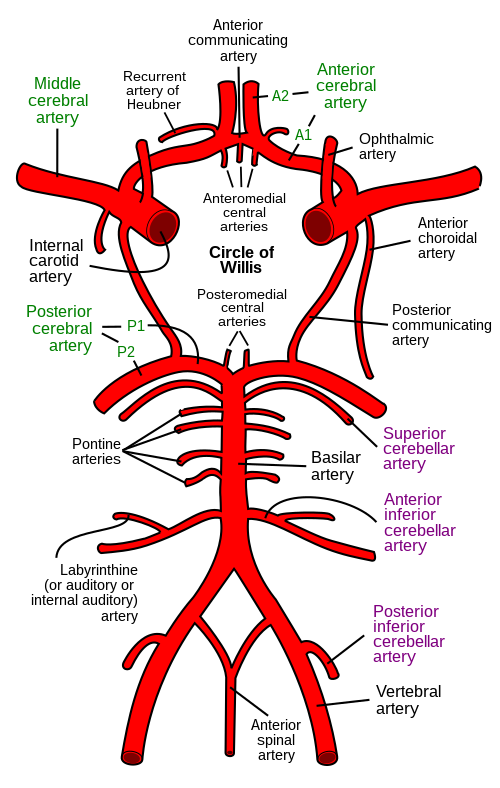
Arterial Circle of Willis
UPDATED: The arterial "circle of Willis" is a roundabout of arteries found at the base of the brain, allowing for collateral circulation at this level. This arterial circle has been described by many anatomists, but it was Thomas Willis (1621 - 1675) who described it in most detail, and he was the first to understand its function.
The circle of Willis receives blood from the two main paired arteries that provide blood supply to the head and brain: the carotid arteries anteriorly, and the vertebral arteries posteriorly.
This arterial circle is formed by the anastomosis of several arteries, paired and unpaired:
• Anterior cerebral arteries: These paired arteries are one of the terminal branches of the internal carotid arteries. They provide blood supply to the medial aspect and part of the lateral aspect of frontal and parietal lobes of the brain
• Anterior communicating artery: A single unpaired small artery communicating both anterior cerebral arteries and providing potential collateral circulation between them
• Internal carotid arteries: These two bilateral arteries are one of the branches of the carotid artery found at the root of the neck. Its two main terminal branches are the anterior cerebral arteries and the middle cerebral arteries.
• Posterior cerebral arteries: These two arteries are formed by the bifurcation of the basilar artery, which itself is formed by the junction of the right and left vertebral arteries. The posterior cerebral arteries provide blood supply to the occipital lobe and part of the temporal lobe of the brain
• Posterior communicating arteries: These paired arteries provide communication between the carotid and vertebral arterial territories
• Middle cerebral arteries: Although not technically part of the arterial circle of Willis, these paired arteries are one of the two terminal branches of the internal carotid arteries. The middle cerebral artery travels deep in the lateral sulcus (Sylvian fissure) of the brain and provides blood supply to the lateral aspect of the brain including the frontal, parietal, occipital, temporal, and insular lobes
The arterial circle of Willis provides all of the arterial blood to the brain. Cerebral blood flow in humans averages 55 mL per 100 g of brain tissue per minute. This is a about over 742.5 mL/min for the average 1350 g brain. Depending on the situation the brain will use between 15 to 20 percent of the total cardiac output, although by weight the brain is only about two to three percent of the average body weight. Incredibly, the brain uses more oxygen that most organs averaging close to 25% of the total oxygen needs of the body!
The importance of the arterial circle of Willis is that beyond this point the arterial supply to the brain becomes terminal, that is, there are little or no anastomoses between the bifurcating branches exposing the brain to ischemia and necrosis should there be an arterial stenosis or stricture. The circle of Willis is an area prone to aneurysms, with over 27,000 cases yearly in the US.
For an image of the vascular territories of the brain, click here.

Thanks to Jackie Miranda-Klein for making me review this post and update it!... and congratulations to Jackie for starting her Physician Assistant Master's degree at Kettering College. Dr. Miranda.
Image in the Public Domain. Courtesy of www.wikipedia.org
Clinical anatomy, pathology, and surgery of the brain and spinal cord are some of the lecture topics developed and delivered by Clinical Anatomy Associates, Inc.
- Details
Click for a larger image
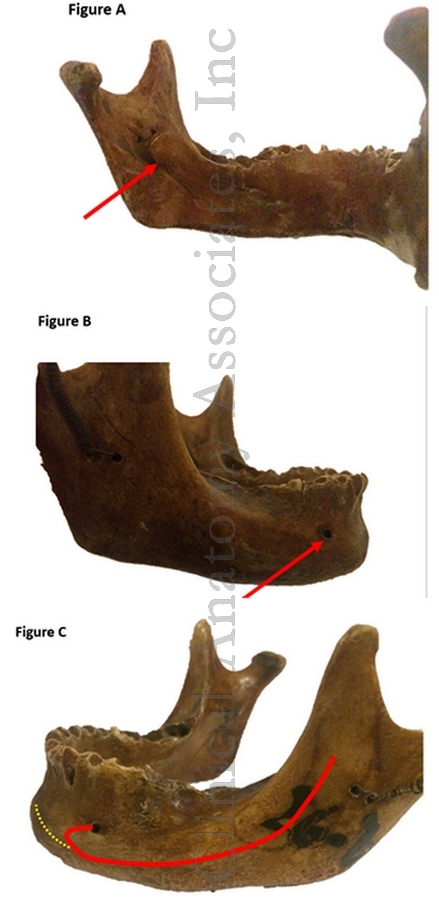
The mandibular canal is a long, bilateral canal which runs along and within the mandible. This canal transports the inferior alveolar neurovascular bundle. The mandible is known vernacularly as the “jawbone” or “lower jaw”.
The mandibular canal starts on the medial surface of the mandibular ramus at the mandibular foramen (Figure A, arrow) descends anteroinferiorly through the body of the mandible until it ends in the mental foramen at the buccal (anterior) surface of the mandible, usually in the area between the premolars (Figure B, arrow).
Before exiting, the canal forms an “anterior loop” projected anterior to the mental foramen prior to changing its direction back and outwards in direction to the buccal plate (Figure C, red line). This last portion of the canal is called the “mental canal”.
A frequent anatomical variation is the presence of a bifid mandibular canal (recent studies indicate it has a prevalence of around 16%).
Different anatomical studies show that the mandibular canal not only finishes at the mental foramen, but it could divide itself giving an incisive canal which runs anteriorly onto the incisal region (Figure C, yellow line). When it doesn’t continue as an incisal canal, the neurovascular elements go anteriorly through the cells of the spongy bone tissue.
The presence of this Incisal canal has surgical relevance, and knowledge of its exact location and anatomical parameters has a high importance on reducing complications of surgical procedures in the mental area such as dental implants, bone lesions removal and bone harvesting among others, all which could damage the incisal canal and the neurovascular bundle inside it.
With the latest use of CBCT (Cone Beam Computed Tomography) technology to evaluate anatomical structures, the presence of this canal has showed to be high (92-100%) and its length can vary from reaching only the premolar area or even the central mandibular incisors in the least of cases.
Sources:
1. Haas LF, Dutra K, Porporatti AL, Mezzomo LA, De Luca Canto G, Flores-Mir C, Corrêa M. Anatomical variations of mandibular canal detected by panoramic radiography and CT: a systematic review and meta-analysis. Dentomaxillofac Radiol. 2016;45(2):20150310.
2. Kong N, Hui M, Miao F, Yuan H, Du Y, Chen N. Mandibular incisive canal in Han Chinese using cone beam computed tomography. Surg Radiol Anat. 2016 Nov 11. [Epub ahead of print] Int J Oral Maxillofac Surg. 2016 Sep;45(9):1142-6.
3. Rouvierre H, Delmas A. Anatomía humana: Descriptiva, topográfica y funcional. Cabeza y cuello. Volumen 1. 11° ed. España: Masson, S.A.;2005. P. 114.
4. Von Arx T, Lozanoff S. Clinical Oral Anatomy: A Comprehensive Review for Dental Practitioners and researchers. Switzerland: Springer; 2016. P 323- 390
Article and image provided by Prof. M. Fernanda Cortes, DDS, MsC.