
Medical Terminology Daily (MTD) is a blog sponsored by Clinical Anatomy Associates, Inc. as a service to the medical community. We post anatomical, medical or surgical terms, their meaning and usage, as well as biographical notes on anatomists, surgeons, and researchers through the ages. Be warned that some of the images used depict human anatomical specimens.
You are welcome to submit questions and suggestions using our "Contact Us" form. The information on this blog follows the terms on our "Privacy and Security Statement" and cannot be construed as medical guidance or instructions for treatment.
We have 614 guests online
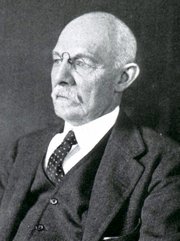
William S. Halsted, MD
(1852 – 1922)
American anatomist, teacher, and surgeon, William Stewart Halsted was born in New York City, USA to a wealthy family of English origin. His father was involved in charitable work and Governor and trustee to a city hospital. Not a brilliant student initially, Halsted took an undergraduate in Liberal Arts in Yale, CT., after which he entered the Medical College of Physicians at the Columbia College, where he excelled.
As a second-year medical student Halsted applied and obtained a position in surgery at a local hospital. In here he learned about Lister’s antiseptic technique and became an adamant proponent of it to reduce infection. In 1877 Halsted obtained his MD. After a short time as House Physician at the New York Hospital, Halsted traveled to Europe to further his education studying for two years at the Universities of Vienna, Leipzig, and W?rzburg.
Besides being at the forefront of surgical and antiseptic techniques (introducing the use of rubber gloves in surgery), Halsted was extremely concerned with the way medical students were taught in the US. He pioneered bedside clinical round discussions with the medical students after two years of basic sciences studies. Halsted developed the idea of a patient chart; he also developed the residency program for medical students in use today.
Halsted is probably the most influential researcher and surgeon at the turn of the century. He dedicated time to the study of intestinal anastomoses and the use of silk as a suture material. His experimental work in 1887 proved that the inclusion of the submucosa layer in an anastomosis was mandatory, as well that a single layered anastomosis was enough to attain closure. Perhaps Halsted’s most important contribution was the application and use of the scientific method to surgical questions. Halsted’s principles, also known as "Halsted's Rules of Surgery", set the standards used today in surgical suturing and surgical stapling.
He also pioneered the development and surgical techniques for radical mastectomy as a treatment for breast cancer.
As a side effect of this studied in anesthesia and the use of cocaine for anesthesia, Halsted became addicted to this substance, a problem that followed him through the years. Without impairing his capacity as a researcher and a surgeon, Halsted eventually recovered. He died in Baltimore in 1922 as a complication to surgery.
Sources:
1. Dubay, A. D., & Franz, G. M. (2003). Acute Wound Healing: The Biology of Acute Wound Failure. Surg Clin NA, 83, 463-481.
2. Halsted, W. S. (1887). Circular Suture of the Intestine - An Experimental Study. Am J Med Sci, 436-461.
3. “William Stewart Halsted: his life and contributions to surgery” Osborne, P. Lancet Oncol 2007; 8: 256–65
4. “William Stewart Halsted: Surgical pioneer” Burress, P Endoc Today (2010), 8: (2) 22
5. “William Stewart Halsted (1852–1922) Neurological stamp” Haas, LF J Neurol Neurosurg Psych 2000;69:641
Original image courtesy of "Images from the History of Medicine" at www.nih.gov

"Clinical Anatomy Associates, Inc., and the contributors of "Medical Terminology Daily" wish to thank all individuals who donate their bodies and tissues for the advancement of education and research”.
Click here for more information


- Details
Click for a larger image
The root term [-carp-] arises from the Greek word [καρπό] meaning “wrist”. The adjectival form is [carpal] meaning “pertaining to the wrist”.
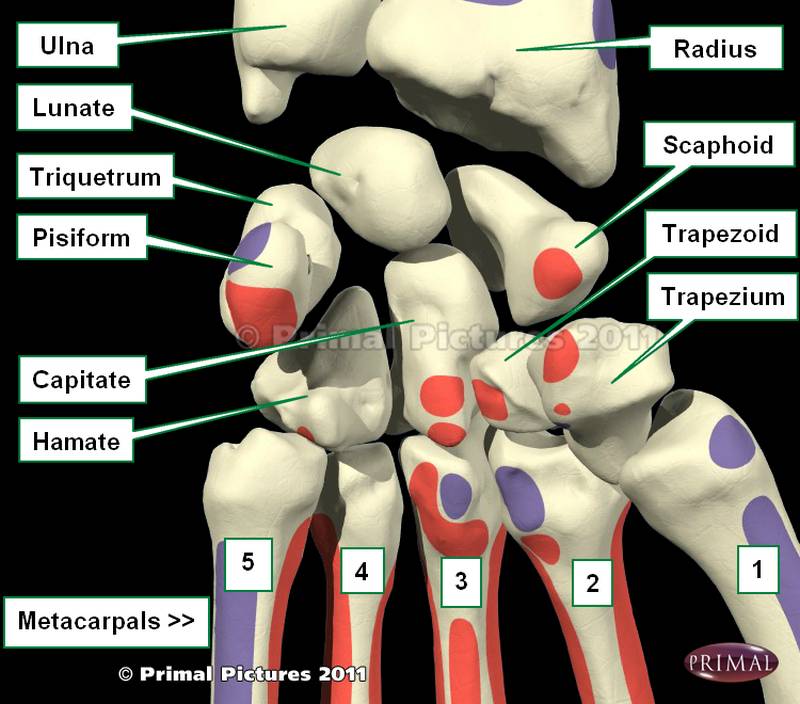
The carpus is a complex region between the hand and the forearm. It is composed by 8 bones arranged in two rows, as well as ligaments and joints that maintain the bones together and in position.
The proximal row is formed from lateral to medial by the following bones: scaphoid, lunate, triquetrum, and pisiform.
The distal row is formed from lateral to medial by the following bones: trapezium, trapezoid, capitate, and hamate.
The accompanying image shows the anterior (volar) surface of the wrist. Click on the image for a larger picture. More information on the wrist and its joints will be published soon.
Image modified from the original: "3D Human Anatomy: Regional Edition DVD-ROM." Courtesy of Primal Pictures
- Details
The term [capillary] is derived from the Latin word [capillus], which refers to a hair of the head.
Capillaries are the smallest components of the cardiovascular system, microscopic vessels that are actually thinner than a hair. Most capillaries are shorter than 1mm in length and their diameter is so narrow that it allows for red blood cells to only pass single file through them (see accompanying video). This accounts for a slow passage of blood through the capillary allowing for exchange of gases and nutrients between the vessel and surrounding tissues.
Capillaries are formed by a single cell wall known as endothelium. In the video, you can see a capillary clearly at the center of the screen, the reverse of flow and movement at the end of the video is an artifact.
Thanks to Stephen Taylor for the use of his video on YouTube.
- Details
Click for a larger image
UPDATED: The term [artery] evolved from two Greek words. The first one is [αέρα], meaning "air", and the second one is [terein], a verb meaning "to keep" or "to maintain"1. [Artery] therefore means "to maintain or to keep air", which is furthest from what we know today! The reason is that initial observations on these structures happened in bodies after combat, or gladiators who had exsanguinated because of their wounds. The arteries were empty (full of air) or contained a mix of blood and air. Arteries were considered a type of windipe. In fact, the original anatomical term for trachea was that of [tracheartery], which means "the rough artery". We have learned since then the true function of the arteries, so the name was shortened to "trachea".
The modern definition of an artery is "a structure that takes blood away from the heart". The amount of oxygen within the vessel has no bearing on the definition; there are arteries that carry oxygenated blood and arteries that carry deoxygenated blood.
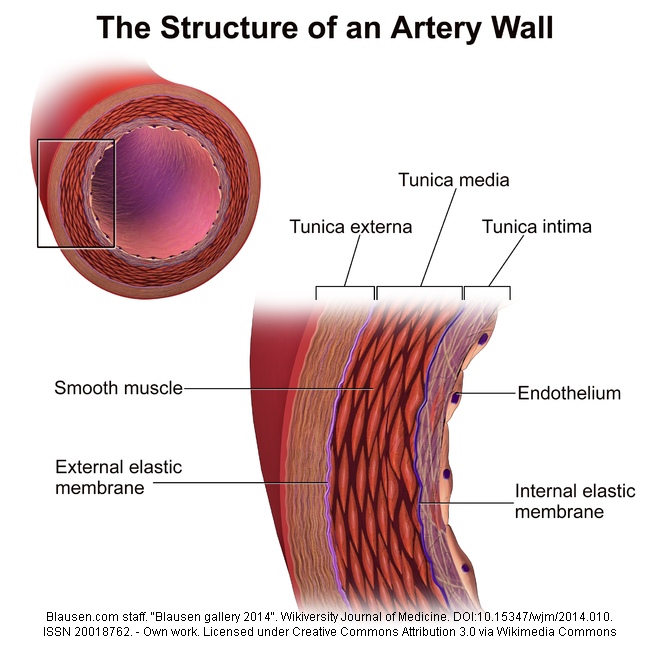
Histologically, an artery is composed of three layers. The external layer is called the "adventitia" or "tunica externa". It is composed mostly of connective tissue. The middle layer is called the "tunica media" and is composed by a varying number of elastic fibers and smooth muscle fibers arranged as shown in the image. The inner layer is called the "tunica intima". The inner portion of the tunica intima is called the endothelium.
Arteries that are closer to the heart have more elastic fibers in their tunica media. As we move further away from the heart arteries become smaller and increase the number of smooth muscle fibers. This is what histologists describe "elastic arteries" and "muscular arteries". The smallest muscular arteries are called "arterioles". Large arteries have their own blood supply, called the "vasa vasorum".
Sources:
1. "The ancient Hellenic and Hippocratic origins of head and brain terminology" Panourias IG, Stranjalis G, Stavrinou L, Sakas DE. Clin Anat 2012 Jul;25(5):548-581
2. Image: "Blausen Gallery 2014" - Wikiversity Journal of Medicine. DOI:10.15347/wjm/2014.010. ISSN 20018762. Licensed under Creative Commons Attribution 3.0 via Wikimedia Commons - Original image

- Details
Click for a larger image
Although blood circulation is one constant circle of flow, it consists of two subsystems: pulmonary and systemic circulation mediated by the heart. Within the systemic circulation there are other subsystems: coronary, portal (hepatic), and renal.
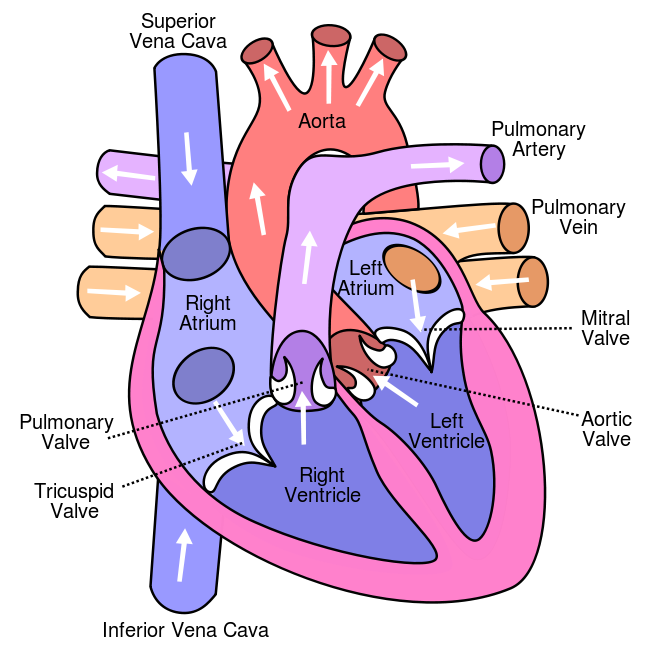
Deoxygenated blood comes into the right atrium of the heart. The blood coming from the body does so by way of the superior vena cava and the inferior vena cava. The blood coming from the heart does so by way of the coronary sinus, the anterior coronary veins, and the venae cordis minimae. Thus, the right atrium receives the blood return from the whole body, including the heart.
From the right atrium, the deoxygenated blood passes through the tricuspid valve (one of the two atrioventricular valves) into the right ventricle. Upon contraction of the right ventricle (ventricular systole) blood is propelled through the pulmonary (sometimes called pulmonic) valve into the pulmonary trunk. The pulmonary trunk divides into a right and a left pulmonary artery, each of which enter a lung, thus starting pulmonary circulation.
Within the lung the arteries divide until they form a minute capillary meshwork around the alveolar sacs. At this point the deoxygenated blood discharges its CO2 and gains O2, becoming oxygenated blood which converges back towards the heart by way of pulmonary veins.
The oxygenated blood enters the left atrium by way of the four pulmonary veins. It passes into the left ventricle through the mitral valve (also known as the bicuspid valve), then it exits through the aortic valve and into the aorta. This starts systemic circulation.
The aorta and its branches provide oxygenated blood to all the body. Once the blood is deoxygenated, it comes back to the right atrium of the heart where the cycle starts again.
As a side note, all the vessels that enter or leave the heart are known as the great vessels. How many are the great vessels? For the answer, click here.
- Details
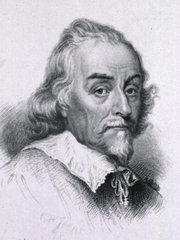
William Harvey
This word derives from the Latin [circulus], meaning a “small circle”, or a “ring”. The act of walking or moving as in a circle in Latin is “circulare”.
In reference to the movement of the blood, the term was not known as the concept of blood flow in a closed circuit “as in a circle” was coined by William Harvey (1578 – 1609) (see image). Before Harvey, Michael Servetus (1511 - 1553) hinted at this concept, but never took it to its logical conclusion: that blood circulates.
In asking my students about this concept, few ever associate the term “circulation” with “circle” or a “closed circuit”.
Click here to read the description of the circulation of blood through the heart.
Original image courtesy of: nlm.nih.gov

- Details
NOTE: Video in Greek Language
This is a video of Greek news about the 2014 Vesalius Continuum meeting recently held in Zakynthos Island in Greece. The video (in Greek) talks about Andreas Vesalius and some of the activities of the meeting starting with the inauguration, which had the presence of the mayor of Zakynthos, Mr Stelios Bozikis, the ambassador of Belgium in Greece, Mr.H.E. Marc Van den Reeck, and the Greek Minister of Tourism, Ms. Olga Kefalogianni. The video also shows the unveiling of the bronze statue celebrating Andreas Vesalius and the welcome dinner of the meeting.
The meeting was organized by Pascale Pollier, President BIOMAB, Mark Gardiner, Professor of University College in London, and Theo Dirix, Consul of the Embassy of Belgium in Athens. For additional images and information about the meeting at BIOMAB, click here.