
Medical Terminology Daily (MTD) is a blog sponsored by Clinical Anatomy Associates, Inc. as a service to the medical community. We post anatomical, medical or surgical terms, their meaning and usage, as well as biographical notes on anatomists, surgeons, and researchers through the ages. Be warned that some of the images used depict human anatomical specimens.
You are welcome to submit questions and suggestions using our "Contact Us" form. The information on this blog follows the terms on our "Privacy and Security Statement" and cannot be construed as medical guidance or instructions for treatment.
We have 523 guests online
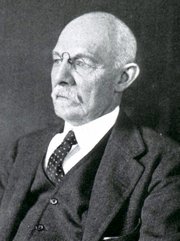
William S. Halsted, MD
(1852 – 1922)
American anatomist, teacher, and surgeon, William Stewart Halsted was born in New York City, USA to a wealthy family of English origin. His father was involved in charitable work and Governor and trustee to a city hospital. Not a brilliant student initially, Halsted took an undergraduate in Liberal Arts in Yale, CT., after which he entered the Medical College of Physicians at the Columbia College, where he excelled.
As a second-year medical student Halsted applied and obtained a position in surgery at a local hospital. In here he learned about Lister’s antiseptic technique and became an adamant proponent of it to reduce infection. In 1877 Halsted obtained his MD. After a short time as House Physician at the New York Hospital, Halsted traveled to Europe to further his education studying for two years at the Universities of Vienna, Leipzig, and W?rzburg.
Besides being at the forefront of surgical and antiseptic techniques (introducing the use of rubber gloves in surgery), Halsted was extremely concerned with the way medical students were taught in the US. He pioneered bedside clinical round discussions with the medical students after two years of basic sciences studies. Halsted developed the idea of a patient chart; he also developed the residency program for medical students in use today.
Halsted is probably the most influential researcher and surgeon at the turn of the century. He dedicated time to the study of intestinal anastomoses and the use of silk as a suture material. His experimental work in 1887 proved that the inclusion of the submucosa layer in an anastomosis was mandatory, as well that a single layered anastomosis was enough to attain closure. Perhaps Halsted’s most important contribution was the application and use of the scientific method to surgical questions. Halsted’s principles, also known as "Halsted's Rules of Surgery", set the standards used today in surgical suturing and surgical stapling.
He also pioneered the development and surgical techniques for radical mastectomy as a treatment for breast cancer.
As a side effect of this studied in anesthesia and the use of cocaine for anesthesia, Halsted became addicted to this substance, a problem that followed him through the years. Without impairing his capacity as a researcher and a surgeon, Halsted eventually recovered. He died in Baltimore in 1922 as a complication to surgery.
Sources:
1. Dubay, A. D., & Franz, G. M. (2003). Acute Wound Healing: The Biology of Acute Wound Failure. Surg Clin NA, 83, 463-481.
2. Halsted, W. S. (1887). Circular Suture of the Intestine - An Experimental Study. Am J Med Sci, 436-461.
3. “William Stewart Halsted: his life and contributions to surgery” Osborne, P. Lancet Oncol 2007; 8: 256–65
4. “William Stewart Halsted: Surgical pioneer” Burress, P Endoc Today (2010), 8: (2) 22
5. “William Stewart Halsted (1852–1922) Neurological stamp” Haas, LF J Neurol Neurosurg Psych 2000;69:641
Original image courtesy of "Images from the History of Medicine" at www.nih.gov

"Clinical Anatomy Associates, Inc., and the contributors of "Medical Terminology Daily" wish to thank all individuals who donate their bodies and tissues for the advancement of education and research”.
Click here for more information


- Details
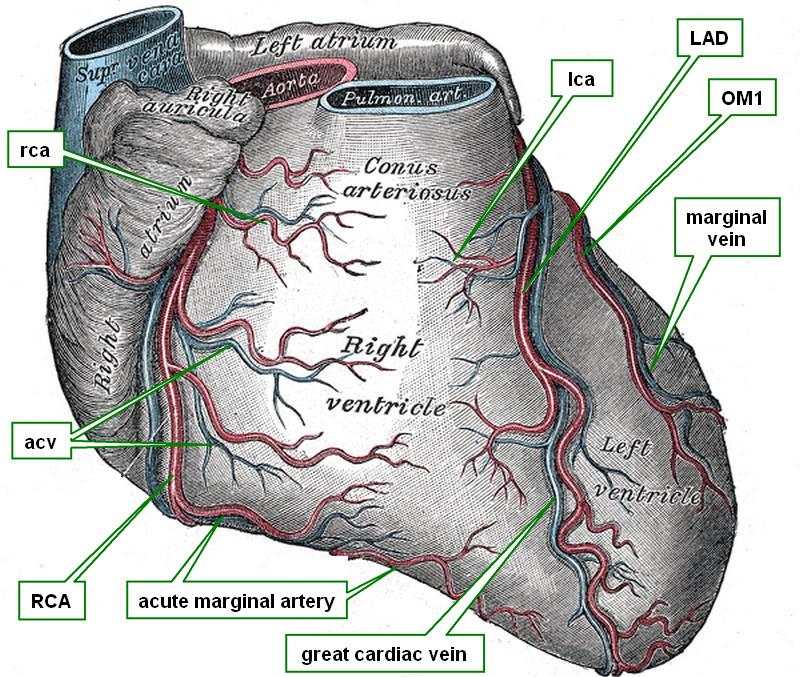
Anterior view of the heart
The conal artery is the first anterior branch that arises from the right coronary artery. It can be double or multiple and it provides blood supply to the superior aspect of the conus arteriosus region (outflow tract) of the right ventricle. It is also known as the “conus artery”, and the “infundibular artery”. In about 50% of the cases the conal artery arises separately from the aorta, very close to the ostium of the right coronary artery. In this case the artery has been dubbed the “third coronary”.
In many cases, a secondary conal artery arises from the anterior interventricular (LAD) artery and is called the “left conal artery”. In some cases this left conal artery can be the only one present and there may be no “right” conal artery. When both conal arteries are present, in some cases and evident superficial anastomosis can be seen forming what is known as the “conal ring” or the “ring of Vieussens”, one of the few cases where there is actual collateral circulation between the right and the left coronary arteries.
Sources:
1. “The clinical anatomy of the conal artery” Loukas, M el al. J Clin Anat 2014 DOI: 10.1002/ca.22469
2. “The Clinical Anatomy of the Coronary Collateral Circulation: Loukas, M, et al J Clin Anat (2009) 22:146–160
3. “The Normal and Abnormal Anatomy of the Coronary Arteries” Loukas, M et al J Clin Anat (2009) 22:114–128
4 "Tratado de Anatomia Humana" Testut et Latarjet 8 Ed. 1931 Salvat Editores, Spain
5. "Anatomy of the Human Body" Henry Gray 1918. Philadelphia: Lea & Febiger
Image modified by CAA, Inc, Original image courtesy of bartleby.com
- Details
Anterior view of the heart
The conus arteriosus is a conical region of the right ventricle as seen from the anterior aspect. This conical region is found between the atrioventricular sulcus on the right side and the left anterior descending artery (LAD), also known as the anterior interventricular artery. At the apex of the conus arteriosus are the pulmonary valve and the pulmonary trunk.
A short fibrous band has been described originating from the superior aspect of the conus arteriosus and the fibrous region of the atrioventricular sulcus and the base of the aorta. It is called the “conus arteriosus tendon”.
Internally the conus arteriosus is smooth-walled and is called by clinicians the “outflow tract” of the right ventricle. Because of the funnel-shape of the outflow tract and its continuation with the pulmonary trunk this area is also called the “infundibulum” of the right ventricle.
Blood supply to the conus arteriosus is by way of the conal artery. This is usually the first anterior branch of the right coronary artery
Sources:
1. “The clinical anatomy of the conal artery” Loukas, M el al. J Clin Anat 2014 DOI: 10.1002/ca.22469
2. “The Clinical Anatomy of the Coronary Collateral Circulation: Loukas, M, et al J Clin Anat (2009) 22:146–160
3. “The Normal and Abnormal Anatomy of the Coronary Arteries” Loukas, M et al J Clin Anat (2009) 22:114–128
4 "Tratado de Anatomia Humana" Testut et Latarjet 8 Ed. 1931 Salvat Editores, Spain
5. "Anatomy of the Human Body" Henry Gray 1918. Philadelphia: Lea & Febiger
Image modified by CAA, Inc, Original image courtesy of bartleby.com
- Details
Click for a larger image
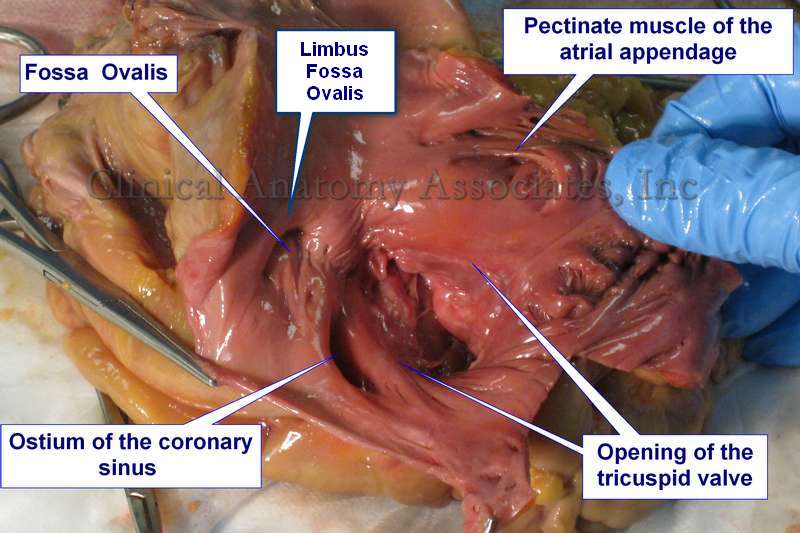
The limbus of the fossa ovalis (limbus fossae ovalis) is a muscular ridge that borders the fossa ovalis, an oval-shaped depression found in the interatrial septum, on the right atrium side.
The limbus fossae ovalis is best developed superiorly and to the sides of the fossa ovalis. It is deficient and not as evident in the inferior aspect, as seen in the accompanying image.
Several authors have described the limbus fossa ovalis as a part of the conduction system of the heart facilitating the distribution of the electrical stimulus from the sinoatrial (SA) node to the atrioventricular (AV) node. These are known as the internodal tracts.
The limbus fossae ovalis is known by the eponym “the ring or anulus of Vieussens”
Sources:
1. “The development of the limbus fossae ovalis in the human heart—a new septum” Christie, GA. J Anat. Jan 1963; 97: 45–54
2. “The Limbic Ledge: A Landmark for Transseptal Left Heart Catheterization” Bloomfield, DA and Sinclair-Smith BC. Circulation. 1965;31:103-107
3. “Cardiac Arrhythmia: Mechanisms, Diagnosis, and Management” Podrid, PJ; Kowey, PR Lippincott Williams & Wilkins, 2001
4. “Electrical Connections: The Precise Location and Preferential Conduction” Sakamoto, SI et al. J Cardiovasc Electrophysiol. 2005;16(10):1077-1086
- Details

Click for a larger image
UPDATED: The word [limbus] is Latin and means "edge", "fringe", or "border". In Medieval Latin the limbus was considered to be an area on the edge of hell where souls waited for their final judgment.
In human anatomy the term is used to mean an "edge", a "border", or a "boundary", such as the limbus of the eye, the border between the iris and the cornea. For an image of the corneal limbus click here.
Another example is the "limbus fossa ovalis", or the "ring or anulus of Vieussens" a muscular border to the fossa ovalis of the heart.
By extension, the term also applies to the limbic system, a group of nuclei, sulci and gyri of the brain found bordering the corpus callosum. The limbic system is involved in emotions, depression, motivation, learning, and memory.
- Details
Medical terminology suffixes are sometimes formed by several components. The suffix component [-y] means "process" and can be used in many different ways.
A "process" can be an actual bony outcropping, a structure, or it can be an action or a series of actions.
Let's dissect a few suffixes to analyze their construction:
• [-(o)tomy]: This suffix is composed by [-tom-], derived from the Greek word [τομή] meaning "to incise" or "to cut". By adding the suffix component [-y] we obtain the meaning of "process of cutting".
• [-ectomy]: This suffix is more complicated. It originates from two Greek root terms εκτός meaning "out or outside" and "[tomos], which means "to cut" or "to open". By adding the suffix component [-y] we obtain the meaning of "process of cutting out". Other synonyms are: extirpation, excision, and removal.
• [-(o)logy]: The accepted meaning of this suffix is "study of", although a better meaning would be "process or action of studying". This suffix has an interesting evolution that you can read here.
The suffix [-y] can also be used alone, as in the case of the anatomical term mesentery. This term is of Greek origin. The prefix [mes(o)-] means "middle", the root term [-enter-] means "small intestine" or "intestine", and the suffix [-y] means "process" or "structure". Thus, the mesentery is "a structure in the middle".
- Details
Click for a larger image
The term [trapezoid] is formed by the root term [-trapez-] which arises from the Latin [trapezius] and itself a derivative of the Greek [τραπέζι] meaning "a small table", referring to an irregular four-sided shape. It also has the suffix [-oid] meaning "similar to". The word then means "similar to a four-sided table".
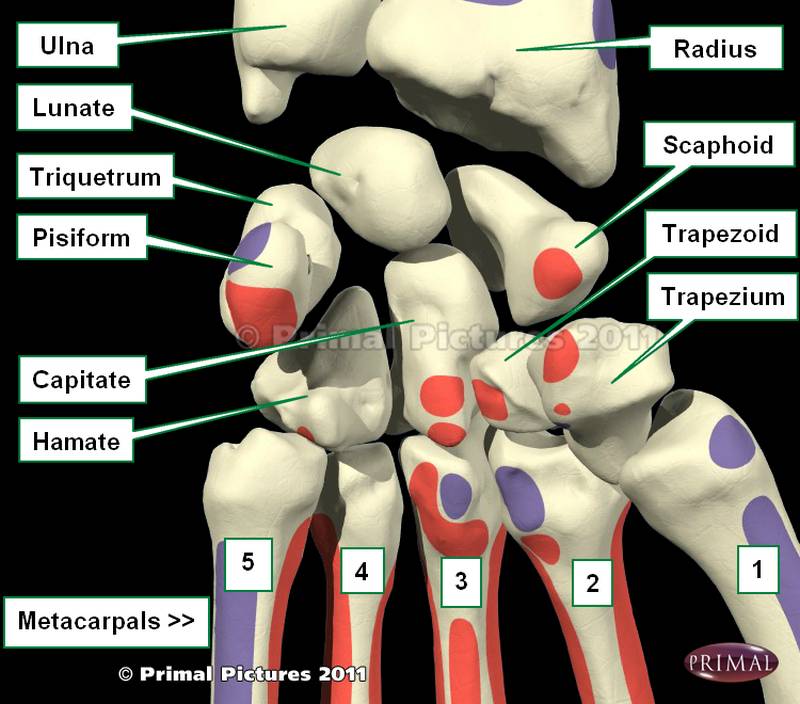
The Trapezoid bone is one of the four bones that comprise the distal row of the carpus or carpal bones that form the wrist. This bone is also known as the "lesser multiangular bone" because of its many angles, surfaces and sharp edges. The Latin name for this bone is os multtangulus minus.
The following text is from Gray's anatomy with annotations in []: "The superior surface, quadrilateral, smooth, and slightly concave, articulates with the navicular [scaphoid bone]. The inferior surface articulates with the proximal end of the second metacarpal bone; it is convex from side to side, concave from before backward and subdivided by an elevated ridge into two unequal facets. The dorsal [posterior] and volar [anterior] surfaces are rough for the attachment of ligaments, the former being the larger of the two. The lateral surface,convex and smooth, articulates with the greater multangular [trapezium bone]. The medial surface is concave and smooth in front, for articulation with the capitate [bone]; rough behind, for the attachment of an interosseous ligament."
The accompanying image shows the anterior (volar) surface of the wrist.