
Medical Terminology Daily (MTD) is a blog sponsored by Clinical Anatomy Associates, Inc. as a service to the medical community. We post anatomical, medical or surgical terms, their meaning and usage, as well as biographical notes on anatomists, surgeons, and researchers through the ages. Be warned that some of the images used depict human anatomical specimens.
You are welcome to submit questions and suggestions using our "Contact Us" form. The information on this blog follows the terms on our "Privacy and Security Statement" and cannot be construed as medical guidance or instructions for treatment.
We have 1426 guests online
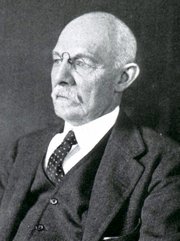
William S. Halsted, MD
(1852 – 1922)
American anatomist, teacher, and surgeon, William Stewart Halsted was born in New York City, USA to a wealthy family of English origin. His father was involved in charitable work and Governor and trustee to a city hospital. Not a brilliant student initially, Halsted took an undergraduate in Liberal Arts in Yale, CT., after which he entered the Medical College of Physicians at the Columbia College, where he excelled.
As a second-year medical student Halsted applied and obtained a position in surgery at a local hospital. In here he learned about Lister’s antiseptic technique and became an adamant proponent of it to reduce infection. In 1877 Halsted obtained his MD. After a short time as House Physician at the New York Hospital, Halsted traveled to Europe to further his education studying for two years at the Universities of Vienna, Leipzig, and W?rzburg.
Besides being at the forefront of surgical and antiseptic techniques (introducing the use of rubber gloves in surgery), Halsted was extremely concerned with the way medical students were taught in the US. He pioneered bedside clinical round discussions with the medical students after two years of basic sciences studies. Halsted developed the idea of a patient chart; he also developed the residency program for medical students in use today.
Halsted is probably the most influential researcher and surgeon at the turn of the century. He dedicated time to the study of intestinal anastomoses and the use of silk as a suture material. His experimental work in 1887 proved that the inclusion of the submucosa layer in an anastomosis was mandatory, as well that a single layered anastomosis was enough to attain closure. Perhaps Halsted’s most important contribution was the application and use of the scientific method to surgical questions. Halsted’s principles set the standards used today in surgical suturing and surgical stapling.
He also pioneered the development and surgical techniques for radical mastectomy as a treatment for breast cancer.
As a side effect of this studied in anesthesia and the use of cocaine for anesthesia, Halsted became addicted to this substance, a problem that followed him through the years. Without impairing his capacity as a researcher and a surgeon, Halsted eventually recovered. He died in Baltimore in 1922 as a complication to surgery.
Sources:
1. Dubay, A. D., & Franz, G. M. (2003). Acute Wound Healing: The Biology of Acute Wound Failure. Surg Clin NA, 83, 463-481.
2. Halsted, W. S. (1887). Circular Suture of the Intestine - An Experimental Study. Am J Med Sci, 436-461.
3. “William Stewart Halsted: his life and contributions to surgery” Osborne, P. Lancet Oncol 2007; 8: 256–65
4. “William Stewart Halsted: Surgical pioneer” Burress, P Endoc Today (2010), 8: (2) 22
5. “William Stewart Halsted (1852–1922) Neurological stamp” Haas, LF J Neurol Neurosurg Psych 2000;69:641
Original image courtesy of "Images from the History of Medicine" at www.nih.gov

"Clinical Anatomy Associates, Inc., and the contributors of "Medical Terminology Daily" wish to thank all individuals who donate their bodies and tissues for the advancement of education and research”.
Click here for more information


- Details
The prefix [hypo-] is a derivate from the Greek [υπό] (ipo) which means "under", "deficient" or "below". Its uses include:
- Hypoglycemia: The root term [-glyc] means "sugar" and the suffix [-emia] means "blood". Low blood sugar
- Hypoplasia: The root term [-plasia] means "to develop". Under development
- Hypochondriac: The<root term [-chondr-] means "cartilage". Below the cartilage. A detailed explanation of this word will follow soon
- Hypodermic: The root term [-derm] means "skin". Below the skin
- Details
The prefix [hyper-] is a derivate from the Greek [υπερ] which means "over" or "above". In today's medical terminology, it is used to mean "in excess of". Its uses include:
- Hyperglycemia: The root term [-glyc] means "sugar" and the suffix [-emia] means "blood". Excess blood sugar
- Hyperplasia: The root term [-plasia] means "to develop". Excess development
- Hyperactivity: Excess activity
- Hyperesthesia: The root term [-esthesia] means "sensation". Excessive sensation
- Details
This article is part of the series "A Moment in History" where we honor those who have contributed to the growth of medical knowledge in the areas of anatomy, medicine, surgery, and medical research.

Jacobus Sylvius
Jacobus Sylvius (1478 - 1555). French physician, teacher, and anatomist, Sylvius was born in poverty as Jacques Dubois, in the city of Louisville, near Amiens. He would eventually become known as Jacobus Sylvius Ambianus. In spite of his humble beginnings Sylvius entered the College of Tournay. Too poor to continue his studies he started to instruct in anatomy, which helped him earn enough to obtain a bachelor’s degree in Medicine in 1531 in Montpellier.
Sylvius returned to Paris as a demonstrator in anatomy, where he excelled. He had many famous students, among them was Andrea Vesalius. Sylvius followed strictly the teachings of Galen, a situation that eventually caused not only his downfall, but enmity with Vesalius and others. Sylvius was also of the opinion that the student of anatomy should learn from dissection as well as from the books. One of Sylvius’ most important achievement was that he added to the Galenic numerical description by numbers, a descriptive nomenclature creating many names in used today such as brachialis, tibial, peroneus, scalene, serratus, biceps, triceps, etc. He is also responsible for many other names such as femoral, popliteal, subclavian, phrenic, axillary, spermatic, epiploic, etc.
Sylvius was a controversial man. He was known for being greedy, a miser, and the use of foul language, but at the same time he wrote a book to guide the poor student who wanted to get through Medical School. He was finally appointed professor of Medicine at the Royal College of Paris, a position he held until his death in 1555.
Sylvius was so enraged with Vesalius’ denouncement of Galen as being wrong, that he started a personal war against him including sending letters to the King and through public letters where he called Vesalius a madman (vaesanus), plus “purveyor of filth and sewage, pimp, liar, and various epithets unprintable even in our own permissive era” (excerpt from Magner, 1992)
Although many attribute the eponyms of the lateral cerebral sulcus (Sylvian fissure) and the cerebral aqueduct (aqueduct of Sylvius) to Jacobus Sylvius, these two structures are actually named after Franciscus Sylvius (1614 – 1672) a German anatomist. On top of this, some of the structures actually discovered by Jacobus Sylvius were named eponymically after someone else, like the incomplete valve found at the junction of the inferior vena cava and the right atrium, named after Bartholomew Eustachius (c.1520 - 1574).
Sylvius’ contribution to anatomy is immeasurable, but his personality traits have made him lose status and almost forgotten.
Sources:
1. “Advice for Poor Medical Students: Sylvius, J. Translated by O’Malley CD J Hist Med 1962 17:141-151
2. “A Historical Lesson from Franciscus Sylvius and Jacobus Sylvius” Bakkum DC (2011) J Chir Hum 18:94-98
3. “A Historical Mistake: The aqueduct of Sylvius” Leite Dos Santos, AR et al Neurosurg Rev (2004) 27: 224-225
4. “Jacobus Sylvius (Jacques Dubois) 1478-1555 – Preceptor of Vesalius” JAMA (1966) 195 13; 1147
5. "Andreas Vesalius; The Making, the Madman, and the Myth" Joffe, Stephen N. Persona Publishing 2009
6. “A History of Medicine” Magner, LN Ed. M Deckker Pub 199
Original image courtesy of Images from the History of Medicine
- Details
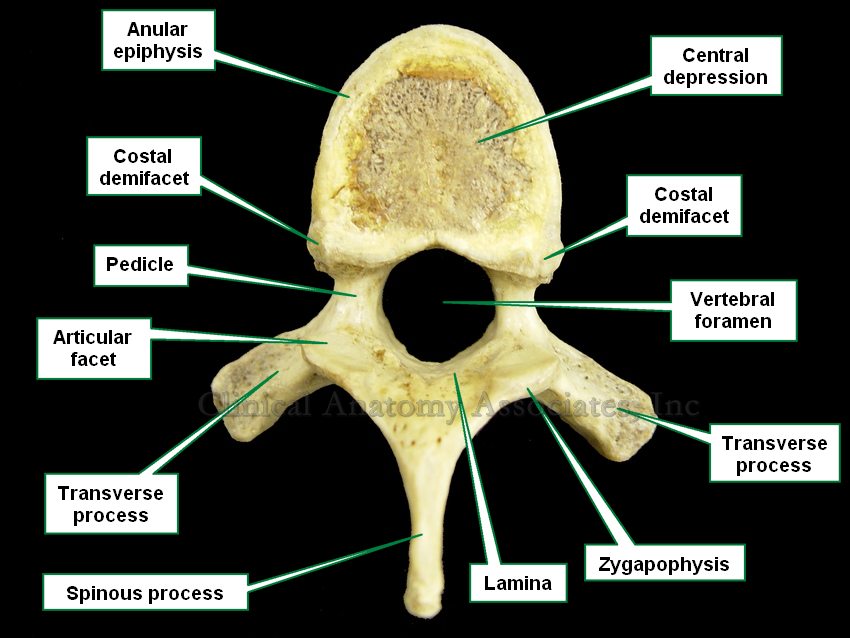
Click for a larger image
The [vertebral laminae] are two bilateral thin, flat regions of the posterior components of a vertebra. Along with the pedicles and the vertebral body (corpus) they are part of the boundaries of the vertebral foramen.
The laminae have regional variations. In the cervical region they are small and more rounded; in the thoracic region they are larger, and overlap each other. In the lumbar region in spite of being relatively large, they do leave intervertebral spaces that allow a physician to perform a "spinal tap" by passing through the ligamentum flavum into the subdural space to take a sample of cerebrospinal fluid.
Image property of: CAA.Inc.Photographer: David M. Klein
- Details
The root term [-lamin-] is a derivate from the Latin word [lamina] which means "something thin", such as a thin plate or a fish scale. Its plural form is [laminae].
The term lamina is used in human anatomy to describe thin structures, like the lamina spiralis of the inner ear, and the bilateral laminae of the vertebrae.
The root term [-lamin-] is used in words such as:
- Laminotomy: The suffix [-otomy] means "to open". Opening of a lamina
- Laminectomy: The suffix [-ectomy] means "to remove". Removal of a lamina
- Lamination: To make or form into a thin structure, a lamina
- Laminaria: A genus of algae characterized by thin leaves
- Details
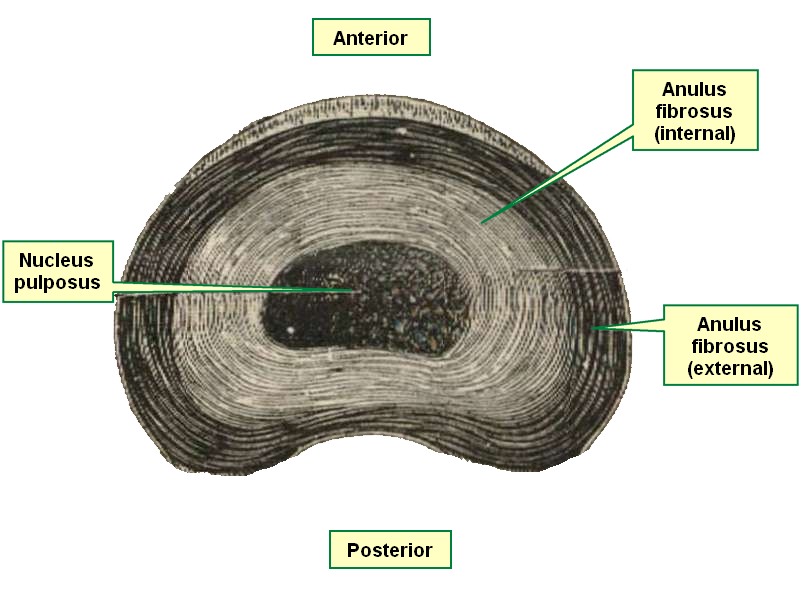
Click for a larger image
The word [lamella] is Latin and is the diminutive form of [lamina], which means "thin", or a "small plate". A lamella is a thin, wafer-like structure. The plural form is [lamellae]. The adjectival form [lamellar] refers to structures that resemble a stack of thin plates.
Many structures in the human body have a lamellar organization, such as compact bone, the pubic symphysis, and intervertebral discs. The accompanying image is a superior view of an intervertebral disc. Click on the image to see a larger depiction and the lamellar structure of the anulus fibrosus, the external component of the disc.
Image modified from the original from Testut and Latarjet, 1931