
Medical Terminology Daily (MTD) is a blog sponsored by Clinical Anatomy Associates, Inc. as a service to the medical community. We post anatomical, medical or surgical terms, their meaning and usage, as well as biographical notes on anatomists, surgeons, and researchers through the ages. Be warned that some of the images used depict human anatomical specimens.
You are welcome to submit questions and suggestions using our "Contact Us" form. The information on this blog follows the terms on our "Privacy and Security Statement" and cannot be construed as medical guidance or instructions for treatment.
We have 1110 guests online
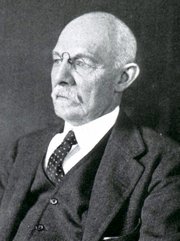
William S. Halsted, MD
(1852 – 1922)
American anatomist, teacher, and surgeon, William Stewart Halsted was born in New York City, USA to a wealthy family of English origin. His father was involved in charitable work and Governor and trustee to a city hospital. Not a brilliant student initially, Halsted took an undergraduate in Liberal Arts in Yale, CT., after which he entered the Medical College of Physicians at the Columbia College, where he excelled.
As a second-year medical student Halsted applied and obtained a position in surgery at a local hospital. In here he learned about Lister’s antiseptic technique and became an adamant proponent of it to reduce infection. In 1877 Halsted obtained his MD. After a short time as House Physician at the New York Hospital, Halsted traveled to Europe to further his education studying for two years at the Universities of Vienna, Leipzig, and W?rzburg.
Besides being at the forefront of surgical and antiseptic techniques (introducing the use of rubber gloves in surgery), Halsted was extremely concerned with the way medical students were taught in the US. He pioneered bedside clinical round discussions with the medical students after two years of basic sciences studies. Halsted developed the idea of a patient chart; he also developed the residency program for medical students in use today.
Halsted is probably the most influential researcher and surgeon at the turn of the century. He dedicated time to the study of intestinal anastomoses and the use of silk as a suture material. His experimental work in 1887 proved that the inclusion of the submucosa layer in an anastomosis was mandatory, as well that a single layered anastomosis was enough to attain closure. Perhaps Halsted’s most important contribution was the application and use of the scientific method to surgical questions. Halsted’s principles, also known as "Halsted's Rules of Surgery", set the standards used today in surgical suturing and surgical stapling.
He also pioneered the development and surgical techniques for radical mastectomy as a treatment for breast cancer.
As a side effect of this studied in anesthesia and the use of cocaine for anesthesia, Halsted became addicted to this substance, a problem that followed him through the years. Without impairing his capacity as a researcher and a surgeon, Halsted eventually recovered. He died in Baltimore in 1922 as a complication to surgery.
Sources:
1. Dubay, A. D., & Franz, G. M. (2003). Acute Wound Healing: The Biology of Acute Wound Failure. Surg Clin NA, 83, 463-481.
2. Halsted, W. S. (1887). Circular Suture of the Intestine - An Experimental Study. Am J Med Sci, 436-461.
3. “William Stewart Halsted: his life and contributions to surgery” Osborne, P. Lancet Oncol 2007; 8: 256–65
4. “William Stewart Halsted: Surgical pioneer” Burress, P Endoc Today (2010), 8: (2) 22
5. “William Stewart Halsted (1852–1922) Neurological stamp” Haas, LF J Neurol Neurosurg Psych 2000;69:641
Original image courtesy of "Images from the History of Medicine" at www.nih.gov

"Clinical Anatomy Associates, Inc., and the contributors of "Medical Terminology Daily" wish to thank all individuals who donate their bodies and tissues for the advancement of education and research”.
Click here for more information


- Details
This is a word of Greek origin. The prefix [epi] means "outer" or "above"; the root term [-thel-] means "nipple" or "female", and the suffix [-ium] means "layer" or "membrane. The reason for the origin of this words is that in c.1700 Ryusch used this term to refer to the surface layer of cells in the nipple and areola. It was later used to denote any covering superficial layer of cells. The plural form for epithelium is epithelia.
There are many types of epithelia in the body, and they are described by their histology, or how they look under the microscope: single-layer, multilayered, cuboidal, columnar, etc.
- Although the above is the standard accepted etymology for this word, I have a different interpretation, as the Latin term [tela], meaning "fabric" or "cover" could have been used. Thus explained, the word means "outer cover layer". Who knows?. Dr. Miranda -
"The origin of Medical Terms" Skinner, AH, 1970
- Details

Cerebelum
The word [cerebellum] is Latin and means "little brain". The cerebellum is one of the three main gross components of the brain (encephalon), the other two being the cerebral hemispheres and the brain stem.
The cerebellum is characterized by a tightly folded external cortex where the gyri are long and parallel to each other and the sulci are not very deep. Upon gross examination, the cerebellum presents with two lateral lobes (left and right) and a median lobe known as the vermis. Other authors divide the cerebellum into an anterior and posterior lobe separated by a primary fissure or sulcus, also known as the preclival sulcus.
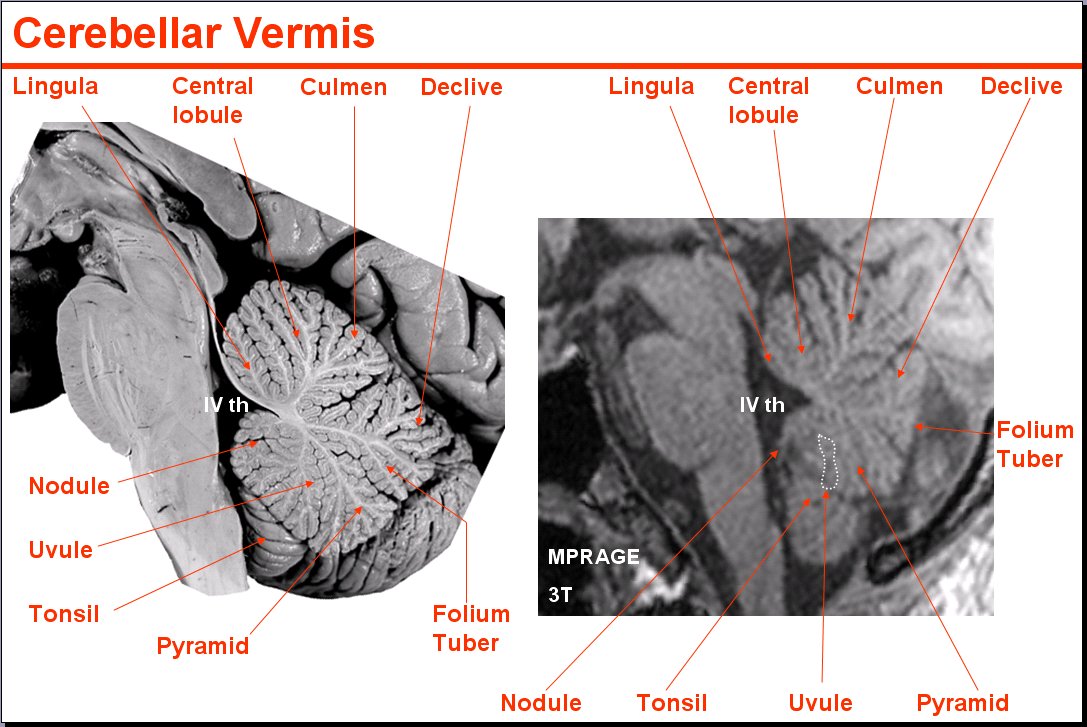
Cerebellar vermis
The cerebellum is located posterior to the brain stem and posteroinferior to the cerebral hemispheres. It is separated from the occipital lobes of the brain by an extension of dura mater called the tentorium cerebelli. Because of its location, the cerebellum serves as a roof for the 4th ventricle, a component of the ventricular system of the brain. Click here to see a median section, of the cerebellum where you can observe its location and relation to the brain stem, 4th ventricle, and occipital lobe.
The cerebellum is part of the motor control of the brain and is involved in motor coordination, precision, balance and accurate motor timing. Cerebellar dysfunction does not cause paralysis, but produces fine motor control disorders.
Median section image link courtesy of UCLA Radiology.
Sources:
1 "Tratado de Anatomia Humana" Testut et Latarjet 8 Ed. 1931 Salvat Editores, Spain
2. "Anatomy of the Human Body" Henry Gray 1918. Philadelphia: Lea & Febiger
Image modified by CAA, Inc. Original image courtesy of bartleby.com
- Details
This article is part of the series "A Moment in History" where we honor those who have contributed to the growth of medical knowledge in the areas of anatomy, medicine, surgery, and medical research.
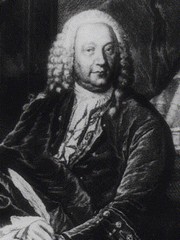
Abraham Vater
Abraham Vater (1684 - 1751) German anatomist and physician, Abraham Vater was the son of a distinguished physician and was born on the city of Wittenberg. He obtained a Doctorate in Philosophy (PhD) in 1706 and his medical degree in 1710 at the University of Leipzig. He became a professor “extraordinarius” of Anatomy and Botany in 1719, continuing his career in anatomy until he obtained the highest professorial degree at the University.
After the death of his father in 1733 Abraham Vater was appointed to the chair of Anatomy. In 1720 he published the discovery of a “biliary diverticulum” , the hepatopancreatic ampulla, known today as the “Ampulla of Vater” or duodenal papilla. His original article was entitled “Dissertatio anatomica qua novum bilis diverticulum circa orificium ductus choledochi”. He also described a large subcutaneous sensory nerve terminal known as the “Vater–Pacinian corpuscle”.
Known as an anatomist, Vater also wrote on surgery, gynecology, pharmacology, pathology, chemistry, and botany, making him a complete scientist. In a twist of fate, Vater died in 1751 after being afflicted with jaundice, probably a consequence of biliary blockage of his eponymic ampulla.
Sources:
1. "Abraham Vater (1684-1751)" Brit Med J; 2,(4) (1951), 1214
2. "Abraham Vater of the Ampulla (Papilla) of Vater" Lerch, MM; Domschke, W. Gastroenterology (2000) 118: (2) 379
- Details
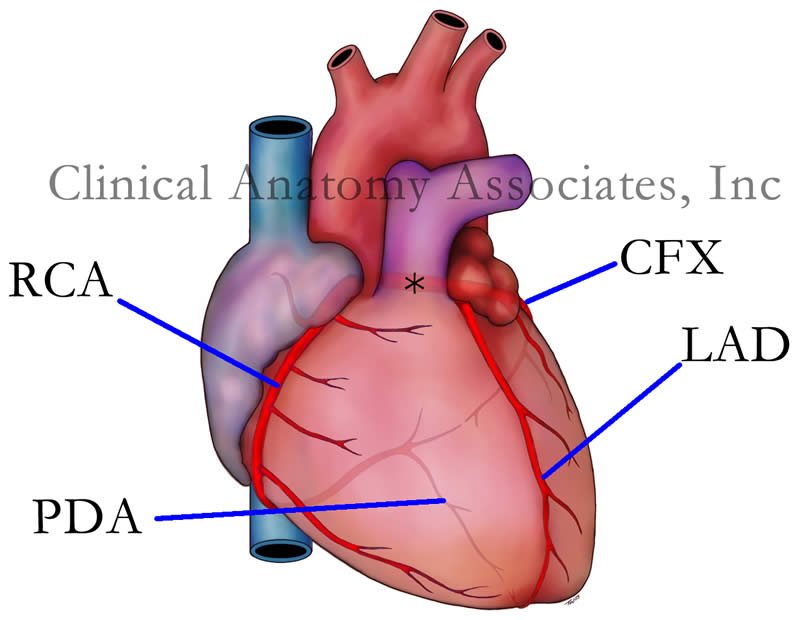
Click for a larger image
The word [epicardium] is composed by the prefix [epi-], meaning "outer" or "above"; the root term [-card-], meaning "heart"; and the suffix [-ium], meaning "layer" or "membrane". Thus, the word means "outer layer of the heart".
The epicardium is part of a larger structure called the pericardium, in fact, since the pericardium is in contact with a viscus (the heart), it can also be called "visceral pericardium". It must be noted that these two terms are synonyms: "epicardium" and "visceral pericardium".
The epicardium is a type of serosa composed of an outer layer formed by mesothelial cells and an inner layer formed by loose connective tissue containing varying amounts of fat. This inner layer known as the "subepicardial layer" (a misnomer) also contains elastic fibers.
The main arterial and venous components of the coronary circulation are found in the subepicardial layer. When performing a Coronary Artery Bypass Graft (CABG), a surgeon has to open the outer layer of the epicardium, and enter the subepicardial layer to perform the graft anastomosis.
As a serosa, the epicardium is involved in the production and absorption of a clear fluid, the "pericardial fluid". This fluid acts as a lubricant for the pericardium, allowing for the effortless movement of the heart within the pericardial sac.
- Details
The suffix [-iasis] has an original Greek root (such as in [iatros] meaning "healer" or "hospital"). It later became a Latin root meaning "condition, pathology, or disease".
This suffix can be found in many medical terms such as:
- Choledocolithiasis - a condition of stones in the bile duct.
- Elephantiasis - A condiction where a body part grows unusually large, usually lower extremities and/ or scrotum
- Phthiriasis- A condition or infestarion with public or crab lice
- Helminthiasis- A bodily infestation with a type of parasitic worms called helminths (tapeworms)
- Cystolithiasis - Bladder stones
- Details
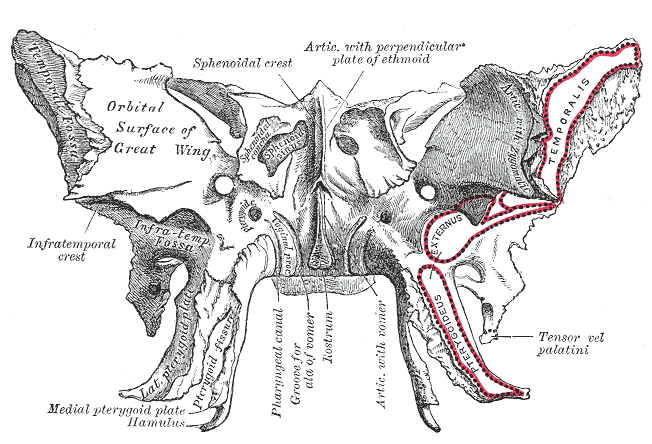
Anterior view of the sphenoid bone
Both these root terms have their origin from the Greek [πτέρυγα] (ptéryga) and mean "wing".
In human anatomy the most common use of this root term is in the word [pterygoid]. Since the suffix [-oid] means "similar to", the word pterygoid means "similar to a wing", or "wing-like".
On the inferior aspect of the sphenoid bone (os sphenoidale) there are two very thin bat-wing-like bony appendages that are called the lateral and medial pterygoid plates. The medial pterygoid plate has a hook-like bony appendage called the hamulus (Latin: little hook).
Related to the pterygoid plates are the lateral and medial pterygoid muscles, both these muscles aid inthe process of mastication.
The root term [pter-] can be found in words such as [pterodactyl] meaning "winged finger", it refers to a phrehistoric winged animal; [pteranodon], and [pterosaurus].
Sources:
1 "Tratado de Anatomia Humana" Testut et Latarjet 8 Ed. 1931 Salvat Editores, Spain
2. "Anatomy of the Human Body" Henry Gray 1918. Philadelphia: Lea & Febiger
Image in the public domain modified by CAA, Inc. Original image courtesy of bartleby.com
Note: Google Translate includes the symbol (?). Clicking on it will allow you to hear the pronunciation of the word.